What You’ll Learn
how to build a marketplace app in Australia — step-by-step guide for founders | Building a marketplace app in Australia right now? You’re timing it perfectly. A marketplace app is a two-sided digital platform that connects buyers and sellers — think Airbnb for properties or Airtasker for services. Australia is in an ideal position to build one: the country consistently ranks in the top 20 global app markets, with total app market revenue projected to exceed USD 11 billion by 2027.
But here’s the reality: most founders skip straight to building without testing if anyone actually wants what they’re making. This guide prevents exactly that. We’ve distilled the fastest, most predictable path from concept to a live, revenue-generating platform into five core steps.
- Validate your marketplace idea before writing a single line of code.
- Define a product strategy and monetisation model tailored for the Australian market.
- Design and build a focused Minimum Viable Product (MVP) that proves your core hypothesis.
- Launch with a supply-first strategy to effectively solve the cold-start problem.
- Grow sustainably using data, iteration, and the right technology partner.
Prerequisites: You don’t need to be technical. You need a problem worth solving, access to potential users for early interviews, and a realistic budget. Most importantly, you need to be willing to test your assumptions before investing heavily.
Why Building a Marketplace App in Australia Matters in 2026
The global marketplace sector is booming at USD 119.9 billion in 2026, projected to hit USD 365.54 billion by 2035 — a CAGR of around 13.5%. Australia sits right in the sweet spot: smartphone users are expected to hit nearly 23.6 million by 2026, meaning more than 85% of Australians now carry smartphones. More than 3 billion people shopped online in 2025, and marketplaces now account for over 60% of global e-commerce sales.
But here’s the critical insight: 67% of startup failures in 2024–2025 happened because teams built products nobody wanted, not because of bad code. Building a full product without validation costs an average of $800,000 and fails 72% of the time. This framework prevents that outcome.
Key Takeaway: Australia’s growing smartphone penetration and thriving e-commerce ecosystem create genuine opportunity for marketplace founders—but only if you validate relentlessly before committing serious capital. For supporting data, see How to Build a Marketplace App in Australia: 2026 Guide.
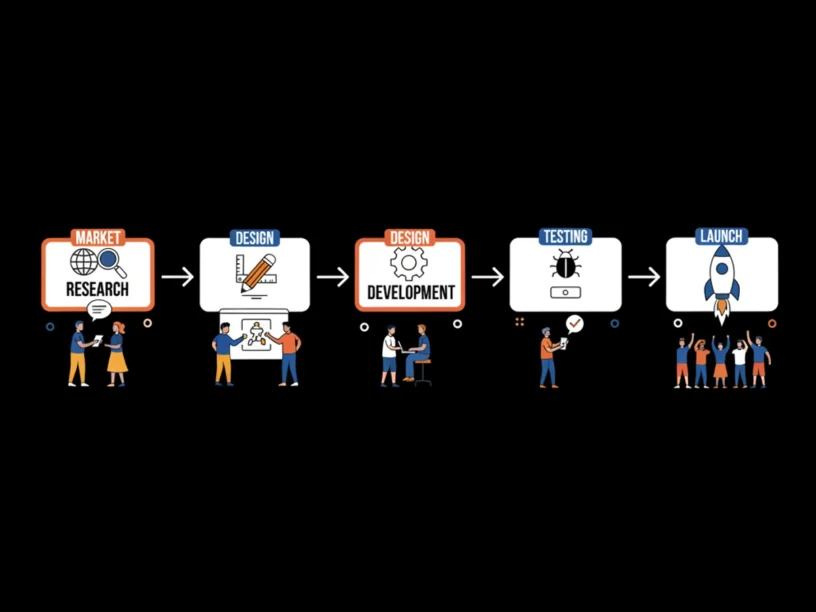
The Process at a Glance
| Step | Action | Time | Outcome |
|---|---|---|---|
| 1 | Validate your marketplace idea | 2–4 weeks | Confirmed problem worth building for |
| 2 | Define product strategy and monetisation | 1–2 weeks | Clear MVP scope and revenue model |
| 3 | Design and build your MVP | 8–14 weeks | Live, testable marketplace platform |
| 4 | Launch with a supply-first strategy | 4–8 weeks | Initial liquidity on both sides |
| 5 | Iterate, grow, and scale the platform | Ongoing | Repeatable growth and revenue |
Total estimated time to first launch: 3–6 months, depending on complexity and validation speed.
Step 1: Validate Your Marketplace Idea
What You’re Doing
Before you spend a dollar on design or development, you need to confirm three things: a real problem exists, real people will pay to solve it, and a two-sided marketplace is the right vehicle. Most founders skip this step—and it determines everything that follows.
How to Do It
- Define the problem in one sentence. Who has it? What is it? Why do existing solutions fall short? If you can’t write this clearly, you’re not ready to build yet.
- Talk to real users on both sides. Interview 10–20 potential buyers and 10–20 potential sellers separately. Use Calendly to schedule calls and Notion to track patterns. Ask about their current behaviour, not their opinions about your idea.
- Map your competitive landscape. Who’s already solving this problem—locally and globally? Evaluate their strengths, weaknesses, target audience, pricing strategies, and marketing approaches to find your angle of differentiation.
- Test willingness to pay early. Build a simple landing page with Carrd or Webflow and drive traffic to it. If people sign up for early access, you have a real signal.
- Write it all down. Summarise your findings in a one-page validation brief: confirmed problem, target segment, evidence of willingness to pay, and what makes you different.
Best Practices
- Always validate supply first. Buyers come for inventory. If you have great listings, demand follows.
- Keep your validation budget under AUD 2,000. A landing page and a handful of conversations is all you need.
Common Mistakes
- Asking “would you use this?” instead of “how do you currently solve this?” The first gets polite agreement; the second reveals actual behaviour.
- Skipping validation because the idea feels obvious. Startups using an MVP approach have a 60% higher success rate than those launching with fully-featured products.
What Done Looks Like
You have documented evidence—user quotes, sign-up numbers, or pre-commitments—that confirms a problem worth solving and a segment willing to pay. You’re ready to design a product around it. For a more detailed walkthrough, see How to make a marketplace app (step-by-step guide).
Step 2: Define Your Product Strategy and Monetisation Model
What You’re Doing
You’ve confirmed the problem exists. Now translate that validation into a concrete product brief. This is where you decide what your MVP will include, what it won’t, and how you’ll make money.
How to Do It
- Decide your marketplace type. Are you building a product marketplace (physical or digital goods), a service marketplace, or a rental/sharing marketplace? Each has different trust requirements, payment flows, and UX needs.
- Choose your monetisation model. Commission-based revenue is the safest starting point—you only earn when users transact, so your incentives align perfectly with theirs. Start simple. You can layer in additional revenue streams later.
- Define your MVP feature set ruthlessly. Essential features: onboarding, listings, search and filters, secure payments, messaging, reviews, and admin moderation tools. Everything else gets cut. Scope creep is the second-biggest killer of marketplace MVPs (right after validation failure).
- Pick your build approach. No-code platforms like Sharetribe let you validate fast. Custom development gives you more control and scalability. Cross-platform frameworks like React Native and Flutter can save 30–40% compared to separate native builds.
- Set realistic numbers. Mid-range marketplace MVPs typically run AUD $40,000 to $100,000 and take 10–16 weeks to build.
Example: Monetisation Model Comparison
| Model | How It Works | Best For | Australian Example |
|---|---|---|---|
| Commission | % taken from each transaction | High-frequency, lower-value transactions | Airtasker, Airbnb |
| Subscription | Sellers pay a recurring fee for access | B2B platforms, professional services | SEEK, Realestate.com.au |
| Listing Fee | One-time charge per listing posted | Classifieds, low-frequency sellers | Gumtree, eBay Australia |
| Hybrid | Combination of above models | Scaling platforms with diverse seller types | Most mature platforms |
What Done Looks Like
You have a one-page product brief covering marketplace type, MVP features, monetisation model, build approach, budget, and target launch date. Your development partner can start designing immediately.
Step 3: Design and Build Your MVP
What You’re Doing
Your MVP is the simplest version that lets real users transact and lets you learn what to improve next. You’re building a learning machine, not a feature-complete product.
How to Do It
- Start with wireframes, not code. Map out the app’s interface using Figma. Validate this prototype with 5–10 real users before any code is written. Catching design issues now costs nothing; catching them after development costs everything.
- Design two separate user journeys. Your marketplace has two types of users—buyers and sellers—and they need fundamentally different experiences. Start mobile-first (since 85%+ of users will be on phones), then scale to desktop.
- Build with a proven tech stack. For most MVPs: Next.js + Node.js + PostgreSQL for the backend, and React Native or Flutter for mobile. Choose technologies your team knows deeply, not the trendiest options.
- Integrate real payments from day one. For Australian marketplaces, Stripe is the standard—it supports AUD transactions, split payments, and local compliance. Don’t launch without a working payment layer.
- Build trust into the foundation. Reviews, verified profiles, dispute resolution, and basic identity checks aren’t nice-to-haves. Include at least a basic version in your MVP.
- Test everything before launch. Every core flow—sign up, list, search, transact, review—across iOS, Android, and desktop.
Best Practices
- Teams who spend at least 20% of their MVP budget on the pre-development phase are 3 times more likely to build a successful product. Don’t rush from wireframe to code.
- Work with a partner who has built marketplaces before. The UX patterns, backend architecture, and payment logic for two-sided platforms are fundamentally different from standard e-commerce apps or SaaS tools.
Common Mistakes
- Scope creep. Freeze scope before development begins.
- Building for desktop first. Mobile-first design is non-negotiable for consumer marketplace apps.
What Done Looks Like
Your MVP is live with real users able to complete the full transaction loop—from sign-up and listing through to payment and review—without your hand-holding.
Step 4: Launch with a Supply-First Strategy
What You’re Doing
Launch isn’t a moment—it’s a sequence. The biggest mistake founders make is trying to acquire buyers and sellers simultaneously, resulting in an empty platform. A supply-first launch strategy prevents this cold-start problem entirely.
How to Do It
- Onboard supply before you open to buyers. Uber paid drivers to be online before there were passengers. Airbnb obsessed over listings before spending on guest acquisition. Manually recruit and onboard your first 20–50 sellers before any public launch.
- Pick a geographic beachhead. Don’t launch nationally on day one. Choose one city or one niche category, reach density there, then expand. Depth beats breadth every time.
- Do things that don’t scale. Personal outreach, direct onboarding calls, even facilitating early transactions yourself. This feels tedious until you see it working.
- Activate demand through targeted channels. Once supply is solid, use targeted advertising, social media, influencer partnerships, and referral programs. Emphasise your unique value proposition.
- Measure the right things. Grade your launch by liquidity (match/fill rate), time-to-first-transaction, take rate, and the balance between both sides.
Best Practices
- Partnering with relevant Australian associations, LinkedIn groups, or industry communities accelerates supply-side onboarding far faster than paid ads.
- Use Stripe or Braintree for payments and Intercom for in-app messaging—these reduce friction during the critical first 90 days.
What Done Looks Like
Your beachhead market has achieved basic liquidity: buyers search and find relevant supply, sellers receive genuine enquiries or bookings within a reasonable timeframe. You have your first repeating transactions and genuine user feedback shaping your next iteration.
Step 5: Iterate, Grow, and Scale
What You’re Doing
Post-launch, your job shifts from building to learning and growing. You now have real data—user behaviour, transaction patterns, drop-off points, seller feedback. Scaling a marketplace isn’t about adding features; it’s about deepening liquidity and trust while strategically expanding reach.
How to Do It
- Track your core metrics weekly. Gross Merchandise Value (GMV), take rate, buyer-to-transaction conversion, seller retention, and time-to-first-transaction reveal the true health of your marketplace.
- Fix disintermediation. Disintermediation happens when buyers and sellers bypass your platform after connecting. Make your platform more valuable than any off-platform alternative: superior trust features, payment protection, or seller tools they genuinely use.
- Expand market by market. Once your beachhead is profitable, replicate the supply-first activation model in the next geography or category.
- Protect quality as you scale. Use structured onboarding, eligibility requirements, performance thresholds, and ranking systems that automatically highlight high-quality providers.
- Explore AI-native features. In 2026, leading Australian marketplace founders are embedding AI for smarter matching, personalised discovery, and automated quality moderation.
What Done Looks Like
Your marketplace is growing GMV month-on-month without a proportional increase in your manual effort. You have a repeatable supply-activation playbook and clear metrics guiding your next expansion decision.
What to Do After Launching Your Marketplace
Phase 1 — Stabilise (Months 1–3): Focus entirely on your beachhead market. Measure liquidity daily and fix UX friction by talking to every churned user. Don’t add features. Improve the core transaction loop. Aim for your first 100 completed transactions before expanding anything.
Phase 2 — Systematise (Months 4–9): Build repeatable onboarding flows for new sellers and automate manual processes. Introduce data-driven matching or ranking logic. Begin targeted paid acquisition once you have confirmed positive unit economics.
Phase 3 — Scale (Month 10+): Expand to a second geography or category using the same supply-first playbook. Diversify your monetisation by adding premium seller subscriptions, featured listings, or value-added services.
Resources You’ll Need
| Resource | Role in the Process | Required / Recommended / Optional | Cost |
|---|---|---|---|
| Appomate | Full-service Australian app development partner — strategy, design, build, launch, and growth for marketplace founders | Recommended | Project-based; startup-friendly pricing |
| Figma | UI/UX wireframing and prototype design | Required | Free starter; from USD $15/month |
| Stripe Australia | Payment processing, split payments, and marketplace payouts | Required | 1.75% + $0.30 per transaction (Australian cards) |
| Sharetribe | No-code marketplace builder for rapid validation or early MVPs | Optional | From USD $99/month |
| Intercom | In-app messaging, user onboarding, and support automation | Recommended | From USD $74/month |
| Mixpanel | Product analytics — track user behaviour, conversion funnels, and retention | Recommended | Free up to 20M events/month |
See also, see How to build a marketplace: A guide for businesses. For related guidance, see How To Build A Marketplace App In Australia What Founders Need To Know.
Troubleshooting Common Issues
Problem: Your marketplace launches but no transactions occur in the first four weeks
Likely cause: You activated demand before supply was dense enough to convert buyers. Fix: Pause demand acquisition immediately. Manually onboard 10–20 more quality sellers in your beachhead. Personally facilitate the first 5 transactions—take bookings via phone, match manually, then let the platform confirm.
Problem: Buyers and sellers are transacting off-platform after their first connection
Likely cause: Your platform isn’t delivering enough value to justify the commission once both parties have each other’s contact details. Fix: Add platform-native value: payment protection, reviews tied to on-platform transactions, dispute resolution, or seller tools they genuinely use.
Problem: Your MVP is taking longer and costing more than planned
Likely cause: Scope creep—where 10% of scope gets added per month—or architectural choices made for production scale rather than validation. Fix: Freeze the feature list immediately. Remove anything not essential to the core transaction loop. Strict scope discipline at the start is your best protection.
Problem: One side of the marketplace is growing but the other is not
Likely cause: Your acquisition efforts and product experience are optimised for one user type. Fix: Growth on the leading side should pause while the lagging side catches up. Dedicate one sprint entirely to the lagging side: improve their onboarding, reduce friction, and add a feature they’ve requested. For more troubleshooting advice, see How To Build A Marketplace App In 2026.
Conclusion
Key Takeaways
- The path forward: This guide provides a predictable, lower-risk path from idea to a live, revenue-generating platform in 3–6 months, grounded in rigorous validation, focused product design, and a supply-first launch strategy.
- What actually works: The founders who win aren’t the ones who build the most features. They’re the ones who validate ruthlessly, launch narrow, and obsess over liquidity before growth.
- Your next move: Consider a strategy session with a specialist partner like Appomate. As a Melbourne-based app development company, Appomate empowers founders to turn concepts into market-ready apps quickly. They’ve delivered 250+ apps for clients including Adidas and L’Oreal, with genuine marketplace expertise across multiple verticals. With Australia-based strategy and design combined with a world-class global development team, they deliver premium quality at startup-friendly pricing, using AI-driven development tools for faster, smarter delivery.
Ready to build your app?
Book a free Visioning Call with our team today and walk away with a clear roadmap, expert feedback, and a plan to bring your idea to life. No technical knowledge required.
FAQ
How do you build a marketplace app in Australia: 2026 Step-by-Step Guide for Founders?
To build a marketplace app in Australia in 2026, follow these five essential steps: (1) Validate your idea by interviewing users on both sides and confirming willingness to pay before any coding. (2) Define your product strategy, including marketplace type, MVP scope, and a monetisation model like commission. (3) Design and build your MVP using a proven tech stack (e.g., React Native/Flutter for mobile, Next.js/Node.js for web) with Stripe for Australian payments. (4) Launch with a supply-first strategy, manually onboarding sellers in a beachhead geography before activating buyer acquisition. (5) Iterate and scale using liquidity metrics (fill rate, GMV) over vanity metrics. This process typically takes 3–6 months from idea to live platform.
How much does it cost to build a marketplace app in Australia?
App development in Australia costs AUD $30,000 to $250,000+ for most projects, with MVPs starting around AUD $15,000 to $50,000. A focused marketplace MVP with core features—onboarding, listings, search, secure payments, messaging, and reviews—typically sits in the AUD $40,000–$100,000 range depending on complexity. Working with a hybrid delivery model can significantly reduce costs while maintaining quality.
How long does it take to build a marketplace app in Australia?
A mid-complexity MVP typically takes 10–14 weeks to build. Add 2–4 weeks for validation and product strategy upfront, plus 4–8 weeks for launch activation, and most Australian founders can reach a live, transacting marketplace within 3–6 months of starting. AI-assisted development tools have further compressed build timelines by 40–60%.
What are the most important features to include in a marketplace app MVP?
The essential features for a two-sided marketplace MVP include onboarding, listings, search and filters, secure payments, messaging, reviews, and admin moderation tools. Everything else—advanced matching algorithms, AI recommendations, loyalty programmes—can wait until you’ve validated that the core transaction loop works.
How do you solve the cold-start problem for a marketplace in Australia?
The cold-start problem—needing supply to attract buyers and buyers to attract supply—is solved with a supply-first, beachhead strategy. Manually recruit quality sellers in one specific city or category. Reach meaningful supply density there before activating any buyer acquisition. Pick the harder side (almost always supply), lock it down, then drive concentrated demand.
What monetisation model works best for an Australian marketplace app?
The commission-based model is often the best starting point. Charging a small fee per transaction—whether to the buyer, seller, or both—proves to be the most scalable and effective method for generating revenue in a two-sided marketplace. For the Australian market specifically, commission rates between 5–15% are common in service marketplaces. As the platform matures, introduce complementary revenue streams such as featured listings or seller subscriptions.
Do I need a technical background to build a marketplace app in Australia?
No. The majority of successful Australian marketplace founders are not developers. What you need is a clear understanding of the problem you’re solving, direct access to potential users for validation, and the right development partner to guide technical decisions. The most important skills are clear communication, comfort with iteration, and the discipline to validate before building.
How do I choose the right app development partner for my marketplace in Australia?
Look for a partner with demonstrated experience building two-sided marketplace platforms specifically—not just generic apps. Prioritise partners who offer product strategy and validation as part of their process. Evaluate their understanding of the Australian market: local compliance, payment processing (Stripe AU), and app store requirements. A good partner asks more questions than they answer in the first conversation. Appomate—with 250+ apps delivered and clients including Adidas and L’Oreal—is one example of a Melbourne-based partner with genuine marketplace experience across multiple verticals.
Methodology: This guide was developed by the Appomate editorial team based on primary research, founder interviews, and analysis of publicly available data from Business of Apps, Statista, Business Research Insights, Studio Slate, Softermii, and Omega Solution. Statistics and cost ranges reflect 2025–2026 market conditions. This article does not constitute financial or legal advice.