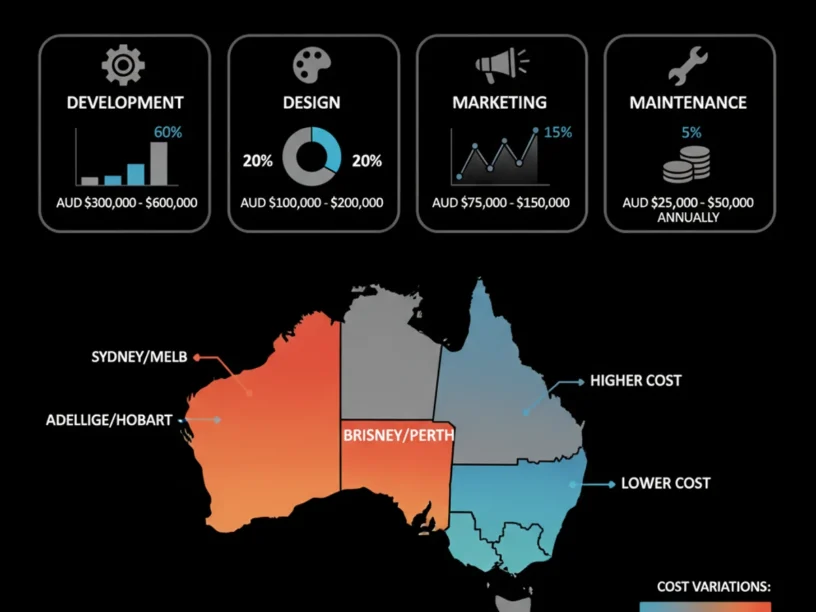
how much does it cost to build a marketplace app in Australia in 2026? | If you’re asking how much it costs to build a marketplace app in Australia in 2026, the answer is between AUD $80,000 and $300,000+, depending on scope and team model. A solid marketplace app typically runs $100,000 to $220,000+, while a lean MVP can cost $80,000 to $130,000. Founders who ship on budget understand exactly where each dollar goes and which decisions actually move the needle on price.
Australia’s app market is attractive right now. The Australian mobile app market generated around $3 billion AUD in revenue in 2024, growing at 15.3% year-on-year, and is projected to reach $5.6 billion by 2026. Australian development rates are among the highest in the Asia-Pacific region because you get same timezone, no language barriers, legal accountability under Australian law, and teams who understand local compliance. This guide covers real AUD price ranges, what drives cost, MVP versus full-build trade-offs, and the offshore-versus-onshore question.
The founders who budget well understand exactly what they’re buying at each price point — and validate their assumptions before committing to a full build.
What Does It Actually Cost to Build a Marketplace App in Australia in 2026?
Marketplace app development cost in Australia sits between AUD $80,000 and $400,000+ depending on complexity. For a marketplace specifically — which means separate buyer and seller experiences plus an admin panel — the realistic starting point is $120,000 to $250,000+.
Marketplace App Cost Tiers at a Glance
| Build Type | AUD Price Range | Timeline | What You Get | Best For |
|---|---|---|---|---|
| Marketplace MVP | $80,000 – $130,000 | 8 – 14 weeks | Core buyer/seller flows, payments, basic admin | Idea validation, pre-seed founders |
| Mid-Range Build | $130,000 – $220,000 | 4 – 8 months | Two-sided UX, real-time features, ratings, search filters | Seed-funded startups, niche verticals |
| Full-Featured Platform | $220,000 – $350,000+ | 8 – 15 months | Multi-platform, AI features, advanced analytics, compliance baked in | Series A, enterprise spin-outs |
Why Marketplace Apps Cost More Than Standard Apps
A marketplace is three apps: one for end users, one for service providers, and one for your team managing the platform. You need buyer and seller profiles, product listings with search and filters, secure payments with commission splits, real-time messaging, reviews and ratings, and admin tools. Backend costs for this tier often land between $30,000 and $80,000 alone.
- Two-sided user management: Buyer and seller accounts require separate onboarding flows, verification logic, and permission systems — doubling the design and authentication work.
- Payment splitting and escrow: Processing marketplace transactions in Australia requires integration with services like Stripe, Afterpay, or similar — plus commission logic, payout scheduling, and GST handling.
- Real-time features: In-app messaging, live availability, and push notifications add backend complexity.
- Admin and moderation panel: Every marketplace needs a back-office tool to manage listings, users, disputes, and payouts — often 15–25% of total build effort.
Key Takeaway: A marketplace is three products sharing one infrastructure. Budget accordingly, or scope your MVP to one user-side first and layer the rest in after validation. For deeper context, see How much does it cost to build an app in Australia in 2026?.
The Key Factors That Drive Marketplace App Development Cost in Australia
App complexity drives 60%+ of pricing through features, user roles, integrations, and backend logic. Understanding which levers move the needle lets you make deliberate trade-offs instead of reacting to confusing quotes.
The Five Biggest Cost Drivers
- Feature scope: Every feature creates design screens, backend logic, API integrations, and testing cycles. Cost grows non-linearly as features stack up.
- Platform choice: Building for iOS and Android simultaneously increases cost by 30–40% over single-platform launch — unless you use a cross-platform framework. Cross-platform frameworks like React Native and Flutter save 30 to 40% compared to building separate native apps.
- Third-party integrations: Connecting to payment gateways, identity verification, mapping APIs, or analytics each adds scoping, development, and testing time.
- Team hourly rate: Hourly rates for Australian app development typically sit between AUD $150 and $330 for small-to-medium agencies, AUD $330 to $495 for larger firms, and AUD $577 to $1,400+ for enterprise consultancies.
- Compliance requirements: Australian privacy and compliance requirements add 10% to 40% to app development costs. Marketplace apps handling personal data, financial transactions, or identity documents sit at the higher end.
Australian-Specific Cost Factors
From December 2026, Australia’s Privacy Act introduces new automated decision-making transparency requirements for apps using personal data. For marketplace apps using algorithmic matching or personalisation, this is a compliance line item — not optional.
From December 2026, Australia’s Privacy Act changes introduce transparency requirements for apps using automated decision-making on personal data. For fintech, healthcare, or real estate marketplace apps, this adds governance and documentation work to the build. Also, GST adds 10% to Australian agency invoices, though registered businesses can usually claim it back.
Key Takeaway: Feature list is only one input. Platform strategy, compliance obligations, and team structure can shift total cost by 40–60% without changing a single user-facing feature. For deeper context, see App Development Cost in Australia 2026 | Complete Guide. For related guidance, see How To Build A Marketplace App In Australia 2026 Guide.
MVP vs. Full Build: Which Approach Is Right for Your Marketplace?
The MVP-versus-full-build decision is the most important budgeting call a non-technical founder makes. An MVP costs AUD $80,000 to $130,000 and takes 8 to 14 weeks, while a fully scaled app runs $220,000 to $350,000+ and takes considerably longer. For a marketplace, a production-worthy MVP — one with real buyer-seller flows, payments, and an admin panel — is essential from the start.
MVP vs. Full Build: Decision Matrix
| Signal | Build an MVP First | Go Straight to Full Build |
|---|---|---|
| Market validation | Concept is unproven — no paying users yet | You have a waitlist, letters of intent, or revenue already |
| Funding stage | Bootstrapped or pre-seed | Seed or Series A with committed capital |
| Competitive pressure | Low — you have time to iterate | High — speed-to-market is a defensible advantage |
| Founder certainty | Still testing pricing, target user, and core value | Customer discovery is complete, feature set is locked |
What a Marketplace MVP Should Actually Include
- Core transaction flow: The single most important thing your marketplace does must work end-to-end without friction.
- Payment processing: Real money must change hands. A marketplace without payments is a directory, not a business model.
- Basic trust signals: User profiles, ratings, and a simple review system. Marketplaces are trust businesses.
- Admin visibility: A lightweight admin panel so you can monitor transactions, manage disputes, and make moderation calls without engineering support.
Launching an MVP first could save you from building $140,000+ worth of features nobody uses. This is exactly the approach Appomate advocates — validating your idea before committing to a larger technology investment. For a side-by-side breakdown, see How Much Does It Cost to Build an App in Australia?.
Onshore vs. Offshore vs. Hybrid: What Each Model Costs Australian Founders
The team model you choose directly determines both price and risk. Australian agency rates run AUD $150 to $330 an hour, roughly three times offshore rates. But the cheapest day rate is rarely the lowest total cost. For marketplace apps — which involve complex logic, multiple user roles, and Australian compliance obligations — this trade-off deserves careful thought.
Comparing Delivery Models for Australian Founders
| Model | Typical AUD Rate | Cost vs. Full Onshore | Risk Profile | Best Suited To |
|---|---|---|---|---|
| Full onshore (Australian agency) | $150 – $330/hr | Baseline | Lowest — same time zone, legal accountability, compliance knowledge | Regulated sectors, complex integrations, first-time outsourcers |
| Hybrid (AU strategy + offshore build) | $80 – $160/hr blended | 30 – 50% savings | Medium — requires strong AU-side oversight | Budget-conscious founders with clear scope |
| Fully offshore | $25 – $90/hr | 50 – 70% lower day rate | Highest — rework, IP risk, compliance gaps | Well-scoped, non-regulated builds with experienced PM |
- Fully onshore advantage: Same timezone, zero language barriers, legal accountability under Australian law, and teams who understand local compliance.
- Hidden offshore costs: Hidden costs typically eat 30–50% of offshore “savings” — including project management overhead, communication delays, and quality issues requiring rework.
- The hybrid sweet spot: A hybrid model — an Australian project manager or technology lead with offshore developers — can save 40–70% in development costs.
- IP risk consideration: Companies that use offshore developers are 31% more likely to experience data leaks or IP loss.
Appomate’s hybrid model combines Australia-based strategy, product design, and project management with a highly skilled global development team — delivering quality expected from a local agency at startup-friendly pricing.
Key Takeaway: Compare total project cost inclusive of rework, management overhead, and compliance risk — not day rates in isolation. For a side-by-side breakdown, see App Development Cost Australia | Complete Pricing Guide. For related guidance, see How To Build A Marketplace App In Australia 2026 Step By Step Guide For Founders Step By Step Guide 2026.
Hidden Costs, Ongoing Budgets, and How to Reduce Your Total Spend
The quote from a development agency covers the build. What it often doesn’t cover are costs that start the day you launch — and they can add 20–50% to your annual technology spend. Hidden costs add 20–50% annually, covering infrastructure, maintenance, third-party APIs, compliance, and app store fees.
Post-Launch Costs to Budget For
- Annual maintenance: Annual app maintenance in Australia costs 15% to 20% of the build cost per year. On a $150,000 build, that’s $22,500–$30,000 per year before any new features.
- Cloud infrastructure: A marketplace app with real-time data might hit AUD $20,000 per year. This scales with your user base.
- App store fees: Cloud hosting ($50–$500+/month) and App Store fees ($149 AUD/year for Apple). Google Play has a one-time registration fee of approximately AUD $37.
- Compliance updates: From December 2026, Australia’s Privacy Act changes introduce new transparency requirements. Budget for legal review and technical updates annually.
- AI inference costs: If your marketplace uses AI-powered matching, this adds 15–30% to build cost, plus ongoing AI inference typically AUD $200–$2,000 per month for mid-traffic products.
Legitimate Ways to Reduce Your Total Cost
- Claim the R&D Tax Incentive: Australian companies with turnover under AUD $20 million can claim a refundable tax offset of 43.5% on eligible development spend — cutting your effective app cost by nearly half. Register with AusIndustry within 10 months of your financial year end.
- Go cross-platform from the start: A single React Native or Flutter codebase serving both iOS and Android is roughly 30% cheaper than two native builds.
- Scope a genuine MVP: Ship the three features that prove your value, not fifteen on your wishlist. This typically saves 40% of first-release cost.
- Choose a fixed-price engagement: With fixed-price work, the agency is motivated to surface everything upfront, protecting you from scope creep surprises.
Key Takeaway: Your real budget is the build cost plus 20% annually, minus the R&D Tax Incentive rebate. Model all three before you sign anything.
Conclusion
How much does it cost to build a marketplace app in Australia in 2026? AUD $80,000 to $300,000+ for a production-ready build, with a well-scoped MVP between $80,000 and $130,000. The gap between those figures is determined by feature scope, platform strategy, team model, and compliance obligations — all within your control.
- Marketplace apps are complex by design: Three user-side products sharing one backend means pricing starts higher than standard apps.
- MVP first, scale second: Validating your core transaction flow before committing to a full build avoids wasting six figures on unused features.
- The hybrid model wins on value: Australia-based strategy and product design with a skilled global delivery team delivers local agency quality at startup-accessible pricing.
- Budget beyond the build: Annual maintenance, infrastructure, compliance updates, and app store fees add 20–50% to annual technology spend.
- Use the R&D Tax Incentive: Eligible Australian startups can recover up to 43.5% of qualifying development spend as a cash refund.
For founders in the research phase, the next step is a structured conversation with a full-service partner like Appomate, which helps validate ideas, design products, manage delivery, and support long-term growth.
FAQ
How Much Does It Cost to Build a Marketplace App in Australia in 2026?
Building a marketplace app in Australia in 2026 typically costs between AUD $80,000 and $300,000+. A lean MVP costs $80,000–$130,000, a mid-range build $130,000–$220,000, and a full-featured platform $220,000–$350,000+. Ongoing annual costs — maintenance, infrastructure, compliance, and app store fees — add another 20–50% of the build cost per year. The R&D Tax Incentive can return up to 43.5% of eligible development spend to qualifying Australian companies.
What is a realistic MVP budget for a marketplace app in Australia?
A production-ready marketplace MVP in Australia costs between $80,000 and $130,000 AUD, typically delivered in 8–14 weeks. This includes buyer and seller accounts, end-to-end payment flows, basic trust mechanisms like ratings, and an admin panel. Using a cross-platform framework like React Native or Flutter keeps the build at the lower end without sacrificing quality.
What are the biggest hidden costs in marketplace app development in Australia?
Annual maintenance (15–20% of build cost per year), cloud infrastructure (AUD $20,000/year for real-time marketplaces), App Store and Google Play fees, Privacy Act compliance updates (especially December 2026 changes), and AI inference costs if using algorithmic matching. Budget for user acquisition separately — the app store isn’t a distribution strategy on its own.
Is it cheaper to build a marketplace app with an offshore development team in Australia?
Offshore offers lower day rates ($25–$90 AUD/hour versus $150–$330 for Australian agencies), but hidden costs erode 30–50% of apparent savings through project management overhead, communication delays, and rework. The most cost-effective model is a hybrid approach: Australia-based strategy and product management with offshore delivery. This is the model Appomate operates.
How does the Australian R&D Tax Incentive apply to marketplace app development?
The Australian R&D Tax Incentive allows eligible companies with turnover under AUD $20 million to claim 43.5% refundable tax offset on qualifying development expenditure. Register with AusIndustry within 10 months of your financial year end. On a $150,000 build, this could return over $65,000.
How long does it take to build a marketplace app in Australia?
Timeline depends on scope. An MVP takes 8–14 weeks, a mid-complexity build 4–8 months, and a full-featured platform 8–15 months. Poorly defined requirements are the biggest driver of timeline and cost blowouts. Appomate’s AI-driven development approach has helped founders go from idea to market in as little as 6 weeks for tightly scoped products.
What Australian compliance obligations affect marketplace app development costs in 2026?
The Privacy Act 1988 governs personal data handling, with new automated decision-making transparency obligations effective 10 December 2026. The Cyber Security Rules 2025 require apps handling personal or financial data to embed security governance from design phase. Together these add 10–40% to development cost. Building compliance in from day one is always cheaper than retrofitting after launch.
Should I build a marketplace app with Appomate or hire an in-house team?
For most non-technical founders and early-stage startups, partnering with a full-service agency like Appomate is more efficient than hiring in-house. Building a two-developer, one-designer, one-project-manager team costs AUD $350,000–$600,000 per year before overhead. A full-service partner provides product leadership and strategy that an in-house team still requires, making it the more predictable path to market.
Methodology: Pricing ranges cited in this article are sourced from publicly available Australian app development cost guides published between January and August 2026, cross-referenced with data from Australian agencies and industry benchmarks. All figures are in Australian Dollars (AUD) and reflect end-to-end delivery costs including strategy, design, development, QA, and launch unless otherwise stated. Ongoing costs are excluded from build-phase estimates and noted separately. Individual project costs vary based on scope, team composition, platform requirements, and compliance obligations. This article is for general guidance only and does not constitute financial or legal advice.