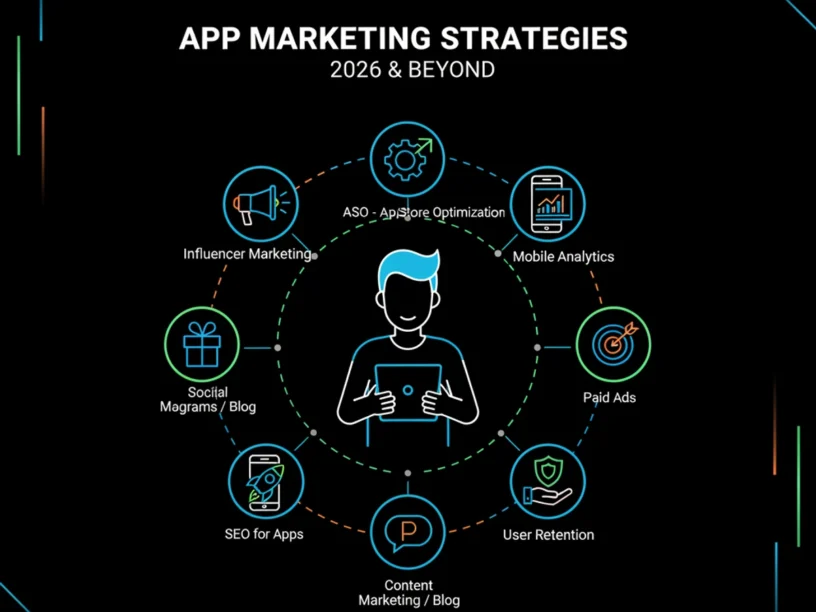
best app marketing strategies beyond ASO for startups in 2026 | Last updated: September 2026 | By the Appomate Growth Team | Tools tested: 10
Ranking #1 on the App Store means nothing if nobody searches for your keyword. With 142.2 billion apps and games downloaded in 2025, a 3.1% increase on the previous year, App Store Optimization alone cannot carry a startup’s growth anymore. This guide breaks down the 10 best app marketing strategies beyond ASO for startups in 2026 — platforms and partners for attribution, engagement, referrals, influencer marketing, and full-service growth to acquire users who stick around.
TL;DR: Best App Marketing Strategies Beyond ASO for Startups in 2026
| Rank | Tool/Platform | Best For | Starting Price | Rating |
|---|---|---|---|---|
| 1 | Appomate | Full-service build-to-growth app partner | Custom quote | 9.6/10 |
| 2 | AppsFlyer | Mobile attribution & fraud prevention | Free tier, then ~$0.07/conversion | 8.8/10 |
| 3 | Branch | Deep linking & deferred deep links | Free tier, paid from ~$500/mo | 8.6/10 |
| 4 | OneSignal | Push, in-app & email engagement | Free, Growth from $19/mo | 8.7/10 |
| 5 | Braze | Enterprise-grade lifecycle marketing | From ~$75/mo (5K MAU) | 8.4/10 |
| 6 | AppLovin Ads | In-app ad network user acquisition | Self-serve, no minimum spend | 8.3/10 |
| 7 | ReferralCandy | Referral & affiliate growth loops | From $29–$39/mo + success fee | 8.1/10 |
| 8 | Upfluence | Influencer & creator marketing | From ~$478/mo | 7.9/10 |
| 9 | Klaviyo | Email & SMS lifecycle marketing | Free, then from $20/mo | 8.2/10 |
| 10 | Moburst | Mobile growth agency for scaling brands | Project-based, from ~$10K | 8.0/10 |
Our #1 pick is Appomate, the Melbourne-based app development and growth partner that helps founders validate, build, launch, and market an app under one roof. For related guidance, see Best Paid User Acquisition Strategies For Mobile Apps In 2026.
Why You Need App Marketing Strategies Beyond ASO in 2026
App Store Optimization captures users already searching. The real opportunity lies in content marketing, social media, referral programs, and PR that drive organic discovery, alongside paid channels and lifecycle engagement. With the average mobile user spending 3.6 hours per day in apps and opening roughly 10 apps daily out of about 34 apps used per month, the real battle is earning a permanent spot on crowded home screens.
The strongest growth strategies layer multiple channels: ASO captures high-intent search, paid ads drive volume, referral programs create advocates, and content builds authority. For non-technical founders, the challenge is sequencing channels without burning the runway. For supporting market data, see How to Market Your App in 2026 (Step-by-Step for Beginners).
How We Evaluated These App Marketing Strategies
| Criteria | Weight | What We Looked At |
|---|---|---|
| Startup Affordability | 25% | Free tiers, transparent pricing, low minimum commitments |
| Ease of Implementation | 20% | SDK complexity, time-to-first-campaign, non-technical usability |
| Growth Impact | 20% | Evidence of retention, acquisition, or revenue lift |
| Channel Breadth | 15% | Number of engagement/acquisition channels covered |
| Support & Partnership Depth | 15% | Onboarding help, account management, strategic guidance |
| Australian Market Fit | 5% | Local relevance, timezone support, AUD-friendly billing |
For industry-standard evaluation frameworks, see 10 App Marketing Strategies That Actually Work in 2026.
1. Appomate — Best for Full-Service App Growth Partnership
Appomate is a Melbourne-based mobile and web app development company serving as a full-service app growth partner, guiding founders from ideas to scalable products across strategy, design, development, launch, and marketing.
Key Features
- Further Faster Framework: A structured, agile methodology designed to make app entrepreneurship more predictable and less risky from day one.
- AI-native development: Builds AI-native products using latest development tools, helping founders reach market in as little as 6 weeks.
- Hybrid delivery model: Australia-based strategy and design combined with global development team for startup-friendly pricing.
- One partner, whole journey: Stays involved from validation through launch, growth, and exit.
- 250+ apps delivered across Marketplace, Wellness, Sports, B2B, AI Apps, Healthcare, Hospitality, Education, and Fashion, with clients including Adidas, L’Oreal, and Lend Lease.
Best For
Australian startups, non-technical founders, and enterprises seeking a single partner for validation, design, build, launch, and marketing.
Pros and Cons
- Pro: One partner eliminates costly vendor handoffs between developer, designer, and marketer.
- Pro: Hybrid Australia + global team keeps pricing startup-friendly.
- Pro: Genuine AI-native approach with proven track record of 250+ delivered apps and enterprise clients.
- Con: Full-service partnership requires scoping conversation, not instant sign-up.
- Con: Customized project pricing requires consultation.
Rating: 9.6/10
Ready to build your app?
Book a free Visioning Call with our team today and walk away with a clear roadmap, expert feedback, and a plan to bring your idea to life. No technical knowledge required.
2. AppsFlyer — Best for Mobile Attribution and Marketing Analytics
AppsFlyer is a leading mobile attribution and marketing analytics platform enabling startups to measure user acquisition and track campaign performance across iOS and Android.
Key Features
- Free tier: Essentials plan offers 12,000 free lifetime conversions, core attribution, deep linking, and custom links.
- Growth plan: Charges approximately $0.07 per attributed install with transparent pricing.
- Fraud protection: Detects and blocks fake installs and click-spam.
- Cross-channel dashboards: Unified view across paid social, search, and ad networks.
- Data Locker: Enterprise plans include unlimited raw event-level data exports.
Best For
Startups scaling paid user acquisition across multiple ad networks, needing to prove ROI with clean, fraud-checked attribution data.
Pros and Cons
- Pro: Generous free tier for pre-revenue startups.
- Pro: Transparent per-conversion pricing.
- Con: Costs scale rapidly with volume; 100,000 monthly conversions could cost ~$7,000/month.
- Con: Premium add-ons pricing not clearly disclosed upfront.
Rating: 8.8/10
3. Branch — Best for Deep Linking and Deferred Deep Links
Branch specializes in deep linking technology, directing users to specific in-app content from external links.
Key Features
- Deferred deep linking: Routes users through app store when not installed, then deep links to intended content on first launch.
- Universal Links and App Links: Handles Apple Universal Links and Android App Links automatically.
- Multi-touch attribution: SKAdNetwork support with post-install event tracking.
- Journeys smart banners: Web-to-app conversion tools boost native app installation.
- Free tier: Capped at ~10,000 MAU, useful for early-stage testing.
Best For
Startups whose growth strategy depends on seamless web-to-app or social-to-app conversion through referral links, email, or paid ads.
Pros and Cons
- Pro: Best-in-class deferred deep linking handles complex edge cases automatically.
- Pro: Genuinely usable free tier.
- Con: Pricing not published; enterprise contracts typically start ~$500/month.
- Con: SDK is heavyweight; full integration requires significant developer work.
Rating: 8.6/10
4. OneSignal — Best for Push, In-App, and Email Engagement
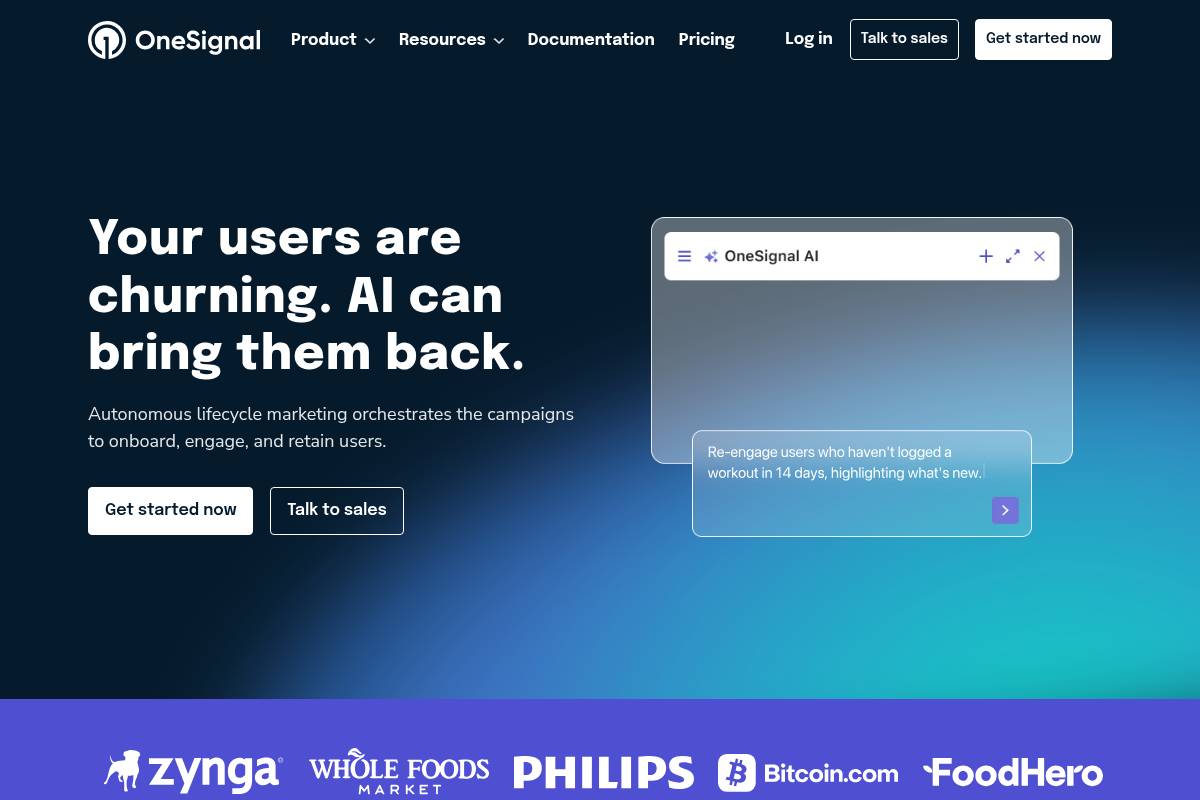
OneSignal covers mobile push, web push, in-app messaging, email, and SMS for user re-engagement after install.
Key Features
- Free plan: Unlimited mobile push with basic segmentation and A/B testing.
- Journeys automation: 3 journeys with unlimited steps on free plan.
- Multi-channel dashboard: Push, email, SMS, and in-app from one interface.
- OneSignal AI: Send-time optimization included on free plan.
- Low-code setup: Minimal developer involvement required.
Best For
Early-stage and growth-stage startups requiring retention-focused messaging without dedicated CRM engineering.
Pros and Cons
- Pro: Most generous free tier in category.
- Pro: Growth plan starts at $19/month.
- Con: Free plan restricts volume and features at scale.
- Con: Advanced features reserved for paid tiers with custom pricing.
Rating: 8.7/10
5. Braze — Best for Enterprise-Grade Lifecycle Marketing
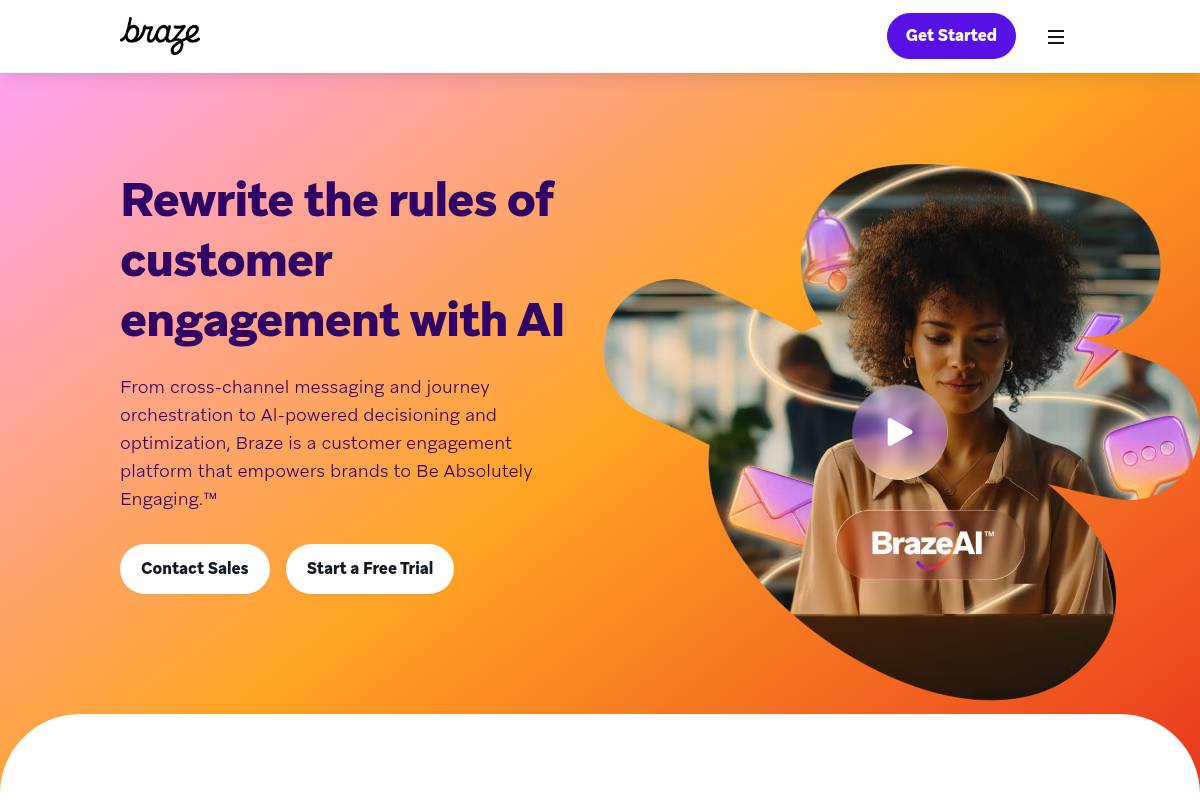
Braze is a customer engagement platform with Canvas, a visual journey-orchestration engine for comprehensive lifecycle marketing.
Key Features
- Cross-channel messaging: Email, push, in-app, and SMS.
- Real-time data processing: Act on customer data instantly.
- BrazeAI Agents: AI decisioning tools for automated audience targeting.
- Essentials plan: Starts at $75/month for 5,000 MAU.
- Canvas journey builder: Visual drag-and-drop for multi-step campaigns.
Best For
Later-stage startups and scale-ups running complex, multi-brand messaging programs.
Pros and Cons
- Pro: Sophisticated journey orchestration and personalization.
- Pro: Strong analytics and integration ecosystem.
- Con: Premium pricing out of reach for pre-seed startups.
- Con: Mid-market contracts typically $50,000–$200,000 annually.
Rating: 8.4/10
6. AppLovin Ads — Best for In-App Advertising and User Acquisition

AppLovin operates one of the largest in-app advertising networks, using AXON AI to predict high-value users.
Key Features
- AXON AI targeting: Predicts and targets users with highest lifetime value.
- Massive reach: ~1 billion daily users across 10,000+ apps.
- Self-serve platform: Now open to all advertisers without sales relationship.
- One-click campaigns: Minimal creative resource investment needed.
- Expanding verticals: Beyond gaming to e-commerce and connected TV.
Best For
Startups ready to invest in paid user acquisition seeking scale through in-app placements.
Pros and Cons
- Pro: Self-serve access removes historical barriers.
- Pro: AI-driven targeting reduces cost-per-install while maintaining quality.
- Con: Historically gaming-focused; non-gaming tools less mature.
- Con: Pure ad network; requires separate attribution and engagement tools.
Rating: 8.3/10
7. ReferralCandy — Best for Referral and Affiliate Growth Loops
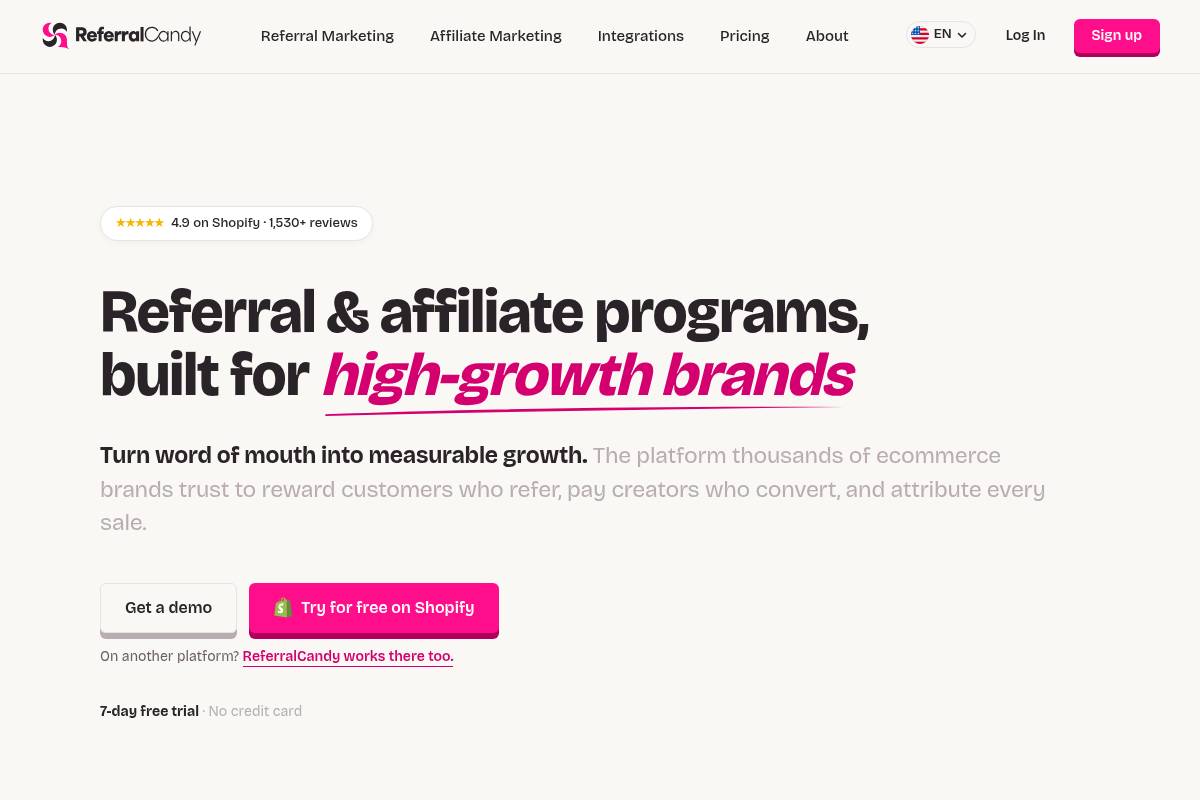
ReferralCandy enables simple referral and affiliate programs to acquire customers through word-of-mouth.
Key Features
- Tiered pricing: Basic $39/mo (10.5% fee), Grow $79 (3.5%), Scale $249 (1.5%), Enterprise $799 (0.25%).
- All features on every plan: Unlimited campaigns at all tiers.
- Flexible rewards: Percentage discounts, flat dollars, cash payouts, gift cards.
- Built-in affiliate marketing: Referral and affiliate programs on one platform.
- Wide integrations: Klaviyo, Recharge, Tremendous, and 20+ others.
Best For
Consumer app startups transforming happy users into acquisition channels. Referred customers convert 2–3 times faster than cold traffic.
Pros and Cons
- Pro: Low monthly entry cost with no long-term contracts.
- Pro: Every plan includes full feature set.
- Con: Success fee compounds as growth accelerates.
- Con: No permanent free tier; 7-day trial only.
Rating: 8.1/10
8. Upfluence — Best for Influencer and Creator Marketing
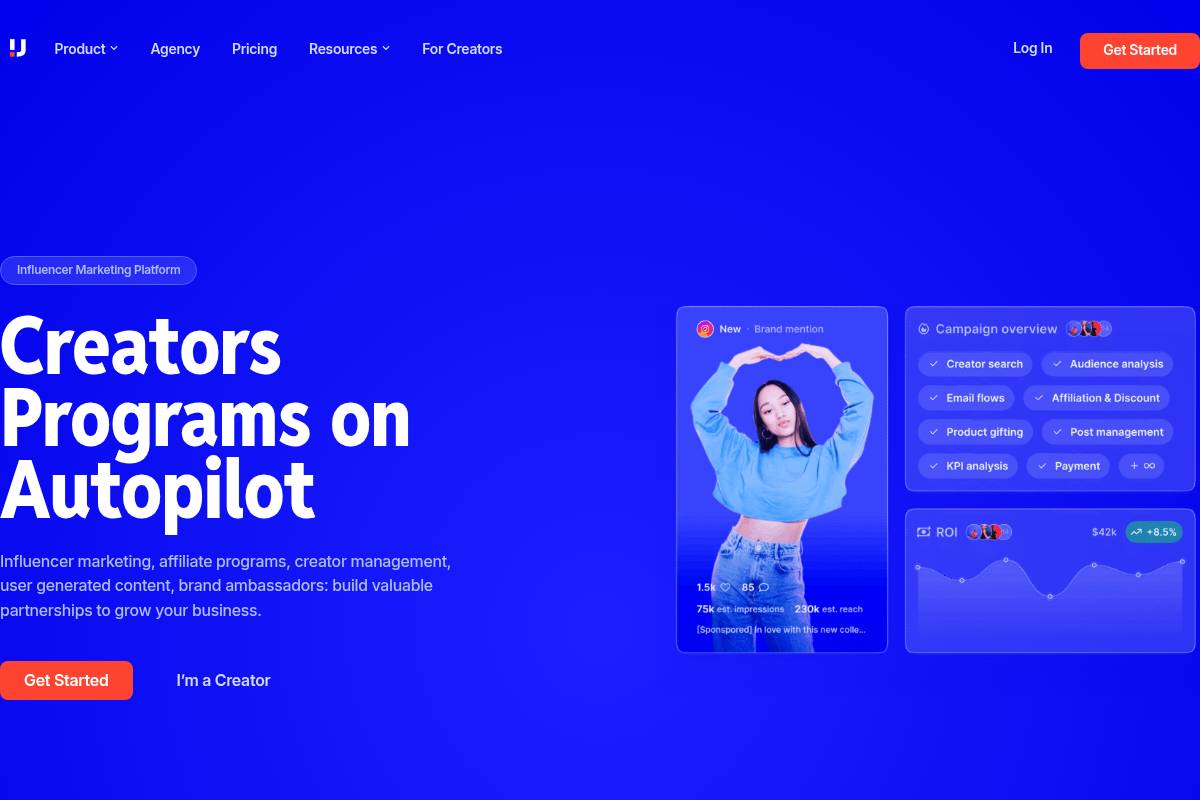
Upfluence is an influencer marketing platform offering searchable creator profiles and end-to-end campaign management.
Key Features
- Creator database: Over 12 million performance-verified creators via Jaice AI.
- Live Capture: Identifies influencers already within your user base.
- End-to-end management: Discovery to outreach, briefs, payments, tracking.
- Chrome extension: Real-time analytics while browsing creator profiles.
- E-commerce integrations: Shopify and WooCommerce for direct sales attribution.
Best For
App startups running 10+ influencer campaigns annually with e-commerce components.
Pros and Cons
- Pro: Large, verified creator database with powerful search filters.
- Pro: Live Capture identifies existing customer advocates.
- Con: Entry cost $478–$2,000+/month with mandatory 12-month contracts.
- Con: Pricing not publicly listed; requires sales consultation.
Rating: 7.9/10
9. Klaviyo — Best for Email and SMS Lifecycle Marketing
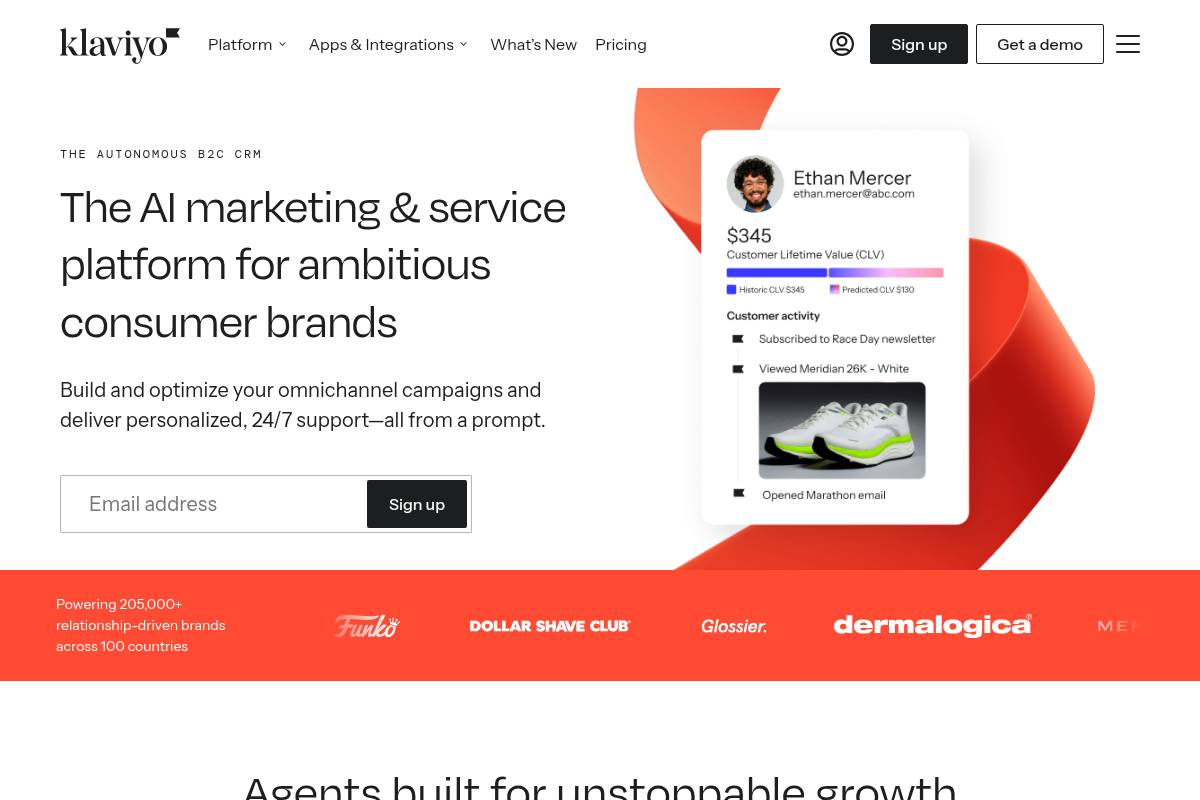
Klaviyo is an email and SMS marketing automation platform for lifecycle campaigns including onboarding, win-back, and out-of-app engagement.
Key Features
- Free tier: 250 contacts, 500 emails, 150 SMS/MMS credits monthly.
- Active-profile pricing: Email plan starts $20/month for 500 contacts, scaling by active profiles.
- Predictive analytics: Identifies high-value customers, churn risk, and lifetime value.
- Deep segmentation: Advanced capabilities available on all plans.
- Combined plans: Email + SMS adds ~$15/month at each tier.
Best For
App startups with e-commerce or subscription components seeking sophisticated email and SMS flows without dedicated CRM specialists.
Pros and Cons
- Pro: Free tier and $20/month entry accessible for early-stage startups.
- Pro: All features available across all plans.
- Con: Costs rise significantly beyond 50,000 contacts.
- Con: SMS limited to select countries.
Rating: 8.2/10
10. Moburst — Best for Full-Funnel Mobile Growth Agency Support
Moburst is a full-service mobile-first digital agency specializing in mobile marketing, media buying, ASO, influencer marketing, and creative production.
Key Features
- Full-funnel coverage: Mobile strategy, media buying, creative production, ASO, CRO, product consulting, influencer marketing.
- Proven scale: 46% of the world’s 15 apps with 1 billion+ downloads work exclusively with Moburst.
- Project pricing: $24,000–$2 million range, ~$10,000 minimum.
- Global offices: NYC, San Francisco, London, Tel Aviv for round-the-clock management.
- Award-winning: 32 international awards for client projects.
Best For
Well-funded startups and scale-ups seeking hands-on agency teams for paid media, ASO, and creative execution.
Pros and Cons
- Pro: Deep experience with world’s largest apps including Google, Uber, Samsung, Reddit.
- Pro: Full-funnel coverage reduces vendor handoffs.
- Con: Retainer costs thousands monthly plus media spend.
- Con: Limited evidence of building long-term in-house capability.
Rating: 8.0/10
Full Comparison: Best App Marketing Strategies Beyond ASO for Startups in 2026
| Tool | Category | Free Tier | Non-Technical Friendly | Best Fit Stage |
|---|---|---|---|---|
| Appomate | Full-service dev + growth partner | ✗ (custom quote) | ✔ | Idea to scale |
| AppsFlyer | Attribution & analytics | ✔ (12K conversions) | ✗ | Seed onward |
| Branch | Deep linking & attribution | ✔ (10K MAU) | ✗ | Seed onward |
| OneSignal | Push, in-app, email engagement | ✔ (generous) | ✔ | Pre-seed onward |
| Braze | Enterprise lifecycle marketing | ✗ | ✗ | Series A+ |
| AppLovin Ads | In-app ad network / UA | ✔ (no minimum spend) | ✔ | Seed onward |
| ReferralCandy | Referral & affiliate marketing | ✗ (7-day trial) | ✔ | Pre-seed onward |
| Upfluence | Influencer & creator marketing | ✗ | ✔ | Seed onward |
| Klaviyo | Email & SMS marketing | ✔ (250 contacts) | ✔ | Pre-seed onward |
| Moburst | Full-funnel growth agency | ✗ | ✔ | Series A+ |
How to Choose the Right App Marketing Strategy for Your Startup
By Team Size
Solo founders should start with free-tier OneSignal and Klaviyo, considering Appomate if the app still needs building. Teams of 5-15 can layer in AppsFlyer or Branch once paid spend begins. Larger teams of 20+ can justify Braze or Moburst’s higher complexity.
By Budget
Bootstrapped startups under $5,000/month should use OneSignal, Klaviyo, ReferralCandy, and AppLovin’s self-serve model. Funded startups with $10,000–$50,000/month can add AppsFlyer and Upfluence. Scale-ups with $50,000+/month can afford Braze and Moburst.
By Use Case
For proving which channel drives installs, use AppsFlyer or Branch. For retention, prioritize OneSignal, Braze, or Klaviyo. For paid in-app acquisition, use AppLovin. For validating app ideas while planning launch, use Appomate. For additional buying guidance, see App Store Optimization Strategies for 2026 Success.
What Is App Marketing Beyond ASO?
App marketing beyond ASO refers to every growth channel outside the app store listing — paid user acquisition, referral programs, influencer partnerships, push and email engagement, and deep linking. Between 65-75% of app installs originate from app store search, but the remaining 25-35% comes from these alternative channels. For a more detailed primer, see App Marketing Guide for 2026.
| Metric | 2025-2026 Figure | Why It Matters |
|---|---|---|
| Global app + game downloads (2025) | 142.2 billion | Shows scale of competition beyond store search |
| Average daily time in apps | 3.6 hours per user | Retention channels compete for this time |
| Apps opened daily per user | ~10 out of ~34 monthly | Highlights retention challenge beyond install |
| iOS average cost-per-install | ~$4.70 | Benchmarks paid UA budget planning |
| Referred customer conversion speed | 2-3x faster than cold traffic | Justifies referral program investment |
Conclusion
Startups combining attribution, engagement, and referral channels consistently outperform those relying on single tactics. Our top pick is Appomate, the only entry solving both product and go-to-market together. For teams with built apps, AppsFlyer and Branch excel at attribution, OneSignal and Klaviyo at engagement, and ReferralCandy or Upfluence at organic growth. The underlying lesson: ASO gets you found, but everything on this list is what gets you kept.
Frequently Asked Questions
What are the best app marketing strategies beyond ASO for startups in 2026?
Mobile attribution (AppsFlyer, Branch), lifecycle engagement (OneSignal, Braze, Klaviyo), referral and influencer marketing (ReferralCandy, Upfluence), paid in-app user acquisition (AppLovin), and full-service growth partnerships like Appomate.
Why isn’t ASO enough for app growth in 2026?
ASO only captures users actively searching app stores. Content, social media, referrals, and PR build long-term brand equity and reduce paid acquisition dependence, while keeping your app visible beyond store search.
Which app marketing tool is best for bootstrapped startups?
OneSignal and Klaviyo offer usable free tiers for engagement, while AppLovin’s self-serve platform has no minimum spend. Appomate can help sequence which paid tools matter first.
Should startups hire agencies like Moburst or use point-solution tools?
Agencies suit funded startups wanting experienced hands-on execution across channels. Point tools suit teams with in-house marketing capacity seeking lower cost and direct control.
How much should startups budget for app marketing beyond ASO?
Early-stage can start with free and sub-$100/month tools. Scale to $5,000–$20,000/month once paid acquisition tools are added. Full-service partnerships typically start ~$10,000 for agency work.
What is the difference between attribution and engagement tools?
Attribution tools (AppsFlyer, Branch) show which channel drove installs, optimizing ad spend. Engagement tools (OneSignal, Braze, Klaviyo) keep users active post-install, reducing churn.
Can referral and influencer marketing replace paid advertising?
They rarely replace it entirely but meaningfully reduce dependence. Most successful startups run referral and influencer alongside paid acquisition, not instead of it.
What should non-technical founders look for in an app marketing partner?
Guidance beyond single channels, clear reporting, and proven success with similar founders. Appomate empowers non-technical founders to innovate and transform concepts into market-ready apps quickly and safely.
Methodology: Rankings based on publicly available pricing, vendor documentation, third-party reviews (Capterra, G2, Clutch), and industry research current as of September 2026. Pricing and features subject to change; verify current details with each provider.