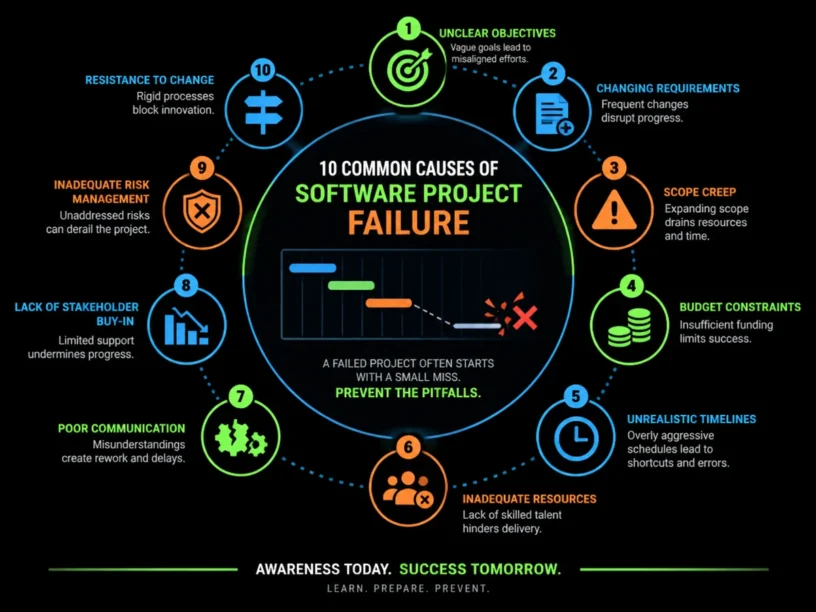
Why Software Projects Fail: 10 Common Causes and How to Prevent Them | Software projects fail for predictable, well-documented reasons, including unclear requirements, scope creep, weak planning, poor communication, and mismatched development partners. If you are a founder, startup, or enterprise buyer in Australia, understand these causes before you sign a development contract, because failure remains the norm. Knowing Why Software Projects Fail: 10 Common Causes and How to Prevent Them is the first step toward a product that reaches market, keeps users, and delivers a real return.
Australia has had its share of cautionary tales, from government IT disasters to startups that burned through seed funding building features nobody wanted. This article breaks down the ten most common causes, backs each with current data, and lays out a practical prevention framework for non-technical founders and seasoned business owners alike.
A software project rarely fails on launch day. It fails in the first planning meeting, when ambition gets mistaken for a plan and “we’ll figure it out as we go” quietly replaces a validated scope.
Why Do Software Projects Fail? The Numbers Behind the 2026 Reality
Software project failure is not a fringe risk. It is the statistical default. The PMI Pulse of the Profession survey reports that 12% of organizational resources are wasted due to poor project performance. The top causes are unclear requirements (39%), scope creep (33%), inadequate planning (29%), and communication breakdowns (25%), according to the Standish Group CHAOS Report. The same research finds that up to 70 percent of software projects end in failure, whether through budget overruns, missed deadlines, or cancellation.
Global and Local Project Performance
- Global Success Rate: PMI’s 2025 Project Success report shows that half of all projects were successful globally, with the other half graded as a mix of failure and success.
- Australian Context: More than half of Australian organizations (51%) successfully complete projects that fulfil their business objectives, while 52% meet stakeholder needs. Close to half of Australian projects still miss the mark in some way.
Breaking Down the Failure Categories
| Outcome Category | Share of Projects | What It Looks Like |
|---|---|---|
| Fully Successful | 29% | Delivered on time, on budget, with required features |
| Challenged | 52% | Completed but late, over budget, or missing features |
| Cancelled or Abandoned | 19% | Project stopped before delivery |
Combine “challenged” and “cancelled” and you get 71% of software projects failing to deliver fully on their original objectives, based on the Standish Group’s CHAOS figures. Size makes things worse. Small projects under $1M succeed 70% of the time, medium projects between $1M and $10M succeed 23% of the time, and large projects over $10M succeed just 6% of the time.
Key Takeaway: Roughly seven in ten software projects fail to meet their original scope, budget, or timeline, and the bigger the build, the worse the odds. Knowing the causes is often the difference between reaching market and watching runway disappear on a product that never ships. For supporting data, see Why Do Software Projects Fail? 7 Real Causes ….
The 10 Most Common Causes of Software Project Failure
Most failures trace back to a small, repeatable set of root causes, not bad luck or bad code. The first five are strategic failures that happen before anyone writes code; the last five happen during the build.
Strategic and Planning Failures (Causes 1-5)
- Unclear or shifting requirements: Unclear requirements show up in 39% of failed projects, usually because founders start building before the problem is validated.
- Scope creep: Scope creep accounts for 33% of project failures, and PMI research links it to an average budget overrun of 27%.
- Inadequate planning: Cited in 29% of failed projects, often because teams skip discovery to “save time.”
- Building the wrong product: CB Insights data shows that 42% of technology startups fail because they built a product no one needed. This risk is sharpest for founders who move straight from idea to full build.
- No clear success criteria: Without a defined “done,” teams keep adding features indefinitely. A check-in at month six often reveals that nothing has actually launched.
Execution and Technical Failures (Causes 6-10)
- Communication breakdowns: Responsible for 25% of failed projects. They surface when founders and offshore teams drift out of alignment on priorities.
- Poor project management: Behind 47% of unsuccessful software projects, whether through no tracking cadence or no risk register.
- Skipping testing and QA: Only 52% of software projects pass quality tests after release, and over 80% of project managers admit to releasing flawed software.
- Technical debt and fragile architecture: Early shortcuts often slow down every later change, as fixes in one area break others.
- Mismatched methodology: Agile projects succeed at a 64% rate, compared with 49% for Waterfall, and large Waterfall projects fail at twice the rate of large Agile projects.
Key Takeaway: Eight of these ten causes happen before the product reaches a user. To fix them, start with strategy and governance, not with hiring better coders. See also, see Why Projects Fail: 8 Causes and How to Prevent Them [2026]. For related guidance, see Vibe Coding What Non Technical Founders Need To Know Before Trusting AI To Build Their App.
Ready to build your app?
Book a free Visioning Call with our team today and walk away with a clear roadmap, expert feedback, and a plan to bring your idea to life. No technical knowledge required.
How to Prevent Software Project Failure: A Practical Framework
Prevention means treating validation, scoping, and quality assurance as non-negotiable stages, not extras squeezed in when there is time.
Prevention Mapped to Cause
| Failure Cause | Prevention Action | When to Apply It |
|---|---|---|
| Unclear requirements | Run a structured discovery and validation phase with real users | Before any development begins |
| Scope creep | Lock an MVP scope document and route new ideas into a backlog | Throughout the build |
| Poor planning | Break the build into short sprints with demoable milestones | Sprint zero onward |
| Communication gaps | Weekly stakeholder demos and a single source of truth for decisions | Every week of development |
| Skipped QA | Budget dedicated testing cycles before every release, not after complaints | Pre-launch and ongoing |
Habits That Separate Successful Founders From Failed Ones
- Validate before you build: Talk to prospective users and test demand before committing a full budget.
- Define “done” in writing: A scope document stops the “just a few more things” spiral that stalls builds for months.
- Protect your source code and IP: Confirm that code ownership and repository access are contractually guaranteed, never assumed.
- Run parallel workstreams: Legal, compliance, and go-to-market planning should run alongside development, not after launch.
- Choose methodology deliberately: Favour iterative Agile delivery over rigid Waterfall plans, given its lower failure rate.
Most failed apps fail because no one really wanted what was built, not because the code itself was bad. That pattern holds whether the budget was $40,000 or $4 million.
Key Takeaway: Preventing failure is a process discipline, not a technology problem. Founders who validate early, scope tightly, and test continuously land in the successful minority. See also, see Why 70% of Software Projects Fail | Solutions & Strategy.
Lessons From Australian Software Project Failures
Australia has produced some of the most expensive software failures on record, and each maps back to the ten causes above. Size and budget do not protect a project when planning, testing, and risk management are weak.
Notable Australian Case Studies
| Project | Sector | What Went Wrong | Cost Impact |
|---|---|---|---|
| Queensland Health Payroll System | State government | Launched in 2010 as one of the most spectacularly over-budget projects in Australian history, coming in at over 200 times the original budget. It was sold on promises of full automation but ended up requiring considerable manual operation. | ~AUD $1.2 billion |
| 2016 Australian Census (eCensus) | Federal government | The census website crashed after four DDoS attacks caused a 40-hour outage, leaving millions of Australians unable to lodge their forms. | Close to $30 million |
| Modernising Business Registers Program | Federal government | A planned AU $480.5 million program was cancelled after AU $530 million had been spent. A review found the projected cost had risen to AU $2.8 billion. | AU $2.8 billion projected |
The private sector is not immune. The Australian technology sector saw a 33% increase in insolvencies from February 2023 to February 2024, followed by a further 23% increase the next year, according to ASIC-sourced insolvency data. Many of those collapses trace back to unvalidated products, scope creep, and weak contingency planning.
Key Takeaway: Even government agencies with deep budgets fail when the same ten causes go unmanaged. A disciplined, founder-focused delivery partner matters more than the size of the budget. See also, see Why Software Projects Fail: 10 Reasons and How to Avoid Them. For related guidance, see Case Study Data Boards Transforming School Management With Technology.
Choosing a Development Partner That Prevents Project Failure
The highest-leverage decision a founder makes is who they build with. The right partner catches common causes early and works as a growth partner across validation, design, build, launch, and support, not just a team that writes code to a brief.
What to Look For in a Partner
- Validation before building: A partner should pressure-test your idea and user demand before committing your budget. This is how Appomate approaches every new engagement.
- Speed without cutting corners: Appomate’s Further Faster Framework and agile methodology have helped founders go from idea to market in as little as 6 weeks, leaving less room for scope creep and misalignment.
- Local strategy, global delivery: Australia-based strategy and product design combined with a skilled global development team delivers premium quality at startup-friendly pricing.
- AI-native, not AI-washed: Appomate builds AI-native products rather than thin AI wrappers, countering the AI-washing risk that derails many 2026 projects.
- A full-journey partner: One accountable partner from validation through launch, growth, and exit reduces the communication breakdowns and handoff failures that plague multi-vendor builds.
With over 250 apps delivered for clients including Adidas, L’Oreal, Lend Lease, and Hoyts, Appomate has a track record across Marketplace, Wellness, Sports, B2B, AI Apps, Healthcare, Hospitality, Education, and Fashion.
Key Takeaway: Software projects fail partly because founder and builder incentives drift apart. A partner built around validation, speed, and long-term support, like Appomate, removes several causes before they become problems. For related guidance, see How Agile Methodology Can Help Startups And Entrepreneurs Speed Up Their Mobile App Development Projects.
Conclusion
Software project failure is common, expensive, and almost always predictable once you know what to look for. The ten causes here show up again and again in Australian government megaprojects and first-time founder MVPs alike, which means they can be planned against.
- Failure is the statistical norm: Up to 70% of software projects end in failure, overruns, or delays, so treat prevention as mandatory.
- Strategy fails more often than code: Unclear requirements, scope creep, and inadequate planning cause more failures than poor engineering.
- Validation comes first: Confirming real demand before a full build prevents what is often the single most expensive mistake founders make.
- Methodology matters: Agile delivery consistently outperforms rigid Waterfall planning on success rates.
- Partner choice is a prevention strategy: A founder-focused, full-journey partner like Appomate helps you get further, faster, with fewer causes derailing your launch.
If you’re planning a build in 2026, your next step is a structured validation and scoping conversation before a single line of code is written.
FAQ
Why Software Projects Fail: 10 Causes and How to Prevent Them (2026)?
Software projects most commonly fail due to unclear requirements, scope creep, inadequate planning, communication breakdowns, poor project management, skipped testing, technical debt, mismatched methodology, no defined success criteria, and building a product nobody validated demand for. Prevention comes down to validating ideas early, locking scope, running iterative Agile sprints, and partnering with a team that manages the whole product journey.
What percentage of software projects fail in Australia?
More than half of Australian organizations (51%) successfully complete projects that fulfil business objectives, and 52% meet stakeholder needs. That means close to half of Australian projects fall short in some way, consistent with global failure rates of up to 70%.
What is the single biggest cause of software project failure?
Unclear requirements are present in 39% of failed projects, the most commonly cited root cause. Scope creep (33%) and inadequate planning (29%) follow closely behind.
How can non-technical founders avoid software project failure?
Start by validating your idea with real users before committing to a full build. Insist on a written scope document that defines “done,” protect ownership of your source code contractually, and choose a partner that handles validation, design, and launch together.
Does Agile or Waterfall methodology reduce project failure risk?
Agile projects succeed at a 64% rate, compared with 49% for Waterfall, and large Waterfall projects fail at twice the rate of large Agile projects. For most software builds, Agile is the lower-risk choice.
What are examples of major Australian software project failures?
Notable examples include the Queensland Health Payroll System, which came in at over 200 times its original budget despite promises of full automation. Another is the 2016 federal Census website, which crashed after DDoS attacks caused a 40-hour outage, at a cost of close to $30 million.
How much does scope creep typically add to a software project budget?
PMI research links scope creep to an average budget overrun of 27%, and 52% of projects experience it, making it one of the most financially damaging and common failure causes.
How does Appomate help founders avoid these common causes of software project failure?
Appomate works as a full growth partner rather than a build-to-brief agency. It validates ideas before development, combines Australia-based strategy and product design with a global development team, and uses an AI-native approach. That has taken founders from idea to market in as little as 6 weeks.
This article draws on publicly available industry research, including the Standish Group CHAOS Report, PMI Pulse of the Profession and Project Success reports, ASIC insolvency data, and documented Australian government case studies. Figures are provided for general information only. Individual project outcomes vary with scope, team, and execution.