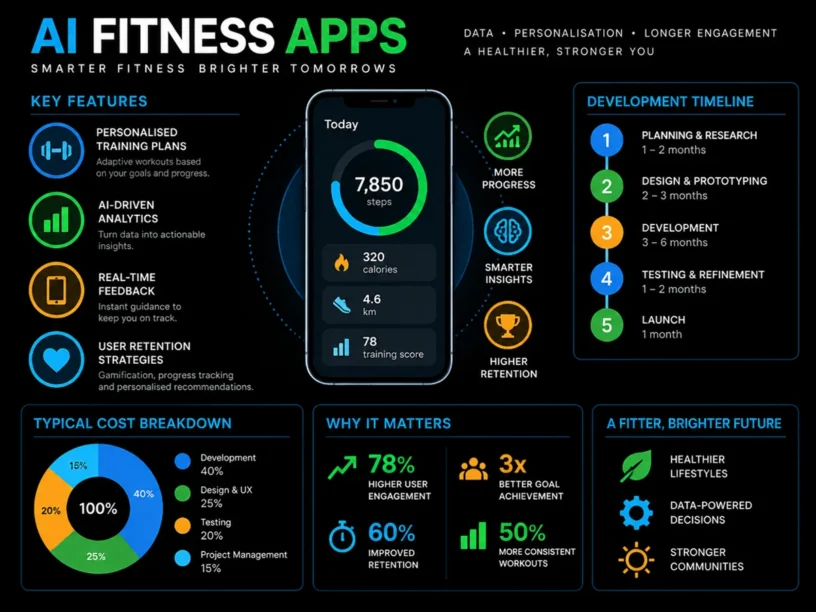
AI fitness app development features | Updated October 2026 | 9 min read | Appomate Team
If you’re planning an AI fitness app development guide for 2026, you probably want to know two things: which features will keep people coming back, and what it will cost to build in Australia. A competitive AI fitness app today needs adaptive coaching, computer vision form correction, deep wearable integration, and personalised nutrition guidance. Australian founders should budget roughly AUD 40,000 for a lean MVP and AUD 400,000+ for an enterprise-grade product with advanced AI. The real differentiator in 2026 isn’t whether you add AI. It’s whether your AI fitness app development features tackle the industry’s biggest problem: keeping users engaged past week one.
This guide covers the core features worth building, realistic Australian pricing by tier, the development process and timeline, and the retention tactics that separate apps people pay for long-term from apps people delete by February. It draws on current Australian market data, global fitness-tech benchmarks, and hands-on build experience, with a no-hype view for non-technical founders.
The fitness app category doesn’t have a discovery problem. It has a habit-formation problem. The apps winning in 2026 aren’t the ones with the most AI features. They’re the ones that get a user to their third meaningful workout before motivation fades.
What Is an AI Fitness App and Why Does It Matter for Australian Founders in 2026?
An AI fitness app is a mobile or web application that uses machine learning, computer vision, or large language models to personalise workouts, track progress, and adjust coaching in real time. For Australian founders, the timing matters. The local market is expanding quickly, and AI capabilities are becoming a baseline expectation rather than a novelty.
The Australian Market Opportunity
- Market Growth: The Australia fitness app market reached USD 70.1 million in 2025 and is projected to reach USD 401.5 million by 2034, growing at a 21.40% CAGR.
- Consumer Shift: In 2026, hyper-personalised AI in fitness draws on data from wearables, health monitoring devices, and user input to create tailored plans.
Core AI Capabilities Founders Should Understand
- Adaptive Coaching Engines: Algorithms that adjust workout intensity, volume, and rest periods based on performance data, fatigue signals, and historical trends, rather than following a fixed program.
- Computer Vision Form Correction: Camera-based movement analysis that flags technique errors in real time, helping reduce injury risk and taking over some of the work a human trainer would do.
- Predictive Health Analytics: Models that flag recovery needs, overtraining risk, or plateau patterns before the user notices them.
- Conversational AI Assistants: Natural-language chat or voice interfaces that answer questions like “why is my recovery score low today?” This kind of feature is already showing up in 2026 wearable ecosystems.
Key Takeaway: AI is no longer a premium add-on in fitness apps. Founders who treat it as a thin chatbot layer rather than a genuine personalisation engine will struggle as the Australian market grows toward USD 401.5 million by 2034. For deeper context, see Why Your Next Fitness App Needs AI-Powered Personalization. For related guidance, see Australia App Market 2025 Growth Statistics Trends And Opportunities For App Founders.
Which AI Fitness App Development Features Actually Drive Retention?
The features that matter most are tied directly to habit formation and measurable progress, not the ones that look good in a pitch deck. Research consistently shows that personalisation and social proof have a bigger effect on retention than a long feature list.
Features Ranked by Retention Impact
| Feature | What It Does | Retention Impact | Build Complexity |
|---|---|---|---|
| Personalised recommendations | AI-tailored workout and nutrition plans based on user data | Personalised recommendations lift retention 27% | Medium-High |
| Gamification | Streaks, badges, challenges, and progress milestones | Gamified apps see 50% higher 90-day retention | Medium |
| Push notification strategy | Behaviour-triggered reminders and milestone alerts | Push notifications boost open rates by 88% | Low |
| Social/community features | Sharing workouts, leaderboards, friend challenges | Social sharing features increase weekly engagement 40% | Medium |
| Live/guided classes | Real-time or scheduled instructor-led sessions | Live classes have 3x higher attendance than on-demand | High |
Features Worth Prioritising in an MVP
- Wearable and Health Data Sync: Native integration with Apple Health and Google Health Connect delivers the baseline functionality users now expect by default, including automatic activity and sleep tracking.
- Onboarding that Drives Early Activation: Getting someone to complete several workouts in their first fortnight is critical. Users who don’t complete at least 3 workouts in their first week churn at 4-5x the rate of those who do.
- Progress Visualisation: Clear dashboards showing strength, endurance, or weight trends. Seeing real movement helps users push through the plateau that often leads to cancellations.
- Nutrition Guidance: AI-generated meal suggestions tied to activity levels and goals, increasingly bundled with GLP-1 medication tracking in 2026’s most competitive apps.
Key Takeaway: Start with the five or six AI fitness app development features that measurably affect activation and retention. AR/VR or voice coaching can wait until the core habit loop is proven with real users. For deeper context, see AI Features, Wearable Integrations, and Retention Mechanics.
How Much Does AI Fitness App Development Cost in Australia?
The cost of AI fitness app development in Australia depends heavily on complexity. Mobile app development typically runs from AUD 40,000 for a simple single-platform MVP up to AUD 400,000+ for a feature-rich cross-platform product with backend integrations. Most mid-complexity apps land between AUD 80,000 and AUD 200,000.
Cost by Build Tier
| Tier | Typical Scope | Estimated Cost (AUD) | Typical Timeline |
|---|---|---|---|
| MVP / Proof of Concept | Core tracking, basic AI recommendations, one platform | AUD 15,000 to AUD 50,000 | 4 to 10 weeks |
| Standard AI-enabled app | Adaptive coaching, wearable sync, payments, cross-platform | AUD 50,000 to AUD 100,000 | 3 to 6 months |
| Advanced / Complex App | Computer vision, predictive analytics, 10+ integrations | AUD 150,000 to AUD 300,000+ | 6 to 9 months |
| Enterprise-Grade or Regulated | Healthcare integrations, multi-market compliance, 50+ features | AUD 400,000 to AUD 700,000+ | 9 to 12+ months |
What Pushes the Price Up or Down
- Developer Rates: Small-to-medium agencies typically sit between AUD 150 and AUD 330 per hour, while larger firms run from AUD 330 to AUD 495.
- Platform Strategy: Building separately for each platform runs about 1.6-1.8x the cost of one, versus 1.1-1.3x for a cross-platform framework like React Native or Flutter.
- AI Complexity: Computer vision form correction, predictive health modelling, and custom machine learning pipelines sit at the top of the cost curve. Simple rule-based recommendation logic costs far less.
- Ongoing Maintenance: Maintenance typically adds 10-15% of the initial build cost each year, especially for apps needing regular updates, security patches, and OS compatibility work.
Your build model has a big effect on the final quote. Appomate pairs Australia-based strategy and product design with a global development team, helping keep quality high while pricing closer to the MVP-to-standard end of these ranges.
Key Takeaway: Don’t anchor on the cheapest or most expensive quote. Match your spend to the AI fitness app development features your retention strategy depends on, and treat the first release as a validation tool rather than the finished product. For deeper context, see Australia’s Trusted Fitness App Development Services.
What Does the AI Fitness App Development Process and Timeline Look Like?
A well-run AI fitness app build moves through distinct stages, and each carries risk if skipped. Rushing the wrong stage is a common route to budget blowouts.
The Standard Build Sequence
- Validation and Strategy: Confirming the problem, the target user, and the monetisation model before writing code. This usually takes 1-2 weeks.
- Product Design (UX/UI): Creating wireframes and clickable prototypes that map the AI coaching flow, onboarding, and core screens.
- MVP Development: Building the core tracking, AI recommendation logic, and wearable sync needed to test real user behaviour.
- AI Model Integration and Testing: Connecting machine learning models or third-party AI APIs, then testing accuracy against real workout and biometric data.
- Launch and Iteration: Shipping to the app stores, then iterating based on activation and retention data from real users.
Why Speed to Launch Matters More in 2026
- Rapid User Opinion Formation: Fitness app users make up their minds fast. A slow build cycle means guessing at feature priority instead of validating it.
- Market Opportunity Cost: Appomate’s AI-driven development approach and Further Faster Framework let founders move from idea to a market-ready product in as little as 6 weeks, well ahead of the 9-12 month timelines typical of enterprise builds. Waiting a year to test an AI coaching feature in a market growing at 21.40% CAGR carries a real opportunity cost.
The founders who win in fitness tech aren’t the ones with the biggest feature list at launch. They’re the ones who got real users testing their core AI loop quickly and adjusted before the budget ran out.
Key Takeaway: Treat your first release as a structured experiment. A partner who compresses validation to launch into weeks gives you more iterations on the AI fitness app development features that drive retention. For deeper context, see AI Fitness App Development: How to Build, Cost, and ….
How Do You Build an AI Fitness App That Retains Users?
Retention is the hardest problem in fitness app development, and it’s a design and product challenge as much as a marketing one. Retention strategy needs to be built into the product from day one rather than bolted on after launch.
The Scale of the Churn Problem
- High Churn Rates: Fitness apps average 9.2% monthly churn, or 68.4% annually. The top driver is loss of motivation or abandoned fitness goals (38% of cancellations), followed by free alternatives (25%).
- Category Comparison: Monthly churn sits at 9.2% against a 4.8% SaaS median, and annual churn runs 68.4% against 43% for typical SaaS products.
Retention Tactics That Work
- Fix Activation First: Activation failure is the biggest churn driver. Users who complete fewer than 3 workouts in week one churn at 4-5x the rate, and lifting activation above 30% reduces churn more than any retention campaign.
- Combat Content Fatigue with AI Variety: Users who exhaust a workout library or feel stuck on a plateau are at high risk of leaving, which makes personalised progression and fresh content releases table stakes.
- Build for the Seasonal Spike: Fitness apps see a surge in early January, followed by 40-60% cancellations by February. Design onboarding to hold motivation past the initial resolve.
- Separate Voluntary from Involuntary Churn: Payment failures and intentional cancellations have different causes, so they need different fixes.
- Use Gamification Deliberately: Badges, streaks, and challenges correlate with the 50% higher 90-day retention seen in gamified apps.
Benchmarks to Measure Against
| Metric | Bottom Quartile | Median | Top Quartile |
|---|---|---|---|
| Monthly churn | 18-25%+ | 10-13% | 4-6% |
| Annual churn | 70-80%+ | 55-65% | 35-45% |
A founder-focused partner adds value beyond writing code. Appomate works with founders to validate the retention loop before scaling spend, treating app entrepreneurship as a full journey from idea to launch, growth, and beyond.
Key Takeaway: Retention is won or lost in the first two weeks of a user’s experience. Design onboarding and early workout flows around activation data, and budget for iteration after launch, not just before it.
Conclusion
Building a successful AI fitness app in 2026 means pairing the right AI fitness app development features with realistic Australian cost expectations and a retention-first strategy from day one. Founders who do well treat their first release as a structured test of the core habit loop, and budget for iteration as seriously as the initial build.
- Prioritise Retention-Driving Features: Personalisation, gamification, and wearable sync move the needle more than a long feature list.
- Budget Realistically by Tier: MVPs start around AUD 40,000-50,000, while advanced AI features push complex builds toward AUD 300,000-400,000+.
- Plan for the Churn Curve: Design activation and onboarding with steep fitness-app retention challenges in mind.
- Move Fast on Validation: Faster build cycles mean more iterations on the features that keep users engaged.
- Choose a Full-Journey Partner: A team supporting strategy, design, build, launch, and growth lowers risk compared with a build-only agency.
If you’re weighing up how to turn an AI fitness app concept into a real product, Appomate offers a founder-focused path from idea validation through launch and growth.
Ready to build your app?
Book a free Visioning Call with our team today and walk away with a clear roadmap, expert feedback, and a plan to bring your idea to life. No technical knowledge required.
FAQ
What does an AI fitness app development guide for 2026 cover in terms of features and cost?
A solid AI fitness app development guide for 2026 covers core AI features, including adaptive coaching, computer vision form correction, wearable integration, and personalised nutrition. It also breaks down Australian cost tiers, from roughly AUD 40,000 for an MVP to AUD 400,000+ for an enterprise-grade product. Retention strategy matters just as much, since fitness apps face some of the steepest churn rates.
What are the must-have AI fitness app development features in 2026?
Must-have AI fitness app development features include adaptive coaching, seamless wearable and health data sync (Apple Health and Google Health Connect), personalised progress tracking, and gamification such as streaks and challenges. Computer vision for form correction and nutrition guidance tied to activity data are also becoming essential.
How much does it cost to build an AI fitness app in Australia?
Costs typically range from AUD 15,000 to AUD 50,000 for an MVP up to AUD 400,000 to AUD 700,000+ for enterprise-grade or regulated builds. Most standard AI-enabled apps land between AUD 80,000 and AUD 200,000.
How long does it take to build an AI fitness app?
An MVP can take 4 to 10 weeks, a standard AI-enabled app typically takes 3 to 6 months, and complex or enterprise builds can run 9 to 12 months or longer. Streamlined partners can compress early validation builds to as little as 6 weeks.
How can I reduce user churn in a fitness app?
Start with activation. Users who don’t complete multiple workouts in their first week churn at several times the rate of those who do. Then layer in personalised progression, gamification, and behaviour-triggered push notifications to address lost motivation, content fatigue, and lack of visible progress.
Do I need a technical co-founder to build an AI fitness app?
Not always. A full-service development partner that handles strategy, design, AI integration, and launch can effectively stand in for an in-house technical co-founder, especially for non-technical founders validating an idea before committing a large budget.
What’s the difference between an MVP and a full-featured AI fitness app?
An MVP (Minimum Viable Product) includes only core tracking and basic AI recommendation logic needed to test user behaviour, typically costing AUD 15,000 to AUD 50,000. A full-featured app adds computer vision, predictive analytics, extensive wearable ecosystems, and deeper personalisation, pushing costs toward AUD 150,000 to AUD 400,000+.
This article is based on publicly available 2026 market research, including Australian fitness app market data, mobile app development cost surveys, and fitness app retention benchmark reports, alongside Appomate’s own experience helping founders build and launch AI-driven mobile products. Figures are estimates for planning purposes. Actual costs and timelines vary by project scope, so request a tailored quote before finalising a budget.