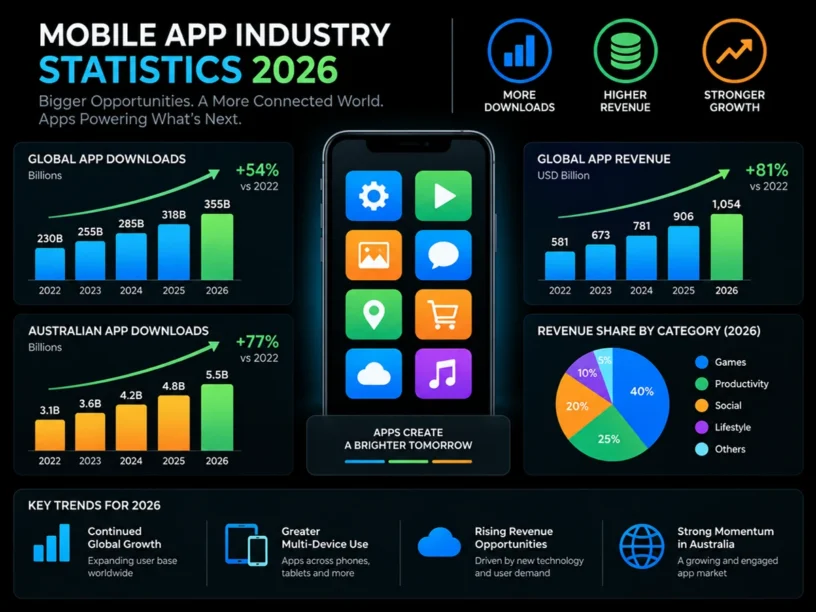
Mobile app industry statistics for 2026 | Updated October 20, 2026 | 9 min read | Appomate Team
Mobile app industry statistics for 2026 paint a picture of a mature market, shaped by retention, deeper monetization, and AI-native product design rather than raw download counts. The global mobile app market is projected to reach $391.3 billion this year, according to Mordor Intelligence. Australia’s smartphone app development sector is valued at approximately $2.8 billion domestically, as reported by IBISWorld. This guide covers the global figures, Australia-specific growth data, revenue trends, and the takeaways that matter before you commit budget to a new app.
Whether you’re a first-time founder, a non-technical business owner, or an enterprise team weighing investments, the underlying data matters more than the headlines. We’ve focused on the figures that will shape real decisions, including market size, Australian smartphone penetration, revenue mix, platform preference, and regulatory shifts.
The app economy no longer rewards the biggest download numbers; it rewards the products people keep opening a year later. In 2026, that shift matters more to a founder’s business case than any single market-size figure.
Global Mobile App Industry Statistics for 2026: Market Size and Downloads
Globally, the mobile app industry in 2026 is best understood as two overlapping markets. Mordor Intelligence’s projection puts the pure mobile app market at $391.3 billion, while a wider measure that counts in-app advertising pushes the total well beyond that.
Market Size: Two Ways to Measure the Same Industry
Analysts don’t always agree on where the “app market” ends and the broader “app economy” begins, which is why reported figures vary. Statista’s Worldwide App Market Outlook, which includes in-app advertising, projects total app revenue of $739.61 billion in 2026, growing at a compound annual rate of 8.17% to reach $1.10 trillion by 2031.
- Revenue Breakdown: Within this broader figure, in-app purchases account for $475.84 billion and advertising for $256.87 billion.
- Paid App Downloads: Paid app downloads contribute just $6.90 billion, less than 1% of the market. One-time purchases have quietly stopped being a primary way to make money.
| Global Metric | 2026 Figure | Source |
|---|---|---|
| Core mobile app market value | $391.3 billion | Mordor Intelligence |
| Broader revenue incl. advertising | $739.61 billion | Statista Worldwide App Market Outlook |
| Annual app downloads | 324 billion expected annual app downloads globally | Industry aggregate |
| Google Play downloads | Increasing from 111 billion in 2021 to 143 billion in 2026 | Google Play |
| Apple App Store downloads | Rising from 33 billion downloads in 2021 to 38 billion by 2026 | Apple App Store |
| Time spent inside apps | 5.5 trillion+ hours annually, 4.2 hours per day on average | Industry aggregate |
- Freemium Dominance: 98 percent of global mobile app revenue comes from freemium apps, making upfront paid downloads a minor factor for most categories.
- Consumer Spending Growth: Consumer spending on apps reached USD 167 billion in 2025 and is expected to climb to approximately USD 223.1 billion in 2026, including games.
- In-App Purchases as Core Engine: According to Sensor Tower, in-app purchases generated approximately $85.6 billion in 2025 and are projected to reach around $95 billion by the end of 2026.
- Downloads vs. Engagement: Time spent is growing faster than downloads. Users are settling into fewer, stickier apps, which makes user engagement the metric to watch.
Key Takeaway: Global mobile app industry statistics for 2026 confirm a market well past $300 billion in core value. In-app purchases and advertising carry nearly all the revenue, while paid downloads continue to fade. For supporting data, see Mobile App Statistics, Latest Trends & Insights for 2026. For related guidance, see Best Paid User Acquisition Strategies For Mobile Apps In 2026.
Australia Mobile App Market Growth Statistics for 2026
Australia’s app market in 2026 looks like a mature, high-spending economy rather than an emerging one. Smartphone penetration is near-universal, iOS holds an unusually strong lead, and revenue is expanding faster than the global average. The smartphone app developers industry in Australia is valued at $2.8 billion in 2026, having increased 2.2% in 2026 and grown at a 1.8% CAGR between 2021 and 2026.
Smartphone Penetration and Platform Split
Smartphone adoption in Australia is exceeding 90 percent, with more than 27 million active smartphone users expected in 2026. Unlike most global markets, where Android dominates, Australia leans heavily toward Apple.
- iOS Dominance: Roughly 55 to 60% of Australian users are on iOS, while about 40 to 45% use Android. That skew makes a polished iPhone experience critical, though cross-platform reach still matters for broader appeal.
Revenue and Developer Landscape
Australia’s app revenue is climbing briskly, even on a mature base. The local app market generated USD 3 billion in revenue in 2024, a 15.3% increase over the previous year. Total app market revenue is projected to exceed USD 11 billion by 2027, a figure Business of Apps estimates could reach approximately US$11.5 billion by 2027.
- Active Developers: More than 2,500 Australian mobile app developers are actively publishing on Google Play and the App Store.
- Average Downloads: Australian mobile apps average around 323,000 downloads per app, a sign of a healthy user base.
| Australia Metric | 2025/2026 Figure | Why It Matters |
|---|---|---|
| Smartphone app dev industry size | $2.8 billion (2026) | Steady, if modest, domestic growth |
| App market revenue | $3B (2024), projected $11B+ by 2027 | Strong revenue trajectory ahead of volume growth |
| Smartphone penetration | 87-90%+ | Near-total addressable audience reach |
| iOS vs Android split | ~55-60% iOS / 40-45% Android | iOS-first design priority for AU launches |
| Active local app developers | 2,500+ | Competitive but not oversaturated builder market |
Key Takeaway: Australia’s mobile app market growth statistics for 2026 show a smaller but faster-expanding revenue base than the global average. The iOS-leaning audience rewards founders who design for Apple’s ecosystem first. For supporting data, see Mobile App Usage Statistics: Key Trends and Insights for ….
Mobile App Revenue Statistics 2026: How Apps Actually Make Money
Monetization has settled around three main models: in-app purchases, advertising, and subscriptions. One-off paid downloads are now a marginal strategy almost everywhere, Australia included. This mix shapes the pricing and growth model your app will need, so it matters more for a business plan than any headline market size.
Australia’s Monetization Mix
Local data follows the global trend. Approximately 6% of apps in the Australian market are paid upfront, 18% rely on in-app advertising, and 16% use in-app purchases. The remainder are free or funded in hybrid ways. Mobile gaming remains a heavy earner, with the Australia mobile gaming market valued at USD 1039.60 million in 2025 and projected to grow at a CAGR of 7.10% between 2026 and 2035, reaching USD 2064.24 million by 2035.
Advertising as a Growing Revenue Channel
In-app advertising is picking up pace in Australia. IMARC Group data shows the Australian mobile advertising market grew from USD 5.1 billion in 2025 to USD 5.8 billion in 2026, with further growth expected through the decade.
A paid-download-only strategy is now a niche play rather than a default. Founders building for Australia in 2026 should plan from day one for a blended model: a free or low-cost entry point, in-app purchases for depth, and advertising or subscriptions to cover casual users.
- In-App Purchases: Still the largest single revenue stream, globally and locally, especially in gaming, wellness, and productivity.
- Advertising Revenue: Growing fastest in Australia’s mobile ecosystem, backed by a near-$6 billion domestic market in 2026.
- Subscriptions: Increasingly preferred for entertainment, fitness, and B2B SaaS-style apps, where ongoing value justifies recurring billing.
- Paid-Upfront Apps: A small minority of the Australian market, better suited to niche professional or enterprise tools than consumer launches.
Key Takeaway: Mobile app revenue statistics for 2026 point to a blended approach. Australian founders should combine in-app purchases, advertising, and subscriptions to match how users actually spend. For supporting data, see Mobile App Usage Statistics 2026: Key Data & Trends.
Mobile App Trends 2026 Shaping Business Impact
Mobile app trends in 2026 are driven as much by regulation and AI adoption as by consumer demand. Two forces stand out: the rise of AI-native apps, and a landmark Australian law that now touches any app with social features.
AI-Native Apps Are Becoming the Baseline
AI is no longer a bolt-on feature; increasingly, it is the product itself. The AI segment within the app space is valued at around $210 billion, and generative AI app downloads are projected to reach approximately 7.5 billion in 2026, roughly 108% year-over-year growth. This is why Appomate’s development philosophy centers on building genuinely AI-native products rather than simple AI wrappers, using the latest AI-driven development tools to deliver faster, smarter builds.
Australia’s Social Media Minimum Age Law
Australia moved first globally on youth online safety, and the effects are reaching app design and compliance planning. In December 2025, Australia became the first country to introduce a social media ban for users under 16. An amendment to the Online Safety Act 2021 set a minimum age for specified platforms, including Facebook, Instagram, Kick, Reddit, Snapchat, Threads, TikTok, Twitch, X, and YouTube. Non-compliant platforms face serious fines of up to about $50 million. Early studies indicate that social media use and account ownership among Australian children under 16 fell by between 9% and 40%.
- Age-Assurance by Design: Any new app with social, chat, or community features needs age verification built in from the design phase, not bolted on later.
- AI-Native Product Thinking: Founders are expected to weave AI into core workflows, not stick a chatbot onto an existing app.
- Retention Over Acquisition: With downloads plateauing globally, budgets are shifting from paid acquisition toward engagement and lifecycle features.
- Platform-Specific Compliance: The eSafety Commissioner’s register of age-restricted platforms is updated regularly, so any app with social features should monitor its classification status.
Key Takeaway: Mobile app trends for 2026 reward founders who treat AI capability and regulatory compliance as core architecture decisions made at the start of a build, not afterthoughts before launch.
What Mobile App Industry Statistics for 2026 Mean for Australian Founders and Businesses
Mobile app industry statistics for 2026 point to a market where building with good information matters more than ever. Speed to a validated launch is a real competitive edge, and Australian development costs vary widely depending on scope, team structure, and how much validation happens before coding begins.
What App Development Costs in Australia Right Now
According to Appomate’s 2026 founder’s guide to MVP costs, MVP development in Australia ranges from AUD $15,000 for a very simple single-feature prototype to AUD $150,000 or more for a complex, AI-native, multi-platform product. A simple, single-platform MVP with three to five core features typically lands between AUD $30,000 and $60,000. Local developer rates sit between $100 and $250 AUD per hour, which is why hybrid delivery models, pairing Australia-based strategy with an efficient global build team, have become the default for cost-conscious founders.
| Build Tier | Typical Cost (AUD) | Best Suited For |
|---|---|---|
| Simple MVP | $15,000 – $60,000 | Validating a single core idea before raising capital |
| Mid-complexity app | $60,000 – $150,000 | Multi-feature consumer or B2B products with integrations |
| Complex / AI-native product | $150,000+ | Marketplace, healthcare, or AI-driven platforms at scale |
Investor money is available for founders who validate first. Australian startup funding reached $5.4 billion across 390 announced deals in 2025. Appetite is strong, but scrutiny is high, and investors want to see validation before they release funds.
- Validate Before Building: A lean, tested MVP protects your runway and credibility ahead of fundraising conversations.
- Design iOS-First, But Build Cross-Platform: Given Australia’s iOS-leaning audience, prioritise Apple’s ecosystem without ignoring Android reach.
- Treat AI as Core Architecture: Appomate builds AI-native products rather than AI wrappers. Its AI-driven development tools compress timelines, helping founders go from idea to market in as little as six weeks.
- Choose One Partner for the Whole Journey: Appomate’s approach spans strategy, design, build, launch, marketing, and ongoing support, so founders aren’t juggling multiple vendors.
- Combine Local Strategy with Global Delivery: Appomate pairs Australia-based strategy and product design with a global development team, aiming for premium quality at startup-friendly pricing. This model has supported more than 250 apps for clients including Adidas, L’Oréal, Lend Lease, and Hoyts.
Key Takeaway: The mobile app industry statistics for 2026 make the business case for building clear. The founders who win pair that opportunity with disciplined validation, AI-native product thinking, and a partner who can carry the whole journey forward. For supporting data, see 100+ Surprising Mobile App Development Statistics You …. For related guidance, see How To Validate A Marketplace App Idea Before Building It 2026 Step By Step Guide 2026.
Ready to build your app?
Book a free Visioning Call with our team today and walk away with a clear roadmap, expert feedback, and a plan to bring your idea to life. No technical knowledge required.
Conclusion
Mobile app industry statistics for 2026 describe a global market worth hundreds of billions of dollars, built almost entirely on in-app purchases, advertising, and subscriptions. Australia punches above its weight, thanks to near-universal smartphone penetration and an unusually strong iOS audience. For founders deciding whether to build, the data supports moving forward, as long as the approach is validated, AI-aware, and compliant with Australia’s evolving rules.
- Global Scale, Local Nuance: A $391.3 billion-plus global market sits alongside a fast-growing $2.8 billion domestic Australian app development sector.
- iOS-First Design Matters in Australia: With roughly 55-60% of local users on iOS, polish on Apple’s platform should be a priority.
- Monetization is Blended, Not Singular: In-app purchases, advertising, and subscriptions now carry almost all app revenue.
- AI and Compliance Are Core Features: Generative AI adoption and Australia’s social media minimum age law both call for early architectural decisions.
- Cost Ranges Are Wide but Predictable: Australian MVPs typically run from $15,000 to $150,000+, depending on complexity and platform scope.
Ready to turn these numbers into a product roadmap? Start with a strategy conversation at Appomate, where validation, design, build, launch, and growth support sit under one roof. The FAQ below covers the questions founders ask most often.
FAQ
What are the mobile app industry statistics for 2026?
The global core market is approximately $391.3 billion, with a broader measure that includes advertising reaching closer to $739.61 billion. Globally, there are around 324 billion annual app downloads and over 5.5 trillion hours spent in apps. In Australia, the smartphone app development industry is valued at $2.8 billion, and total app market revenue is projected to exceed $11 billion by 2027.
How big is the mobile app market in Australia in 2026?
Australia’s app development industry is valued at $2.8 billion in 2026, according to IBISWorld. The broader app market revenue is projected to exceed USD 11 billion by 2027, up from USD 3 billion in 2024.
How much does it cost to build an app in Australia in 2026?
Costs depend on complexity. A simple MVP typically runs between AUD $15,000 and $60,000, mid-complexity apps fall between $60,000 and $150,000, and complex AI-native or enterprise platforms cost $150,000 or more, according to Appomate’s 2026 MVP cost guide. Local developer hourly rates generally sit between $100 and $250 AUD.
What percentage of Australians use iOS versus Android?
Australia leans unusually toward iOS. Roughly 55 to 60% of users are on iOS, and about 40 to 45% are on Android, based on StatCounter data referenced in Appomate’s market analysis. A polished iPhone experience is therefore a priority for most Australian launches, though cross-platform reach still matters.
How do mobile apps make money in 2026?
Nearly all app revenue now comes from in-app purchases, advertising, and subscriptions, with paid-upfront downloads making up under 1% of the broader global market. In Australia, roughly 6% of apps are paid upfront, 18% rely on advertising, and 16% use in-app purchases.
What is Australia’s social media minimum age law and how does it affect app developers?
Effective from 10 December 2025, Australia’s Online Safety Amendment (Social Media Minimum Age) Act requires age-restricted social media platforms to prevent under-16s from holding accounts. Non-compliance can bring penalties of up to roughly $50 million. Any app with chat, community, or social-feed features should build age-assurance and compliance considerations into its architecture from the outset.
Is 2026 a good time to launch an app in Australia?
Yes, for founders who validate first. Australian app market revenue is growing faster than the global average, smartphone penetration is near-universal, and startup funding reached $5.4 billion across 390 deals in 2025. The opportunity is strongest for founders who pair good timing with disciplined validation and AI-native product design.
How can Appomate help with app development in Australia?
Appomate is a Melbourne-based mobile and web app development company covering validation, strategy, design, build, launch, marketing, and ongoing support. Its hybrid model pairs Australia-based strategy with a global development team. Appomate has delivered more than 250 apps for clients including Adidas, L’Oréal, Lend Lease, and Hoyts, and uses AI-driven development to help founders get from idea to market in as little as six weeks.
Methodology: Figures in this article are drawn from publicly available industry reports including IBISWorld, Mordor Intelligence, Statista, Sensor Tower, IMARC Group, Expert Market Research, and Australian Government sources such as the Department of Infrastructure and the eSafety Commissioner, current as of October 2026. Market estimates vary by provider depending on methodology and definitions used. Treat figures as directional benchmarks rather than precise forecasts, and consult primary sources for investment or compliance decisions.