How to Build a SaaS Ecommerce Platform: Key Types, Essential Features, and Business Models | Updated October 2026 | 11 minute read | Appomate Editorial Team
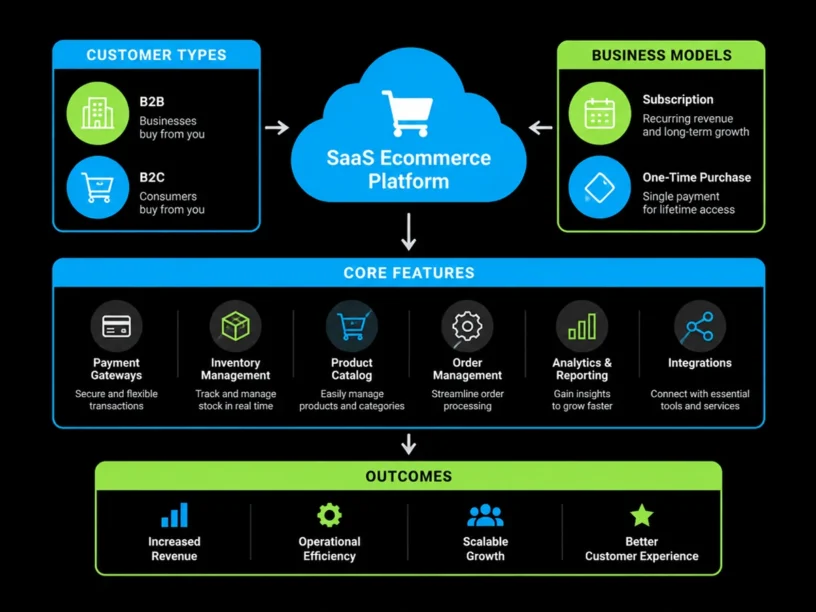
Building a SaaS ecommerce platform means creating a cloud-hosted system that lets merchants launch, run, and grow online stores without owning any servers. You manage the infrastructure, billing, and updates from one central place. The short answer to how to build one comes down to three things: a multi-tenant architecture, a well-chosen set of commerce features, and a recurring revenue model that suits your target merchants. This guide covers the platform types worth considering, the features that matter most at launch, and the business models that earn steady income in the Australian market.
Why Australia is a Compelling Market for SaaS Ecommerce
Strong growth in both online consumer spending and SaaS adoption makes Australia an attractive market, provided the platform is designed properly from day one.
- Strong Online Spending: Australians spent $82.6 billion online in 2025, a 14% year-on-year increase. Online purchases now make up roughly 24% of total retail spending.
- High Household Adoption: Approximately 9.8 million households, or 82% of all Australian households, shopped online during the year.
- Growing SaaS Investment: Gartner’s May 2026 forecast puts Australian SaaS spending at A$16,377 million, still growing at 13.8% a year.
- Opportunity for Founders: Even without a technical background, this level of demand makes now a sensible time to start planning.
A SaaS ecommerce platform is not just a website builder with a subscription fee attached. It is a business in itself, one where your product, your merchants’ products, and your recurring revenue all depend on the same underlying architecture working flawlessly at scale.
What Is a SaaS Ecommerce Platform?
A SaaS ecommerce platform is a cloud-hosted software system that lets a business build, manage, and scale an online store without installing or maintaining its own servers. The vendor owns the servers, handles security patching, and pushes updates automatically, all paid for through a subscription. Well-known examples include Shopify, BigCommerce, and Salesforce Commerce Cloud. Merchants pay monthly or annually and receive hosting, security, and new features as part of that fee, making it a fully managed solution.
How It Differs From Traditional Ecommerce Software
Traditional, self-hosted software (think Magento installed on-premise) puts servers, security patches, and scaling on the merchant. A SaaS platform moves that burden to the operator, who in return needs the engineering capability to serve potentially thousands of tenants reliably.
- Centralised updates: Every merchant receives new features and security patches at the same time.
- Shared infrastructure: Pooled hosting, databases, and compute keep per-merchant costs lower than dedicated hosting.
- Recurring revenue for the operator: Ongoing subscription or commission income replaces a one-off licence fee.
- Lower technical barrier for merchants: Store owners don’t need developers on staff to keep things running.
Key Takeaway: A SaaS ecommerce platform moves the technical burden from thousands of merchants onto one operator, so getting the underlying architecture right the first time matters far more than it does for a single store. For deeper context, see SaaS eCommerce Platform: Everything You Need to Know.
What Are the Key Types of SaaS Ecommerce Platforms?
There are four main architectural types, and the right one depends on how many merchants you plan to serve and how much customisation they need. This choice shapes your technology stack, hosting costs, and onboarding speed, so treat it as a foundational decision.
Multi-Tenant, Single-Tenant, Headless, and Marketplace Models
A multi-tenant platform runs many independent storefronts from one codebase and shared infrastructure. Each tenant gets its own catalog, pricing, checkout, and admin access, while the operator manages updates, hosting, and scaling centrally. It is the dominant SaaS ecommerce model because it keeps costs predictable as you add merchants.
| Platform Type | How It Works | Best Fit | Key Trade-Off |
|---|---|---|---|
| Multi-tenant SaaS | One codebase, shared infrastructure, isolated tenant data | Store-builder networks, white-label SaaS, high-volume onboarding | Harder to deeply customise individual tenants |
| Single-tenant SaaS | Dedicated instance per customer on shared code | Enterprise or regulated merchants needing isolation | Higher infrastructure cost per customer |
| Headless/composable | Commerce engine decoupled from the storefront front end | Brands needing custom UX across web, app, and kiosk | Requires more development effort per storefront |
| Multi-vendor marketplace | Many sellers list on one shared storefront | Marketplace businesses, B2B2C networks | Complex commission, payout, and dispute logic |
- Multi-tenant architecture: Best for onboarding large numbers of merchants quickly with shared, predictable hosting costs.
- Single-tenant architecture: Suited to enterprise clients needing data isolation, custom compliance, or dedicated performance.
- Headless commerce: Separates commerce logic from presentation, so merchants can build bespoke storefronts, apps, or kiosks on the same engine.
- Marketplace SaaS: Combines ecommerce with vendor management for B2B2C models where commission replaces or supplements subscriptions.
Key Takeaway: Most founders should start with a multi-tenant architecture. It is the most cost-efficient to scale and sits behind the vast majority of successful store-builder platforms worldwide. See also, see Top 10 SaaS Tools That Every Startup Should Use in 2026.
What Essential Features Does a SaaS Ecommerce Platform Need?
A launch-ready platform needs a core set of features covering tenant management, commerce functionality, and billing. Leaving out any layer usually leads to expensive rework, especially around billing and tenant isolation, which are difficult to retrofit once merchants are live. Upfront planning is critical.
Core Platform Layer
- Tenant provisioning: Automated onboarding that creates a new store, assigns a plan, and sets up the owner account.
- Role-based access control: Separate permission levels for store owners, staff, and the platform’s support team.
- Subscription and billing engine: Handles upgrades, downgrades, trials, and renewals, including proration when a tenant changes plans mid-cycle.
- Admin console: A central dashboard showing tenant activity, revenue, and platform health.
Storefront and Commerce Layer
- Product catalog and inventory management: Each merchant manages variants, stock, and pricing independently.
- Checkout and payment gateway integration: Supports local Australian payment methods. Card payments, BNPL, and digital wallets are now standard expectations.
- Order and fulfilment management: Tracks orders from placement through shipping and returns.
- Mobile-responsive design: Essential, given that mobile devices account for over 60% of ecommerce sessions in Australia.
Founders often underestimate how much of the “ecommerce” work in a SaaS platform is actually billing and tenant infrastructure. The storefront is the visible 30%. The subscription engine, security, and compliance layer underneath is the other 70%, and it decides whether the business survives growth.
Key Takeaway: A platform with a polished storefront but a weak billing engine and tenant isolation will struggle at your hundredth merchant. These layers must be designed in parallel, not bolted on afterward.
What Business Models Work Best for SaaS Ecommerce Platforms?
The three dominant models are flat subscription tiers, commission-based revenue, and hybrids that blend the two. The right choice depends on whether your merchants value predictability or prefer to pay as they grow. Getting this right early avoids awkward repricing conversations and keeps your revenue stream sustainable.
| Business Model | How Revenue Is Earned | Merchant Appeal | Operator Risk |
|---|---|---|---|
| Flat subscription tiers | Fixed monthly or annual fee per plan level | Predictable costs, easy to budget | Revenue doesn’t scale with merchant success |
| Usage/transaction-based | Percentage of sales or per-transaction fee | Low barrier to entry, pay only when selling | Revenue volatile during slow seasons |
| Commission marketplace model | Platform takes a cut of every sale | No upfront cost for vendors | Requires sophisticated payout and tax logic |
| Hybrid (subscription + commission) | Base fee plus a smaller transaction percentage | Balances predictability with shared upside | More complex billing architecture to build |
| Freemium with paid upgrades | Free core plan, paid add-on features | Fastest path to initial sign-ups | Low conversion rates to paid tiers if not managed carefully |
- Tiered subscriptions: Starter, growth, and enterprise plans gated by products, staff accounts, or storage.
- Commission-based pricing: Works well for marketplaces, where the operator earns only when merchants sell.
- Hybrid pricing: A smaller flat fee plus a transaction percentage spreads risk between operator and merchant.
- Add-on marketplace: Charging for apps, themes, or premium integrations on top of a base subscription.
Key Takeaway: Many successful platforms eventually move toward a hybrid model, pairing a predictable subscription base with a smaller transaction fee. This balances revenue stability against merchant affordability. See also, see SaaS eCommerce Platform: Features & Benefits to Look …. For related guidance, see How Founders Can Scale Saas Products In 2025 Strategies For Sustainable Growth.
How Do You Build a SaaS Ecommerce Platform Step by Step?
The build follows a sequence of validation, architecture design, iterative development, and compliance work, typically moving from idea to a usable first version in months rather than years. Skipping validation is the most common and costly mistake first-time founders make, so a structured, disciplined approach pays off.
The Build Sequence
- Validate the merchant need: Interview prospective merchants before writing code, and confirm they will pay to solve the problem.
- Design the tenant architecture: Decide between multi-tenant, single-tenant, or headless before development, since this is expensive to reverse.
- Build a minimum viable platform: Launch with core storefront, checkout, and billing rather than every roadmap feature.
- Onboard a pilot cohort: Stress-test billing, support, and performance with a small group of real merchants.
- Layer in compliance: Australian eCommerce businesses must comply with consumer law, privacy rules, and online trading regulations to operate legally, so build Australian Consumer Law requirements in from the start.
- Scale and iterate: Expand features and volume based on real usage data rather than assumptions.
The right development partner changes the odds. Appomate is a Melbourne-based app development company built around this sequence, helping non-technical founders validate, design, build, and launch scalable products rather than simply coding whatever is asked. Its Further Faster Framework and AI-driven development approach have helped founders reach market in as little as six weeks. The team pairs Australia-based strategy and product design with a highly skilled global development team, delivering premium quality at startup-friendly prices.
Key Takeaway: Successful founders are rarely the ones with the longest feature list at launch. They validate demand early, choose the right architecture upfront, and partner with a team experienced in guiding non-technical founders through the whole journey. For deeper context, see Product Management in SaaS for E-commerce: Building ….
What Does It Cost and How Long Does It Take to Build a SaaS Ecommerce Platform in Australia?
Timelines and costs vary with architectural complexity, feature depth, and whether you work with a traditional agency or an AI-accelerated partner. Understanding these variables early helps you budget realistically and avoid the scope creep that stalls momentum.
Factors That Drive Cost and Timeline
- Architecture choice: Multi-tenant takes longer to engineer correctly up front but costs less per merchant over the long term.
- Payment and compliance integration: Connecting Australian payment gateways and building Australian Consumer Law-compliant terms, returns, and privacy policies adds time and is non-negotiable before launch.
- Feature scope at MVP: The more features in version one, the longer the build. Lean, testable MVPs reliably shorten time to market.
- Development model: Agencies that only build to specification often take longer and cost more than full-service partners who validate, design, and build in parallel.
| Build Stage | Typical Focus | Why It Matters |
|---|---|---|
| Validation and strategy | Merchant interviews, pricing model testing, competitive scan | Prevents building features nobody will pay for |
| Product design | UX flows for merchant admin and shopper storefront | Reduces costly rework during development |
| MVP development | Core tenant, catalog, checkout, and billing features | Gets a usable product in front of real merchants fast |
| Pilot and iteration | Small merchant cohort, feedback loops, bug fixing | Surfaces billing or performance issues before wide rollout |
| Launch and growth support | Marketing, onboarding automation, ongoing feature releases | Turns a working platform into a scalable business |
Appomate shortens this sequence by combining Australia-based strategy and product management with a global development team. Founders get AI-native development, which genuinely compresses build time. Appomate has delivered more than 250 apps for clients including Adidas, L’Oreal, Lend Lease, and Hoyts, bringing pattern recognition from dozens of prior commerce and marketplace builds into every engagement.
Key Takeaway: Cost and timeline are driven more by scope discipline and partner experience than by raw development hours. Choosing a team that has built similar platforms is often the biggest lever for reaching market faster and more safely.
Conclusion
Learning how to build a SaaS ecommerce platform comes down to three sequenced decisions: choosing the right architectural type, building essential tenant and commerce features properly the first time, and selecting a business model that balances predictable revenue with merchant affordability. Australia’s online retail market, now worth $82.6 billion a year and still growing at double-digit rates, gives founders a real window.
- Architecture first: Multi-tenant is the default for most SaaS ecommerce builds, balancing cost efficiency with scale.
- Features in layers: Tenant management, billing, and compliance must be built alongside the storefront.
- Business model discipline: Hybrid models tend to align operator and merchant incentives over time.
- Validation before code: Talk to real prospective merchants before committing budget to any feature set.
- Partner choice matters: A partner that validates, designs, builds, and supports the whole journey reduces risk more than an agency that only codes to spec.
If you are weighing up how to build a SaaS ecommerce platform for Australia, your next step is a conversation with a team that has done it before. Appomate works with founders from idea validation through launch, marketing, and ongoing support, helping them get further, faster. The FAQ below answers the questions founders ask most often.
Ready to build your app?
Book a free Visioning Call with our team today and walk away with a clear roadmap, expert feedback, and a plan to bring your idea to life. No technical knowledge required.
FAQ
How do you build a SaaS ecommerce platform: key types, essential features, and business models?
Start by choosing an architectural type, typically multi-tenant for scalability. Then layer in essential features such as tenant provisioning, a subscription billing engine, catalog and checkout functionality, and compliance with Australian Consumer Law. Finally, select a business model, commonly a hybrid of flat subscription fees and transaction-based commission. The process generally runs through validation, architecture design, MVP development, pilot testing, and iterative scaling. Partnering with an experienced team like Appomate can shorten this timeline considerably.
What is the difference between multi-tenant and single-tenant SaaS ecommerce platforms?
A multi-tenant platform runs multiple merchant storefronts from one shared codebase and infrastructure, keeping hosting costs low and updates centralised. A single-tenant platform gives each merchant a dedicated instance, which costs more per customer but offers greater data isolation. Most businesses start multi-tenant and move only enterprise clients to single-tenant setups when compliance or performance demands it.
How much does it cost to build a SaaS ecommerce platform in Australia?
Costs vary widely depending on feature scope, architecture complexity, and whether you build through a traditional agency or an AI-accelerated partner. Disciplined MVP scoping is the biggest factor in keeping costs manageable. Most experienced partners scope a lean first version, validate it with real merchants, and then price later phases based on actual usage and feedback.
What features are essential for a SaaS ecommerce platform at launch?
A launch-ready platform needs tenant provisioning, role-based access control, a subscription billing engine with proration and trial handling, a product catalog and inventory system, a checkout flow integrated with local payment methods, and order management. Compliance features covering Australian Consumer Law, including clear returns, refunds, and privacy disclosures, should be built in from day one.
What business model should a SaaS ecommerce platform use?
Most platforms choose between flat subscription tiers, commission-based transaction fees, or a hybrid of the two. Hybrid models are increasingly popular because they combine predictable base revenue with upside tied to merchant success. Freemium models can accelerate early sign-ups but need careful conversion management to turn free users into paying customers.
How long does it take to build a SaaS ecommerce platform?
Timelines depend heavily on scope and the experience of your development partner. Lean, well-validated MVPs reach market much faster than feature-heavy first releases. Founders working with experienced, AI-driven partners such as Appomate have gone from idea to market in as little as six weeks, though complex multi-tenant architectures with extensive integrations will reasonably take longer.
Do I need technical experience to build a SaaS ecommerce platform?
No. Many successful founders are non-technical and rely on a full-service development partner to turn their idea into a working product. The key is choosing a partner that handles strategy, product design, and development together, rather than one that only builds to a rigid specification.
What legal requirements apply to SaaS ecommerce platforms operating in Australia?
Australian SaaS ecommerce platforms must comply with the Australian Consumer Law, which governs truthful advertising, transparent pricing, consumer guarantees, and refunds. They must also follow the Privacy Act when handling customer data. Online retailers typically need to comply with these areas from day one, whether they trade through a website, a marketplace store, or a mobile app. Legal review should run alongside development, not after launch.
This article is based on publicly available Australian ecommerce and SaaS market data current as of October 2026, including figures from Australia Post, CommBank iQ, Gartner, and industry legal resources. It is general informational content and does not constitute legal, financial, or technical advice. Founders should seek independent professional guidance specific to their business circumstances.