how to validate a wellness app idea before spending money on development | Updated September 17, 2026 | By the Appomate Editorial Team | 4-7 weeks | Beginner
What You’ll Learn
Most founders skip validation and spend months and thousands on development, only to discover nobody wants their app. This guide shows you how to validate your wellness app idea in 4-7 weeks with evidence rather than hope.
- How to confirm real demand using structured interviews, not opinions from friends.
- How to research the wellness app market and competitors without expensive tools.
- How to test app ideas without coding using clickable prototypes and no-code builders.
- How to read demand signals-signups, pre-orders, engagement-to make a confident build or no-build decision.
Prerequisites: a rough idea of the wellness problem you want to solve, access to 15-30 people in your target audience, and 4-7 weeks of part-time focus.
Why Validating a Wellness App Idea Matters in 2026
The wellness apps market is booming. The Australian market generated USD 221.9 million in 2024 and is expected to reach USD 537.6 million by 2030, with a CAGR of 15.7%. Globally, the category is projected to grow from $15.3 billion in 2026 to $26.2 billion by 2030, at a CAGR of 14.9%.
This explosive growth pressures founders to build first. But that pressure is costly: 42% of startups fail due to lack of market need, and 77% of users abandon apps within 3 days if they don’t deliver on their promise. Founders who conduct rigorous validation-structured problem interviews and willingness-to-pay testing-see failure rates from no market need drop below 15%. Validation isn’t a delay; it’s the highest-leverage action before spending on development.
In a crowded category where meditation, fitness, sleep, and women’s health apps compete for attention, a validated idea with a sharp niche beats a polished app built on assumptions. For supporting data, see 13 App Startup Ideas for 2026 (Validated, Not Hyped).
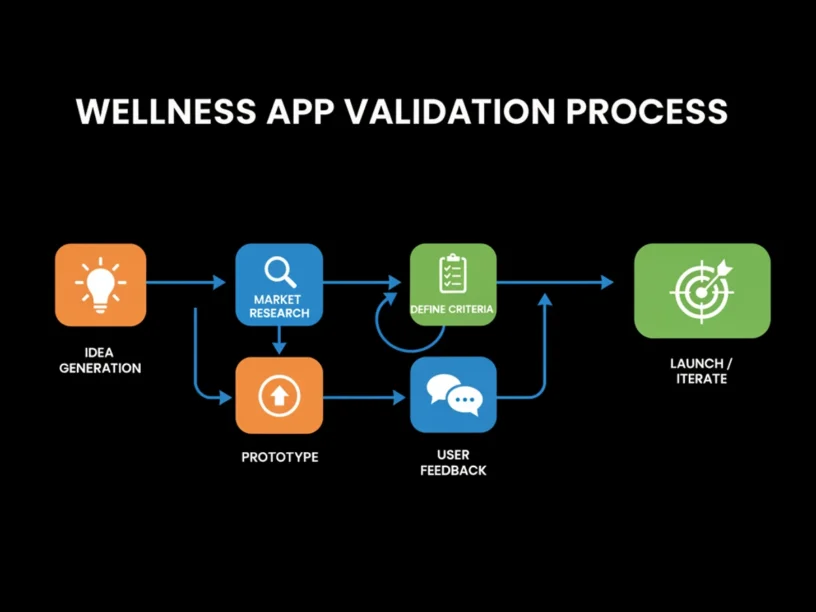
The Process at a Glance
| Step | Action | Time | Outcome |
|---|---|---|---|
| 1 | Interview 15-30 target users about the problem | 1-2 weeks | Confirms whether the problem is real |
| 2 | Research the wellness market and competitors | 3-5 days | Reveals gaps and your unique angle |
| 3 | Build a clickable or no-code prototype | 3-7 days | Visual proof to react to and refine |
| 4 | Run a landing page or waitlist demand test | 1-2 weeks | Real signups signal genuine demand |
| 5 | Get an expert validation review before building | 1-2 weeks | Confident go/no-go decision |
Total time: approximately 4-7 weeks, part-time.
Step 1: Talk to Real Users Before Writing Code
What You’re Doing
You’re testing whether the problem actually matters enough that people will change behavior, spend money, or seek a solution today.
How to Do It
- Identify 15-30 people who fit your target user profile, e.g., busy professionals with disrupted sleep, or new parents managing postnatal fitness.
- Book 15-20 minute conversations via phone or video.
- Ask open questions about how they currently handle the problem, what they’ve tried, and what frustrates them-not pitching your app.
- Note recurring language, workarounds, and emotional intensity.
- Only after confirming the problem, briefly describe your concept and gauge genuine reaction.
Best Practices
- Successful founders talk to fifty potential users before writing code, validating the problem first.
- AI-assisted interview tools can deliver 30-50 structured conversations in days.
- Record interviews, with permission, so you can revisit exact wording for app copy.
Common Mistakes
Asking “would you use this app?” produces false-positive enthusiasm. Ask “how do you currently deal with this problem?” instead. Interviewing only friends and family skews results toward “yes” even when the market would say no.
What Done Looks Like
You describe the target user’s problem in their own words, and 60-70% of interviewees describe real frustration or a workaround they’ve tried. For a more detailed walkthrough, see Write Like You Talk.
Step 2: Research the Wellness App Market and Your Competitors
What You’re Doing
You map the competitive landscape to find if the problem is already solved well, poorly, or not at all. This sharpens your unique value proposition before development.
How to Do It
- List 8-10 direct and adjacent competitors depending on your niche.
- Download and use each for at least 20 minutes; note onboarding flow, pricing, and app store reviews.
- Search app store reviews for complaints and unmet needs-users tell you exactly what’s missing.
- Identify a segment or feature gap. Exercise and weight loss apps remain the largest revenue segment, while meditation is the fastest-growing.
Example
| Competitor Type | What They Do Well | Common Complaint | Your Opportunity |
|---|---|---|---|
| Generic meditation app | Large content library | Feels impersonal, generic scripts | Personalised, culturally specific programs |
| Fitness tracker | Detailed data and wearable sync | Overwhelming for beginners | Simplified onboarding for a niche group |
| Women’s health tracker | Cycle and symptom logging | Lacks community or coaching | Peer support layered onto tracking |
What Done Looks Like
You articulate your unique value proposition in one sentence that a competitor cannot claim.
Step 3: Build a No-Code Prototype to Test Real Reactions
What You’re Doing
A prototype makes feedback concrete instead of hypothetical. You give people something tangible to hold, tap, and react to.
How to Do It
- Sketch your core user flow: 3-5 screens covering only the single most important feature.
- Build a clickable mockup in Figma, or a functioning no-code version in Bubble.
- Show the prototype to 8-10 interviewees and watch where they hesitate, tap incorrectly, or ask questions.
- Iterate based on friction points, not preferences.
Best Practices
Keep the prototype narrow. A validation prototype needs only the core feature solving the primary pain point. A simple landing page or validation MVP can be live in one to three days.
What Done Looks Like
Testers complete the core task without explanation, and feedback focuses on the value of the feature, not confusion about how to use it.
Step 4: Run a Landing Page or Waitlist Test to Measure Real Demand
What You’re Doing
You move beyond opinions to behavior. Signups, email addresses, and pre-orders are the strongest evidence that people want your app before you spend money on development.
How to Do It
- Build a one-page site describing the app’s core promise using Carrd or Webflow.
- Add a clear call to action: join the waitlist, reserve early access, or pre-order a founding-member discount.
- Drive 200-500 targeted visitors through relevant Facebook or Instagram groups, wellness communities, or small paid ads.
- Track conversion rate; a healthy benchmark is 10-20% for well-targeted niche audiences.
Common Mistakes
Broad, untargeted traffic dilutes conversion signals. Skipping a follow-up email to your waitlist wastes the chance to ask deeper questions and gauge willingness to pay.
What Done Looks Like
You’ve confirmed the problem through interviews, measured demand with a landing page, tested a prototype with real users, and set a firm decision deadline of 2-3 weeks.
Step 5: Get an Expert Validation Review Before Committing to Development
What You’re Doing
You pressure-test your findings with people who have seen hundreds of app ideas succeed or fail. This stops you from mistaking a small enthusiastic sample for genuine market fit.
How to Do It
- Compile interview notes, competitor research, prototype feedback, and landing page data into a one-page summary.
- Book a structured review with a product strategist or validation-focused development partner.
- Ask them to stress-test your assumptions on scope, technical feasibility, and monetization.
A program like Appomate’s Spark program fits naturally into the process. Appomate validates your idea and designs your prototype within the first few weeks, using an approach they describe as “See It Before You Build It”. This ensures you leave the review with a scoped, de-risked plan. Appomate’s philosophy is to help founders get further faster, turning validated ideas into scalable businesses from validation to launch, growth and exit, as one partner for the whole journey. This expert review provides an objective assessment before significant investment.
What Done Looks Like
You walk away with a clear, evidence-backed recommendation: build, refine the concept, or shelve it, plus a realistic scope and cost estimate.
Ready to build your app?
Book a free Visioning Call with our team today and walk away with a clear roadmap, expert feedback, and a plan to bring your idea to life. No technical knowledge required.
What to Do After Validating Your Wellness App Idea
Phase 1: Scope your MVP (weeks 1-2). Take only the validated core feature and define the smallest version that delivers confirmed value.
Phase 2: Choose your build path (weeks 2-4). Decide between a lean no-code build to keep testing, or professional development with a partner such as Appomate, whose AI-driven development approach has helped founders go from idea to market in as little as 6 weeks.
Phase 3: Plan for iteration and growth (ongoing). Set up analytics, a feedback loop with early users, and a marketing plan before launch.
Resources You’ll Need
| Resource | Role | Requirement Level | Price |
|---|---|---|---|
| Appomate Spark | Idea validation, prototyping, and expert review | Recommended | Custom quote |
| Figma | Clickable prototype design | Recommended | Free tier available |
| Bubble | No-code functional MVP builder | Optional | Free tier, paid plans from ~$29/month |
| Carrd | Landing page and waitlist test | Optional | Free, paid plans from $19/year |
| Typeform | Structured interview surveys | Optional | Free tier available |
See also, see How to Validate App Idea: The 2026 Startup Strategy Guide.
Common Plateaus and How to Break Through
Problem: Everyone says they “love the idea,” but nobody signs up
Likely cause: Polite feedback rather than genuine intent, often from friends or unrepresentative samples.
Fix: Switch from opinions to commitments. A waitlist signup, small deposit, or scheduled follow-up call count as valid signals.
Problem: The prototype tests well, but reviewers say it looks like every other wellness app
Likely cause: Step 2 was rushed, so the concept has feature parity instead of a genuine wedge.
Fix: Go back to interview notes for a specific, underserved pain point and rebuild around that gap.
Problem: My landing page gets traffic but almost no signups
Likely cause: The headline describes a feature rather than the outcome users care about.
Fix: Rewrite the headline using exact language from interviewees describing their frustration, then A/B test.
Problem: I can’t get anyone to respond to interview requests
Likely cause: Outreach is too broad or sent to cold audiences.
Fix: Post in niche Facebook groups, subreddits, or communities where your target user already discusses the problem. For more troubleshooting advice, see How to Validate Your Mobile App Idea Before Spending. For related guidance, see How To Validate An AI Mobile App Idea Before Spending Money On Development.
Conclusion
Validating a wellness app idea comes down to gathering evidence from real behavior before you write a brief. Interviews, competitor research, a lightweight prototype, and a genuine demand test give you confidence that no pitch deck can.
Key Takeaways
- A validated idea is backed by interview evidence, competitor gaps, a tested prototype, and real signup data-not assumptions.
- Validation is fast and affordable: 4-7 weeks and a few hundred dollars can save months and tens of thousands in wasted development.
- Your next action is to book 15-30 target user interviews this week.
FAQ
How to validate a Wellness App Idea Before Spending Money 2026?
Interview 15-30 target users to confirm the problem is real, research competitors to find your unique angle, build a low-cost prototype to test reactions, and run a landing page or waitlist test to measure genuine demand through signups. Conclude with an expert review before committing budget to full development. This typically takes 4-7 weeks and dramatically reduces the risk of building something nobody wants.
How much does it cost to validate an app idea in Australia?
A lean validation process, including interview tools, a no-code prototype, and a landing page test, typically costs a few hundred dollars in software and ad spend, well below the cost of even a basic development sprint.
How many users should I interview before building a wellness app?
Aim for 15-30 structured problem interviews at minimum; experienced founders talk to fifty potential users before writing code.
Can I validate a wellness app idea without any technical skills?
Yes. Interviews, competitor research, and landing page tests require no coding. No-code tools like Figma, Bubble, and Carrd let non-technical founders build prototypes and demand tests without hiring a developer.
What’s the difference between validation and building an MVP?
Validation confirms whether the problem and solution are worth pursuing using interviews, prototypes, and demand tests. An MVP is the first usable version built only after validation confirms market need.
How long does wellness app validation typically take?
Most founders complete a full validation cycle, including interviews, market research, prototyping, and a demand test, in 4-7 weeks of part-time effort.
What wellness app niches are worth targeting in 2026?
Exercise and weight loss apps remain the largest revenue segment, while meditation is the fastest-growing, suggesting both established and emerging niches carry opportunity if your validation reveals an underserved angle.
When should I bring in a development partner like Appomate?
Bring in a development partner once your interviews, prototype feedback, and landing page data show genuine demand signals, typically after Step 4, so the partner can validate your findings and scope the build accurately.
Methodology: This guide synthesizes publicly available market research on the Australian and global wellness app industry, startup failure data, and current no-code and validation tooling as of September 2026. Always confirm current pricing and market data directly with linked sources before making investment decisions.