marketplace app development for non-technical founders – what you need to know | September 21, 2026 | 11 min read | Appomate Team
Marketplace App Development for Non-Technical Founders: What You Need to Know
Building a marketplace app without technical expertise requires five core decisions: who owns the code, how to evaluate a development partner, what a solid product brief looks like, how to manage the build, and realistic costs in Australia. AI-assisted development now compresses timelines and lowers entry costs, but protecting your IP and choosing the right partner remain non-negotiable. This guide walks Australian founders through what to know before signing any development contract.
The biggest risk for a non-technical founder isn’t a bad idea, it’s signing a development contract you don’t fully understand and discovering too late that you don’t legally own what you paid for.
What Does Marketplace App Development for Non-Technical Founders Actually Involve in 2026?
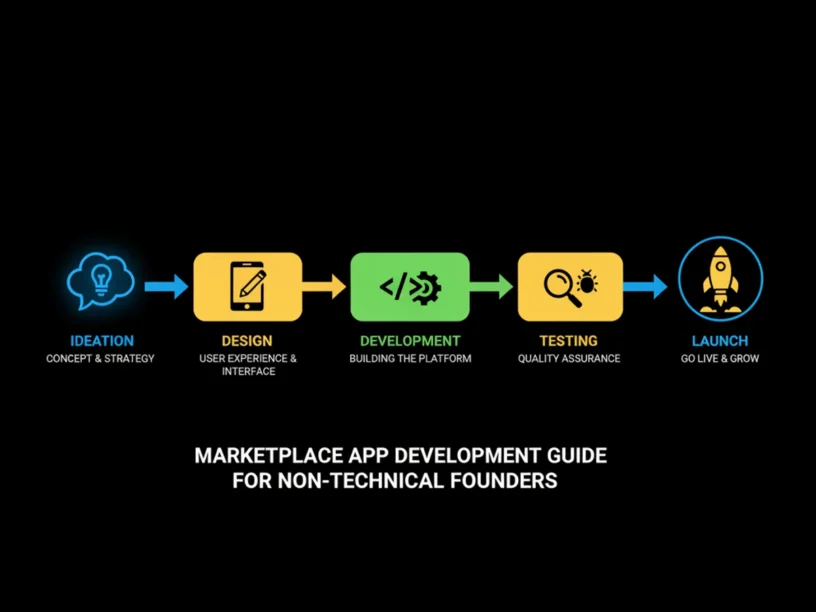
Marketplace app development means building a two-sided (or multi-sided) platform connecting buyers and sellers, renters and owners, or clients and service providers. A development partner translates your vision into a technical roadmap. The process typically includes discovery, UI/UX design, backend and frontend development, payment integration, and post-launch support. Core mechanics include two distinct user types, a discovery layer for finding listings, a transaction engine, and a trust layer with reviews, messaging, and verification.
Typical Marketplace App Cost and Timeline in Australia
Australian development costs vary significantly based on features and platforms needed. A realistic marketplace MVP typically starts around AUD 15,000 to 50,000.
| Build Type | Typical Cost (AUD) | Timeframe | What’s Usually Included |
|---|---|---|---|
| Validation prototype | $5,000 to $20,000 | 2 to 4 weeks | Clickable prototype, core screens, no live payments |
| MVP marketplace | $25,000 to $60,000 | 6 to 12 weeks | Buyer/seller profiles, listings, basic payments, messaging |
| Mid-complexity marketplace | $80,000 to $150,000 | 3 to 5 months | Split payments, ratings, admin dashboard, search/filter |
| Full-featured marketplace | $200,000 to $400,000+ | 6+ months | Advanced logistics, multi-currency, compliance tooling |
These ranges align with Australian development agency reports for 2026, where mid-complexity apps land between $80,000 and $200,000. Hourly rates sit between roughly $150 and $330. Marketplace builds cost more because they require buyer and seller profiles, secure payments with split commissions, messaging, and admin tools from day one.
Key Takeaway: Budget $25,000 to $60,000 for an MVP and treat quotes under $15,000 for a full two-sided marketplace with scepticism. For deeper context, see How to make a marketplace app (step-by-step guide).
Who Owns Your App? IP Ownership Every Non-Technical Founder Must Understand
IP ownership is the single most misunderstood issue in marketplace app development and must be locked down in writing before development starts. Under Australian copyright law, the developer owns the software they create unless a written agreement explicitly states otherwise. Paying an invoice does not automatically transfer ownership.
The Legal Reality of Software Ownership
Australian copyright legislation treats software as a literary work. A development contract must explicitly state who will own the copyright in newly developed code.
- Employee vs. Contractor Status: Employees’ code is owned by the company by default; contractor ownership must be explicitly assigned in writing.
- Pre-existing Code and Libraries: Separate “background IP” (existing tools and frameworks) from new IP created for your marketplace.
- Open Source Dependencies: Some open source licences (like GPL) can force you to release your entire codebase publicly if used carelessly.
- Practical Control: Owning IP on paper means little if your developer retains sole access to your code repository, domain, or hosting account.
- Confidentiality Clauses: Confidentiality provisions protect your competitive position even after IP ownership is transferred.
Insist on a written agreement assigning all newly created IP to your company, naming who holds repository and hosting access, and specifying what happens to pre-existing components.
Key Takeaway: Get IP assignment in writing before development starts, confirm you hold actual account access, and never assume payment equals ownership. For deeper context, see App Development for Non-Technical Founders in Australia.
How Do You Evaluate a Marketplace App Development Partner Without a Technical Background?
Evaluating a partner without coding knowledge means asking the right questions and watching how they respond, not judging technical jargon. A trustworthy partner explains trade-offs in plain English, shows real work, and is transparent about ongoing costs rather than just upfront pricing.
Green Flags vs. Red Flags in Partner Evaluation
| Evaluation Area | Red Flag | Green Flag | Question to Ask |
|---|---|---|---|
| Portfolio | Vague case studies, no live app links | Named clients, live App Store links, verticals shown | “Can I see live apps you have built?” |
| Pricing | One flat number, no breakdown | Itemised strategy, design, build, launch, support | “What’s excluded from this quote?” |
| Ownership | Vague “we handle everything” language | Written IP assignment clause upfront | “Who owns the code and who holds the accounts?” |
| Process | No structured validation step | Discovery, prototype, and user testing before full build | “How do we validate demand before scaling spend?” |
| Post-launch | Silence on support after launch | Warranty period, maintenance retainer, clear response times | “What happens after launch, and what does it cost?” |
“Most people assume the number of features is the biggest cost driver. It is not.” That’s Studio Slate’s assessment of what actually moves an Australian app development budget.
- Full-service vs. Build-only: Full-service agencies validate ideas, design products, build, launch, and support long-term; build-only agencies just code what you ask for.
- Local Strategy, Global Delivery: A hybrid model combining Australia-based strategy with experienced offshore development can deliver premium quality at startup-friendly pricing.
- Speed Without Shortcuts: AI-driven development tools compress timelines; Appomate has taken founders from idea to market in 6 weeks using this approach.
- Marketplace Experience: A partner with prior marketplace builds understands two-sided liquidity, trust mechanics, and commission-based payment flows.
Key Takeaway: Judge a partner on transparency, not jargon. Ask about ownership, post-launch costs, and validation process before discussing tech stack. For deeper context, see How to Change a Background in Affinity Photo. For related guidance, see Vibe Coding What Non Technical Founders Need To Know Before Trusting AI To Build Their App.
What Does a Good Marketplace App Brief Look Like for a Non-Technical Founder?
A good brief is not a technical specification. It’s a clear description of your users, their problem, and how your marketplace solves it in plain business language. You don’t need to know Flutter from React Native to write one; you need clarity on who your user groups are and what value exchange happens between them. A strong brief saves weeks of costly back-and-forth and prevents building the wrong thing.
The Five Essential Elements Every Brief Needs
- User Definitions: Describe both sides precisely, for example, “independent skincare therapists” and “clients booking mobile beauty services,” not just “buyers and sellers.”
- Core Transaction Flow: Explain step-by-step what happens from discovery to booking to payment to completion.
- Trust and Safety Needs: Note whether you need identity verification, reviews, dispute resolution, or insurance-style protections.
- Monetisation Model: Specify whether revenue comes from commission, subscription, listing fees, or hybrid, as this shapes the entire payment architecture.
- Must-have vs. Nice-to-have Features: Separate what’s needed for launch from what can wait for version two.
Founders sometimes assume a brief needs wireframes or technical diagrams. In reality, an experienced agency will run structured discovery to turn a plain-language idea into a technical roadmap.
Key Takeaway: Write your brief around users and transactions, not technology. A skilled partner will translate business logic into technical requirements. For deeper context, see Non-Technical Founder Guide – a Startup Without Coding. For related guidance, see Top AI Trends For Startup Founders In 2025 What Every Non Technical Founder Must Know.
How Do You Manage a Marketplace App Build When You Can’t Code?
Managing a build without coding skills is achievable by focusing on outcomes, milestones, and communication cadence rather than reviewing code. Non-technical founders who succeed treat the relationship like managing any specialist contractor by asking clear questions and demanding visibility at every stage.
Staying in Control Without Writing Code
- Weekly Check-ins: Require short updates showing what was built, tested, and what’s next, preventing surprises.
- Milestone-based Payments: Tie payment releases to demonstrable progress rather than paying upfront.
- Real Device Testing: Test the app on your own phone regularly, not just screen-share demos, to catch usability issues early.
- Documented Decisions: Keep a shared log of every scope decision and change request in writing.
- Account Ownership: Ensure your business owns the Apple Developer account, Google Play Console, domain, and hosting from day one.
A full-service partner with Australia-based product management gives non-technical founders a single point of accountability throughout the build, from validation through launch and growth.
Key Takeaway: You don’t need to understand code to manage well; you need milestone accountability, account ownership, and plain-English communication at every step.
Conclusion
Marketplace app development for non-technical founders in 2026 is more accessible than ever, but accessibility doesn’t remove the need for diligence around IP, partner selection, briefing, and build management. Founders who get these five fundamentals right dramatically reduce their risk.
- Budget Realistically: Expect an Australian MVP marketplace to cost $25,000 to $60,000, with full-featured builds reaching $200,000 or more.
- Lock Down IP in Writing: Get a signed IP assignment clause before development begins.
- Vet Partners on Transparency: Judge agencies by how clearly they explain ownership, pricing, and post-launch support.
- Brief Around Users, Not Tech: A clear description of your user groups and transaction flow beats a technical spec you can’t write.
- Manage with Milestones: Weekly updates, milestone payments, and account ownership let you stay in control without coding knowledge.
If you’re ready to move from idea to a validated marketplace product, Appomate combines Australia-based strategy and product design with a proven global development team, helping non-technical founders get further, faster, from validation through launch and growth.
FAQ
What is marketplace app development for non-technical founders in 2026?
Marketplace app development for non-technical founders is building a two-sided marketplace connecting buyers and sellers or clients and providers through a development partner who handles all technical work. The founder focuses on business strategy, user validation, and IP protection. AI-assisted development has shortened typical timelines, but founders must understand ownership, partner evaluation, and briefing to avoid costly mistakes.
How much does it cost to build a marketplace app in Australia?
A lean MVP marketplace typically costs between $25,000 and $60,000 in Australia. Mid-complexity builds often land between $80,000 and $200,000. Full-featured marketplaces can exceed $300,000.
Do I automatically own the code if I pay a developer to build my app?
No. Under Australian copyright law, the developer owns the software by default unless a written agreement explicitly assigns IP to you. Always insist on a signed IP assignment clause before development starts.
How do I choose a marketplace app development partner if I’m not technical?
Focus on transparency: ask to see live apps, request itemised quotes, confirm who owns code and hosting accounts, and check for post-launch support. A partner who explains trade-offs in plain English and has marketplace experience signals reliability.
What should a marketplace app brief include if I don’t know how to code?
Describe your two user groups, the step-by-step transaction flow, trust and safety requirements, monetisation model, and must-have versus later features. You don’t need wireframes or technical specifications; a clear business description is sufficient for an experienced partner.
How long does it take to build a marketplace app in Australia?
A validation prototype takes 2 to 4 weeks, an MVP marketplace takes 6 to 12 weeks, and a mid-complexity build takes 3 to 5 months. Appomate has helped founders reach market in as little as 6 weeks using AI-driven development.
Can I manage a marketplace app build without any coding skills?
Yes, by focusing on milestone-based payments, weekly updates, real device testing, and ensuring your business retains account ownership. Effective oversight requires accountability and clear communication, not technical fluency.
What are the biggest risks for non-technical founders building a marketplace app?
Common risks include losing IP ownership through poorly written contracts, choosing build-only agencies without demand validation, underestimating ongoing costs (typically 15 to 20 percent of build cost annually), and losing control of critical accounts to the development team.
This article is based on publicly available Australian app development pricing data, intellectual property guidance from Australian legal resources, and industry research current as of September 2026. Costs and timelines are indicative ranges and will vary based on project scope; founders should seek tailored legal and technical advice before signing any development agreement.