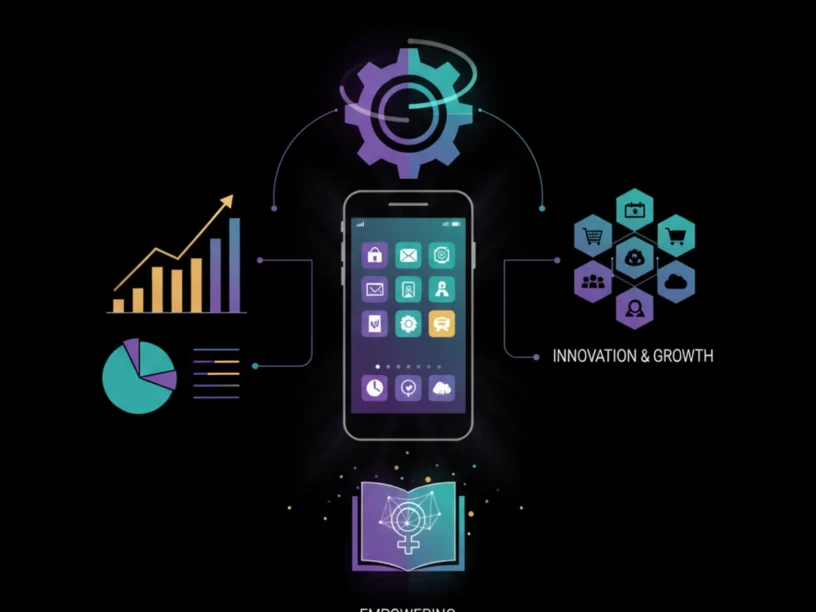
marketplace app development for women entrepreneurs and female founders in Australia | Updated September 2026 | Appomate Team
Marketplace app development for women entrepreneurs and female founders in Australia refers to building a two-sided digital platform (connecting buyers and sellers, service providers and clients, or product makers and shoppers) with a development partner who understands the funding gaps, time constraints, and validation hurdles unique to female-led ventures. In 2026, this process is less about coding a booking screen and more about choosing a partner who can move an idea from concept to a launched, revenue-generating product without draining scarce early-stage capital.
Female-only founding teams in Australia raised less than 0.5% of total venture capital in Q2 2025, a record low. Most women building a marketplace app in Australia are doing it with **tighter budgets, more scrutiny, and less room for costly missteps**, which makes the choice of development partner and delivery model critical.
The gap in venture funding for women is not a talent gap; it is a capital access gap. A development partner who understands that can build in the efficiency, staged validation, and lean pricing that female-led marketplaces need to reach revenue before they need a Series A.
What Does Marketplace App Development for Women Entrepreneurs in Australia Actually Involve?
Marketplace app development for women entrepreneurs and female founders in Australia involves designing, building, and launching a two-sided platform (buyers and sellers, clients and providers) that runs on mobile and web, typically including profiles, search and discovery, secure payments, messaging, and admin tools. For female founders, the process usually needs to be structured around **leaner budgets and staged validation**, with a delivery partner willing to act as a long-term growth partner.
The Core Building Blocks
Every marketplace app needs the same functional backbone. What changes for women-led startups is how those pieces get prioritised against limited runway.
- Two-sided user architecture: Separate buyer and seller (or client and provider) experiences, each with its own onboarding, profile, and dashboard.
- Secure payments and split commissions: Integrated payment processing that can handle provider payouts, platform fees, and refunds, a feature that Australian developers note is where marketplace backends become the most expensive part of the build.
- Search, filtering, and discovery: Category browsing, location-based search, and rating systems so users can find the right match quickly.
- Trust and verification tools: Reviews, ID checks, and provider verification to build confidence between strangers transacting through the platform.
- Admin and analytics dashboard: A back-office view for founders to manage disputes, monitor transactions, and track growth metrics.
Why the Founder Journey Looks Different
Australian women are starting businesses at a faster rate than men. Women founders grew 95% between 2016 and 2021, compared to a 45% increase for men, according to Deloitte data cited by the OECD. Yet women-led enterprises secured only 0.7% of start-up funding despite generating strong revenue per dollar invested. This mismatch is why **marketplace app development for women entrepreneurs** often hinges on finding a technology partner willing to work in phases, validate before building the full feature set, and keep early costs proportional to bootstrapped or grant-funded budgets.
Key Takeaway: A marketplace app for a female-founded business needs the same technical foundations as any other marketplace, but the delivery approach-staged, validated, and budget-conscious-matters far more given how little venture capital currently reaches women-only teams. For deeper context, see Boosting Female Founders Initiative Round 2.
How Much Does Marketplace App Development Cost in Australia?
Marketplace app development costs in Australia typically range from **AUD 100,000 to over 250,000** for a fully-featured platform, though a lean MVP can start lower depending on scope. For female founders operating on grant funding, angel capital, or personal savings, understanding this range upfront is critical.
Typical Cost Bands in 2026
| App Tier | Estimated AUD Cost | Typical Inclusions | Best Suited For |
|---|---|---|---|
| Lean validated MVP | $40,000 – $80,000 | Core booking/listing flow, basic payments, single platform | Testing demand before a full build |
| Mid-complexity marketplace | $80,000 – $150,000 | Two user roles, admin panel, integrations, notifications | Grant-funded or pre-seed founders |
| Full-featured marketplace | $120,000 – $250,000+ | Split payments, verification, messaging, analytics | Founders scaling post-validation |
| Enterprise-grade platform | $250,000 – $400,000+ | Real-time GPS, complex compliance, multi-market rollout | Series A+ or corporate-backed ventures |
These figures align with industry pricing guides showing marketplace apps typically cost between $100,000 and $220,000 or more, and with estimates that mid-complexity apps generally land between $80,000 and $200,000 in 2026. Budget an additional **15-20% annually for maintenance, hosting, and infrastructure** once live.
Where the Budget Goes
- Backend and payments infrastructure: Often the largest line item due to databases, real-time syncing, and payment logic.
- Design and user experience: Two distinct interfaces (buyer-facing and seller-facing) each need wireframes, flows, and testing.
- Third-party integrations: Payment gateways, mapping, and notification services carry ongoing subscription costs.
- Post-launch support: Bug fixes, app store compliance updates, and feature iteration based on user data.
Key Takeaway: Female founders should treat the AUD 100,000+ marketplace price tag as a range to negotiate down through phased delivery, prioritising partners who scope an MVP before committing to the full build. For deeper context, see Female Founders.
What Funding and Support Pathways Exist for Women-Led Marketplaces in Australia?
Australia has a growing set of **funding pathways specifically for women-led startups**, ranging from government grants to dedicated venture capital funds. Most female founders will need to combine several sources rather than rely on one large raise.
Government and Grant Pathways
The federal Boosting Female Founders Initiative has offered grants between $100,000 and $400,000, or up to $480,000 for priority groups, to majority women-owned and led startups scaling into domestic and global markets. State-level programs such as Queensland’s Backing Female Founders program continue to run alongside private alternatives.
Dedicated VC Funds and Angel Networks
- Scale Investors: Australia’s first women-led VC fund backing women-led startups, with a network built around community, education, and capital access.
- ALIAVIA Ventures: A fund investing in early-stage female-founded tech companies, having supported 175 women founders who have collectively raised over $120 million in funding.
- Artesian’s Female Leaders VC Fund: A AUD 100 million fund that invests in high-growth start-ups led by women who are often overlooked by other VCs.
- LaunchVic’s Alice Anderson Fund: A sidecar fund that tops up funding rounds for women-led Victorian startups already backed by other investors.
Only 18 per cent of surveyed female founders felt supported by their investors, and just 27 per cent felt supported by the wider ecosystem, according to the 2025 State of Startup Funding report.
This sentiment gap is why **the technology partner a founder chooses matters as much as the investor she pitches**. A development team that helps validate the idea, controls burn rate, and supports fundraising milestones effectively becomes part of the founder’s support ecosystem.
Key Takeaway: Female founders should stack funding sources-grants, angel networks, and dedicated VC funds-rather than waiting on a single large raise, and should choose a development partner who understands how to build within that staged, capital-conscious reality. For deeper context, see Female entrepreneurs battle to receive funding as a report ….
How Should Female Founders Choose a Marketplace App Development Partner?
Choosing a marketplace app development partner comes down to three things: whether the team validates before building, whether their pricing model fits early-stage capital constraints, and whether they act as a long-term partner rather than a one-time vendor. **Getting this choice right is often more decisive** for a female-led marketplace’s survival than the funding round itself.
What to Look For
- Validation-first process: A partner who tests demand and scopes a lean MVP before committing to a six-figure full build, reducing wasted spend on unproven assumptions.
- Founder-focused, not just technical: Teams that support non-technical founders through strategy, design, and go-to-market.
- Transparent, staged pricing: Clear cost breakdowns tied to milestones rather than one large upfront quote.
- Local strategy with global delivery: Australia-based product thinking paired with efficient global development resourcing tends to deliver better value.
- Post-launch commitment: Ongoing support for marketing, iteration, and scaling rather than a build-and-exit arrangement.
Appomate’s Approach for Female-Led Marketplaces
Appomate is a Melbourne-based mobile and web app development company that has worked directly with female founders building marketplace platforms, including Urban Glow, a marketplace app connecting users with wellness and beauty professionals for bookable treatments. One founder noted: “Our experience with them has been fantastic. The final product is better than we envisioned.”
Appomate’s approach focuses on being a full growth partner:
- Concept Validation: Validating the idea before committing to development.
- Product Design: Designing the product with user experience and market fit in mind.
- Build and Launch: Efficiently building and launching the application.
- Marketing and Support: Providing ongoing marketing and long-term support.
- Hybrid Delivery Model: Pairing Australia-based strategy and product design with a skilled global development team for high quality and accessible pricing.
- AI-Driven Development: Utilizing AI-assisted tools to compress build timelines, helping some founders go from idea to market in as little as six weeks.
| Founder Need | Traditional Agency Approach | Appomate’s Approach |
|---|---|---|
| Idea validation | Skipped; goes straight to build | Built into the process before development starts |
| Non-technical founder support | Assumes technical fluency | Guides founders through strategy, design, and delivery |
| Pricing structure | Large fixed quote, scope creep risk | Staged, milestone-based, startup-friendly pricing |
| Post-launch relationship | Ends at handover | Ongoing support through growth and marketing |
Key Takeaway: The right marketplace app development partner validates before it builds, prices in stages, and stays involved after launch, exactly the model Appomate applies with its Further Faster Framework. For related guidance, see Appomate Vs Appetiser Which Appomate Vs Appetiser Which App Development Company Is Better For Startups Platform Fits Your Team In 2026.
What Trends Will Shape Marketplace Apps for Women-Led Businesses in 2026?
Marketplace apps for women-led businesses in 2026 are being shaped by **AI-native product design, growing regional participation**, and a shift toward services-based marketplaces in wellness, beauty, and professional categories.
Where the Momentum Is Building
- AI-native functionality: Founders are increasingly expected to build products that are AI native rather than simple AI wrappers, using AI for personalised matching, smart search, and automated admin.
- Regional expansion: Growth in women-led business registration is strong not just in Sydney or Melbourne but also across regional Queensland, Victoria, and Western Australia, widening the addressable market for location-based marketplace apps.
- Services-first marketplaces: Wellness, beauty, coaching, and professional service marketplaces continue to be a natural fit for female founders.
- Faster time to market: AI-assisted development tools are compressing build timelines, meaning founders no longer need 6-12 months to get a validated product live.
- Investor appetite shifting toward proof: With all-female founding teams capturing just 2% of total capital in 2025, founders who can show early revenue and retention data from a live app stand out more than those with a deck alone.
What This Means for Product Scope
Founders scoping a marketplace app in 2026 should **plan for AI-assisted matching and search from day one** rather than retrofitting it later. Retrofitting AI into a rigid data architecture is far more expensive than designing for it upfront.
Key Takeaway: Female founders who build AI-native, services-oriented marketplace apps and can demonstrate real usage data will be better positioned to compete for the limited capital flowing to women-only teams in 2026. For the latest trends, see Eight Trends for 2026: Pricing, Passion, and the Risks Ahead. For related guidance, see Australia App Market 2025 Growth Statistics Trends And Opportunities For App Founders.
Conclusion
Marketplace app development for women entrepreneurs and female founders in Australia in 2026 comes down to choosing a partner who validates before building, prices in achievable stages, and stays involved well past launch day. The technical requirements of a marketplace app do not change based on the founder’s gender, but the funding reality-staged capital, limited VC access, and heavier reliance on grants and angel networks-means the delivery model has to work harder to reduce risk.
- Cost clarity matters: Budget AUD 100,000 to 250,000+ for a full marketplace build, but start with a lean, validated MVP to prove demand first.
- Funding must be stacked: Combine grants, angel networks like Scale Investors, and dedicated VC funds like ALIAVIA Ventures rather than relying on one raise.
- Partner selection is strategic: Choose a team that supports non-technical founders through the full journey, not just the build phase.
- AI-native design pays off: Build matching, search, and admin tools with AI in mind from the start rather than retrofitting later.
- Real case studies exist: Female-founded platforms like Urban Glow show that a validated, well-designed marketplace app can launch successfully within realistic budgets.
Founders ready to scope their marketplace concept can start by requesting a validation conversation with Appomate, whose Melbourne-based team has helped founders go from idea to market in as little as six weeks.
FAQ
What is marketplace app development for women entrepreneurs in Australia in 2026?
Marketplace app development for women entrepreneurs and female founders in Australia in 2026 refers to designing, building, and launching a two-sided digital platform tailored to the funding realities and validation needs specific to women-led startups. This typically means staged, budget-conscious development delivered by a partner who understands grant cycles, limited VC access for women-only teams, and the value of validating an idea before committing to a full build.
How much does it cost to build a marketplace app in Australia?
Most Australian marketplace apps cost between $100,000 and $220,000 or more, with lean MVPs starting lower and enterprise-grade platforms exceeding $250,000. Costs are driven primarily by backend complexity, payment processing, and the number of distinct user roles the platform needs to support.
What grants are available for female founders building a marketplace app?
The federal Boosting Female Founders Initiative has offered co-contribution grants of up to $480,000 for majority women-owned startups scaling into new markets, while state programs such as Queensland’s Backing Female Founders program and private funds like Scale Investors and ALIAVIA Ventures provide additional pathways.
Why is venture capital funding so limited for female founders in Australia?
Structural bias in investor decision-making, smaller median deal sizes, and a leaky pipeline where women drop off sharply at Series A all contribute to the gap. In 2025, women-only founding teams secured less than 0.5% of all capital raised in Australia, a record low despite improved numbers for mixed-gender teams.
What is an example of a successful female-founded marketplace app in Australia?
Urban Glow is a marketplace app built with Appomate that connects users with wellness and beauty professionals, allowing them to browse and book treatments seamlessly with secure in-app payments. It illustrates how a services-based marketplace concept can move from idea to a polished, functioning app with the right development partner.
How long does it take to build and launch a marketplace app?
A validated MVP can launch in a matter of weeks when built with AI-assisted development tools, while a full-featured marketplace with split payments and verification typically takes several months. Appomate’s AI-driven development approach has helped some founders move from idea to market in as little as six weeks.
Should a non-technical founder build an MVP or a full-featured marketplace first?
Starting with a validated MVP is the safer path, since it tests core demand assumptions before committing six-figure budgets to features that may not be needed. This approach is particularly important for women-led startups given how constrained early-stage capital remains.
What should female founders look for in an app development partner?
Look for a partner that validates the idea before building, offers staged and transparent pricing, supports non-technical founders through strategy and design, and remains engaged after launch to support marketing and growth. Appomate positions itself as a full growth partner rather than a build-only vendor, covering the journey from validation to launch, growth, and exit.
This article was researched using publicly available Australian government sources, industry funding reports, and published app development pricing guides current as of September 2026. Figures such as grant amounts, funding percentages, and cost estimates are subject to change; founders should verify current details directly with the relevant program or development partner before making financial decisions.