Should I Build an AI Mobile App for My Business in 2026? How to Know If Your App Really Needs AI
should I build an AI mobile app for my business and how to know if my app really needs AI | 9 min read | Appomate Editorial Team
The honest answer to whether you should build an AI mobile app for your business in 2026 is this: add AI only when it solves a specific, measurable problem for your users or operations, not because competitors are doing it. The real test is whether AI reduces manual work, personalises the experience, or unlocks something that isn’t possible without it. For most Australian founders, the smarter starting point is a lean, validated app that solves one real problem well, with AI added later once there is clear evidence it adds value.
Australia is in the middle of what economists call a “two-speed” AI economy. Deloitte’s research estimates AI could contribute $44 billion annually to the Australian economy, yet only around 5% of small and medium businesses using AI are considered “fully enabled” to realise its benefits. That gap between hype and real value is why a decision framework matters more than chasing trends before you commit development budget.
The founders who win with AI mobile apps in 2026 are not the ones who add the most AI features. They are the ones who can point to a single workflow where AI removes real friction for a real user, and prove it before they scale it.
Should I Build an AI Mobile App for My Business? How to Know If Your App Really Needs AI
You should build an AI mobile app only when AI directly improves a core user outcome, such as speed, accuracy, or personalisation, in a way a simpler solution cannot match. Many founders ask should I build an AI mobile app for my business and how to know if my app really needs AI before validating the underlying problem, which is the wrong order. AI should respond to a validated need, not sit on the feature list to make the app sound innovative.
Signs You Genuinely Need AI
- Repetitive manual decisions: Your team or users keep sorting, categorising, matching, or scoring information by hand, a classic pattern AI automation handles well.
- Large, messy data sets: You hold customer, transaction, or operational data that no person could realistically analyse at scale.
- Personalisation at volume: You need to tailor recommendations, pricing, or content to thousands of users simultaneously.
- Natural language or image understanding: Your product must interpret text, speech, or images well beyond simple keyword rules.
Signs You Probably Don’t (Yet)
- Low transaction volume: If you handle a handful of decisions a day, a person or simple rules engine will usually beat AI on cost and reliability.
- Unvalidated core idea: If you haven’t proven people want your core product, AI only raises build costs and delays launch.
- “Me too” feature pressure: Building AI because a competitor announced it, rather than because users asked, is usually a marketing decision, not a product one.
Key Takeaway: Map your app’s core workflows and ask whether AI removes a genuine bottleneck or just adds complexity. If you can’t name the metric AI will move, such as time saved per task or conversion lift, the idea isn’t ready to build. For deeper context, see AI App Development for Startups | Features, Cost & Strategy.
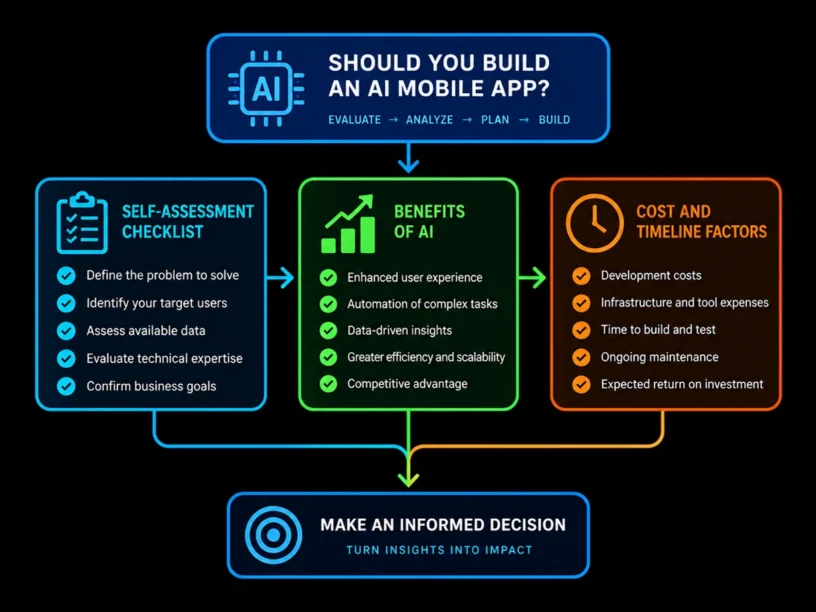
How to Know If Your App Really Needs AI: A Self-Assessment Checklist
A practical self-assessment checklist is the quickest way to move from “AI sounds exciting” to “AI is the right technical decision.” Be honest with yourself rather than optimistic.
- Can I describe the exact task AI will perform in one sentence? If the answer is vague (“make the app smarter”), the use case isn’t defined well enough to build.
- Does this task require prediction, pattern recognition, or generation? Typical examples include recommending products, flagging anomalies, generating text or images, or forecasting demand.
- Do I have, or can I access, enough quality data to power the model? AI features are only as good as the data behind them.
- Would a simpler rules-based feature solve 80% of the problem? If so, ship that first as a Minimum Viable Product (MVP) and validate it before adding AI.
- Can I measure the impact within 90 days of launch? AI investments should come with a clear before-and-after metric, such as fewer support tickets or a faster checkout.
- Have I budgeted for ongoing model costs and privacy compliance? AI features carry ongoing inference costs and, under OAIC guidance on commercially available AI products, specific disclosure obligations.
“Businesses should update their privacy policies and notifications with clear and transparent information about their use of AI,” the OAIC notes in its guidance, a requirement that will tighten once automated decision-making transparency rules commence.
If you answer “yes” to four or more of these six checks, your app probably has a genuine AI use case worth prototyping. If you score lower, launch a lean MVP first. That is the approach Appomate takes with founders: validate the core idea, then layer in AI where the data shows it will move the needle.
Key Takeaway: A disciplined checklist beats a hunch. Score your idea against data availability, measurable impact, and compliance cost before approving an AI build. For deeper context, see Can AI Build Your App? A Developer’s Honest Answer.
Benefits of Using AI in Mobile Apps for Australian Businesses
When AI is applied to the right problem, the benefits are measurable and significant, whether that means time saved on admin or faster growth. MYOB Business Monitor data shows Australian small businesses adopting AI tools grow 2.8 times faster than non-adopting peers, with over half reporting direct time savings in daily operations.
| Benefit | What It Looks Like in an App | Typical AI Feature |
|---|---|---|
| Time savings on admin | Automated invoicing, booking confirmations, and customer follow-up | Workflow automation, smart notifications |
| Personalised experience | Product or content recommendations tailored to each user | Recommendation engines |
| Faster customer support | Instant answers to common questions, 24/7 | AI chatbots and support assistants |
| Smarter decision-making | Forecasting demand, flagging fraud, or scoring leads | Predictive analytics models |
| Content and creative speed | Auto-generated descriptions, images, or summaries | Generative AI integrations |
- Operational efficiency: Xero Small Business Insights found that consistent AI users save between 21 and 40 employee hours per month by automating invoicing, follow-up, and admin.
- Competitive differentiation: In crowded categories like marketplace, wellness, and hospitality, AI-driven personalisation can turn a one-time download into a user who stays.
- Revenue growth signal: Businesses that build AI into core operations, not just marketing, tend to pull ahead of peers over time.
- Scalable support: AI assistants handle tier-one queries around the clock, freeing your people for complex conversations.
Key Takeaway: The benefits compound only when AI is tied to a specific operational or customer-facing workflow. Sprinkling it across the app as a buzzword feature rarely delivers the same results. For measured impact data, see 15 Best AI App Ideas For Entrepreneurs in 2026. For related guidance, see Best Paid User Acquisition Strategies For Mobile Apps In 2026.
When You Should (and Shouldn’t) Use AI in a Mobile App
Knowing when to use AI is as much about recognising when not to use it. Around 82% of large enterprises have implemented at least one AI system, compared to just 33% of micro businesses, largely because bigger businesses have the data volume and scale to justify the investment.
Good Fit Scenarios
| Scenario | Use AI? | Why |
|---|---|---|
| Marketplace app matching buyers and sellers | Yes | AI matching and ranking improves conversion at scale with high transaction volume |
| Wellness app personalising fitness or nutrition plans | Yes | Individual user data enables genuinely tailored recommendations |
| Hospitality app for a single venue booking table | No, not initially | Low volume and simple logic make a rules-based booking flow sufficient |
| B2B app automating invoice reconciliation | Yes | Pattern recognition across large data sets reduces manual error and admin time |
| Early-stage MVP testing a new concept | No, not yet | Validate demand first; AI adds cost and complexity before product-market fit is proven |
Regulatory and Data Considerations
- Privacy Act obligations: Organisations using AI to make or inform significant decisions about individuals must disclose these practices in their privacy policies from December 2026.
- Privacy by design: The OAIC recommends businesses use AI only when necessary and align data processing with the original purpose of collection.
- Small business exceptions are narrow: Most businesses under $3 million turnover sit outside the Privacy Act, but health, data-trading, and related-entity businesses are covered regardless of size.
Key Takeaway: Use AI where data volume, repetition, and personalisation value are high. Skip it where the app is simple, volume is low, or the idea is unproven. For deeper context, see The Truth About AI in Mobile Apps and Why You Should …. For related guidance, see How To Validate A Marketplace App Idea Before Building It 2026 Step By Step Guide 2026.
What AI Mobile App Development Costs and Timelines Look Like in Australia
Budget often decides whether to build an AI mobile app, and costs vary widely with complexity. Standard mobile app development in Australia typically runs AUD 50,000 to 100,000, rising to AUD 250,000 or more for enterprise-grade builds. AI-driven features sit toward the higher end of that range because of data infrastructure and model integration work.
| App Tier | Typical Cost (AUD) | Timeline | Example Features |
|---|---|---|---|
| MVP / proof of concept | $40,000 – $95,000 | 2-4 months | Core workflow, login, basic content, 1-2 integrations |
| Medium complexity | $100,000 – $200,000 | 4-6 months | Custom UI, payments, push notifications, light personalisation |
| AI-driven / complex | $170,000 – $450,000+ | 6-10 months | Recommendation engines, predictive analytics, generative AI, AR/VR |
These figures reflect broader market benchmarks, including Australian developer rates, which rose to roughly AUD 110-230 per hour in 2026. Speed and cost discipline matter as much as the feature set, which is where a hybrid delivery model becomes valuable.
- Australia-based strategy, globally delivered build: Appomate pairs Australia-based strategy and product design with a highly skilled global development team, delivering premium quality at startup-friendly pricing.
- AI-native, not AI-wrapped: Appomate builds genuinely AI-native products rather than thin wrappers around third-party APIs, using AI-driven development tools to deliver faster builds.
- Speed to market: Through its Further Faster Framework and agile methodology, Appomate has helped founders go from idea to market in as little as six weeks.
- Full journey partner: Appomate validates the idea, designs the product, builds and launches it, and supports growth and marketing after launch.
Key Takeaway: AI features add real cost and time, so validate demand with a lean MVP before scaling into AI. Choose a partner whose pricing and delivery speed suit a startup budget. For related guidance, see Startup Mobile App Development Timeline Australia 2026.
Conclusion
Should you build an AI mobile app for your business in 2026? Yes, but only if you can point to a specific workflow, data set, and measurable outcome that AI genuinely improves. Trends alone aren’t a reason. Answering should I build an AI mobile app for my business and how to know if my app really needs AI comes down to honest self-assessment.
- Start with validation, not AI: Prove your core idea solves a real problem before layering in AI cost and complexity.
- Use the checklist: Data availability, measurable impact, and compliance readiness should all check out before you commit budget.
- Match AI to volume and repetition: High-volume, data-rich, personalisation-heavy use cases are strong fits. Low-volume, simple apps usually aren’t, yet.
- Budget realistically: AI-driven builds in Australia commonly run from $170,000 upward, so plan your MVP-to-AI roadmap in stages.
- Choose a founder-focused partner: Appomate’s approach to helping non-technical founders validate, build, and scale makes the AI decision far less risky.
If you’re still unsure whether your idea needs AI, Book a discovery call with Appomate to get a clear, honest read on whether AI belongs in your first release or your second.
Key Takeaway: The decision to build an AI mobile app should be strategic, based on validated needs, measurable impact, and realistic budgeting, and is often best approached in stages.
Ready to build your app?
Book a free Visioning Call with our team today and walk away with a clear roadmap, expert feedback, and a plan to bring your idea to life. No technical knowledge required.
FAQ
Should I Build an AI Mobile App for My Business in 2026?
Build an AI mobile app only if you can identify a specific, high-volume, data-driven task that AI performs better than a simpler rules-based feature, such as personalised recommendations, predictive forecasting, or natural language understanding. If your core idea is unvalidated or your user base is small, launch a lean Minimum Viable Product (MVP) first, and add AI once evidence shows it will move a measurable metric.
How do I know if my app really needs AI?
Run your idea through a short checklist. Can you describe the AI task in one sentence? Do you have quality data to power it? Would a simpler feature solve most of the problem? Can you measure impact within 90 days? If you answer “yes” to most of these, your app likely has a genuine AI use case worth prototyping.
What are the main benefits of using AI in mobile apps?
The core benefits include time savings on repetitive admin tasks, personalised user experiences at scale, faster 24/7 customer support through chatbots, and smarter forecasting or fraud detection through predictive analytics. MYOB data shows AI-adopting SMEs growing 2.8 times faster than non-adopters.
How much does it cost to build an AI mobile app in Australia?
AI-driven mobile apps in Australia typically cost between $170,000 and $450,000 or more, depending on the complexity of the AI features. A basic non-AI MVP usually falls between $40,000 and $95,000, according to current Australian development cost benchmarks.
What’s the difference between an AI-native app and an “AI wrapper” app?
An AI-native app is designed with AI built into its core architecture and data flows. An AI wrapper simply bolts a third-party AI API onto an existing product without deeper integration. Appomate builds AI-native products rather than thin wrappers, which generally produces more reliable and scalable AI features.
Do small businesses in Australia actually need AI in their apps?
Not always. Roughly 82% of large enterprises have implemented at least one AI system compared to just 33% of micro businesses. Smaller businesses often lack the transaction volume to justify AI yet, and are usually better served by validating their core app first.
What privacy rules apply to AI features in an Australian app?
From December 2026, businesses using AI or algorithms to make or inform significant decisions about individuals must disclose this in their privacy policies under new OAIC automated decision-making transparency obligations. The regulator also recommends a privacy-by-design approach before deploying AI features that touch personal data.
How can Appomate help me decide if my app needs AI?
Appomate works with founders from the idea stage, validating the problem and the AI use case before any code is written. Through its hybrid delivery model and Further Faster Framework, Appomate helps founders reach a validated, market-ready app, with or without AI, often in as little as six weeks.
This article was researched using publicly available Australian industry data from sources including the Australian Bureau of Statistics, Deloitte, MYOB, Xero, NAB Economics, and the Office of the Australian Information Commissioner (OAIC), current as of November 2026. Cost and timeline figures are indicative industry benchmarks and will vary by project scope; readers should seek a tailored quote and current regulatory advice before making development or compliance decisions.