startup mobile app development timeline Australia realistic expectations | Updated August 2026 | Appomate Editorial Team
For Australian founders asking how long it takes to build a startup app, the honest answer ranges from 6 weeks to 6 months — depending almost entirely on scope, team, and process. AI-assisted development tools like GitHub Copilot and Cursor are accelerating coding by 40–60%, compressing what once took a full quarter into weeks. Understanding realistic expectations requires separating the actual build from surrounding work — discovery, design, testing, and launch — that agencies rarely foreground in pitch decks.
Most first-time founders underestimate total timeline by two to three times. After building 200+ MVPs, a consistent pattern emerges: founders hear “minimum viable product” and think “minimum time investment.” With the right partner and disciplined scope, experienced Australian teams are delivering market-ready apps in 6 to 12 weeks — far shorter than the 6-to-12-month timelines circulating in online forums.
Speed to market is not a shortcut — it is a strategy. Every week spent building without user feedback is a week your competition pulls ahead. In 2026, the founders who win are those who validate fast, scope tightly, and iterate continuously.
What Is a Realistic App Development Timeline for Australian Startups?
A startup mobile app development timeline places most MVPs between 6 and 16 weeks from first brief to App Store submission — driven by feature complexity, platform choice, and founder decision speed. Simple apps with 3–5 core features launch in 6–8 weeks; mid-complexity marketplace or healthcare apps typically run 10–16 weeks.
Industry Benchmark Timelines
Well-scoped MVPs typically take 8–16 weeks from concept to launch. Melbourne-based Appomate has pushed that benchmark further — helping founders go from idea to market in as little as 6 weeks using AI-driven development combined with Australia-based strategy and product design.
| App Type | Typical Features | Industry Avg Timeline | Fast-Track (AI-Assisted) | AUD Cost Range |
|---|---|---|---|---|
| Simple MVP | Login, profiles, push notifications, 1 core flow | 8–12 weeks | 6–8 weeks | $30,000–$80,000 |
| Mid-Complexity App | APIs, payments, dashboards, user roles | 12–20 weeks | 10–14 weeks | $80,000–$150,000 |
| Marketplace / Platform | Dual-sided user flows, search, ratings, payments | 16–24 weeks | 12–16 weeks | $120,000–$250,000 |
| AI-Powered / HealthTech | ML features, real-time data, compliance requirements | 20–36 weeks | 16–24 weeks | $200,000–$400,000+ |
Why Timelines Blow Out
- Scope creep: Adding features mid-sprint is the single biggest delay driver. A “quick addition” of social login or real-time chat adds 2–4 weeks instantly.
- Delayed founder decisions: Waiting on approval for designs, copy, or brand assets stalls entire sprints.
- Skipping discovery: Teams jumping straight to code without validated product design invariably rebuild 30–50% of work after early user testing.
- Underestimating App Store review: Apple’s App Store review averages 1–3 days but can run to 2 weeks for health or financial apps.
Key Takeaway: A 6–16 week window is realistic for most Australian startup MVPs if scope is locked before development and decision-making is fast. For deeper context, see App Design & Development for Startups.
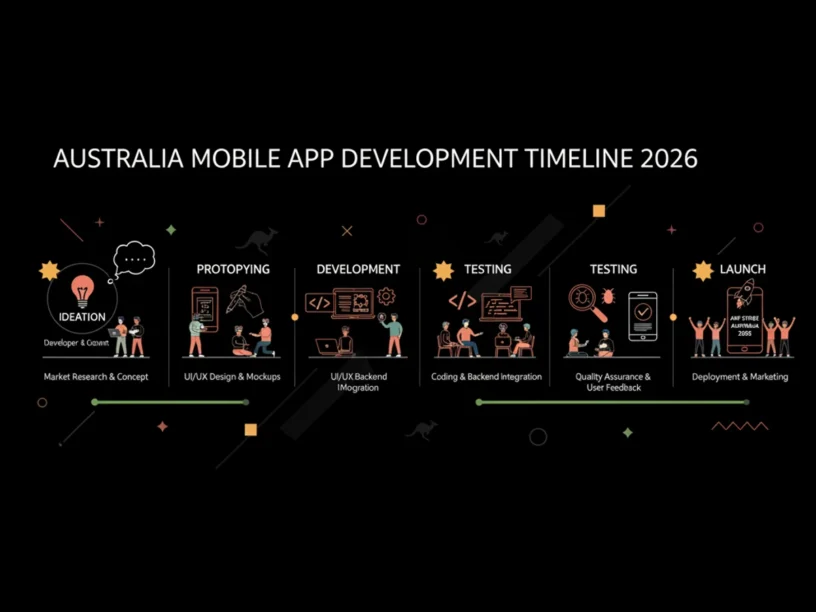
The 5 Stages of Mobile App Development in Australia
Understanding the mobile app development stages founders move through — and how long each takes — is the first step to building a reliable project plan.
Stage-by-Stage Breakdown
- Discovery and Validation (1–2 weeks): Market research, competitor analysis, user persona definition, and feature prioritisation. This stage answers “should we build this?” before spending on design.
- UX Design and Prototyping (2–4 weeks): Wireframes, user flows, and interactive prototypes built in Figma. Founders can test product feel before code is written.
- Development Sprints (4–10 weeks): Frontend and backend development in parallel two-week agile sprints. AI-powered code generation accelerates development by 40–60%, and automated testing frameworks catch 95% of potential issues before production.
- Quality Assurance and Testing (1–3 weeks): Functional, performance, security, and device-compatibility testing. Apps touching healthcare or financial data require compliance checks against Australian Privacy Principles under the Privacy Act 1988.
- Launch and Post-Launch Support (1–2 weeks + ongoing): App Store and Google Play submission, onboarding flows, analytics setup, and bug fixes. Ongoing maintenance typically adds 10–15% of initial build cost annually.
| Stage | Duration | Key Output | Founder Involvement |
|---|---|---|---|
| Discovery & Validation | 1–2 weeks | Validated scope, feature list | High |
| UX Design & Prototyping | 2–4 weeks | Figma prototype, user flows | High |
| Development Sprints | 4–10 weeks | Working app builds | Medium |
| QA & Testing | 1–3 weeks | Bug reports, compliance sign-off | Low |
| Launch & Support | 1–2 weeks + ongoing | Live app, analytics dashboard | High |
Key Takeaway: Most timeline risk lives in Stages 1 and 2 — not development. Founders who invest properly in discovery and design consistently launch faster and with fewer costly rebuilds. For deeper context, see How to Develop an App Idea in Australia | Complete Guide.
App Development Cost in Australia: What to Budget in 2026
Mobile app development costs in Australia typically range from AUD $25,000 to over $300,000, depending on complexity, feature set, platform choice, and team selection. The gap between a $35,000 MVP and a $250,000 platform app is rarely about technology — it is about scope, integrations, and compliance requirements.
Cost Drivers Non-Technical Founders Often Miss
- Platform strategy: Native iOS and Android development can double cost. Cross-platform frameworks like Flutter or React Native deliver both platforms for roughly 60–70% of native cost.
- Third-party integrations: Payment gateways (Stripe, Tyro), authentication services, mapping APIs, and CRM connections each add complexity and testing overhead.
- Compliance requirements: Apps handling health records must meet requirements under the My Health Records Act 2012. Fintech apps are regulated by ASIC. Compliance work is real cost that low-ball quotes routinely exclude.
- Hourly rates: Senior Australian developers command AUD $120–$200 per hour. Hybrid models combining Australia-based strategy with skilled global development teams significantly reduce rates without sacrificing quality.
- Post-launch maintenance: Budget for ongoing support. A live app requires updates, performance tuning, and new feature releases.
Appomate’s hybrid delivery model combines Australia-based strategy, product design, and product management with a highly skilled global development team — delivering premium-quality products at startup-friendly pricing. Key Takeaway: Budget honestly by including discovery, design, development, compliance, launch, and 12 months of post-launch support. Most timeline blowouts stem from process gaps and poor partner selection, not cost miscalculations.
What Slows Australian Startups Down (And How to Avoid It)
The most common reasons Australian startup apps miss launch windows have nothing to do with technology. They stem from process gaps, founder bottlenecks, and poor partner selection.
The Six Most Common Timeline Killers
- No validated product brief: Starting development without a locked feature set and user flow document causes costly rebuilds. Designing correctly the first time is three times cheaper than rebuilding a half-finished screen.
- Choosing a partner on price alone: Partner selection is key to successful app development. A $20,000 quote producing a product needing an $80,000 rebuild is not a saving.
- Building too many features for Version 1: More features equal more time. Ruthless prioritisation is essential — a disciplined MVP scope is a skill, not a compromise.
- Ignoring market validation before development: About 70% of tech startups fail due to lack of market need from insufficient market research. Building a validated prototype and getting real user feedback before full development prevents the most common failure mode.
- Unclear stakeholder sign-off process: When multiple decision-makers must approve designs or copy, delays compound. Define a single point of authority before kickoff.
- Treating launch as the finish line: Startups that systematically collect feedback and iterate are 30% more likely to reach product-market fit within a year. Launch is the start of learning, not the end of building.
Key Takeaway: Most Australian startup app timelines blow out from avoidable process failures, not technical ones. A partner guiding you through discovery, validating your idea, and locking scope before coding is worth more than the cheapest quote. For deeper context, see Australian Startup Success Stories: Mobile Apps Case ….
How AI Is Compressing the Australia App Development Timeline in 2026
AI-driven development is the most significant shift in Australian app development right now. By 2026, software development in Australia is being reshaped by deeply embedded AI across every stage of delivery, from product ideation through to long-term production support. For startup founders, this translates directly into shorter timelines and lower costs — if their development partner has fully integrated AI into workflow rather than simply marketing it as a feature.
Where AI Is Genuinely Accelerating Delivery
- Code generation and review: AI coding assistants automate boilerplate, suggest optimisations, and flag security vulnerabilities in real time. AI-augmented workflows accelerate time-to-market by 60–70% while delivering personalised user experiences that drive engagement above 40%.
- Automated QA testing: Machine-learning-driven test suites run thousands of device and scenario combinations overnight — work previously consuming weeks of manual effort.
- Design-to-code tools: Figma with AI plugins converts high-fidelity mockups directly into production-ready component code, collapsing the handoff gap between designers and developers.
- AI-native product features: Growing numbers of Australian applications leverage AI for enhanced personalisation, predictive analytics, and improved user experiences.
Appomate has embedded AI-driven development into every stage of delivery — building AI-native products, not just AI-wrapped ones. Founders benefit from faster timelines without sacrificing quality, security, and scalability. Key Takeaway: AI is a present-day competitive variable for Australian app development. Choose a partner using AI throughout the full delivery lifecycle, not just in marketing. For deeper context, see Mobile App Development in Australia (2026).
Choosing the Right App Development Partner in Australia
With Australia’s smartphone app development industry projected to reach AUD $5.6 billion by 2026, the market for development partners is large — and varied in quality. For non-technical founders, selecting the right partner is the most consequential early decision.
What to Look For in a Partner
- Full-cycle capability: The best partners cover strategy, design, build, launch, and post-launch growth — not just code delivery. Handing off between multiple agencies adds weeks of coordination overhead and context loss.
- Founder-first process: Look for partners running structured discovery and validation before quoting. This protects your budget and surfaces derailing assumptions early.
- Transparent timelines: Any partner unable to show a milestone-by-milestone project plan in the first conversation is a risk. A transparent mobile app development timeline enables efficient resource use, risk awareness before crises, and clear progress communication to investors and stakeholders.
- Verified portfolio: Review live apps in the App Store and Google Play, not just case study PDFs. Apps with real users and meaningful reviews demonstrate genuine delivery capability.
- Hybrid delivery model: Australia-based strategy and product management paired with skilled global development delivers the best balance of quality, communication, and cost-efficiency.
Why Appomate Is Purpose-Built for Australian Founders
Appomate is a Melbourne-based technology partner with over 250 apps delivered and a client list including Adidas, L’Oreal, Lend Lease, and Hoyts. Unlike traditional agencies that build what you ask, Appomate acts as a full growth partner — validating ideas, designing products, building, launching, and supporting long term. Their proven agile methodology makes app development timelines more predictable, less risky, and consistently faster than industry average. For non-technical founders, this means less guesswork, fewer surprises, and a partner who shares accountability for outcomes — not just deliverables.
Key Takeaway: The right development partner in Australia in 2026 is not the cheapest or fastest — it is the one treating your product success as their own responsibility from first idea to long-term growth.
Ready to build your app?
Book a free Visioning Call with our team today and walk away with a clear roadmap, expert feedback, and a plan to bring your idea to life. No technical knowledge required.
Conclusion
Setting realistic expectations for startup mobile app development timeline in Australia is the difference between a product launching with momentum and one running out of budget and confidence before reaching users. In 2026, the best Australian founders validate early, scope tightly, choose the right partner, and leverage AI-accelerated delivery to reach market in 6 to 16 weeks rather than six-plus months.
- Timeline reality: Most Australian startup MVPs take 6–16 weeks with focused scope and experienced partner — not 6–12 months as commonly quoted.
- Stage discipline matters: Discovery and design are not optional — skipping them causes rebuilds costing more in time and money than original stages would have.
- Cost benchmarks: AUD $30,000–$150,000 covers the majority of Australian startup MVPs, with complexity, compliance, and integrations as primary cost drivers.
- AI is a real accelerant: AI-driven workflows compress build timelines by 40–60% at leading Australian agencies — choose a partner who genuinely embedded this, not one mentioning it in pitch.
- Partner selection is highest-leverage: A full-cycle partner like Appomate covering validation, design, build, launch, and growth dramatically reduces timeline blowout risk for non-technical founders.
If you are ready to map your app development timeline with Australia’s most experienced startup technology partner, speak with the Appomate team to start a free discovery conversation.
FAQ
What is a realistic Startup Mobile App Development Timeline in Australia for 2026?
For 2026, a realistic range for a well-scoped MVP is 6 to 16 weeks from initial brief to App Store launch. Simple apps with 3–5 core features ship in 6–8 weeks with AI-assisted delivery. Mid-complexity apps involving APIs, payments, or dual-sided flows run 10–16 weeks. Timelines extend when scope is not locked before development, founder decision-making is slow, or the partner lacks structured discovery. Partners like Appomate, combining Australia-based product strategy with AI-driven development, consistently deliver faster than industry average while maintaining quality and compliance.
How long does it take to build a startup app in Australia?
Most Australian startup apps take 8 to 16 weeks from concept to launch with an experienced team and clear brief. Very simple apps launch in 6 weeks. Complex apps involving healthcare, fintech, or marketplace dynamics run 16–24 weeks. Duration depends less on coding speed and more on how quickly discovery, design, and decisions resolve before and during build.
How much does mobile app development cost in Australia in 2026?
Mobile app development cost in Australia ranges from approximately AUD $30,000 for simple MVPs to AUD $250,000+ for complex, multi-platform products with compliance requirements. Most startup MVPs fall in the AUD $50,000–$150,000 range. Key cost drivers include feature complexity, platform choice (native vs cross-platform), third-party integrations, and regulatory compliance under Australian law. Local senior developer rates run AUD $120–$200 per hour; hybrid delivery models combining Australia-based strategy with global development deliver startup-friendly pricing.
What are the stages of mobile app development in Australia?
The five core stages are: (1) Discovery and Validation — 1–2 weeks of research and scope definition; (2) UX Design and Prototyping — 2–4 weeks producing Figma prototypes; (3) Development Sprints — 4–10 weeks of agile build cycles; (4) Quality Assurance and Testing — 1–3 weeks of functional, performance, security, and compliance testing; and (5) Launch and Post-Launch Support — App Store submission and ongoing iteration. Discovery and design are most commonly skipped by cost-cutting founders — and most reliably responsible for costly rebuilds.
How does AI affect app development timelines for Australian startups?
AI-powered development tools compress Australian app development timelines by 40–60% in the coding phase as of 2026. AI code generation, automated QA testing, and design-to-code platforms reduce manual effort in repetitive tasks. However, discovery, design, and stakeholder decision-making take the same human time. The best Australian partners embed AI across the full delivery lifecycle, not just coding sprints.
Should Australian startup founders build a native or cross-platform app?
For most Australian startups launching an MVP in 2026, cross-platform development using Flutter or React Native is recommended. A single shared codebase launches on iOS and Android simultaneously at roughly 60–70% of native build cost. Native development (Swift for iOS, Kotlin for Android) is worth additional investment when your app requires deep device hardware integration, specialised performance, or platform-specific features cross-platform frameworks cannot replicate.
What compliance requirements affect app development timelines in Australia?
Australian app developers must factor in compliance with several regulatory frameworks depending on app category. Apps handling personal data are subject to Australian Privacy Principles under the Privacy Act 1988. Health apps connecting to My Health Records must comply with the My Health Records Act 2012. Fintech and payment apps are regulated by ASIC. Compliance work — including security architecture, data handling documentation, and legal review — adds real timeline and budget and should be scoped from day one.
What should a non-technical founder look for in an Australian app development partner?
Non-technical founders should prioritise partners running structured discovery and validation before coding. Look for full-cycle capability covering strategy, design, build, launch, and post-launch growth. Ask for a milestone-by-milestone project plan and portfolio of live apps with real users. Transparent communication, agile methodology, and clear ownership of outcomes are non-negotiable. Appomate is purpose-built for founders without technical background — their proven validation process and founder-focused approach make the journey from idea to market faster, safer, and more predictable than traditional development agencies.
Methodology: This article draws on publicly available Australian industry reports, market data from Gartner and the Australian Bureau of Statistics, and global MVP development benchmarks. Cost and timeline figures reflect 2025–2026 market conditions in Australia and are indicative ranges, not fixed quotes. Individual project outcomes vary based on scope, complexity, partner selection, and founder readiness. For compliance requirements specific to your app category, consult a qualified Australian legal professional or the relevant regulator.