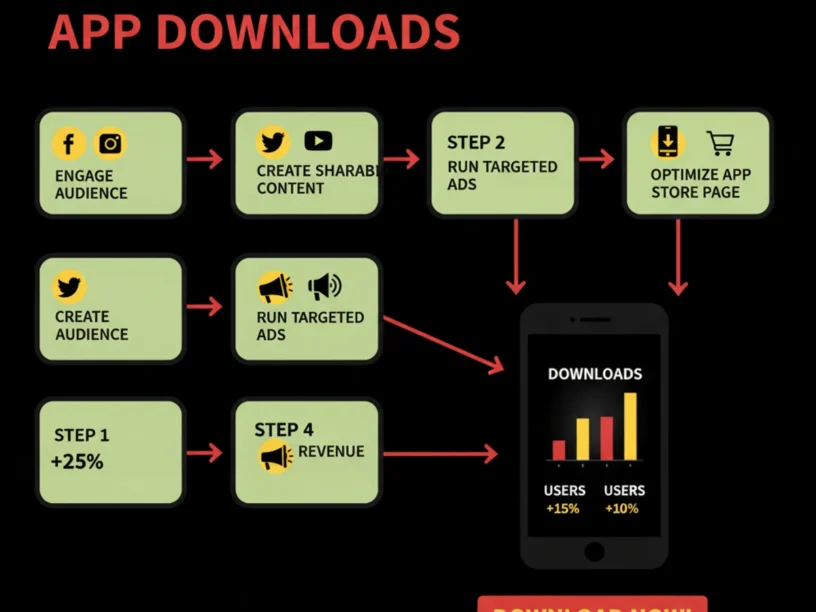
how to use social media to get app downloads | Updated August 2026 | Appomate Editorial Team | 4–6 hours of setup + 4 weeks of execution | Beginner
What You’ll Learn
Pick one or two platforms where your target users already hang out, publish short-form video content that shows your app solving a real problem, partner with relevant micro-influencers to amplify reach, run a small paid campaign to drive downloads at scale, and track everything so you can double down on what works. Done consistently over four weeks, this moves you from zero organic traction to a steady, repeatable download funnel.
- Choose the right social platform for your app’s audience (consumer vs. B2B, fashion vs. wellness vs. productivity)
- Create short-form video content that generates genuine curiosity and a clear call to download
- Leverage micro-influencers and creator content to build trust at scale
- Run and optimise paid social ads to turn interest into installs cost-effectively
Prerequisites: A live app on the App Store or Google Play, a basic social media account for your brand, and a smartphone camera or free screen-recording tool.
Why This Matters in 2026
Social media is one of the most effective user acquisition channels because users consume content on the same devices they use to download apps. Zero friction between scroll and install. According to Sensor Tower’s State of Mobile 2026, consumers spent $167 billion on in-app purchases in 2025, downloaded apps nearly 150 billion times, and spent 5.3 trillion hours in apps.
Platforms like TikTok, Instagram Reels, YouTube Shorts, and emerging social video apps have become search engines for products and recommendations. With Australia’s social ad market growing 7.74% annually through 2030, early adopters report up to 4:1 ROAS. Social media user acquisition is no longer optional for Australian founders — it’s the primary growth lever. For supporting data, see Social App Revenue and Usage Statistics (2026).
The Process at a Glance
| Step | Action | Time | Outcome |
|---|---|---|---|
| 1 | Match your app to the right platform | 2–3 hours | Clear platform strategy defined |
| 2 | Create short-form video content consistently | 1–2 hours per video, 3x per week | Organic reach and download link clicks |
| 3 | Partner with micro-influencers in your niche | 1 week to identify and brief | Trusted third-party app endorsements live |
| 4 | Run targeted paid social ads for installs | 1–2 days to set up; 2–4 weeks optimising | Measurable cost-per-install benchmark |
| 5 | Track, measure, and iterate every week | 30–60 minutes per week | Improving download volume week on week |
Total estimated time to first measurable results: 4 weeks of consistent execution.
Step 1: Match Your App to the Right Social Platform
What You’re Doing
Find the one or two platforms where your target users already are. Spreading yourself thin across every platform wastes time and dilutes your message.
How to Do It
- Define your ideal user in one sentence: their age, what problem they have, and what they do on their phone for fun.
- Cross-reference your user profile against the platform breakdown below.
- Pick your primary platform and one cross-posting destination. Commit to those two for your first four weeks.
- Set up a business profile on each platform, add your app store link in the bio, and write a one-line description of what your app does.
Platform Selection by App Type
| App Type | Best Primary Platform | Best Secondary Platform | Why |
|---|---|---|---|
| Fashion / Lifestyle / Beauty | TikTok | Instagram Reels | TikTok has 1.9 billion monthly active users globally with the deepest session depth of any social platform. |
| Wellness / Fitness / Health | Instagram Reels | YouTube Shorts | Instagram Reels achieve a 30.81% average reach rate, more than double that of carousels or image posts. |
| B2B / Productivity / SaaS | YouTube Shorts | 80% of all B2B social leads flow through LinkedIn. | |
| Sports / Gaming / Entertainment | TikTok | YouTube Shorts | YouTube Shorts leads engagement at 5.91%, and its integration with long-form YouTube creates a unique discovery-to-depth funnel. |
Best Practices
- Link directly to your App Store or Google Play listing in every bio — not to your homepage.
- Use a link-in-bio tool like Linktree if you want to link to both iOS and Android versions from a single URL.
What Done Looks Like
You have two active business profiles, your app store URL is live in both bios, and you know exactly which platform gets your primary creative energy this month. For a more detailed walkthrough, see Mobile app downloads through social media.
Step 2: Create Short-Form Video Content That Gets Downloads
What You’re Doing
Short-form video is the engine of organic social media app marketing in 2026. Your job is to create content that earns attention and makes your app feel necessary.
How to Do It
- Lead with the problem, not the product. Open with a situation your target user recognises within the first two seconds.
- Show the app in action. Use a hook in the first two seconds, follow it with a visible app demonstration, and add simple captions for users watching without sound.
- End with a clear call to action. Say the words “download it free” or “link in bio” aloud and display it as on-screen text simultaneously.
- Post consistently. Aim for three videos per week on your primary platform.
- Repurpose the same video to your secondary platform with minor edits for format.
Example: Content Formats by App Vertical
| App Vertical | Content Idea | Format | Platform |
|---|---|---|---|
| Wellness | “My 5-minute morning routine using [App]” | Screen recording + voiceover | Instagram Reels |
| Fashion / Retail | “I styled 5 outfits using AI in this app” | Try-on video with app overlay | TikTok |
| Sports | “How I track my training load — free app” | In-app walkthrough | YouTube Shorts |
| B2B / Productivity | “The app that saves my team 3 hours a week” | Problem → Solution demo | LinkedIn video |
Best Practices
- Batch-produce four to six videos in one session each week so you always have content ready to post.
- Use visually appealing graphics, compelling stories, and interactive elements like quizzes or polls.
Common Mistakes
- Making every video a product announcement. Viewers skip promotional content in under two seconds. Prioritise entertainment and education first; the download will follow.
- Inconsistent posting. Post three times a week minimum for the first month before drawing conclusions about what works.
What Done Looks Like
You have at least 12 short-form videos live across your platforms, your app store link is being clicked consistently from your bio, and at least one video has generated comments asking “what app is this?”
Step 3: Partner with Micro-Influencers in Your Niche
What You’re Doing
Micro-influencers (10,000–100,000 followers) consistently outperform mega-influencers for app promotion. Their audiences are tightly niched and their recommendations feel personal.
How to Do It
- Find your creators. Search your primary platform for accounts that already talk about problems your app solves.
- Vet before you reach out. Look for genuine engagement, an audience that matches your target user, and content that feels authentic rather than ad-heavy.
- Pitch with a free app experience. Offer the creator a free premium account or early access. Give them creative freedom — scripted posts underperform.
- Ask for a trackable link or promo code. Use a unique UTM parameter or referral code per creator so you can measure installs from each partnership.
- Repurpose their content. Ask for permission to boost their post as a paid ad — this dramatically improves performance.
Best Practices
- Ten micro-influencers (10K–50K followers) give you audience diversification, lower risk, and combined reach exceeding one macro-influencer. Start with three to five creators and scale what works.
- Micro-influencers on Instagram achieve an average engagement of around 3.86%, while mega-influencers generate about 1.21%. A smaller, engaged audience always beats a large, passive one.
What Done Looks Like
You have two to five creator posts live that include your app store link, each tracked with a unique code, and you can see which creator is driving the most installs in your analytics dashboard.
Step 4: Run Targeted Paid Social Ads for App Installs
What You’re Doing
Organic content and influencer posts build awareness. Paid ads scale what’s already working and reliably grow download volume without relying on the algorithm.
How to Do It
- Start with the platform where your organic content is performing best. If your TikTok videos are getting genuine engagement, run TikTok Ads. If Instagram Reels are driving bio clicks, start with Meta Ads Manager.
- Choose “App Installs” as your campaign objective. Both Meta and TikTok have specific campaign types optimised for driving app store downloads.
- Use your best organic video as your ad creative. Native-looking video consistently outperforms polished ad creative. If a video already got 10,000 organic views, it’s proven — boost it.
- Set a test budget and let it run. TikTok Ads require a minimum of $20/day per ad group in 2026. For Meta in Australia, the average CPC is $1.47. Start small, establish your cost-per-install benchmark, then scale.
- Target by interest and behaviour, not just demographics. Utilise detailed targeting options to reach specific demographics, interests, and behaviours.
Paid Platform Comparison for Australian App Founders
| Platform | Avg. Cost Per Install (CPI) | Best For | Ad Manager Link |
|---|---|---|---|
| TikTok Ads | $0.50–$1.80 USD | Consumer apps, fashion, wellness, Gen Z audiences | TikTok Ads Manager |
| Meta Ads (Instagram/Facebook) | $1.50–$3.50 AUD est. | Lifestyle, health, broad consumer audiences | Meta Ads Manager |
| LinkedIn Ads | Higher CPC, lower CPA at deal level | B2B apps, professional productivity tools | LinkedIn Campaign Manager |
Best Practices
- Run at least two creative variants per ad set so the platform can identify which message resonates.
- A well-optimised app store page boosts conversion rates and helps reduce cost per install.
What Done Looks Like
Your campaign is live, you can see cost-per-install data in your ad manager, and you have a benchmark figure to beat as you iterate your creative and targeting. For related guidance, see App Store Optimisation Australia Aso Best Practices For 2026.
Step 5: Track, Measure, and Iterate Every Week
What You’re Doing
All the steps above generate data. This step turns that data into a smarter, more cost-effective strategy each week. Without measurement, you’re guessing. With it, you’re compounding.
How to Do It
- Connect a mobile measurement partner (MMP). Tools like AppsFlyer or Adjust attribute each download to the exact platform, campaign, influencer, or video that drove it.
- Track these four numbers weekly: impressions, link clicks, installs, and day-7 retention.
- Double down on what’s working. If TikTok is driving installs at half the cost of Instagram, shift 70% of your energy and budget there.
- Cut what’s not working after two weeks. Don’t run an underperforming ad for a month hoping it’ll improve. Kill it, analyse why, and test a new creative or audience.
Best Practices
- Use Google Analytics 4 with UTM parameters on every link so you can track the full journey from social post to app open.
- Monitor your day-30 retention alongside install volume. A typical app loses 75% of its users within the first three days after install. If retention is poor, your content is attracting the wrong audience — adjust your targeting and messaging.
What Done Looks Like
You have a weekly dashboard showing installs by channel, your cost-per-install is trending down, and you know exactly which content type and platform is driving your best users.
What to Do After Your First Month
Phase 1: Consolidate (Weeks 5–8)
You know which platform, content format, and creator type drives your best installs. Consolidate your budget and content effort on those winners. Pause anything that’s not delivering downloads at an acceptable cost. Refresh your top three performing organic videos with updated hooks.
Phase 2: Scale (Weeks 9–16)
Increase your paid ad budget by 20–30% per week on your best-performing campaign. Add two or three new micro-influencers in adjacent niches. Build community — reply to every comment, ask questions in captions, and repost user-generated content from people who’ve downloaded your app.
Phase 3: Optimise for Retention and Revenue (Month 3+)
Day-30 median retention in 2026 sits at around 12% for social apps and 5% for health and fitness. Use social media to re-engage lapsed users through retargeting ads and behind-the-scenes content that reminds existing users why they downloaded in the first place.
Resources You’ll Need
| Resource | Role in This Process | Required / Recommended / Optional | Cost |
|---|---|---|---|
| Appomate | Full-service app development and launch partner for Australian founders — from idea validation through build, launch, and marketing strategy. | Recommended (if your app is still in development or needs marketing strategy support) | Project-based pricing — contact for quote |
| AppsFlyer | Mobile measurement and attribution — tracks which social post, ad, or influencer drove each download | Recommended | Free starter plan; paid plans from ~$0.05/conversion |
| TikTok Ads Manager | Paid app-install campaigns targeting consumer audiences | Recommended (consumer apps) | Min. ~$20/day per ad group |
| Meta Ads Manager | Paid app-install campaigns on Facebook and Instagram | Recommended (lifestyle and broad consumer apps) | Flexible; avg. AUD $1.47 CPC in Australia |
| Linktree | Single bio link directing users to both iOS and Android store listings | Recommended | Free plan available |
| LinkedIn Campaign Manager | Paid campaigns for B2B app installs targeting professionals and decision-makers | Optional (B2B apps only) | Min. $10/day; higher CPC than TikTok/Meta |
See also, see How to boost app downloads and installs: reliable strategies.
Ready to build your app?
Book a free Visioning Call with our team today and walk away with a clear roadmap, expert feedback, and a plan to bring your idea to life. No technical knowledge required.
Troubleshooting Common Issues
Problem: Lots of Views but Very Few App Store Clicks
Likely cause: Your content is entertaining but not converting because there’s no clear call to action, or your app store link is buried.
Fix: Add a spoken and on-screen CTA in every video’s final three seconds (“Download free — link in bio”). Ensure your bio link goes directly to the App Store or Google Play listing. Test adding a pinned comment with the download link on your top-performing videos.
Problem: Clicks to App Store but Low Conversion to Install
Likely cause: Your app store listing isn’t doing its job once social traffic lands on it. App Store Optimisation (ASO) is the backbone of effective user acquisition, supporting both organic discovery and paid marketing efforts.
Fix: Revisit your app icon, first two screenshots, and preview video. They should immediately communicate the core value of your app. Check that your app description opens with the benefit, not the feature list.
Problem: Paid Ads Are Spending but Cost-Per-Install Is Too High
Likely cause: Your creative isn’t resonating, or your audience targeting is too broad.
Fix: Swap in your best organic video as the ad creative — proven organic content almost always outperforms purpose-built ad creative. Narrow your audience to a specific interest cluster. The biggest cost lever on TikTok is creative quality, not bids or targeting.
Problem: Influencer Posts Are Live but Driving Almost No Installs
Likely cause: The influencer’s audience doesn’t match your app’s target user, or the content felt too scripted.
Fix: Review the creator’s comment section for engagement quality. For the next campaign, give creators more creative freedom and brief them on the problem to solve, not the script to follow. Start with creators who already use apps similar to yours. For more troubleshooting advice, see The 5 Biggest Mistakes First-Time App Founders Make.
Conclusion
Key Takeaways
- Outcome recap: Knowing how to use social media to get app downloads comes down to five repeatable actions — choosing the right platform, creating consistent short-form video, partnering with micro-influencers, running targeted paid ads, and measuring everything weekly. Done for four weeks, this builds a sustainable download engine.
- Key insight: Social media is uniquely powerful for app marketing because users consume your content on the same device they use to download your app — eliminating the friction that kills conversions on every other channel.
- Next action: Today, set up your business profile on your primary platform, add your app store link to the bio, and film one short-form video showing your app solving a real problem. Post it before the end of the week.
If your app is still being built — or you want a partner who understands both product development and go-to-market strategy — Appomate is a Melbourne-based team that takes founders from idea to market faster and more safely. They help founders turn app ideas into successful, scalable businesses — not just apps — from validation to launch, growth, and exit.
FAQ
How do you use social media to get app downloads?
Follow five core steps: (1) Choose the platform where your target users spend their time — TikTok and Instagram Reels for consumer apps, LinkedIn for B2B apps, YouTube Shorts for cross-audience reach. (2) Create short-form video content three times per week that shows your app solving a real problem, with a clear call to action directing viewers to your bio link. (3) Partner with micro-influencers (10,000–100,000 followers) in your niche who can authentically recommend your app. (4) Run paid app-install campaigns on your best-performing platform, starting with a small test budget and scaling what works. (5) Use mobile attribution tools like AppsFlyer or Adjust to track installs by source and cut what isn’t converting. Consistent execution over four weeks establishes a measurable, repeatable download funnel.
Which social media platform is best for getting app downloads in Australia?
For most consumer apps — especially in fashion, wellness, and lifestyle — TikTok is the strongest platform for organic discovery, while Instagram Reels offers the broadest paid reach. For B2B and professional apps, LinkedIn drives significantly higher-quality leads. YouTube Shorts works well as a secondary platform for any vertical. Define your ideal user first, then pick the platform where they already spend time.
How much does it cost to run social media ads for app downloads in Australia?
TikTok’s global cost-per-app-install averages $0.50–$1.80 USD. In Australia, the average Meta Ads CPC is approximately AUD $1.47 in 2026. LinkedIn is significantly more expensive per click but delivers lower cost-per-acquisition at the qualified-lead level for B2B apps. A realistic first-month test budget across any single platform is AUD $700–$1,500 to gather meaningful data.
What type of content gets the most app downloads from social media?
Short-form video that opens with a relatable problem within the first two seconds, shows the app in action, includes captions for silent viewing, and ends with a spoken and on-screen download CTA. Problem-solution demos, “day in my life” videos that naturally feature the app, and creator reviews outperform traditional ad-style content. Authenticity is the defining factor — native-feeling content converts far better than polished promotional material.
Do micro-influencers actually drive app downloads?
Yes, and often more effectively than large influencers. Micro-influencers (10,000–100,000 followers) generate higher engagement rates and drive more targeted installs because their audiences are niche and trust their recommendations. For app founders with limited budgets, running campaigns with five to ten micro-influencers provides audience diversification and measurably better cost-per-install in most categories.
How do I track which social media channel is actually driving my app downloads?
Use a mobile measurement partner (MMP) such as AppsFlyer or Adjust. These tools attribute each app install to the exact source — a specific TikTok video, an influencer post, or a paid Meta ad. Add UTM parameters to every link you post in your bio so you can track traffic through Google Analytics 4.
How long does it take to see results from social media app marketing?
With consistent effort, you can expect early signals — bio link clicks, first organic installs, influencer-driven downloads — within the first two weeks. A meaningful, measurable download volume from paid campaigns typically emerges after two to four weeks of optimisation. Most founders see their cost-per-install improve significantly between weeks four and eight as they identify their best-performing creative and audience combination.
Methodology: This guide was researched and written in August 2026 using data from Sensor Tower’s State of Mobile 2026, AppsFlyer’s 2025 performance benchmarks, and platform-specific ad cost data from Australian market sources. All statistics are cited inline with their primary sources. Results will vary based on app category, audience, creative quality, and budget.