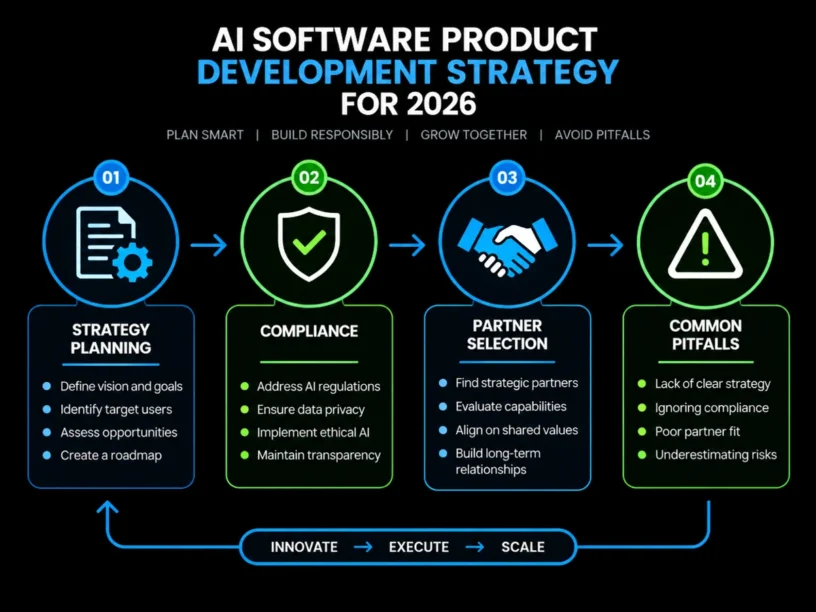
AI software product development strategy for successful products | Updated October 2026 | 10 min read | The Appomate Team
Building a successful AI product in 2026 requires integrating rigorous idea validation, AI-native product architecture, and alignment with Australia’s voluntary AI governance framework. You need a rapid go-to-market execution partner to avoid the two biggest traps: superficial AI integration that adds no real value, and building something nobody wants. Over 60% of venture capital flowing into Australian startups in 2025 went to AI-enabled companies, yet many products fail because teams skip validation, over-engineer, or treat AI as a feature bolted onto legacy code rather than a foundational element. This guide covers market timing, the build framework, compliance, and how to pick the right technology partner.
The founders who win in 2026 won’t be the ones with the flashiest AI demo. They’ll be the ones who validated the problem first, built an AI-native product second, and found a partner who could get them to market before the opportunity window closed.
What Is an AI Software Product Development Strategy for Success in 2026?
An AI software product development strategy for success in 2026 is a structured plan that sequences idea validation, AI-native design, agile development, regulatory compliance, and go-to-market activity. It’s a decision framework that determines where AI creates genuine value, how the product will be architected around it, and how the business will scale once it has traction-not simply “adding a chatbot” to an existing app.
The Five Pillars of the Strategy
- Problem validation: Confirming real demand exists before code is written, using user interviews, landing pages, and clickable prototypes.
- AI-native architecture: Designing the product so AI models, data pipelines, and feedback loops are core infrastructure, not an afterthought.
- Agile, AI-accelerated build: Using sprint-based development combined with AI coding tools to compress build timelines without sacrificing quality.
- Governance and compliance: Aligning with Australia’s Voluntary AI Safety Standard and the Privacy Act from day one.
- Launch and growth loop: Treating launch as the start of a data-driven iteration cycle.
Key Takeaway: A genuine AI software product development strategy for successful products treats validation, architecture, compliance, and growth as one connected system. This separation is what distinguishes founders who ship confidently from those who endlessly rebuild. See also, see Top 25 AI Tools Every Business Should Use in 2026.
Why Australian Founders Need an AI-Driven Software Success Plan in 2026
Australia’s market conditions in 2026 reward founders who move decisively on AI-driven software. AI adoption is accelerating, capital is concentrating around AI-enabled startups, and the local tech sector has matured into a genuine growth engine.
The Numbers Behind the Opportunity
- Tech Sector Value: The Australian tech sector is worth over A$167 billion, contributing nearly 8.5% of national GDP.
- AI Investment Driver: Over 60% of all venture capital in 2025 went to startups with AI in their tech stack.
- Startup Ecosystem Growth: Australia’s startup ecosystem grew by approximately 24.8% in 2025 and ranks around #12 globally.
| Metric | Figure | What It Means for Founders |
|---|---|---|
| SMB regular AI adoption | Nearly doubled from 40% in July 2024 to 69% in January 2026 | AI-enabled products are becoming expected, not optional |
| Large enterprise AI adoption | 35% of large businesses, up from 9% in 2021-22 | B2B and enterprise buyers are ready for AI-native solutions |
| Startup funding deals (2025) | 390 startup funding deals completed | Capital is active and concentrated in high-growth, AI-driven ventures |
| SaaS companies operating in Australia | 800+ SaaS companies | Competition is real, speed to market matters |
| B2B startups offering software products | 80% of B2B startups | Software-first thinking is the default |
A total of $5.1 billion was raised across the Australian startup ecosystem, with strong AI interest giving founders a supportive environment to build and scale.
Key Takeaway: Australia’s AI adoption curve is steep and still climbing. Founders who build a credible AI software product development strategy for successful products now are positioned ahead of the next wave of enterprise and consumer adoption. See also, see Best AI Tools for Developers in 2026 (That Actually Matter ….
Building Your AI Product Strategy: A Step-by-Step App Development Planning Framework
A practical AI product strategy breaks app development planning into distinct phases, each with a clear output. This means you always know what decision comes next and never commit full budget before demand is proven.
Phase-by-Phase Breakdown
| Phase | Core Activity | Typical Timeframe | Outcome |
|---|---|---|---|
| 1. Validate | User interviews, clickable prototype, demand testing | 1-2 weeks | Confirmed problem-solution fit |
| 2. Define AI Strategy | Decide where AI adds real value and map the tech stack | 1-2 weeks | Clear feature scope and architecture |
| 3. Design | UI/UX design and interactive prototyping | 2-4 weeks | Tested, investor-ready prototype |
| 4. Build | Agile sprints using AI-accelerated development | 6-10 weeks | Production-ready iOS and Android app |
| 5. Launch and Grow | Go-to-market, marketing, and continuous iteration | Ongoing | Live product with a data-driven growth loop |
Why Sequencing Matters
- Validation before architecture: Skipping user validation is the single most common reason AI products fail. Teams build for assumptions instead of evidence.
- Scope discipline: Freezing scope to the validated MVP list and deferring extras to a later sprint keeps budgets intact.
- AI as infrastructure, not decoration: Cross-platform frameworks like Flutter and React Native now support AI and machine learning SDKs natively, meaning a single codebase can carry real AI functionality across iOS and Android.
- Cost reality: Mobile app development in Australia costs AUD 25,000 to 600,000 depending on complexity, with a basic MVP typically costing between AUD 50,000 and 95,000 over two to four months.
Key Takeaway: App development planning works best as a staged funnel: validate cheaply, design before building, and build with AI acceleration. This approach gives you natural checkpoints to course-correct if market signals shift. For related guidance, see AI Integration Mobile Apps Australia Machine Learning Development.
Avoiding Common Pitfalls: AI Compliance and Governance in Australia
Founders building AI products in Australia operate without a standalone AI Act, but compliance is not optional. The government’s current approach layers voluntary guidance on top of existing law, and getting this wrong early is costly.
The Current Regulatory Landscape
- Voluntary AI Safety Standard: A practical, non-binding framework published by the Australian Government’s National Artificial Intelligence Centre, emphasizing a risk-based, human-centered approach.
- Current Framework Components: The framework includes 10 voluntary guardrails, an Australian AI Safety Institute funded at AUD 29.9 million launching in early 2026, and full continuing application of existing law including the Privacy Act.
- “Voluntary” Interpretation: The term “voluntary” indicates regulation is addressed through existing legal frameworks and guidance, not a standalone AI Act.
Common Pitfalls to Avoid
- Confusing “AI wrapper” with “AI-native”: Simply calling an API from a language model provider creates easily copied products with no defensible data advantage.
- Treating compliance as an afterthought: Compliance needs to be negotiated at the vendor stage, not after launch.
- Ignoring data governance: Clean, consented, and well-labelled data is the foundation of reliable AI features.
- No human oversight mechanism: Meaningful human oversight and user-facing transparency exist because unchecked automated decisions create legal and reputational risk.
- Underestimating the talent gap: 72% of Australian employers have sourced IT talent internationally, so a blended delivery model avoids delays.
The right question in 2026 isn’t “do I need to comply with an AI Act,” it’s whether you have documented how your AI system meets the standards you are already legally obliged to meet, in a way a regulator would find credible.
Key Takeaway: Building compliance and genuine AI-native architecture into the product from day one is cheaper and faster than retrofitting either after launch. For more on common pitfalls, see AI-First Software Product Development Strategy Guide.
Choosing an AI Software Product Development Strategy Partner for Successful Products
The right development partner can be the difference between a product that reaches market in weeks and one that stalls for years. For non-technical founders especially, choosing a partner who understands both AI-native engineering and commercial strategy is the single highest-leverage decision.
What to Look For in a Partner
- Full-service capability: A partner covering strategy, design, build, launch, marketing, and support avoids coordination overhead.
- AI-native development, not AI wrapping: Look for teams who architect products around AI as core infrastructure and use AI-driven development tools to build faster.
- Proven validation process: A credible partner validates your idea with real users before committing to full development.
- Hybrid delivery model: Combining Australia-based strategy and design with a skilled global development team delivers premium quality at startup-friendly pricing.
- Track record at scale: Experience across verticals signals a partner who can adapt the framework to your market.
Appomate’s Approach to AI-Native Product Development
- Company Overview: Appomate is a Melbourne-based mobile and web app development company that has delivered 250+ apps for clients including Adidas, L’Oreal, Lend Lease, and Hoyts.
- Full Growth Partner: Operates as a full growth partner covering validation, design, development, launch, marketing, and long-term support.
- Further Faster Framework: Uses the Further Faster Framework and agile methodology to help founders go from idea to market in as little as six weeks.
- AI-Native Development: Builds products that are genuinely AI native rather than AI wrappers, using AI-driven development tools to deliver faster outcomes.
- Hybrid Delivery Model: Pairs Australia-based strategy and product design with a global development team to deliver high-quality digital products efficiently and affordably.
- Empowering Founders: Specifically empowers founders, especially non-technical ones, to turn concepts into market-ready apps quickly and safely.
Key Takeaway: The strongest AI software product development strategy for successful products pairs a validated idea with a partner built to execute across the entire journey, from first prototype to profitable exit. See also, see Best AI Tools for Business in 2026.
Ready to build your app?
Book a free Visioning Call with our team today and walk away with a clear roadmap, expert feedback, and a plan to bring your idea to life. No technical knowledge required.
Conclusion
Success with an AI software product development strategy for success in 2026 comes down to sequencing: validate the problem, architect the product around genuine AI capability, stay ahead of Australia’s governance expectations, and partner with a team that can execute the full journey. Founders who skip steps to “move fast” typically end up moving slower overall.
- Validate first: Confirm real user demand before committing development budget.
- Build AI-native, not AI-wrapped: Architect AI as core infrastructure so the product has a defensible advantage.
- Plan for compliance: Align with the Voluntary AI Safety Standard and Privacy Act from day one.
- Control scope and cost: Use a phased framework to avoid feature creep and budget blowouts.
- Choose a full-journey partner: A team covering strategy through growth reduces coordination risk and accelerates time to market.
The next step is straightforward: get an honest validation read on your idea before you write a single line of code, and bring in a partner equipped to take you from there to launch.
FAQ
What is the best AI software product development strategy for success in 2026?
The best AI software product development strategy for success in 2026 integrates early idea validation with real users, AI-native product architecture, and adherence to Australia’s Voluntary AI Safety Standard. It emphasizes a phased, agile development process supported by a full-service delivery partner capable of guiding the product from initial prototype through launch and sustained growth.
How do I validate an AI app idea before building it in Australia?
Start with structured user interviews, a landing page testing real demand, and a clickable prototype. This typically takes one to two weeks and confirms problem-solution fit, saving significant rework costs later.
What’s the difference between an AI-native product and an AI wrapper?
An AI wrapper simply calls an external AI model’s API with no proprietary data advantage. An AI-native product is architected from the ground up with AI as core infrastructure, including dedicated data pipelines, feedback loops, and a service layer that isolates AI failures.
How much does AI software product development cost in Australia in 2026?
Mobile app development in Australia ranges from approximately AUD 25,000 to over AUD 600,000 depending on complexity. Most mid-complexity projects fall between AUD 60,000 and 250,000. A basic, validated Minimum Viable Product (MVP) usually costs AUD 50,000 to 95,000 and launches within two to four months.
Do I need to comply with AI regulations in Australia?
Australia has no standalone AI Act, but the current framework includes the Voluntary AI Safety Standard with 10 voluntary guardrails, an Australian AI Safety Institute, and full continuing application of existing law including the Privacy Act. Treat the guardrails as a practical checklist for governance, data handling, and transparency.
How long does it take to build and launch an AI-powered app in Australia?
With a disciplined, phased approach, founders can move from validated idea to a production-ready app in roughly 10 to 16 weeks. Experienced partners using AI-accelerated development have taken founders from idea to market in as little as six weeks.
What is an AI product strategy and why does it matter for startups?
An AI product strategy is the decision framework that determines where AI genuinely improves the user experience, how the product will be architected around it, and how the business plans to scale. It matters because without it, startups risk building expensive, generic AI features that competitors can replicate in weeks.
How can non-technical founders build an AI app successfully?
Non-technical founders succeed by partnering with a full-service team that handles validation, design, AI architecture, and development while keeping the founder closely involved in product decisions and user feedback.
This article was researched using publicly available Australian industry data, government publications including the Department of Industry, Science and Resources, and market reporting current as of October 2026. Figures and regulatory details are subject to change; founders should verify current requirements with official sources before making business decisions.