is product-led growth the right app marketing strategy for SaaS apps | Updated September 2026 | Appomate Team
Is product-led growth the right app marketing strategy for SaaS in 2026? For most self-serve, usage-based SaaS products, the answer is yes: product-led growth (PLG) remains one of the most capital-efficient ways to acquire and retain customers. Whether PLG fits your SaaS app depends on three things: your price point, how complex your buyer is, and whether your product can deliver a genuine “aha moment” without a salesperson. Australia has given the world two of the clearest PLG success stories in Atlassian and Canva.
Product-led growth isn’t a marketing channel you switch on. It’s an operating model that lives or dies on whether your product can create value in the first five minutes, not the first sales call.
What Is Product-Led Growth and How Does It Work for SaaS Apps?
Product-led growth (PLG) is a go-to-market model where the product itself, rather than a sales team or marketing campaign, drives user acquisition, activation, conversion, and expansion. Users try the product, experience value, and often pay before ever speaking to a human. Bessemer Venture Partners traces this model back to Atlassian, one of the pioneering companies to build a cloud business this way.
The Core Mechanics of PLG
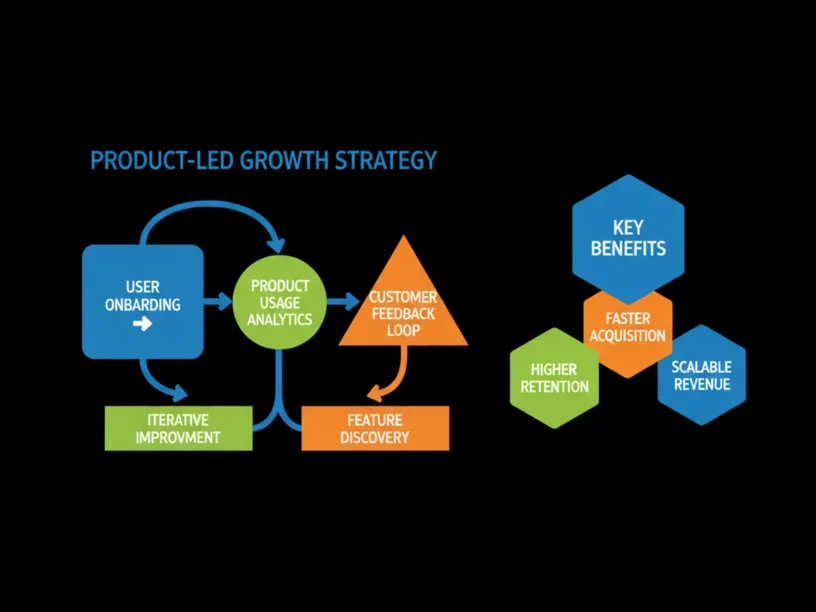
PLG typically runs on a few connected systems:
- Free trial or freemium entry point: Users sign up with no sales contact, often credit card-free or with a permanently free tier with usage caps.
- Time-to-value optimization: Onboarding delivers a meaningful outcome within minutes, not weeks.
- Product Qualified Leads (PQLs): Usage signals tell the team which free users are ready for upgrade conversations.
- In-product upgrade prompts: Paywalls appear at the exact moment a user hits a feature or usage limit.
- Expansion loops: Existing users invite teammates or share outputs, creating viral growth.
Former Atlassian product lead Matt Ryall notes that product-led companies give buyers the “keys” to use the product and help them experience a meaningful outcome, at which point upgrading becomes a no-brainer. Removing every barrier between curiosity and value is the throughline of every successful PLG SaaS business.
Key Takeaway: PLG works when the product can prove its value unassisted. If your product needs a human to explain its worth, PLG alone will underperform. For deeper context, see What is product-led growth? Building the best strategy.
Is Product-Led Growth Still Effective for SaaS in 2026?
Yes. Product-led growth is now the dominant operating model for scaled B2B SaaS. The companies winning with it in 2026 are layering sales and AI-driven onboarding on top of self-serve foundations rather than relying on free signups alone.
The 2026 Adoption Numbers
- Mainstream adoption: Industry benchmark data shows 91% of B2B SaaS companies with over $50 million in ARR have implemented PLG strategies, with 91% planning to increase investment.
- Revenue advantage: PLG companies achieve 50% higher revenue growth rates than traditional sales-led counterparts while spending 39% less on sales and marketing.
- Hybrid model prevalence: Roughly 67% of companies above $10M ARR run a hybrid PLG plus sales-led growth motion.
- Execution challenges: Only 27% of PLG companies report sustained year-over-year expansion, underscoring that PLG requires disciplined execution.
| Metric | 2021 Benchmark | 2026 Benchmark | What It Signals |
|---|---|---|---|
| SaaS companies self-identifying as product-led | 35% | 58-60% | Adoption has grown significantly |
| Companies planning to increase PLG investment | n/a | 91% | Confidence in the model is compounding |
| Companies actively tracking activation rate | n/a | 34% | Most teams under-invest in the metric that predicts revenue |
| Hybrid PLG + sales-led motion (>$10M ARR) | n/a | 67% | Pure self-serve is rare at scale |
Key Takeaway: For most self-serve products, the data says yes. But winners pair PLG with activation tracking and a hybrid sales layer, not treating a free trial as the whole strategy. For related guidance, see How Founders Can Scale Saas Products In 2025 Strategies For Sustainable Growth.
Where Product-Led Growth Works Best: Australian Examples
PLG performs best in products with low-friction adoption, individual or small-team buyers, and a clear, fast path to a single “aha” outcome. Australia has produced two of the clearest global case studies.
Atlassian: PLG Before It Had a Name
Atlassian, founded in Sydney in 2002, is one of the first cloud companies to build a PLG business model deliberately. Bessemer Venture Partners documents that Atlassian famously employed no salespeople for the first decade. When a major Wall Street bank demanded an enterprise discount, the company simply declined.
- Geographic necessity: Being based far from Silicon Valley meant Atlassian had to sell online, at low prices, and in massive volume.
- Market capitalization: Atlassian now trades at roughly $45 billion, built almost entirely on self-serve distribution.
Canva: PLG Beyond Developer Tools
Canva, founded in Sydney in 2013, proved PLG works far outside technical, developer-first products.
- User growth: Monthly active users reached 265 million at the end of 2025, up from 180 million the year prior, with over 31 million paid users.
- Profitability: Canva has been operating profitably for 7 years with an efficient product-led growth motion, funding AI investment without repeated fundraising.
| Company | Founded | PLG Mechanism | Scale Achieved |
|---|---|---|---|
| Atlassian | 2002, Sydney | No-sales-team self-serve model | ~$45B market cap |
| Canva | 2013, Sydney | Freemium design tool | 265M+ monthly active users, $42B valuation |
Key Takeaway: Both succeeded by removing friction between a user and a real outcome. This pattern applies regardless of product category. For a detailed case study, see Product-Led Growth Strategy in 2026: Transition into the ….
Ready to build your app?
Book a free Visioning Call with our team today and walk away with a clear roadmap, expert feedback, and a plan to bring your idea to life. No technical knowledge required.
Product-Led Growth vs Paid User Acquisition: Which Should Your SaaS App Choose?
Most scaled SaaS companies eventually run both. The right starting point depends on your average contract value, buyer sophistication, and how self-explanatory your product is.
When PLG Fits Best
- Low price point, high volume: Products priced under roughly $100 a month per seat, where a credit card purchase doesn’t need approval, are natural PLG candidates, a threshold Atlassian’s product team has pointed to.
- Individual or small-team buyer: If one person can decide and start using the product without procurement, self-serve conversion is viable.
- Fast, demonstrable value: If a user experiences core benefit in a single session, free trials convert.
- Viral or collaborative usage: Products where one user naturally invites others get free distribution built in.
When Paid Acquisition or Sales-Led Still Wins
- High-value, complex enterprise deals: Six and seven-figure contracts require relationship-based sales and security reviews.
- Regulated or high-stakes categories: Healthcare, fintech, and government-adjacent SaaS often require compliance conversations a free trial cannot replace.
- Long, non-obvious time-to-value: If real value only appears after weeks, self-serve trials will churn before users see the benefit.
| Factor | Favours Product-Led Growth | Favours Paid/Sales-Led Acquisition |
|---|---|---|
| Price point | Under ~$100/seat/month | Enterprise contracts, custom pricing |
| Buyer | Individual, small team | Committee, procurement, compliance |
| Time-to-value | Minutes to single session | Weeks, needs support |
| Growth loop | Viral/invite-driven | Account-based, relationship-driven |
| CAC efficiency | 39% less spend on sales and marketing | Sales-led CAC typically climbing 20-30% annually |
Key Takeaway: For complex enterprise sales, a hybrid model works best: self-serve for individual users, sales-assisted for enterprise deals. For a side-by-side breakdown, see Product-led vs sales-led growth: Which is right ….
What Are the Biggest Risks and Common Mistakes with PLG?
Product-led growth fails most often because teams copy surface tactics without fixing underlying activation and retention problems. The model rewards discipline over imitation.
The Most Common Failure Patterns
- Copying tactics without fixing activation: 85% of PLG shifts fail because teams copy free trials and freemium without fixing activation, time-to-value, or pricing.
- Neglecting key metrics: Only 34% of PLG companies actively track activation, even though top performers target 40-60% activation rates.
- Confusing free signups with growth: Many companies acquire free users faster than they retain them.
- Underpricing the free tier: Giving away the exact feature that would justify upgrade removes the reason to convert.
- Ignoring enterprise potential: Waiting to add sales-assisted motion can leave revenue on the table as deal sizes grow.
Only 27% of PLG companies report sustained year-over-year expansion, a reminder that a free trial page is not a growth strategy on its own.
Key Takeaway: The risk isn’t the model itself; it’s treating it as a checkbox rather than an engineering discipline. For more on common pitfalls, see 15 SaaS Marketing Strategies That Work in 2026 | TGS.
How Should a SaaS Founder Decide and Build for Product-Led Growth?
Deciding whether PLG suits your SaaS app is less about picking a marketing tactic and more about product and go-to-market design choices made from the first build.
A Practical Decision Framework
- Map true time-to-value: Before committing to a free trial, test how long it genuinely takes a first-time user to reach a meaningful outcome unaided.
- Validate before building: Atlassian’s product leadership has stressed that validating PLG potential requires talking to prospective users first.
- Design onboarding as a product feature: Interactive guides, sensible defaults, and in-product prompts do more for conversion than email sequences.
- Instrument activation from day one: Build analytics to track PQL signals before launch, not six months after you notice churn.
- Plan the hybrid layer early: Decide upfront where self-serve stops and sales-assisted begins, so pricing and permissions support both from the start.
Appomate, a Melbourne-based mobile and web app development company, works with founders from validation through design, development, launch, and growth support. This means onboarding flows, activation tracking, and pricing architecture can be designed for PLG from the first sprint rather than retrofitted later. Its Further Faster Framework and AI-driven development pair Australia-based strategy with a global team to get founders from idea to market-ready product quickly.
Key Takeaway: Founders who get the most from PLG treat activation, onboarding, and pricing as product decisions from day one. Having a growth-minded technology partner early materially reduces the risk of building the wrong thing. For related guidance, see How Long Does It Take To Build An AI Mobile App In Australia From Idea To Launch.
Conclusion
Product-led growth remains one of the most efficient go-to-market models for SaaS founders in 2026, but it rewards discipline over imitation. Atlassian and Canva prove the model can scale to tens of billions in value, yet most PLG attempts underperform when teams skip activation tracking and genuine time-to-value design.
- Mainstream adoption: Most scaled B2B SaaS companies have adopted PLG and plan to invest further.
- Fit depends on product and buyer: Low-price, self-serve, individual-buyer products suit PLG; complex enterprise sales usually need a hybrid layer.
- Execution over imitation: Copying a free trial without fixing activation is the biggest cause of PLG failure.
- Proven Australian playbooks: Atlassian and Canva show PLG can scale globally from Australia in different product categories.
- Strategy starts at build: Founders get better outcomes when onboarding, pricing, and activation are designed in from day one.
If you’re weighing whether product-led growth suits your SaaS app, validate your specific product against this framework, ideally with a partner who can help design for activation and growth from the first sprint.
FAQ
Is Product-Led Growth the Right App Marketing Strategy for SaaS in 2026?
For most self-serve SaaS products with a price point under roughly $100 per seat per month and a fast value moment, yes. 91% of B2B SaaS companies with over $50 million in ARR have implemented PLG strategies. The model works best as part of a hybrid approach that layers sales-assisted motions on top for larger deals.
What is the difference between product-led growth and sales-led growth?
Product-led growth lets users try, activate, and pay without speaking to a salesperson, using in-product signals to identify who is ready to upgrade. Sales-led growth relies on a human sales team to qualify, demo, and close deals, suiting higher-priced, complex, or compliance-heavy products.
Do small SaaS startups in Australia have the resources to run PLG?
Yes, PLG is often more accessible to lean startups than sales-led growth because it doesn’t require building a sales team before product-market fit. Atlassian itself started this way from Sydney with no salespeople for its first decade.
What metrics matter most for measuring PLG success?
Activation rate, the percentage of new users who complete a key action correlated with retention, is the single most predictive PLG metric, yet only 34% of PLG companies actively track it. Free-to-paid conversion rate, net revenue retention, and product-qualified lead (PQL) volume are also core metrics.
Can product-led growth work for enterprise SaaS?
Yes, but usually as a hybrid model. Roughly 67% of companies above $10M ARR run a hybrid PLG plus sales-led growth motion, using self-serve entry points to build usage before sales steps in for larger contracts.
What is the biggest mistake founders make when adopting PLG?
Copying surface-level tactics like adding a free trial without fixing underlying activation, onboarding, and pricing issues. 85% of PLG shifts fail for this reason.
How does Appomate help SaaS founders decide on and build for PLG?
Appomate works with founders from validation through design, development, launch, and growth support, meaning onboarding flows, activation tracking, and pricing architecture can be designed for PLG from the first sprint. Its Further Faster Framework pairs Australia-based strategy with a global development team to get founders from idea to market-ready product quickly.
This article was compiled using publicly available industry research, benchmark reports, and named company case studies current as of September 2026. Figures on Atlassian and Canva are drawn from company statements and third-party analysis cited inline; SaaS market and PLG benchmark statistics are drawn from the sources linked throughout. This content is intended as general information for founders evaluating growth strategy and is not financial, legal, or investment advice.