how to choose an app marketing agency in Australia | Updated September 2026 | By the Appomate Team | Beginner
What You’ll Learn
This guide walks you through how to choose an app marketing agency in Australia in 2026. You’ll learn to define your growth goals, shortlist agencies with proven App Store Optimization (ASO) and user acquisition results, vet case studies and client references, check for full-funnel capability beyond paid ads, and lock in reporting and contract terms that protect your budget. By the end, you’ll have a repeatable evaluation checklist.
- A five-step vetting process you can run in one to two weeks.
- The exact questions to ask before signing a retainer.
- Realistic 2026 cost benchmarks for Australian app marketing services.
- Red flags that separate genuine growth partners from vanity-metric sellers.
Prerequisites: a live or near-launch app, a rough monthly marketing budget, and clarity on whether you need ASO, paid user acquisition, or both.
Why Choosing the Right App Marketing Agency Matters in 2026
The App Store now hosts around 2.19 million apps, with Google Play carrying over two million more. Apple’s 2024 Transparency Report revealed that the App Store saw an average of 839 million downloads per week, but 1.9 billion redownloads weekly-redownloads outpaced new downloads by more than 2 to 1. Agencies that only chase new installs miss half the growth picture.
Mobile app marketing budgets typically range from $5,000 for indie apps to $500,000+ annually. Working with an app marketing agency costs $5,000 to $25,000 monthly but often delivers 3-5x higher ROI than in-house teams. Sixty-five percent of app downloads come from App Store search, and the top 3 results capture over 50% of all downloads for that search term. An agency without a store-listing strategy will waste both money and early-launch momentum.
Australia adds complexity: tier-1 markets like the US, UK, and Australia command 3-5x higher CPIs (Cost Per Install) than emerging markets. An agency unfamiliar with local media costs can burn through your budget quickly. For supporting data, see Top 25 Creative app marketing agencies based in Australia.
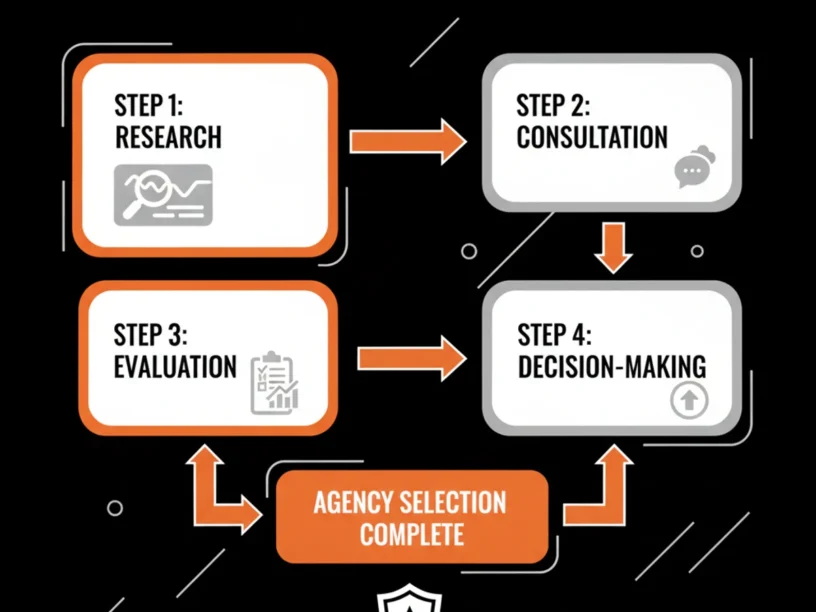
The Process at a Glance
| Step | Action | Time | Outcome |
|---|---|---|---|
| 1 | Define goals, budget and success metrics | 1-2 days | Clear brief agencies can quote against |
| 2 | Shortlist agencies with proven ASO/UA results | 2-3 days | 4-6 qualified candidates |
| 3 | Vet case studies, reviews and references | 3-5 days | Evidence-backed shortlist of 2-3 |
| 4 | Evaluate full-funnel and post-launch capability | 2-3 days | Confirmed strategic fit, not just ad-buying |
| 5 | Confirm reporting, contract and cultural fit | 1-2 days | Signed agreement with clear KPIs |
Total time: 1.5 to 2.5 weeks from brief to signed agreement.
Step 1: Define Your App Marketing Goals and Budget
What You’re Doing
Before contacting any agency, define what “success” means for your app: installs, retention, revenue, or ranking position. This prevents vague quotes and enables fair comparison.
How to Do It
- List your top three metrics (e.g., cost per install, Day-30 retention, or App Store keyword rank).
- Set a realistic monthly budget. ASO services typically cost $2,000 to $8,000 monthly and can reduce paid acquisition costs by 15-25%.
- Decide whether you need ASO only, paid user acquisition only, or a blended program.
- Note your app’s category: finance and banking apps average $15.48 per install; gaming apps average $6.45 CPI.
Best Practices
- Separate agency management fees from ad spend in your budget. Agency fees cover strategy, account management, creative production, and optimization. Ad spend goes directly to platforms.
- Aim for a 3:1 LTV (Lifetime Value) to CAC (Customer Acquisition Cost) ratio as a baseline.
What Done Looks Like
You have a one-page brief with goals, budget range, and category context ready to send to every shortlisted agency. For a more detailed walkthrough, see 10 App Marketing Strategies That Actually Work in 2026. For related guidance, see Best Paid User Acquisition Strategies For Mobile Apps In 2026.
Step 2: Shortlist Agencies With Proven ASO and User Acquisition Results
What You’re Doing
Build a list of four to six agencies that have demonstrably worked on apps similar to yours in category, stage, or region.
How to Do It
- Search Clutch’s Australian app marketing rankings and Business of Apps’ user acquisition marketplace for verified reviews.
- Filter for agencies that explicitly mention App Store Optimization (ASO). App Store search remains the largest acquisition channel on iOS.
- Check whether the agency understands 2026 ASO shifts, including how screenshot text became a critical ranking factor.
- Confirm they have handled Australian or APAC campaigns specifically.
Common Mistakes
Shortlisting purely on price is misleading. Cheaper hourly rates can hide inexperienced teams or inflated hours.
What Done Looks Like
You have four to six agencies whose portfolios show relevant category or regional experience.
Step 3: Vet Case Studies, Reviews and Client References
What You’re Doing
Separate agencies that talk about growth from those that have actually driven it through case studies and direct reference calls.
How to Do It
- Request two to three case studies with before/after numbers, not just testimonials.
- Request one live client reference in a similar app category.
- Ask how they measure success. Sophisticated agencies track keyword relevance, tap-through behavior, conversion rate, install velocity, ratings, review sentiment, and retention signals-not just installs.
- Confirm their pricing model. Hybrid pricing (combining a base retainer of $3,000–$8,000 monthly with performance bonuses) is now dominant in 2026.
Example
| Question to Ask | Strong Answer Looks Like | Weak Answer Looks Like |
|---|---|---|
| “Show me a before/after ASO result” | Specific keyword rank jump, download lift, timeframe | Vague “we improved visibility” |
| “What’s your pricing model?” | Clear retainer + performance breakdown, separate from ad spend | Bundled, unclear fee including media spend |
| “Can I speak to a current client?” | Immediate yes, offers a call within days | Hesitation or only written testimonials |
What Done Looks Like
You’ve had at least one direct conversation with a real client and can point to specific, dated results.
Step 4: Evaluate Full-Funnel and Post-Launch Capability
What You’re Doing
Check whether an agency supports your app through retention and long-term growth, not just launch spikes.
How to Do It
- Ask whether the agency handles retention and re-engagement. Weekly redownloads now outpace new downloads by more than 2 to 1.
- Check if they advise on product changes that affect marketing performance. Retention marketing typically requires 25-30% of total marketing spend but generates 65% of long-term revenue.
- Ask if they offer development and product support or can coordinate with your team.
- Full-service technology partners have an edge over pure media-buying shops. Appomate, for example, partners across the entire journey: validation, product design, development, launch, marketing, and ongoing support.
Best Practices
- Ask what happens after month three. Does the agency have a retention or lifecycle plan?
- Favor agencies that understand your app’s technical roadmap.
What Done Looks Like
You have a written answer on how the agency handles retention, re-engagement, and product-marketing coordination. For related guidance, see 10 Best App Development Marketing Agencies For Non Technical Founders In Australia 2026.
Step 5: Confirm Reporting, Contract Terms and Cultural Fit
What You’re Doing
Lock in practical details: reporting cadence, exit clauses, communication speed, and KPI checkpoints.
How to Do It
- Request a sample reporting dashboard before signing.
- Clarify contract length and exit clauses; avoid 12-month lock-ins on first engagements.
- Confirm your day-to-day contact and response time.
- Set explicit KPI checkpoints at 30, 60, and 90 days.
Common Mistakes
Signing long-term contracts before a trial period is costly. Many agencies offer 60-90 day trial retainers.
What Done Looks Like
You have a signed agreement with clear reporting cadence, defined KPIs, and an exit path if underperforming.
What to Do After Choosing Your App Marketing Agency
Phase 1 (Weeks 1-4): Share analytics, app store listings, and prior campaign data for baseline benchmarking.
Phase 2 (Weeks 4-12): Initial ASO or ad adjustments take time. It typically takes 2-4 weeks for initial campaign learning. Meaningful data requires 4-8 weeks and $5K–$10K per channel minimum.
Phase 3 (Month 3+): Double down on highest-performing channels and consider expanding scope.
Ready to build your app?
Book a free Visioning Call with our team today and walk away with a clear roadmap, expert feedback, and a plan to bring your idea to life. No technical knowledge required.
Resources You’ll Need
| Resource | Role | Required/Recommended | Price |
|---|---|---|---|
| Appomate | Full-service app development, marketing and growth partner | Recommended | Custom quote |
| Clutch Australia App Marketing Directory | Agency shortlisting and verified reviews | Required | Free |
| Business of Apps Marketplace | Agency comparison and benchmarking | Recommended | Free |
| Apple Search Ads | Paid iOS user acquisition channel | Optional | Pay-per-click |
| Sensor Tower | Market and competitor benchmarking | Optional | Freemium/paid |
See also, see Top App Marketing Companies (2026).
Common Plateaus and How to Break Through
Problem: Agency reports only show installs, no retention or revenue data
Likely cause: The agency optimizes for the easiest metric, not the one that matters.
Fix: Require retention, LTV, and CAC ratios in every report from day one. Hold the agency to the 3:1 LTV to CAC benchmark.
Problem: Costs climbing but installs plateauing
Likely cause: Over-reliance on paid ads without ASO. The average cost per install through paid advertising is $2.24 on iOS and $0.88 on Android, while organic ASO-driven installs cost nothing per acquisition.
Fix: Push the agency to rebalance spend toward organic ASO. Developers investing in ASO alongside paid campaigns typically see 3-5x improvement in overall ROI.
Problem: No clear owner for post-launch product or feature requests
Likely cause: The agency is a pure marketing shop with no development capability.
Fix: Choose a partner with both marketing and product/development capability.
Problem: Agency locks you into a long contract before proving results
Likely cause: The agency’s business model depends on retainer revenue rather than performance.
Fix: Negotiate a 60-90 day trial period with defined KPIs before signing any 6-12 month agreement. For more troubleshooting advice, see How to Choose the Right App Marketing Agency.
Conclusion
Choosing the right app marketing agency in Australia in 2026 comes down to five steps: define your goals and budget, shortlist agencies with proven ASO and UA results, vet case studies and references, confirm full-funnel capability, and lock in clear reporting and contract terms. Skip any and you risk wasting premium Australian CPIs on an agency that can’t move your numbers.
Key Takeaways
- A structured five-step vetting process takes 1.5 to 2.5 weeks and dramatically reduces selection risk.
- The strongest agencies combine ASO, paid acquisition, and retention strategy.
- Write your one-page brief today and start shortlisting from Clutch before reaching out to agencies.
FAQ
How do I choose an App Marketing Agency in Australia in 2026?
Define your goals, budget, and success metrics first. Then shortlist four to six agencies with proven ASO and user acquisition track records using Clutch. Vet their case studies and speak to a current client reference, confirm full-funnel support including retention, and lock in a trial-period contract with clear reporting and KPIs. This process takes one to two and a half weeks.
How much does an app marketing agency cost in Australia?
Working with an app marketing agency costs $5,000 to $25,000 monthly but often delivers 3-5x higher ROI than in-house teams. ASO services typically cost $2,000 to $8,000 monthly. Always confirm whether quoted fees include ad spend or are management fees only.
What’s the difference between ASO and paid user acquisition?
App Store Optimization (ASO) focuses on organic App Store and Google Play search discovery, which drives 65% of iOS discovery at zero cost per install. Paid user acquisition buys visibility through ads on platforms like Google, Meta, and TikTok. The strongest agencies run both in tandem.
Should I hire a specialist ASO agency or a full-service growth partner?
Early-stage apps needing ongoing product development often benefit from a full-service partner like Appomate, which combines strategy, design, development, launch, and marketing. A specialist suits apps with strong dev teams that just need marketing execution.
How long before I see results from an app marketing agency?
It typically takes 2-4 weeks for initial campaign learning and optimization. Meaningful performance data requires 4-8 weeks and $5K–$10K in spend per channel minimum. ASO changes take a few weeks to reflect in rankings.
What questions should I ask before signing a contract?
Ask for two to three case studies with before/after numbers, a live client reference, their pricing model (retainer versus performance versus hybrid), how they measure retention and revenue, and whether they offer a trial period. These five answers reveal more than any pitch deck.
Are Australian app marketing costs higher than other countries?
Yes. Tier-1 markets like the US, UK, and Australia command 3-5x higher CPIs than emerging markets. However, these markets typically deliver higher-quality, higher-spending users, justifying the premium if your unit economics support it.
Can one agency handle both app development and app marketing in Australia?
Yes. Appomate combines Australia-based strategy and design with a global development team, offering full-service support from validation through launch and beyond. This integrated approach simplifies vendor management for founders avoiding separate dev and marketing agencies.
This guide uses publicly available 2026 industry data from Sensor Tower, Apple’s Transparency Report, Business of Apps, and Clutch. Costs vary by app category, market conditions, and agency scope; confirm current pricing directly with any agency before signing.