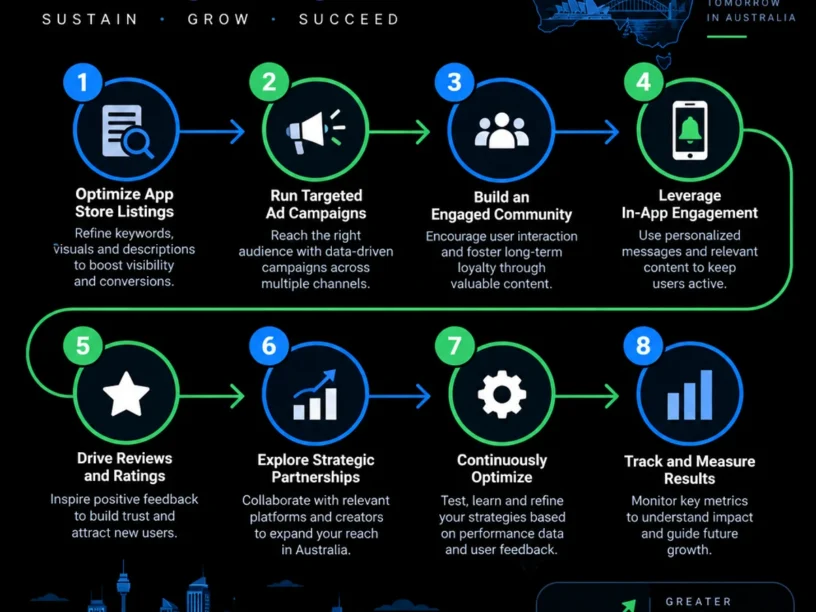
post-launch mobile app marketing strategies Australia 2026 | Updated October 2026 | Appomate Team | 4-8 weeks to implement, ongoing thereafter | Beginner
What You’ll Learn
Your app is live. Now comes the harder part: keeping people using it. By the end of this guide, you’ll know exactly what to do in your first 90 days and beyond:
- How to optimize your app store listing so organic installs compound over time.
- How to design a first-session experience that keeps users past day one.
- How to build retention loops using push, email, and in-app messaging.
- How to scale paid acquisition and referrals without burning your budget.
Prerequisites: You need a live app on the App Store and/or Google Play, basic analytics tracking installed (Firebase or similar), and access to update your store listing and send push notifications.
Why Post-Launch Mobile App Marketing Matters in 2026
Launching an app is no longer the hard part. Keeping users is. Industry-wide, mobile app retention data for 2026 shows iOS apps retain just 25.4% of users on day one and only 5.3% by day 30, while Android trails at 20.2% and 3.8% respectively. More than 90% of users abandon apps before the 30-day mark.
Australia is a particularly attractive but competitive market. The Australian app market generated $3 billion in revenue in 2024, a 15.3% increase from the previous year, and Australians downloaded 1.3 billion apps in 2024. However, app fatigue is real: people download, test quickly, and delete fast if they don’t see value. Apps with strong user experience, retention strategies, and subscription models perform particularly well in the Australian market.
Key Takeaway: User retention is paramount for app success in Australia. A launch without a structured post-launch marketing plan quietly dies within a month.
The Process at a Glance
| Step | Action | Time | Outcome |
|---|---|---|---|
| 1 | Optimize app store listing (ASO) | 1-2 weeks | Higher organic visibility and installs |
| 2 | Redesign onboarding for fast activation | 1-2 weeks | Users reach “aha moment” faster |
| 3 | Build push, email and in-app retention loops | 2-3 weeks | Users return without paid prompting |
| 4 | Scale paid UA, ASA and referrals | Ongoing | Predictable, profitable user growth |
| 5 | Track, measure and iterate weekly | Ongoing | Data-driven decisions, fewer wasted dollars |
Total time to implement the full system: roughly 4-8 weeks for setup, then ongoing weekly optimization.
Step 1: How to Optimize Your App Store Listing for Post-Launch Growth (ASO)
What You’re Doing
App Store Optimization improves your title, keywords, screenshots, and reviews so more of the right people find and install your app organically. Think of it as SEO for apps.
How to Do It
- Build a keyword list from your app’s core features, how users describe their problem, and competitor listings. 2026 ASO guidance confirms that focus has shifted toward long-tail queries: longer, more specific phrases face less competition and bring more targeted traffic.
- Place your top keyword in the title (iOS) or short description (Google Play).
- Redesign your screenshots to show the outcome a user gets, not just the UI, and test them continuously.
- Actively reply to and encourage reviews. App stability, update frequency, and retention now have more visible impact on Google Play rankings.
- Use an ASO platform such as AppTweak or Sensor Tower to monitor keyword rankings monthly.
Best Practices
- Avoid keyword stuffing. Stores and users penalize unnatural metadata.
- Refresh keywords quarterly as search behaviour and competitors shift.
Common Mistakes
Targeting only high-volume, high-competition keywords you can never rank for is the most common ASO error. A moderate-volume, low-competition term you actually rank on page one for will consistently outperform a popular term buried on page two.
What Done Looks Like
Your app ranks in the top 10 for at least 3-5 relevant keywords and organic installs climb week over week without any paid spend. For a more detailed walkthrough, see Mobile Growth Consulting for Mobile Apps in 2026. For related guidance, see Best Paid User Acquisition Strategies For Mobile Apps In 2026.
Step 2: How to Nail Onboarding So New Users Stick Around
What You’re Doing
Onboarding is the first 60-90 seconds inside your app, where most retention is won or lost. Get users to a meaningful “aha moment” as fast as possible, then get out of their way.
How to Do It
- Map your single most important user action (the one that correlates with long-term retention) and strip every step that delays it.
- Remove unnecessary sign-up friction. Let users explore core value before asking for an account.
- Add a short, skippable product tour highlighting only the one or two features new users need on day one.
- Trigger a welcome push or in-app message within the first hour to reinforce the value they experienced.
Best Practices
- Test onboarding flows with 10-20 real users before full rollout.
- Keep the first session focused on one outcome, not a full feature tour.
Example
| App Type | “Aha Moment” Example | Typical Day-1 Retention Target |
|---|---|---|
| Fintech | First successful transfer or balance check | 28-34% |
| Health & Fitness | First workout logged or goal set | 30-36% |
| Marketplace | First listing viewed or saved | 24-29% |
These benchmarks come from recent industry retention data. UXCam’s 2026 retention analysis found that apps that nail first-session activation retain at 2-3x the rate of apps that don’t.
What Done Looks Like
Day-1 retention matches or beats your category benchmark.
Step 3: How to Build a Retention Engine with Push, Email and In-App Messaging
What You’re Doing
Turn one-time installs into repeat habits by using behaviour-triggered messaging instead of generic broadcasts. You’re directly targeting the steep day-7 to day-30 drop-off most apps face.
How to Do It
- Segment users by behaviour (new, active, lapsing, churned) rather than sending the same message to everyone.
- Set up event-triggered push notifications tied to specific actions or inactions. 2026 push marketing data shows targeted push notifications enable a 39% retention rate for users with 11+ sessions, compared to just 21% for broadcast messages.
- Personalize message content with behavioural context, not just a first name. Customer.io’s research found personalized push notifications deliver 59% higher engagement than generic ones, and segmented, behavior-driven messages achieve 4x higher engagement than broadcast sends.
- Layer in email and in-app messages for users who opt out of push, keeping the same behavioural triggers.
- Cap frequency. Over-messaging drives opt-outs and uninstalls faster than it drives engagement.
Best Practices
- Test send times per user rather than a fixed global schedule. Contextual push campaigns achieve 14.4% open rates compared to 4.19% for generic ones.
- Use rich media (images, action buttons) where relevant to lift engagement.
Common Mistakes
Sending too many pushes too soon is a common trap. Users disable or uninstall at higher rates once frequency exceeds roughly 5-6 messages a week. Start conservative and scale based on opt-out rates.
What Done Looks Like
Lapsing users reliably return within 48 hours of a triggered message, and your day-7 and day-30 retention curves flatten rather than crash toward zero.
Step 4: How to Scale Paid Acquisition and Referral Loops in Australia
What You’re Doing
Once organic ASO and retention are working, add paid user acquisition and referral mechanics to scale growth predictably. You’re buying installs that actually stick around, not vanity numbers.
How to Do It
- Start with Apple Search Ads and Google Ads App campaigns targeting the same keywords your ASO work validated.
- Set a target cost-per-install (CPI) using Australian benchmarks. Average iOS CPI was reported around $5.84 and Android around $1.92 in Q1 2026 globally, with local Australian costs often tracking close to or above these figures.
- Build a simple in-app referral or share mechanic. Word-of-mouth installs typically retain better and cost nothing beyond the incentive.
- Only scale spend on channels where day-7 retention of paid users equals or exceeds organic users. If it doesn’t, pause and fix onboarding first.
Best Practices
- Run small test budgets across 2-3 channels before committing a full monthly budget to one.
- Track cost per retained user, not just cost per install.
What Done Looks Like
You have at least one paid channel delivering users at a profitable cost against your lifetime value, plus a referral loop contributing a measurable share of new installs each month.
Step 5: How to Track, Measure and Iterate Your Marketing Post-Launch
What You’re Doing
Close the loop through consistent measurement. Without it, you cannot tell which steps are driving results and risk repeating mistakes indefinitely.
How to Do It
- Set up cohort-based analytics (Firebase, Mixpanel, or Amplitude) to track day-1, day-7, and day-30 retention by acquisition channel.
- Review ASO keyword rankings, push engagement rates, and CPI weekly, not just monthly.
- Run one experiment at a time so you know what actually moved the number.
- Benchmark results against your specific app category rather than a global average.
What Done Looks Like
A simple weekly dashboard shows retention, CPI, and engagement trends. Every marketing decision is backed by last week’s numbers rather than a guess.
What to Do After Completing the Process
Phase 1 (Months 1-3): Stabilize. Close the gap between your actual day-30 retention and your category benchmark. Small onboarding and messaging tweaks usually deliver the biggest early wins.
Phase 2 (Months 3-6): Scale what works. Once retention is stable, increase paid acquisition spend gradually on your best-performing channel and expand ASO into secondary keyword clusters.
Phase 3 (Months 6-12): Diversify and deepen. Introduce lifecycle campaigns for high-value segments, test subscription or monetisation changes, and consider working with a growth partner like Appomate to extend your product roadmap alongside your marketing.
Ready to build your app?
Book a free Visioning Call with our team today and walk away with a clear roadmap, expert feedback, and a plan to bring your idea to life. No technical knowledge required.
Resources You’ll Need
| Resource | Role | Requirement | Price |
|---|---|---|---|
| Appomate | Full-service growth partner for post-launch marketing, strategy and ongoing development | Recommended | Project-based quote |
| AppTweak | ASO keyword research and competitor tracking | Required | Paid, free trial available |
| Firebase Analytics | Cohort retention tracking and event measurement | Required | Free tier available |
| Braze or CleverTap | Push, email and in-app behavioural messaging | Recommended | Paid, tiered pricing |
| Apple Search Ads | Paid iOS keyword-based acquisition | Optional | Pay-per-click |
See also, see IRS app | Internal Revenue Service.
Common Plateaus and How to Break Through
Plateau: Installs climb but day-30 retention stays flat
Likely cause: Onboarding is not delivering the “aha moment” fast enough, or acquisition channels are bringing in low-intent users.
Fix: Audit your first-session flow against the benchmark table in Step 2 and pause the lowest-retaining acquisition channel until onboarding is fixed.
Plateau: Push notifications get opened less each month
Likely cause: Message fatigue from over-sending or purely generic, non-behavioural content.
Fix: Cut frequency, switch to event-triggered sends, and personalize based on in-app behaviour.
Plateau: ASO rankings stall despite keyword updates
Likely cause: Metadata changes without matching improvements in ratings, reviews, or app stability.
Fix: Prioritize fixing review-flagged bugs and prompt satisfied users for reviews alongside any keyword refresh.
Plateau: Paid acquisition cost keeps rising with no retention gain
Likely cause: Scaling spend on a channel before confirming its users retain as well as organic users.
Fix: Pause scaling, segment paid cohorts by channel, and only reinvest in channels with retention equal to or above your organic baseline. For more troubleshooting advice, see How to Build a Marketplace App in Australia: 2026 Step-by- …. For related guidance, see How Much Does It Cost To Build A Marketplace App In Australia 2026.
Conclusion
Effective post-launch mobile app marketing strategies for Australia in 2026 are not a single tactic but a sequence: optimize discoverability, nail onboarding, build behavioural retention loops, scale acquisition carefully, and measure everything weekly. Skipping any step leaves money and users on the table, especially in Australia’s competitive, high-value market.
Key Takeaways
- A structured five-step system (ASO, onboarding, retention, acquisition, measurement) outperforms ad-hoc marketing after launch.
- Retention, not downloads, is the real currency of post-launch success.
- Your next action: audit your current day-1 and day-30 retention against your category benchmark this week before investing further in acquisition spend.
FAQ
How do you use post-launch mobile app marketing strategies in Australia for 2026?
Follow this sequence: optimize your App Store and Google Play listing (ASO), redesign onboarding to drive fast activation, build behaviour-triggered push, email and in-app messaging for retention, scale paid acquisition and referrals only once retention is solid, and measure cohort retention weekly. This system works because it prioritizes retention before spend, which matters given Australia’s high app-fatigue environment.
What is a good retention rate for an app in Australia in 2026?
Benchmarks vary by category, but 2026 industry data shows strong performers retain 30-40% of users on day 1 and 5-8% by day 30, while the median app sits closer to 4% by day 30. Compare your app against its specific category rather than a global average.
How soon after launch should I start marketing my app?
Marketing should start before launch with ASO foundations in place, and intensify immediately post-launch. The first 7-30 days are when onboarding and early retention patterns are set.
What’s the difference between ASO and paid user acquisition?
ASO improves organic visibility and conversion within the app stores through keywords, visuals, and reviews, while paid user acquisition uses ad spend on channels like Apple Search Ads or Google Ads to drive installs directly. The two should share the same keyword strategy.
How many push notifications per week is too many?
Risk increases sharply once frequency exceeds roughly 5-6 messages a week. Most apps should start with 2-3 well-targeted sends weekly and adjust based on engagement.
Do I need a marketing agency after launching my app, or can I do this myself?
Many founders can run Steps 1-3 (ASO, onboarding, retention messaging) independently with the right tools, but scaling paid acquisition and measurement often benefits from a growth partner like Appomate.
How much should I budget for post-launch app marketing in Australia?
Allocate the first month primarily to ASO and onboarding fixes (low cost, high leverage), then introduce a modest paid acquisition test budget once retention benchmarks are met. Scale spend only on channels proving profitable.
What tools do I need for post-launch mobile app marketing?
At minimum you need an analytics platform like Firebase for cohort tracking, an ASO tool like AppTweak for keyword research, and a messaging platform like Braze or CleverTap for push and in-app campaigns.
This guide was compiled using publicly available 2026 industry retention, push notification, and ASO benchmark data alongside Australian app market statistics current as of early 2026. Figures and benchmarks should be treated as directional industry averages; always validate against your own app’s category and cohort data before making budget decisions.