why did my AI mobile app fail common reasons and how to avoid them | 9 min read | Appomate Team
If you are asking “why did my AI mobile app fail?”, you are not alone. Most AI-powered apps never reach sustainable revenue, and the reasons are almost always predictable rather than random. Common culprits include skipping crucial market validation before writing code, bolting AI onto a product that did not genuinely need it, uncontrolled API cost blowouts, clunky user experience, and a fundamental mismatch between what you built and what the market actually wants. Understanding why your app failed is the essential first step toward fixing the product, rebuilding user trust, and relaunching with a model that actually works in 2026.
This challenge is not just a global problem. Recent Australian startup data shows the failure rate sits at 75%, with a success rate of about 25%, and one-third of startups failing due to a lack of product demand. Layer AI-specific risks like runaway token costs and rushed feature selection on top of that, and it is easy to see why so many founders end up asking what went wrong.
An AI mobile app does not usually fail because the technology is broken. It fails because the business questions, “who needs this?”, “what will they pay?”, and “what happens when 10,000 people use it at once?” were never answered before the build started.
Why Did My AI Mobile App Fail? Common Reasons and How to Avoid Them
Most AI mobile app failures trace back to a small set of repeatable mistakes rather than bad luck or bad technology. When you break down the common reasons for failure, the pattern is consistent across markets: teams often build first and validate later, treat AI as a marketing feature rather than a core function, and underestimate ongoing running costs. Recognizing which of these applies to your app is the fastest way to diagnose the real problem and begin the recovery process.
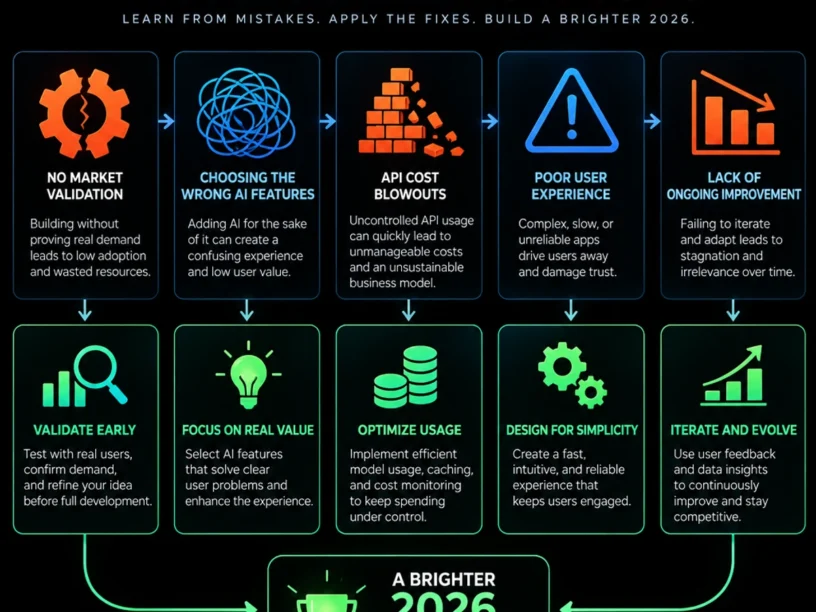
The Five Most Common Failure Patterns
- No market validation: The team builds a full product before confirming that a paying audience actually wants it. This pattern, where founders build something nobody wants instead of talking to potential users first, is linked to 35% of app failures.
- Wrong AI feature selection: AI gets added because it is trendy, not because it solves a genuine user problem. This often results in a thin “AI wrapper” around someone else’s model rather than a defensible product.
- API cost blowouts: Token-based billing scales with usage, and without robust cost controls, a founder can watch margins evaporate as the user base grows.
- Poor user experience: Clunky onboarding, slow AI responses, or confusing interfaces push users away fast. One industry study found that 77% of users abandon apps within three days, meaning one in four people who download an app are gone within a day.
- Weak product-market fit: The app technically works, but it does not solve a problem urgently or valuably enough for people to keep opening it, leading to low repeat usage.
| Failure Reason | What It Looks Like | Typical Warning Sign | Fix Focus |
|---|---|---|---|
| No validation | Full build before customer discovery | No pre-launch waitlist or paying pilot users | Structured validation sprint |
| Wrong AI feature | AI added as a gimmick, not core value | Users ignore the AI feature after first use | Rebuild around a real user job-to-be-done |
| API cost blowout | Margins shrink as usage grows | Token spend rising faster than revenue | Cost architecture and model routing |
| Poor UX | Slow, confusing, or buggy interface | High Day-1 uninstall rate | UX audit and redesign |
| Weak product-market fit | Low repeat usage despite downloads | Flat or declining retention curve | Re-scope the value proposition |
Key Takeaway: There is no single reason AI mobile apps fail; it is usually two or three of these patterns compounding at once. This is exactly why a proper diagnostic before rebuilding matters more than jumping straight back into development. Now let’s look at each one in detail, starting with the most fundamental mistake. For deeper context, see AI for App Development: Common Pitfalls and How to …. For related guidance, see 5 Expensive Mistakes To Avoid When Hiring A Mobile App Development Team.
No Market Validation: Building Something Nobody Asked For
Skipping validation is the single most preventable reason an AI mobile app fails, because it means the team spent months building before confirming anyone would actually use or pay for the product. This mistake is especially common with AI apps, where the novelty of the technology can be mistaken for genuine demand. In Australia, this shows up clearly in the data: market research attributes one-third of startup failures directly to a lack of product demand.
What Validation Actually Looks Like
- Problem interviews: Talking to 30 to 50 potential users about their current workaround before writing a single line of code, rather than asking whether they would “use an app like this.”
- Paid pilots: Getting a small group of real customers to pay something, even a modest deposit, before full development begins.
- Landing page tests: Measuring sign-up intent through a simple page and ad spend before committing to a build budget.
- Competitive mapping: Understanding who else solves this problem today and why your AI approach is meaningfully better, not just newer.
A founder who spends four weeks validating demand before writing a single line of code will almost always outperform one who spends four months building in isolation, because the validated founder knows exactly what to build.
Appomate’s Approach to Validation
- Structured Process: Appomate’s app development approach is built to close the validation gap. Rather than simply taking a brief, Appomate runs a structured validation process before development begins.
- Founder Empowerment: This process reflects the belief that founders, especially those without a technical background, deserve to test an idea safely before committing real capital to it.
Key Takeaway: If your AI mobile app failed and you never ran structured validation, the technology probably was not the problem; the absence of a proven, paying audience was. This realization often points to the next mistake: the wrong AI features chosen despite that audience. For deeper context, see AI Business Idea Validator With Real-Time Market Insights. For related guidance, see How Long Does It Take A Startup To Exit 21 Real Mobile Saas App Acquisitions With Founder Equity Insights.
Choosing the Wrong AI Features (Building an “AI Wrapper” Instead of an AI-Native Product)
Many failed AI apps share a subtle flaw: they are a thin interface layered over a general-purpose model, often called an “AI wrapper,” rather than a product genuinely built around AI-native workflows. Users notice the difference quickly, because a wrapper feels generic and replaceable the moment a competitor launches something similar or a foundation model provider ships a native feature that replicates it.
Wrapper vs. AI-Native: What Separates Them
| Dimension | AI Wrapper App | AI-Native App |
|---|---|---|
| Core value | Passes user input to a model and returns output | Uses AI as one component within a broader workflow, data model, and UX |
| Defensibility | Low, easily copied | Higher, built on proprietary data, workflow, or integrations |
| Cost control | Often unmanaged, one model for everything | Routed intelligently across models by task complexity |
| User retention | Novelty-driven, drops off fast | Habit-driven, tied to ongoing value |
- Feature-first thinking: Adding an AI chatbot or generator because competitors have one, rather than because it solves a specific, high-friction problem for your users.
- Model lock-in: Building the entire product around a single provider’s API with no fallback plan if pricing or availability changes.
- Ignoring workflow integration: Treating AI as a standalone screen instead of weaving it into the core journey where users already spend their time.
- No differentiation strategy: Failing to answer what happens to your app the day ChatGPT, Gemini, or another platform adds a similar feature natively.
Appomate’s AI-Native Philosophy
- Defensible Products: Appomate’s brand philosophy centers on explicitly building products that are AI-native rather than AI wrappers. The team uses current AI-driven development tools to deliver features that are harder to replicate and cheaper to run.
- Expert Feature Selection: With over 250 apps delivered across sectors including Wellness, B2B, Healthcare, and Education, Appomate applies extensive pattern recognition from past AI builds to help founders choose the right AI feature set from day one.
Key Takeaway: If your app’s AI feature could be swapped out for any competitor’s chatbot with no loss of value, that is the wrapper problem. It is fixable by redesigning around a workflow only your product can deliver. But even the best feature set cannot survive if the costs spiral out of control or the user experience drives people away. For deeper context, see The AI Application Development Lifecycle: Concept to ….
API Cost Blowouts and Poor UX: The Silent Killers of AI Apps
Two of the quietest killers of AI mobile apps are runaway API costs and poor user experience. Both can sink a genuinely useful product long before anyone notices a strategic flaw. Unlike traditional app hosting, AI features are billed per token, which means usage growth can directly erode margins instead of improving them.
Why AI API Costs Escalate So Fast
- Soaring Spend: Recent industry data shows AI-native application spend soared 108% in 2025, with organizations paying an average of $384,500 annually on OpenAI API costs alone.
- Unexpected Charges: The same research found that 78% of IT leaders experienced unexpected charges tied to AI and consumption, and 60% lacked full visibility into their generative AI usage.
- Wasted Budget: Separate analysis found that foundation model API spending hit $8.4 billion globally in 2025, and most production AI applications waste 40 to 70 percent of their token budget without anyone noticing.
UX Failures That Compound the Problem
- Slow AI response times: Every extra second of “thinking” before a result appears increases abandonment, especially on mobile where attention spans are short.
- No cost-aware architecture: Sending every request to the most expensive model available instead of routing simple tasks to cheaper, faster models.
- Confusing onboarding: Users do not understand what the AI can and cannot do, so they either misuse it or abandon it within the first session.
- No usage caps or budgets: Launching without spend alerts, so a viral moment or bot traffic spike can produce a bill nobody planned for.
One founder documented losing 60% of monthly revenue to a single provider’s API bill within five months of launch, before switching to a routed, multi-model architecture that cut spend by more than half while preserving output quality, according to a founder’s own account of the crisis.
Key Takeaway: If your AI app failed because “the numbers stopped adding up,” the fix usually is not the product itself. It is the cost architecture underneath it, paired with a UX pass that keeps users engaged long enough to see the value. The good news: these are fixable problems. The better news: you do not have to start from scratch to fix them. For deeper context, see Mobile app user experience: how to improve it easily.
How to Recover: Fixing a Failed AI App and Launching Successfully in 2026
A failed AI mobile app is rarely unfixable. Most rescue projects succeed by isolating what is genuinely broken (validation, feature selection, cost, or UX) and rebuilding only that layer rather than starting from scratch. Recovery is a structured process, not a guessing game, and it is exactly where a full-service technology partner earns its value.
A Practical Recovery Framework
- Audit the failure: Review analytics, retention curves, support tickets, and API cost logs to pinpoint whether the problem is demand, UX, cost, or feature-market fit.
- Re-validate with real users: Go back to the audience that churned and ask directly what did not work, rather than assuming.
- Rebuild the weakest layer: Fix the specific failure point (rearchitect AI cost routing, redesign onboarding, or re-scope the core feature) instead of rebuilding the entire app.
- Relaunch in stages: Ship to a small cohort first, monitor cost and engagement metrics closely, then expand.
Why Founders Turn to a Rescue Partner
- Targeted Intervention: Appomate’s Project Rescue service is built to close the exact gap for founders whose app has stalled, gone over budget, or simply is not performing.
- Efficient Diagnosis: Rather than treating a rescue as a standard rebuild, Appomate combines Australia-based strategy and product management with a highly skilled global development team to diagnose the real failure point and get the product moving again, often faster and more affordably than starting over with a new agency.
- Founder-focused diagnosis: Appomate’s team, experienced across Marketplace, AI Apps, Sports, and Hospitality verticals, identifies whether the core issue is technical, strategic, or commercial before recommending a fix.
- Speed to relaunch: Using the Further Faster Framework and an AI-driven development approach, Appomate has helped founders go from idea to market in as little as six weeks, a pace that applies equally to rescues for a failed AI mobile app.
- One partner, whole journey: From validation through launch, growth, and eventual exit, Appomate positions itself as a single long-term partner rather than a one-off build shop.
- Trusted delivery track record: With over 250 apps delivered and clients including Adidas, L’Oreal, Lend Lease, and Hoyts, Appomate brings enterprise-grade discipline to founder-stage rescue projects.
Key Takeaway: Understanding why your AI mobile app failed is only half the job. Recovery depends on a disciplined audit, a targeted fix, and a staged relaunch, ideally guided by a partner who has already solved this problem for other founders. For related guidance, see Product Management Process 4 Digitally Powered Steps To Build Scalable Apps.
Ready to build your app?
Book a free Visioning Call with our team today and walk away with a clear roadmap, expert feedback, and a plan to bring your idea to life. No technical knowledge required.
Conclusion
AI mobile apps fail for identifiable, fixable reasons: skipped validation, the wrong AI features, uncontrolled API costs, weak UX, and a mismatch with real market demand. None of these are permanent verdicts on your idea; they are diagnosable problems with proven fixes.
- Validate before you build: Confirm paying demand with real users before committing development budget.
- Choose AI-native, not AI-wrapper: Build features that are genuinely defensible, not a thin layer over someone else’s model.
- Control your AI cost architecture: Route tasks across models by complexity and set spend alerts before you scale.
- Fix UX friction early: Fast, clear onboarding keeps users past the critical first-week drop-off window.
- Get a second opinion before rebuilding from scratch: A structured rescue audit often costs less and moves faster than starting over.
If your AI mobile app has stalled or failed, the next step is a proper diagnosis, not another guess. Appomate’s Project Rescue service and broader app development team can help you identify exactly what went wrong and chart the fastest path back to market.
FAQ
Why did my AI mobile app fail? Common reasons and fixes for 2026
AI mobile apps most commonly fail due to a lack of market validation before building, choosing AI features that do not solve a real problem, unmanaged API cost growth as usage scales, poor user experience that drives early abandonment, and weak product-market fit. The fix in each case is a structured diagnostic followed by a targeted rebuild of the specific weak layer, not a full restart, ideally supported by a partner experienced in both AI-native product design and cost-aware development.
How do I know if my app failed due to lack of product-market fit or poor execution?
Check your retention curve first: if users download the app but rarely return after the first session despite a smooth, bug-free experience, the problem is usually product-market fit. If users churn because of crashes, confusing navigation, or slow responses, it is an execution and UX problem that can be fixed without changing the core concept.
What percentage of AI startups actually fail in Australia?
Broader startup data from recent research shows Australia’s overall startup failure rate sits at around 75%, with roughly a 25% success rate. AI-specific ventures face the same pressures plus added API cost and feature-selection risk on top.
How much does an out-of-control AI API bill actually cost a startup?
Costs vary widely by usage, but the risk is real. One 2026 analysis found organizations paying an average of $384,500 annually on OpenAI API costs alone. Separate research found that most production AI applications waste 40 to 70 percent of their token budget without anyone noticing. Cost routing across models and setting spend alerts early are the most effective preventative fixes.
Can a failed AI mobile app actually be rescued, or is it better to start over?
Most failed apps can be rescued rather than rebuilt from scratch, provided the core idea has any validated demand. A proper audit typically isolates the specific failure point (cost, UX, feature choice, or validation), which is almost always cheaper and faster to fix than starting a brand-new build with a different agency.
How long does it typically take to relaunch a failed AI app?
Timelines depend on the scope of the fix, but structured, AI-driven development approaches can move quickly. Appomate, for example, has taken founders from idea to market in as little as six weeks using its Further Faster Framework, and rescue timelines are often shorter still since core assets already exist.
Do Australian businesses actually trust AI enough to build products around it?
Trust remains a real barrier. National AI Centre data found 65% of non-adopting businesses cited a distrust in AI decision-making or a preference to keep humans in control as their main reason for not adopting AI. This is exactly why AI-native products need to be built with clear, transparent UX rather than opaque “black box” features.
What’s the difference between an AI wrapper and an AI-native app?
An AI wrapper is a thin interface that simply passes user input to a general-purpose model and returns the output, making it easy for competitors to copy. An AI-native app embeds AI into a genuine workflow, data model, or integration that only that product offers, which is the approach Appomate uses when it says it builds products that are AI-native, not AI wrappers.
This article was compiled using publicly available industry and Australian market research current as of September 2026. Statistics cited are drawn from named third-party sources linked throughout; figures may change as new data is published. This content is general information only and does not constitute business, financial, or technical advice specific to your situation.