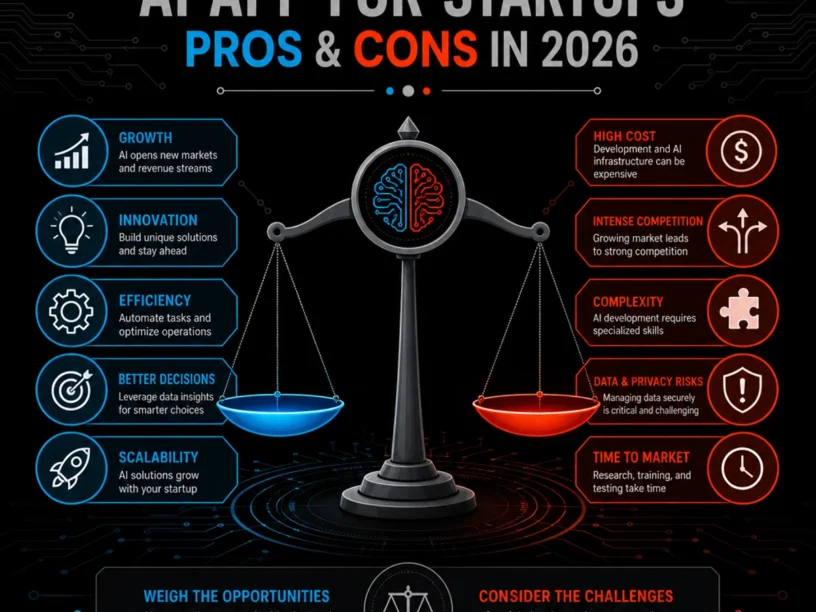
Is Building an AI App Worth It for a Startup in 2026?
is building an AI app worth it for a startup in 2026 | Appomate Team
Yes, for most Australian founders with a validated problem, clear monetisation path, and realistic budget of $40,000–$150,000. The catch: AI must genuinely power your product. If it’s just a chatbot bolted on as a marketing feature, you’re wasting money. Australian venture capital data shows investors are backing AI-embedded companies at record rates, but capital concentrates into fewer, stronger deals rather than spreading across every pitch deck with “AI” in the title.
2026 is not 2021. Building an AI app is a serious capital allocation decision, not a novelty play. You’re competing against thousands of Australian startups for investor attention and customer wallets. Winners aren’t those who shipped an AI feature fastest, but those who shipped the right feature to the right customer after validation.
The startups that thrive in 2026 are not the ones that shipped an AI feature fastest. They’re the ones that shipped the right AI feature to the right customer, validated before they built.
The Three-Question Filter
Whether building an AI app is worth it depends on three factors: problem validation, unit economics, and your ability to reach a defined customer segment. You can know the answers before spending a dollar on development. Founders who skip this homework and jump straight to code end up with expensive apps nobody opens twice.
- Problem validation: Have you spoken to 20–30 potential users who described this exact pain point unprompted, before you mentioned your solution?
- Unit economics: Can you articulate a plausible customer acquisition cost against lifetime value that leaves room for sustainable margin once AI compute and API costs are factored in?
- Distribution advantage: Do you have an existing audience, partnership, or channel that gets your app in front of real users without relying purely on paid acquisition?
| Signal | Build now | Wait or rethink |
|---|---|---|
| Customer validation | 20+ documented problem interviews completed | Idea based on personal hunch only |
| Budget available | $40,000–$150,000 committed for MVP plus 6–12 months runway | Less than $20,000 with no fundraising plan |
| AI role in product | AI is the core value driver (diagnosis, matching, generation) | AI is a chatbot bolted onto a generic app |
| Competitive landscape | Clear differentiation vs incumbents or global tools | Direct clone of an existing well-funded product |
| Regulatory exposure | Low-risk sector or compliance plan already mapped | Health, finance, or credit data with no compliance budget |
Australian investors filter by these criteria at scale. Australian VC deployed A$5.1 billion across 390 deals in 2025, up 24% from 2024, with AI-related deals dominating the top end. However, AI rounds are structurally larger, often needing A$3M–A$10M at seed to build meaningful differentiation. Undifferentiated AI ideas struggle to raise even as sector-wide capital grows.
What Does It Actually Cost to Build an AI App in Australia in 2026?
An AI-powered MVP built by an Australian agency typically costs $50,000–$150,000. Simple single-feature builds might start lower; complex products with multiple integrations and compliance requirements easily exceed $300,000. Cost is driven more by feature complexity, data integrations, and regulatory requirements than by the “AI” label itself.
Typical Price Bands by Complexity
| App tier | Typical AUD range | Timeline | Example use case |
|---|---|---|---|
| Simple prototype | $15,000–$40,000 | 4–8 weeks | Single AI feature demo for investor pitch |
| Startup MVP | $50,000–$120,000 | 2–4 months | Core AI workflow with basic user accounts and payments |
| Mid-complexity product | $80,000–$200,000 | 4–8 months | Marketplace or wellness app with AI matching or personalisation |
| Enterprise or regulated build | $200,000–$400,000+ | Up to 15 months | Healthcare or fintech app with compliance and audit logging |
One 2026 pricing guide places startup-focused MVP apps between AUD 50,000 and AUD 120,000, while another notes mobile app development typically costs between AUD $40,000 for a simple single-platform MVP and AUD $400,000+ for a feature-rich cross-platform product. Australian agency rates run AUD 120–250 per hour, roughly three times common offshore rates. This is why hybrid delivery models-pairing Australian strategy with global engineering-have become the pragmatic middle ground.
- Hidden compliance costs: Australian privacy and compliance requirements can add 10–40% to development costs, depending on data your app handles.
- Ongoing maintenance: Annual app maintenance typically runs 15–20% of the original build cost.
- Platform strategy: Building natively for both iOS and Android roughly doubles cost compared to a cross-platform framework, which adds only 10–30% over a single platform.
Key Takeaway: Budget $50,000–$150,000 for a genuine AI MVP in Australia. Treat sub-$20,000 quotes with scepticism; they rarely include real AI integration, testing, or compliance groundwork. For deeper context, see AI in Australia’s interests. For related guidance, see Australian Startup Success Stories Mobile Apps Case Studies 2026.
How Do You Measure AI App ROI Before and After Launch?
AI app ROI is measured by comparing total build, data, and compute costs against revenue, retention, or efficiency gains within 12–24 months. Founders who only track vanity metrics like downloads miss signals that predict whether the investment was worth it.
Pre-Launch ROI Signals
- Willingness to pay: Did prospective users commit to a waitlist deposit, letter of intent, or pre-order before the app existed?
- Cost-to-value ratio: Does the AI component save users measurable time or money compared to their current manual alternative?
- Compute cost per user: Have you modelled API costs at 1,000 users versus 100,000? Many AI apps look profitable at small scale and collapse at growth scale.
Post-Launch ROI Metrics
| Metric | What it tells you | Healthy early benchmark |
|---|---|---|
| Activation rate | Percentage of signups who complete the core AI action | 40%+ within first session |
| 30-day retention | Whether users return without prompting | 20%+ for consumer apps |
| Customer acquisition cost (CAC) | Cost to convert a paying user | Under one-third of lifetime value |
| Gross margin after AI compute costs | Real profitability once inference costs are deducted | 60%+ for SaaS-style AI products |
An AI feature that costs more in API calls than it earns in subscription revenue isn’t a product, it’s a very expensive demo.
Appomate’s Further Faster Framework builds ROI thinking into the validation phase itself, rather than treating it as an afterthought. This discipline separates a worthwhile AI app from an expensive experiment. Track activation, retention, CAC-to-LTV, and post-compute gross margin from day one. For measured impact data, see How To Turn AI Product Claims Into Measurable Business ….
AI Native vs AI Wrapper: Which Approach Delivers ROI?
An “AI wrapper” is a thin interface on top of an existing model with little proprietary logic. An “AI native” app embeds AI deeply in core workflow, data pipeline, and user experience. This distinction matters because wrapper-style apps are cheap to copy and rarely defensible, while AI-native products build a genuine moat.
Spotting the Difference
- Data moat: AI-native apps accumulate proprietary user data or feedback loops that make the product smarter over time; wrappers just pass prompts through to a third-party model.
- Switching cost: Native AI products create workflows users don’t want to leave; wrapper apps can be replicated by competitors in weeks.
- Margin structure: Wrappers are vulnerable to API price changes; native builds can optimise model choice, caching, and fine-tuning to protect margin.
- Investor perception: Australian investors scrutinise whether “AI” claims reflect genuine technical depth, since 61% of all capital invested in Australian startups in 2025 went to companies with AI embedded in their product or technology stack.
| Factor | AI wrapper | AI native |
|---|---|---|
| Build speed | Very fast, days to weeks | Slower, weeks to months |
| Defensibility | Low, easily copied | High, compounding advantage |
| Investor appeal | Weak beyond pre-seed | Strong through seed and Series A |
| Margin risk | High exposure to API pricing changes | Lower, more architectural control |
Appomate builds products that are AI native, not just AI wrappers, using AI-driven development tools to deliver faster without sacrificing product depth. If your AI app idea can be rebuilt by a competitor over a weekend using the same public API, invest the extra weeks to make it native. For a side-by-side breakdown, see Best AI chatbot for business of 2026. For related guidance, see React Native Vs Native Apps In 2026 Which Is Best For Your Business.
When Should You NOT Build an AI App in Australia in 2026?
Building an AI app is not worth it when you haven’t validated demand, when your budget can’t survive a 20–40% compliance cost increase, or when your sector faces incoming regulation you haven’t planned for. Knowing when to wait is as valuable as knowing when to build.
The December 2026 Privacy Act Deadline
From 10 December 2026, automated decision-making transparency obligations under the Privacy Act 1988 (Cth) come into effect. These require businesses to disclose in their privacy policy when personal information is used in automated decisions that significantly affect individuals, as detailed by Terralex. This applies broadly to most businesses operating in Australia, including startups and SaaS providers. Civil penalties for non-compliance can reach $50 million or 30% of annual turnover.
Red Flags That Mean Wait, Not Build
- No customer validation: Without 20+ real conversations about this specific problem, building first is expensive guesswork.
- Health, credit, or HR data with no compliance plan: Pause and plan before December 2026 if your app touches sensitive personal data.
- Thin runway: If your budget covers development but leaves nothing for 6–12 months of iteration after launch, you’re setting up to fail when you need to learn from users.
- Copy-paste competitive position: If your app is a near-identical clone of an existing well-funded product with no distribution edge, the market has likely answered the question for you.
The founders who lose money on AI apps rarely lose it on development. They lose it building the wrong thing quickly, then rebuilding it slowly after the market says no.
Melbourne’s own Canva built its MVP approach around simplified design tools and attracted over 300,000 users within its first 12 months before scaling globally. This proves that a disciplined, validated MVP strategy still works in the Australian market. Validate, build lean, then scale once the data supports it.
Conclusion
Is building an AI app worth it for a startup in 2026? Yes, when the idea is validated, the AI is genuinely native to the product rather than a thin wrapper, and the founder has budgeted realistically for both build costs and Australia’s tightening privacy compliance landscape.
- Validate before you build: Twenty or more real customer conversations should precede any development spend.
- Budget for $50,000–$150,000: This is the realistic range for a genuine AI-powered MVP in Australia, plus 15–20% annually for maintenance.
- Choose AI-native over AI-wrapper: Defensibility and investor appeal depend on how deeply AI is embedded in your workflow.
- Plan for the December 2026 Privacy Act deadline: If your app touches personal data in automated decisions, your compliance plan needs to start now.
- Partner with a team that treats ROI as the goal: The right development partner validates, designs, builds, and supports you long after launch.
If you have an AI app idea and want a founder-focused partner to pressure-test it before spending a dollar on development, Appomate works with founders across healthcare, wellness, marketplace, and B2B verticals, helping go from idea to market in as little as 6 weeks with a world-class global development team.
Ready to build your app?
Book a free Visioning Call with our team today and walk away with a clear roadmap, expert feedback, and a plan to bring your idea to life. No technical knowledge required.
FAQ
Is Building an AI App Worth It for a Startup in 2026?
Yes, building an AI app is worth it for founders who have validated a real problem, budgeted realistically ($50,000–$150,000 for a genuine MVP), and designed AI as a core product part rather than a bolted-on feature. It is not worth it for founders chasing the AI label without validation, without a compliance plan for Australia’s December 2026 Privacy Act changes, or without enough runway to iterate after launch.
How much does it cost to build an AI app in Australia in 2026?
Most startup-focused AI MVPs in Australia cost between $50,000 and $150,000. Simple prototypes start around $15,000–$40,000, and complex, compliance-heavy builds can exceed $300,000. Costs are driven primarily by feature complexity, data integrations, and regulatory requirements.
What is the difference between an AI-native app and an AI wrapper?
An AI-native app embeds AI deeply into its core workflow and data pipeline, building a genuine data moat and switching cost. An AI wrapper is a thin interface over a third-party AI model with little proprietary logic. Wrapper apps are fast and cheap to build but easy to copy, while AI-native products are more defensible and attractive to investors.
How do I calculate ROI on an AI app before launch?
Model your projected customer acquisition cost against lifetime value and estimate AI compute costs per user at both small and large scale. Validate willingness to pay through waitlists or pre-orders before committing to a full build. Post-launch, track activation rate, 30-day retention, CAC-to-LTV ratio, and gross margin after compute costs.
What Australian regulations affect AI app development in 2026?
From 10 December 2026, new transparency obligations under the Privacy Act 1988 require businesses to disclose in their privacy policy when personal information is used in automated decisions that significantly affect individuals. This applies to most businesses with turnover above $3 million and to smaller businesses in regulated sectors like health and credit, with civil penalties reaching $50 million or 30% of annual turnover.
How long does it take to build an AI app MVP in Australia?
A basic AI MVP typically takes two to four months, while mid-complexity products with integrations take four to eight months. Appomate’s founder-focused delivery model has helped founders go from idea to market in as little as 6 weeks for validated, well-scoped concepts.
Should a non-technical founder try to build an AI app themselves?
Non-technical founders can validate an AI app idea through customer interviews and no-code prototypes. However, building a production-grade AI-native product typically requires a technical development partner who handles strategy, design, development, and compliance considerations together.
What industries in Australia are seeing the best AI app ROI in 2026?
Healthcare, wellness, and marketplace apps are among the strongest performers because AI can meaningfully improve matching, personalisation, or triage in ways users are willing to pay for. Australian venture data shows AI-embedded companies across fintech, healthtech, and other sectors captured the majority of 2025 venture capital.
This article is based on publicly available Australian startup funding data, app development cost guides, and regulatory updates current as of September 2026. Figures and regulations cited are subject to change; founders should confirm current compliance requirements with a qualified privacy professional and obtain a tailored quote before committing to any app development budget. This content is general information and does not constitute legal, financial, or investment advice.