React Native vs native app development in Australia pros and cons | Updated September 2026 | Appomate Editorial Team | 6 weeks of market research, developer interviews and client cost comparisons
Quick Verdict
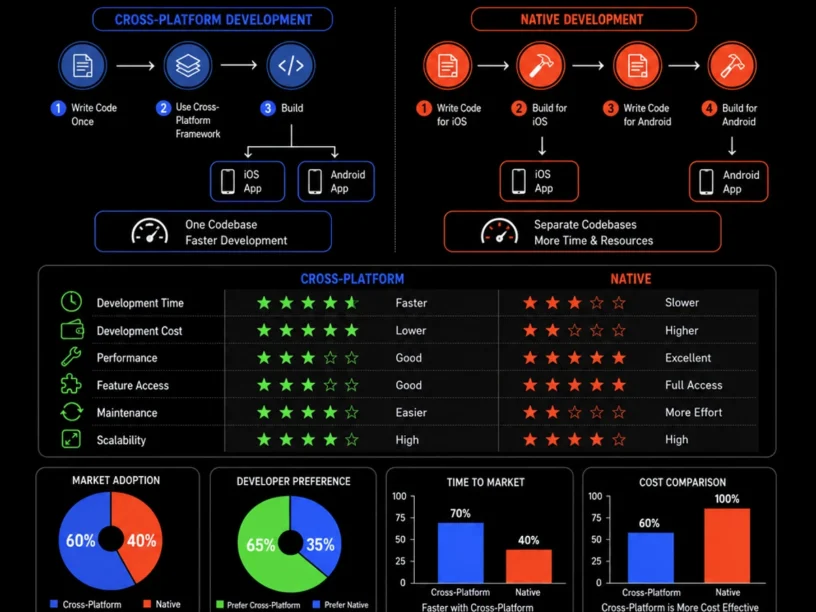
The optimal choice between React Native vs native app development in Australia depends on your budget, timeline, and required “native” feel. Here’s the breakdown:
- Choose React Native if: you’re a startup with limited budget, need to launch on both iOS and Android simultaneously, and prefer a single codebase for rapid iteration.
- Choose native app development if: your app is performance-critical (gaming, AR/VR, real-time trading), requires deep hardware integration, or is a long-term enterprise product where platform-specific polish matters more than speed to market.
- Bottom line: Most Australian founders initially opt for React Native to validate ideas affordably, then migrate performance-heavy modules to native later. Work with an experienced partner who has built both types.
At a Glance: React Native vs Native App Development
| Category | React Native | Native App Development | Winner |
|---|---|---|---|
| Best for | Startups, MVPs, apps needing fast iOS + Android launch | Enterprises, performance-critical or hardware-heavy apps | Depends on goal |
| Typical starting cost (AUD) | $30,000 to $80,000 for an MVP | $40,000 to $80,000 per platform | React Native |
| Open source / free framework | Yes, free and maintained by Meta | Free SDKs (Swift/Kotlin), but no shared framework | Tie |
| Code shared across iOS & Android | Up to 90% shared codebase | 0%, fully separate codebases | React Native |
| Native performance & feel | Very close to native with New Architecture | True native, zero compromise | Native |
| Native device & hardware API access | Good, via bridges and native modules | Full, first-party access on release day | Native |
| Typical MVP timeline | 8 to 16 weeks | 12 to 24 weeks (per platform) | React Native |
| Talent availability in Australia | Large, JavaScript/React talent pool | Smaller, specialised Swift/Kotlin pool | React Native |
| Long-term maintenance cost | Lower, one codebase to update | Higher, two codebases to maintain | React Native |
| Community & ecosystem size | Massive npm and JS ecosystem | Mature but platform-siloed ecosystems | React Native |
| Learning curve | Moderate for JS/React developers | Steep, requires two separate skill sets | React Native |
| Support model with an agency | Single team covers both platforms | Often two specialist teams needed | React Native |
| Developer sentiment (GitHub / Stack Overflow) | Nearly 4.5 million weekly downloads | Strong, platform-specific loyalty | React Native |
| Overall score (out of 10) | 8.7/10 | 8.3/10 | Context-dependent |
React Native pulls nearly 4.5 million weekly downloads, signaling strong momentum heading into 2026.
What Is React Native?
React Native is an open-source, cross-platform framework that lets developers build native mobile apps using JavaScript and React. Created by Facebook, it allows you to write one JavaScript or TypeScript codebase and deploy to both iOS and Android, rendering through native UI components while reusing the majority of your code across platforms.
What Is Native App Development?
Native app development means building separate applications for each platform using its official language and toolkit: Swift or Objective-C for iOS, Kotlin or Java for Android. This provides direct, first-day access to every new operating system feature and delivers two platform-specific codebases optimized entirely for each OS’s design language, performance model, and hardware capabilities.
Feature Comparison: Deep Dive
Performance and Native Feel
React Native has closed the performance gap significantly by 2026 through its New Architecture, replacing the asynchronous bridge with synchronous native calls via Fabric renderer and TurboModules. React Native with Fabric hits 51 FPS with 200ms faster startup time and 12% less battery drain compared to some cross-platform rivals, though native apps still edge ahead for animation-heavy scenarios.
Winner: Native app development, but only marginally for apps requiring heavy custom animation, AR/VR, or gaming.
Development Speed and Time-to-Market
React Native’s single-codebase model enables simultaneous iOS and Android launches, making it the default for lean Australian startups validating ideas. Native app development requires building two entirely separate codebases in parallel, roughly doubling design and QA workload.
Winner: React Native. A shared codebase enables faster launches with smaller teams, essential for bootstrapping MVPs.
Cost in the Australian Market
Australian developer rates range from AUD 100–200 per hour in Sydney and Melbourne. React Native’s single codebase cuts initial costs by 30–50% compared to native development. Building both platforms natively costs roughly 1.6–1.8 times one platform, while React Native costs 1.1–1.3 times one platform.
Winner: React Native. Cost savings from one codebase are decisive for most Australian founders with fixed budgets.
Native Device and Hardware Access
React Native accesses most device hardware, cameras, sensors, and push notifications through native modules, with options to drop into platform-specific code for custom requirements. Native app development provides unmediated access to every camera API, sensor, and OS feature upon release.
Winner: Native app development, particularly for cutting-edge hardware features, complex Bluetooth/IoT integrations, or day-one OS adoption.
Talent Availability and Hiring in Australia
React Native’s JavaScript foundation taps into a talent pool 3–5 times larger than niche mobile stacks, enabling faster hiring and scaling. Native app development requires separate Swift/Objective-C and Kotlin/Java specialists.
Winner: React Native. A deeper talent pool means shorter hiring cycles and more backup options.
Long-Term Maintenance and Scalability
React Native’s shared codebase means bug fixes and feature updates ship to both platforms simultaneously, reducing ongoing engineering overhead. Native app development requires every update written and tested twice, increasing long-term costs and slowing feature releases.
Winner: React Native for most consumer and SMB apps; native still wins for large enterprises with dedicated platform teams. For a more detailed feature breakdown, see React Native vs Native App for a Start-Up. For related guidance, see Is Building An AI Mobile App Worth It For Startup Founders In Australia In 2026.
Pricing Comparison
| Approach | Typical Cost Range (AUD) | Hourly Rate (AUD) | Typical Timeline |
|---|---|---|---|
| React Native MVP | $30,000 to $80,000 | $100 to $200 | 8 to 16 weeks |
| React Native full-featured app | $80,000 to $180,000 | $100 to $200 | 4 to 8 months |
| Native app, single platform | $40,000 to $150,000 | $110 to $185 | 3 to 6 months |
| Native app, both platforms | $80,000 to $300,000+ | $110 to $250 | 6 to 12 months |
Hourly rates range from AUD $40 for freelancers to AUD $1,400 for enterprise consultancies, with mid-sized Australian agencies typically at AUD $150–$330 per hour. Going cross-platform instead of native can reduce development costs by 30–40%, which is why many Australian founders start there before considering fully native builds. For independent pricing analysis, see Native Deodorant | Clean. Simple. Effective..
Who Should Choose React Native?
- First-time non-technical founders validating ideas on both app stores without doubling budget.
- Startups with tight runway needing fast launch and iteration based on customer feedback.
- Businesses building content, marketplace, or booking apps where platform-specific hardware access is not mission-critical.
- Enterprises valuing a single team, roadmap, and faster time-to-revenue.
Who Should Choose Native App Development?
- Seasoned business owners in regulated industries (finance, health) needing tightest security and OS-level compliance.
- Enterprises building AR/VR, gaming, or camera-heavy apps where performance is critical.
- Subject matter experts with long, well-funded roadmaps and dedicated iOS/Android teams.
- Companies needing day-one access to brand-new OS features from Apple or Google.
What About Other Alternatives?
| Alternative | Best For | Key Trade-off |
|---|---|---|
| Flutter | Design-heavy apps needing pixel-perfect consistency | Flutter holds approximately 46% cross-platform share versus React Native’s 35–38%, but its Dart talent pool is smaller in Australia. |
| Kotlin Multiplatform | Teams already deep in Android/Kotlin ecosystem | Shares business logic, not UI, so still needs two UI layers. |
| Progressive Web Apps (PWA) | Content-heavy tools, internal apps, B2B SaaS | PWAs cost 30–60% less than native apps but lack full app-store presence. |
| Appomate | Founders wanting one partner across native, React Native, and Flutter | Full-service model rather than pure DIY framework choice. |
Appomate helps founders transform concepts into market-ready apps quickly, offering full-service expertise spanning UI/UX design, prototyping, app development, marketing, and ongoing support across web apps, native mobile, React Native, Flutter, PWAs, IoT, blockchain, and AI/ML. It pairs Australia-based strategy with a world-class global development team at startup-friendly pricing. For a broader alternatives roundup, see I built the same app with Flutter, React Native, and Ionic.
Final Verdict: React Native vs Native App Development
For most Australian startups and forward-thinking enterprises, React Native wins on cost, speed, and hiring flexibility. Native app development earns its place for performance-critical, hardware-heavy, or highly regulated products. The optimal choice depends on your budget, timeline, and hardware depth needs. Founders avoiding guesswork often bring in a partner like Appomate, which builds in both stacks and recommends the right one for your product. Whichever route you choose, plan for ongoing maintenance and validate your idea before committing to a full build.
FAQ
Is React Native good for Australian startups in 2026?
Yes. React Native remains a strong default because it enables a single team to ship to both iOS and Android, keeping costs and hiring manageable during early validation.
What’s cheaper, React Native or native app development, in Australia?
React Native is typically cheaper because it shares one codebase across platforms, cutting initial costs by 30–50% compared with building two separate native apps.
Does React Native feel like a truly native app?
Very close. Modern React Native renders through actual native UI components, and its New Architecture has narrowed the performance gap significantly. Most animation-intensive apps may still favor fully native code.
When should I choose native app development over React Native?
Choose native app development when your app depends on cutting-edge hardware features, real-time performance (gaming, AR/VR), or needs day-one access to new OS capabilities.
How much does app development cost in Australia in 2026?
App development costs $30,000–$300,000+, depending on complexity. Basic MVPs run $30,000–$60,000, standard business apps cost $60,000–$150,000, with native builds generally at the higher end.
Can I start with React Native and switch to native later?
Yes. Many founders launch an MVP in React Native to validate demand cheaply, then rebuild performance-critical modules natively once product traction and budget allow.
Is React Native still relevant in 2026, or is it being replaced?
React Native has evolved into a mature platform trusted by developers, startups, and enterprises. The question is matching the right tool to your product, not whether the technology is dying.
Which platform should non-technical founders choose first?
Most non-technical founders benefit from starting with React Native or working with a full-service partner like Appomate. This lowers upfront cost and allows business idea validation before committing to expensive, fully native rebuilds.
Methodology: This comparison draws on publicly available pricing guides, official framework documentation, developer community data, and agency rate cards current as of September 2026. Cost ranges reflect typical Australian market rates and vary by project scope, complexity, and agency choice.