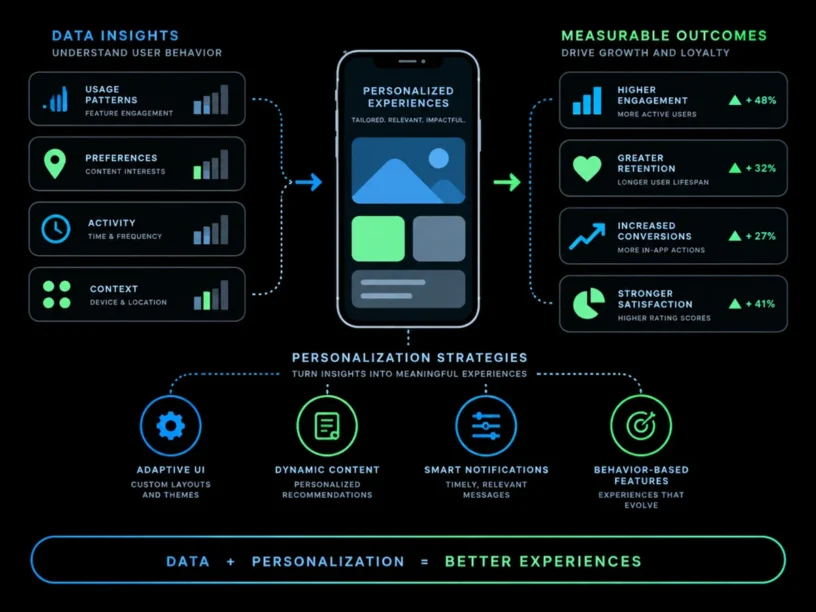
Mobile App Personalization Strategies for Custom App Development in 2026
mobile app personalization strategies for custom app development | 9 min read | Appomate Team
Mobile app personalization strategies for custom app development in 2026 center on using real-time behavioral data, AI-driven recommendations, and adaptive interfaces so every user feels like the app was built specifically for them. For Australian founders and businesses, this matters because the local market is mature and crowded: the Australian app market generated $3 billion in revenue in 2024, a 15.3% jump on the previous year, and the average Australian spent $137 on apps that same year. Winning market share now depends less on having an app and more on how intelligently it adapts to each user.
This guide breaks down the mobile app personalization strategies for custom app development in 2026 that drive engagement for Australian startups, scale-ups, and enterprises, from AI-powered recommendation engines to behavioral segmentation and adaptive UI. We’ll cover practical techniques, real benchmarks, and how Appomate builds these capabilities into apps without blowing out timelines or budgets.
Personalization has quietly become the retention strategy. In a market where users try an app once and vanish 95% of the time within 30 days, the apps that survive are the ones that learn something about the user on day one and act on it by day two.
What Does Mobile App Personalization Actually Mean for Custom App Development?
Mobile app personalization is the practice of tailoring content, features, recommendations, and interface elements to an individual user based on their behavior, preferences, location, and history inside the app. In custom app development, this is a design and data-architecture decision made from the first sprint, not a bolt-on feature. Australian users increasingly expect this: on-device machine learning has become standard practice, with 78% of top-grossing Australian apps implementing AI-driven personalization that analyzes behavior patterns to customize interfaces and content without constant cloud connectivity.
Personalization vs. Customization: The Key Difference
- Personalization: The app automatically adapts based on inferred behavior, past purchases, location, or usage patterns, with no manual input required from the user.
- Customization: The user manually sets preferences such as themes, notification frequency, or dashboard layout.
- Hybrid approach: Most high-performing 2026 apps blend both, offering smart defaults through personalization while letting users override settings manually.
Why 2026 Is a Turning Point
AI is no longer optional in mobile development. 44% of mobile apps now use AI personalization to deliver tailored content, and for Australian businesses planning a build in 2026, this means personalization needs to be part of the technical specification from day one, not a “phase two” feature.
Key Takeaway: Mobile app personalization is no longer a competitive edge-it’s table stakes. Apps that treat every user identically in 2026 are competing against a market where nearly half of all apps already adapt automatically to the individual. For deeper context, see Mobile experiences: Enhancing user engagement and ….
Core Mobile App Personalization Strategies for Custom App Development in 2026
The most effective mobile app personalization strategies for custom app development combine behavioral data, AI recommendation models, and adaptive interface design, layered on top of a solid data architecture built during initial development. Below are the five strategies Australian product teams are prioritizing, ranked by implementation ease and typical engagement lift.
| Strategy | What It Does | Typical Implementation Stage | Engagement Impact |
|---|---|---|---|
| Behavioral segmentation | Groups users by in-app actions to trigger tailored content | MVP to Phase 2 | Moderate to high |
| AI-driven recommendations | Suggests products, content, or features using machine learning trained on user history | Phase 2 onward | High |
| Adaptive onboarding | Changes the first-run experience based on declared goals or inferred intent | MVP | High (retention-focused) |
| Location and context awareness | Surfaces relevant offers or features based on geography, time of day, or device context | Phase 1 to Phase 2 | Moderate |
| Predictive push notifications | Times and tailors notifications using behavioral prediction rather than fixed schedules | Phase 2 to 3 | High |
Where to Start If You’re Building From Scratch
- Start with onboarding, not recommendations: Adaptive onboarding is cheaper to build and produces faster retention gains than a full AI recommendation engine.
- Build event tracking into the MVP: You cannot personalize what you haven’t measured, so instrument key user events from the first release.
- Prioritize one segment before scaling: Personalizing for a single high-value user segment often delivers more ROI early on than broad, shallow personalization across all users.
Key Takeaway: The strongest mobile app personalization strategies don’t require a full AI model on day one. Sequencing matters: adaptive onboarding and behavioral segmentation typically deliver the fastest wins before layering in predictive AI features. For further reading, see Mobile App Development Trends 2026: What Businesses ….
Mobile App Customization Techniques That Drive Real User Engagement
Mobile app customization techniques give users direct control over their experience, and when paired with smart defaults, they consistently lift satisfaction and session length. Australian consumers expect this control: a 2026 survey of over 1,050 shoppers across the US, UK, and Australia found that personalized experiences influence 93% of shoppers to stay loyal to a brand.
Proven Customization Techniques
- Customizable dashboards and widgets: Letting users rearrange or hide dashboard elements increases perceived control and reduces cognitive load on repeat visits.
- Theming and accessibility controls: Dark mode, font scaling, and color contrast options are now baseline expectations.
- Notification preference centers: Granular control over notification types and frequency reduces uninstall rates driven by notification fatigue.
- Saved filters and smart defaults: Remembering a user’s last search filters or preferred categories removes repetitive friction on return visits.
- Progressive profiling: Collecting preference data gradually over multiple sessions, rather than in one long onboarding form, improves completion rates significantly.
Identity Resolution: The Technique Most Teams Skip
One overlooked challenge is recognizing the same user across devices and sessions. The Attentive research found that the average consumer shopped in four different ways across platforms and devices in the past three months, with 53% aware they’d switched devices before completing a purchase. Without accurate identity resolution, personalization breaks down the moment a user moves from mobile to desktop or switches phones.
A customization feature that only works on one device isn’t really personalization, it’s a setting. True mobile app customization techniques follow the user, not the device.
Key Takeaway: Mobile app customization techniques work best when they combine user-controlled settings with cross-device identity resolution, so preferences carry seamlessly from a phone to a tablet or web session. For deeper context, see App Feature Customization.
User Engagement Strategies for Mobile Apps: What the Data Shows
User engagement strategies for mobile apps succeed or fail based on retention data, and the numbers in 2026 are unforgiving for apps that don’t personalize early. Industry-wide, app retention rates plummet to roughly 3 to 4% by day 30, meaning fewer than 5% of users who install an app are still using it a month later.
Engagement Benchmarks Worth Tracking
| Metric | Industry Benchmark | What It Signals |
|---|---|---|
| Day-30 retention | ~3-5% average | Whether onboarding and early personalization are working |
| AI personalization adoption | 44% of apps | Competitive baseline for tailored content delivery |
| Educational app retention lift with AI | Up to 50% higher | Impact of personalization in high-engagement verticals |
| Mobile share of web traffic (Australia) | 61.9% | Confirms mobile-first design is non-negotiable |
Strategies That Move Retention Numbers
- Gamified milestones: Reward systems and progress indicators increase repeat visits by giving users a reason to return beyond the core function.
- Behavior-triggered re-engagement: Sending a nudge based on a specific drop-off action (e.g., an abandoned cart) outperforms generic scheduled notifications.
- Micro-personalized content feeds: Even small content ordering changes based on past interaction can lift session duration meaningfully.
- Segmented onboarding paths: Educational apps with AI personalization achieve up to 50% higher retention than those without it, a pattern that extends to wellness, fintech, and marketplace apps.
Key Takeaway: User engagement strategies for mobile apps are about timing, relevance, and behavioral triggers, all of which depend on the personalization architecture built into the app from the start. For supporting data, see Top Mobile App Development Trends of 2026 to Watch.
How Appomate Builds Personalized Mobile App Experiences Without Slowing Down Launch
Personalized mobile app experiences are only valuable if they actually ship, and that’s where many Australian founders get stuck. Appomate, a Melbourne-based mobile and web app development company, builds personalization into the product from strategy through launch rather than retrofitting it after the fact.
The Appomate Approach
- Validation before build: Confirming which personalization features will move engagement for your audience before code is written, reducing wasted development spend.
- AI-native, not AI-wrapped: Building products that are AI native rather than simple AI wrappers, using AI-driven development tools to deliver personalization logic faster and smarter.
- Further Faster Framework: This structured, agile methodology sequences personalization features in the order most likely to drive early retention, rather than building every feature at once.
- Hybrid delivery model: Australia-based strategy and product design paired with a highly skilled global development team delivers premium-quality personalization features at startup-friendly pricing.
- Speed to market: Appomate has helped founders go from idea to market in as little as 6 weeks, meaning personalization features don’t have to wait for “version two.”
Why This Matters for Non-Technical Founders
Founders without a technical background often assume personalization requires a dedicated data science team and a six-figure budget. Appomate’s founder-focused approach makes this kind of app entrepreneurship more predictable and less risky, with over 250 apps delivered across Marketplace, Wellness, Sports, B2B, AI Apps, Healthcare, Hospitality, Education, and Fashion verticals, serving clients such as Adidas, L’Oreal, Lend Lease, and Hoyts.
Key Takeaway: Appomate’s full-service model means mobile app personalization strategies don’t have to be a second phase-they can be part of the very first release.
Ready to build your app?
Book a free Visioning Call with our team today and walk away with a clear roadmap, expert feedback, and a plan to bring your idea to life. No technical knowledge required.
Conclusion
Mobile app personalization strategies for custom app development in 2026 are foundational decisions that determine whether an app retains users past the first month. Australian founders who build personalization, adaptive onboarding, and behavioral segmentation into their MVP from day one are positioning themselves well ahead of the 95% of apps that lose nearly all their users within 30 days.
- Personalization beats generic experiences: AI-driven personalization is now used in 44% of mobile apps, and educational apps see up to 50% higher retention with it in place.
- Sequencing matters more than scope: Start with adaptive onboarding and behavioral segmentation before investing in complex AI recommendation engines.
- Customization and personalization work together: Give users manual control alongside automated, data-driven defaults, and make sure preferences follow them across devices.
- Australia’s market rewards engagement: With the local app market generating $3 billion in 2024 revenue and high per-user spending, retention-focused personalization directly impacts commercial outcomes.
- Partner choice shapes speed: Working with a founder-focused, full-journey partner like Appomate means personalization is built in from validation through launch, not added as an afterthought.
If you’re planning a custom app build in 2026 and want personalization engineered in from the start, the next step is a conversation about validation and scope.
FAQ
What are the best mobile app personalization strategies for custom app development in 2026?
The most effective mobile app personalization strategies for custom app development in 2026 combine behavioral segmentation, adaptive onboarding, AI-driven recommendations, location and context awareness, and predictive push notifications. These should be sequenced during development, starting with adaptive onboarding and event tracking to gather initial data, then layering in more complex AI recommendations once sufficient behavioral data has been collected to train the models effectively.
How is mobile app personalization different from customization?
Personalization happens automatically based on inferred user behavior, location, or history. Customization requires the user to manually adjust settings like themes, notification preferences, or dashboard layouts. Most strong 2026 apps use both together, offering smart automated defaults through personalization paired with manual override options for user control.
Why does personalization matter so much for app retention in Australia?
Personalization is crucial for app retention in Australia because industry-wide app retention rates fall to roughly 3-5% by day 30. A 2026 survey of shoppers across the US, UK, and Australia found that 93% of respondents say personalized experiences influence their loyalty to a brand. In a mature, high-spending market like Australia, where the app market generated $3 billion in 2024 revenue, personalization significantly improves user retention and commercial outcomes.
Do I need AI to personalize my mobile app, or can simpler techniques work?
You don’t need a full AI model to start personalizing your mobile app. Simpler techniques like adaptive onboarding flows, saved user preferences, and behavior-triggered notifications can meaningfully improve engagement and retention before investing in machine learning-based recommendation engines. AI-driven features are better introduced in later development phases once you have enough usage data to train them effectively.
How much does it cost to build a custom app with personalization features in Australia?
Costs vary significantly based on scope, complexity, and the depth of personalization desired. However, personalization features are generally cheaper to build when planned from the MVP stage rather than retrofitted later. Working with a hybrid delivery partner that combines Australia-based strategy with a highly skilled global development team, such as Appomate, can help keep premium personalization features accessible at startup-friendly pricing.
What mobile app customization techniques do Australian users expect in 2026?
Australian users increasingly expect customizable dashboards, comprehensive theming and accessibility controls (like dark mode and font scaling), granular notification preference centers, saved filters, and smart defaults that remember past choices. Crucially, they also expect cross-device identity resolution, so their preferences follow them seamlessly between phone, tablet, and web sessions, especially given Australia’s smartphone penetration, with mobile devices now accounting for around 61.9% of all web traffic in the country.
How long does it take to build a personalized app from scratch?
Timelines depend on scope and complexity. However, founders working with an experienced, AI-native development partner using an efficient agile methodology have gone from idea to market in as little as 6 weeks for an MVP. More complex personalization features, like full AI recommendation engines, are typically introduced in later development phases once core usage data exists to train them effectively.
What industries benefit most from mobile app personalization strategies for custom app development?
Industries that benefit most from mobile app personalization strategies for custom app development include Marketplace, Wellness, Education, Healthcare, Hospitality, and Fintech. These verticals tend to see the strongest engagement lift from personalization because they involve repeat usage patterns and generate rich behavioral data. Education apps with AI personalization achieve up to 50% higher retention than those without it, a trend that extends to other data-rich, high-engagement categories.
This article was researched using publicly available industry data from sources including Business of Apps, Attentive, CMARIX, Bytevault, and Red Search, current as of October 2026. Statistics and benchmarks are provided for general informational purposes and may vary by app category, audience, and market conditions; businesses should validate specific projections against their own user data and consult a development partner for tailored advice.