how to validate a marketplace app idea before building it | September 2, 2026 | Appomate Team | 3-6 weeks | Beginner
What You’ll Learn: How to Validate a Marketplace App Idea Before Building It in 2026
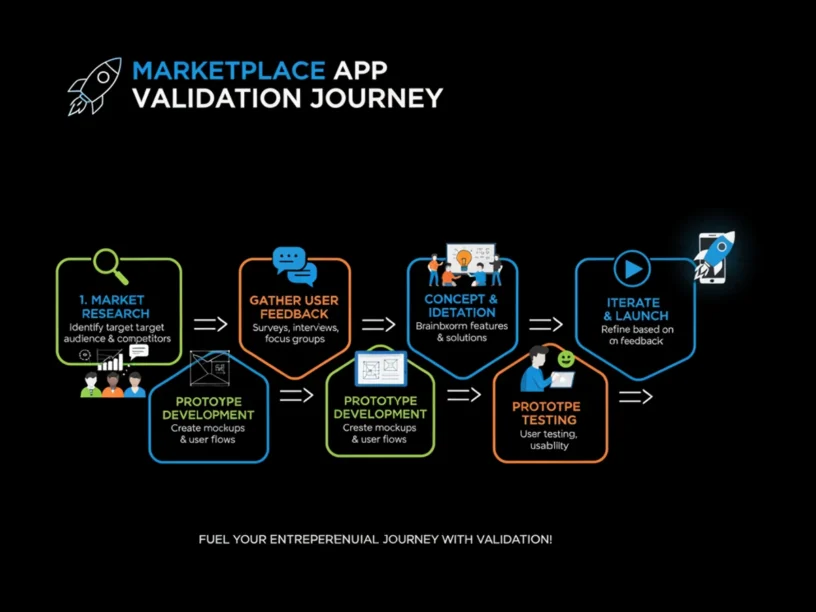
This guide walks you through a five-step process to validate a marketplace app idea before building it, ensuring you test real demand and supply before committing to development. By the end, you’ll know:
- How to run structured interviews with both buyers and sellers to confirm a real, shared problem exists.
- How to build a landing page smoke test and correctly interpret conversion data to prove genuine interest.
- How to manually seed one side of your marketplace to solve the classic chicken-and-egg problem.
- How to use a rapid, no-code clickable prototype to pressure-test the user journey and validate the user experience.
- How to confirm people will actually pay for your marketplace service before committing to a full build.
Prerequisites: no coding skills required — just a clear idea, access to 15-20 potential users (buyers and sellers), and 3-6 weeks of focused effort.
Why Marketplace App Validation Matters in 2026
Two-sided marketplaces are harder to launch than single-sided apps because you’re solving two adoption problems at once. The classic chicken-and-egg problem has killed more marketplace startups than any technical challenge, and most founders validate only the buyer side while assuming sellers will follow. Marketplaces quietly die before launch when supply-side demand is ignored.
Marketplaces raised US$4.8 billion in 2025, a 27% jump over the year before, as investors continue backing platform models. However, no market need and running out of cash together cause 71% of startup shutdowns according to CB Insights. The single biggest reason ventures fail is lack of real market demand — not technology, competition, or timing.
For Australian founders, there’s a lesson in Airbnb’s origin story. The founders used extremely simple prototypes to test one critical question — would strangers actually be willing to stay in other people’s homes — before writing production code. Validating a marketplace app idea before building it isn’t a formality; it’s the difference between a funded, growing platform and an expensive app nobody opens twice. For supporting data, see How to Find, Validate, and Build a Successful Startup in 2026.
The Process at a Glance
| Step | Action | Time | Outcome |
|---|---|---|---|
| 1 | Interview buyers and sellers separately | 5-7 days | Confirmed shared problem, not just an idea |
| 2 | Run a landing page smoke test | 1-2 weeks | Real conversion data on demand |
| 3 | Manually seed one side (concierge MVP) | 1-2 weeks | Working supply-demand loop in one niche |
| 4 | Build a clickable prototype | 1-2 weeks | Tested user journey, accurate cost estimate |
| 5 | Run a small paid pilot | 1-2 weeks | Proof people will actually pay |
Total time: approximately 3-6 weeks from first interview to pilot results.
Step 1: Interview Both Sides of Your Market Before Writing a Line of Code
What You’re Doing
Before sketching wireframes or talking to developers, confirm that a real, painful problem exists for both your buyers and sellers — independently. This foundational step is where most founders fail.
How to Do It
- List the two distinct groups your marketplace connects (e.g., property owners and renters, freelancers and clients).
- Recruit 8-10 people from each side through LinkedIn, Facebook groups, or your network.
- Ask about their current problem and workarounds, not your app. Open with “how do you currently solve X?” rather than “would you use my app?”
- Take notes on repeated pain points, frustrations with existing solutions, and what they’d pay to fix it.
- Identify which side has a bigger incentive to join first — this determines your launch sequence.
Best Practices
- Interview potential users about their problems, not your idea — a marketplace that doesn’t solve a real pain point has no reason to exist.
- Keep interviews to 15-20 minutes and let the person talk more than you do.
- Look for patterns across at least 10-20 conversations before drawing conclusions.
Common Mistakes
Founders often interview only buyers and assume supply will appear, but supply frequently has higher switching costs. Another common error is asking hypothetical “would you use this?” questions, which produce polite agreement rather than honest signal.
What Done Looks Like
You can describe the shared problem in one sentence, backed by near-identical complaints from at least 15 people across both sides of your market. For a more detailed walkthrough, see How to Validate a Startup Idea Before You Begin Building It.
Step 2: Run a Landing Page Smoke Test to Measure Real Demand
What You’re Doing
Replace opinions with behavior. A smoke test measures user interest in a product that doesn’t fully exist yet, typically through a landing page with a call to action. You’re building a simple page, driving real traffic to it, and watching how many strangers take a meaningful action — before any product exists.
How to Do It
- Build a single landing page describing the value proposition with one clear call-to-action (“join the waitlist” or “reserve early access”).
- Drive genuinely cold traffic via targeted social ads, Reddit, or relevant Facebook groups — avoid warm traffic from your own network, since if prospects already know you or your brand, this will skew your conversion rate upwards unpredictably.
- Set a target conversion rate in advance so you’re not tempted to move the goalposts after seeing the data.
- Collect enough traffic for the number to mean something — landing pages typically need 200-500 visitors for reliable conversion rate data.
- Analyse results against your pre-set threshold, then decide: build, pivot the messaging, or kill the idea.
Example
| Signal | What It Suggests | Next Move |
|---|---|---|
| Conversion rate exceeds your target on cold traffic | Real, unmet demand in this niche | Move to Step 3 |
| Traffic arrives but conversion is flat | Weak messaging or wrong audience | Rewrite value proposition, retest |
| No traffic converts even with strong targeting | Problem may not be painful enough | Revisit Step 1 interviews |
Common Mistakes
Over-optimising the page can inflate results, measuring your marketing skill rather than genuine demand. Only observed behaviour, like clicks, sign-ups, or payments, actually counts as proof.
What Done Looks Like
You have a measurable conversion number from cold traffic, compared against a threshold you set before seeing any results.
Step 3: Solve the Chicken-and-Egg Problem With a Manual Concierge MVP
What You’re Doing
You’ve got demand signals. Now prove the two-sided loop actually works by manually recruiting and connecting real buyers and sellers — no app required yet. A concierge MVP manually performs all core functions to test demand and supply, rather than automating them with technology.
How to Do It
- Pick the side identified in Step 1 as harder to recruit (usually supply), and go all-in on winning it first.
- Narrow your focus to one city, suburb, or micro-niche rather than covering a whole country or category.
- Personally recruit 5-10 suppliers through cold outreach, communities, or a limited-time fee holiday to reduce their risk.
- Bring in a small, matched group of buyers and manually connect them via spreadsheet, WhatsApp, or email.
- Watch for supply-side retention: if sellers keep coming back without you chasing them, the liquidity problem is solving itself, and that’s the moment to invest in a real build.
Example
Freightos, a freight marketplace, brought in supply first by offering a “single-player mode” — tools to manage bookings and payments that were useful to sellers even before any buyers showed up. This tactic worked really well for Freightos. Give the harder-to-recruit side a reason to stay even before the loop is fully turning.
Best Practices
- Resist the temptation to try to grow both sides at once — sequence it deliberately.
- Do unscalable things on purpose: personal onboarding calls, manual matching, hand-written intro emails.
- Treat this as a learning exercise, not a scaling exercise.
What Done Looks Like
At least one real transaction (or repeated match) has happened between a genuine buyer and seller, entirely manually, and both sides asked to do it again.
Step 4: Build a Clickable Prototype to Test the Core User Journey
What You’re Doing
You’ve proven demand exists and the loop works manually. Now turn that validated signal into something you can tap through. A clickable prototype is an interactive, non-functional model of an app’s user interface that allows users to click through screens and experience the flow, without any underlying code.
How to Do It
- Map the core user journey for both sides: how a buyer searches and how a seller lists or responds.
- Build a clickable wireframe or interactive mockup covering only the essential flow.
- Put it in front of 8-10 people from your interview list and watch where they hesitate, tap the wrong thing, or drop off.
- Use the feedback to refine the flow, then get an accurate cost and timeline estimate for the real build.
Example
Househub, a property marketplace app built by the Appomate team, began with prototype validation — mapping out the core user journey, testing the property search and connection flow, and confirming the UI/UX before a single line of production code was written. Early testing directly shaped features like the review system and identity verification. Appomate calls this “See It Before You Build It,” helping founders visualise their app in real time, validate technical feasibility, and get a clear, accurate estimate for development costs. Appomate empowers founders, especially those without a technical background, to innovate and transform their concepts into market-ready apps quickly and safely.
Best Practices
- Keep the prototype focused on the core loop, not every screen you eventually want.
- Watch users interact rather than just asking what they think.
- Use this stage to get a firm cost and timeline quote before committing budget.
What Done Looks Like
You have a tested, clickable flow that real users can navigate without confusion, plus a concrete cost and timeline estimate for full development.
Step 5: Run a Small Paid Pilot to Prove Willingness to Pay
What You’re Doing
You’re at the final and most important signal — that people will part with real money. A paid pilot offers your service to a small group of users for a real fee or commission to validate actual purchase intent and pricing.
How to Do It
- Offer a limited pilot to a small group from your concierge MVP, this time charging a real fee or commission.
- Keep the transaction simple — invoice, deposit, or a basic payment link is enough.
- Track how many people follow through on payment versus how many just expressed interest.
- Use the results to set realistic pricing and take-rate assumptions for launch.
Common Mistakes
Running the pilot for free feels safer but proves nothing — free tests generate interest but don’t prove viable business models or sustainable customer acquisition economics. People say they’ll buy but money reveals the truth.
What Done Looks Like
At least a handful of real, paying transactions have occurred between genuine users, at a price point close to what you’ll charge at launch.
What to Do After Validating Your Marketplace App Idea
Phase 1 (Week 1-2 after validation): Document everything — interview notes, smoke test conversion data, prototype feedback, and pilot results — into a single one-page validation summary you can share with a development partner or investors.
Phase 2 (Month 1-3): Move from prototype to MVP build with a technology partner who understands marketplace mechanics. A full-service partner like Appomate can guide you from validation to launch, using AI-driven development tools to deliver faster and get founders from idea to market in as little as 6 weeks.
Phase 3 (Month 3+): Focus relentlessly on supply-side retention and expanding liquidity within your original niche before widening geography or categories.
Ready to build your app?
Book a free Visioning Call with our team today and walk away with a clear roadmap, expert feedback, and a plan to bring your idea to life. No technical knowledge required.
Resources You’ll Need
| Resource | Role | Type | Price |
|---|---|---|---|
| Appomate | Prototyping, validation, and full-service app development partner | Recommended | Custom quote |
| Sharetribe | No-code marketplace MVP for early concierge testing | Optional | Free trial, paid plans |
| NFX’s 19 Tactics for the Chicken-or-Egg Problem | Framework for sequencing supply and demand | Recommended | Free |
| Google Analytics | Tracks landing page traffic and conversion data | Required | Free |
| Typeform or Google Forms | Structuring interview notes and smoke test surveys | Optional | Free / paid tiers |
See also, see How to validate an app idea before you build it.
Common Plateaus & How to Break Through
Landing page gets traffic but almost nobody signs up
Likely cause: the value proposition is unclear or you’re targeting the wrong sub-niche. Fix: rewrite the headline to state the problem in the user’s own words (pulled from Step 1 interviews) and retest before touching the design.
Supply-side interviews go well but nobody joins the concierge MVP
Likely cause: the switching cost or risk is higher than the incentive offered. Fix: add a fee holiday, guaranteed first customers, or a “single-player” tool that’s useful to sellers even without buyers yet.
Everyone says “I’d use that” but nobody pays in the pilot
Likely cause: you’re measuring stated interest, not observed behaviour. Fix: require a real payment or deposit, even a small one, before counting anyone as validated demand.
One side keeps waiting for the other to join first
Likely cause: you’re trying to grow both sides simultaneously instead of sequencing. Fix: pick the harder side, go narrow to one city, and hand-recruit until the loop turns on its own. For more troubleshooting advice, see 10 Startup Idea Validation Mistakes That Kill Companies….
Conclusion
Validating a marketplace app idea before building it in 2026 comes down to replacing assumptions with evidence — real conversations, real conversion data, a real (if manual) transaction loop, a tested prototype, and real payments — in that order, before you commit serious development budget.
Key Takeaways
- A five-step validation process can confirm demand in roughly 3-6 weeks.
- The chicken-and-egg problem is solved by sequencing, not simultaneity: pick the harder side, go narrow, and win it first.
- Your next action is to book 8-10 interviews this week with people on both sides of your marketplace.
FAQ
How to validate a Marketplace App Idea Before Building It 2026?
Validate by running five checks in sequence: interview both buyers and sellers to confirm a shared, painful problem; run a landing page smoke test to measure real demand from cold traffic; manually seed one side to prove the supply-demand loop works; build a clickable prototype to test the user journey; and run a small paid pilot to confirm people will pay. Completing all five typically takes 3-6 weeks and costs far less than building a full app first.
What is the chicken-and-egg problem in marketplace validation?
It’s the challenge where buyers won’t join without sellers already present, and sellers won’t join without buyers already there. The recommended approach is to identify which side has a bigger incentive to join, win that side first, and only then bring in the other side to match.
How many people should I interview before building an MVP?
Aim for 8-10 people on each side of your marketplace. Customer interviews typically show clear patterns after 10-20 conversations. Fewer than that risks acting on noise rather than a real signal.
What’s a good conversion rate for a marketplace landing page smoke test?
There’s no single universal number — it depends on your niche and traffic quality. Set your target threshold before launching the test, not after. Even a 2% conversion rate can be significant for a high-ticket or niche B2B product if the leads are high quality.
Do I need to build a full app to validate a marketplace idea?
No. A clickable prototype, a landing page, and a manually operated concierge MVP are enough to test demand, supply, and the user journey without writing production code, which is exactly the approach Airbnb’s founders used to test the core trust mechanism before investing in the full platform.
Which side of a marketplace should I validate and build first — buyers or sellers?
Generally the harder-to-recruit side, which is often supply, because that side creates the value the other side comes for. Once that side is engaged and returning without active chasing, it’s a strong signal to move toward a real build.
How long does marketplace app validation take before development starts?
Most founders following this process complete validation in 3-6 weeks. From there, moving into an actual MVP build with an experienced technology partner can take as little as 6 weeks, depending on scope and complexity.
What’s the biggest reason marketplace apps fail even after validation?
Most commonly it’s a failure to reach liquidity — not enough repeat, active supply and demand within a specific niche or geography — often because founders expand too broadly too soon instead of dominating one narrow niche first.
This guide was compiled using publicly available research on marketplace validation methods, startup failure statistics, and rapid prototyping practices current as of September 2026, alongside Appomate’s own experience validating and building marketplace apps for Australian founders. Individual results vary by industry, niche, and execution quality.