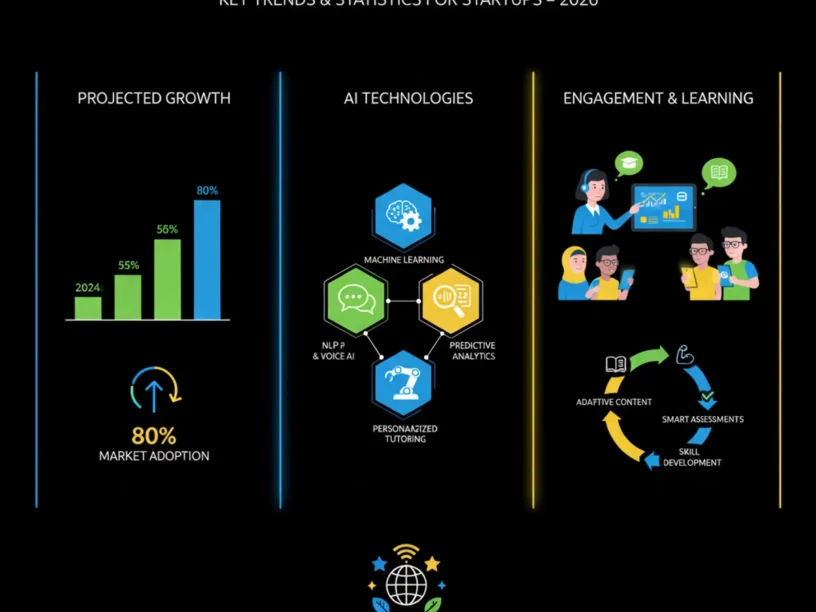
AI Mobile App Development for Education Startups 2026: What to Know
AI mobile app development for education startups in Australia — what to know before you build | 9 min read | By the Appomate Team
Building an AI-powered education app in Australia in 2026 means navigating a fast-growing but tightly regulated market. Here, student data protection, curriculum alignment, and genuine learning outcomes matter just as much as clever machine learning. Success requires understanding three key areas: the significant market opportunity, the complex compliance landscape governing student data, and the optimal technical approach to launch efficiently. Founders who nail these aspects before development tend to launch faster, minimise rework costs, and avoid privacy errors that can derail promising EdTech products.
This guide is built for founders, non-technical entrepreneurs, and forward-thinking education businesses launching AI mobile apps in the Australian education sector in 2026. You’ll find everything from market sizing and regulation through to development costs, timelines, and how to pick the right development partner.
The education apps that win in Australia in 2026 won’t be the ones with the flashiest AI demo — they’ll be the ones that respect a teacher’s time, a parent’s trust, and a regulator’s checklist, all at once.
Why Is AI Mobile App Development for Education Startups Growing So Fast in Australia?
Australia’s education technology sector is expanding rapidly. Government digital investment is climbing. Demand for personalised learning is climbing faster. AI adoption is now mainstream. For startups building AI-native learning products, this creates a genuine window of opportunity — though it also means competition is intensifying quickly.
The numbers tell the story. IMARC Group values the Australian EdTech market at USD 4.2 billion in 2025, with projections to reach USD 7.7 billion by 2034, representing a CAGR of 6.73% from 2026-2034. EduGrowth’s Australian EdTech Snapshot 2026 paints an even more vivid picture: a robust sector comprising 880 Australian EdTech companies, employing 23,500 people, generating $5 billion in annual revenue, and contributing $1.6 billion in exports.
What’s Driving the Growth
- Government Digital Infrastructure Spending: The government’s $1.2 billion Digital Economy Strategy is actively fuelling growth by supporting online learning platforms and smart classroom technology across schools and universities.
- Personalised and Adaptive Learning Demand: Adaptive learning systems, which adjust content difficulty and pace in real time, are increasingly recognised as a powerful way to enhance student engagement and improve educational outcomes.
- Corporate Upskilling Expansion: Businesses are increasingly leveraging EdTech for employee training, skill development, and workforce transformation, opening a substantial B2B channel alongside traditional K-12 and higher education markets.
- Tighter Capital, Sharper Focus: While investment in Australian EdTech startups declined significantly in 2025, with funding dropping by over 67%, this reflects tighter capital conditions and a strategic shift toward sustainable, outcome-driven business models. Investors now expect real usage data and proven learning outcomes, not just a compelling roadmap.
Key Takeaway: The Australian EdTech opportunity is real and growing, but 2026 investors are rewarding startups that can prove engagement and learning outcomes early — not just AI novelty.
Understanding the opportunity is half the battle. The other half is navigating the rules. For deeper context, see Artificial intelligence (AI) | V9 Australian Curriculum.
What Rules and Regulations Apply to AI Education Apps in Australia?
For any founder building an AI education app in Australia, treating privacy and AI governance as a fundamental design input — not an afterthought — is critical. Australia operates under two overlapping layers of oversight: sector-specific AI-in-education frameworks and broader Privacy Act reforms that significantly tighten how children’s data is handled.
Education-Specific AI Guidance
The Australian Framework for Generative AI in Schools, approved by Education Ministers, provides essential guidance on understanding, using, and responding to generative AI in Australian school-based education. It’s structured around six core principles:
- Teaching & Learning: Ensuring AI supports pedagogical goals.
- Human & Social Wellbeing: Prioritising student and teacher welfare.
- Transparency: Clearly communicating AI’s role and function.
- Fairness: Preventing bias and ensuring equitable access.
- Accountability: Establishing clear responsibilities for AI use.
- Privacy, Security & Safety: Protecting data and ensuring secure environments.
A companion Australian Framework for Artificial Intelligence in Higher Education extends similar guidance to universities and tertiary providers, ensuring consistent AI governance across the entire education spectrum.
The Privacy Act and Children’s Online Privacy Code
If you’re collecting data from students under 18, a significant compliance deadline is approaching fast. The Office of the Australian Information Commissioner (OAIC) has released an exposure draft of the Children’s Online Privacy Code. This Code expands children’s privacy protections well beyond social media, now encompassing apps, games, and websites used by children. Registration is due by 10 December 2026, and non-compliance carries serious penalties: fines up to $50 million, three times the value of any benefit obtained, or 30% of adjusted turnover.
Key implications for education apps include:
- Age-Appropriate Consent: Children under 15 generally cannot provide consent without limited exceptions, meaning you’ll need to integrate parental consent flows into your app’s onboarding process.
- Best Interests Test: Any collection, use, or disclosure of a child’s data must be consistent with the best interests of the child — a higher standard than a typical privacy policy checkbox.
- Deletion Rights: Children (or their guardians) have a right of destruction of personal information. Your data architecture must support clean, complete deletion, not just account deactivation.
- Automated Decision-Making Disclosure: From 10 December 2026, APP entities using computer programs for decision-making that may significantly impact a person’s rights must disclose how those AI systems work. This applies directly if your app uses AI to flag, grade, or stream students.
“The stakes are real, and the deadlines are close,” notes Corrs Chambers Westgarth’s 2026 privacy compliance briefing, highlighting the scale of change facing any business handling children’s data online.
Key Takeaway: Privacy-by-design isn’t optional. Build consent flows, data minimisation, and deletion capability into your architecture from day one, because retrofitting compliance after launch is far more expensive than designing for it upfront.
Once you’ve got compliance locked down, the next decision is which AI features will actually drive results for your users. For deeper context, see Guidance on privacy and the use of commercially available ….
What AI Features Actually Matter for Education Apps in 2026?
Not every AI feature adds genuine value to a learning product. The most successful AI education apps in 2026 solve a specific pedagogical or administrative problem, rather than merely showcasing a large language model. Founders should prioritise features that genuinely improve engagement, reduce teacher workload, or personalise the learning path.
| AI Feature | What It Does | Best Suited For | Compliance Consideration |
|---|---|---|---|
| Adaptive learning paths | Adjusts content difficulty and sequencing based on individual performance | K-12 tutoring apps, exam prep platforms | Requires clear disclosure if used to make significant decisions about a student |
| AI tutoring / chat assistants | Answers subject-matter questions, explains concepts in plain language | Higher education, corporate upskilling | Needs guardrails against inaccurate or unsafe content for minors |
| Automated formative feedback | Reviews written or spoken responses and gives instant, low-stakes feedback | Literacy and language learning apps | Should be framed as support, not a substitute for teacher assessment |
| Engagement and progress analytics | Surfaces patterns in usage, completion, and mastery for teachers or parents | School-facing and parent-facing dashboards | Falls squarely under the Children’s Online Privacy Code’s data minimisation rules |
| Speech and accessibility tools | Text-to-speech, translation, and reading-level adjustment | Inclusive education and EAL/D learners | Generally lower risk, but still needs a clear privacy policy |
Real-world examples show what works:
- Adaptive Learning Success: Platforms like Edrolo are used in over 1,100 schools across Australia, proving that curriculum-aligned adaptive content scales nationally when integrated with real classroom workflows, not just generic AI chat.
- AI Skilling Initiatives: Amazon Web Services has launched a large-scale AI education initiative aiming to train one million students in AI skills in 2025, signalling growing institutional appetite for AI literacy tools.
- Corporate and Lifelong Learning: Businesses are increasingly using EdTech platforms for employee training, skill development, and compliance programs, creating a growing niche for B2B education apps.
Key Takeaway: The strongest AI education apps in 2026 pair one or two well-executed features — such as adaptive content, tutoring, or feedback — with strict data discipline, rather than attempting to bolt on every AI capability at once.
Once you’ve decided what features to build, the next question is always the same: what’s this going to cost? For deeper context, see How to Actually Build Mobile Apps with AI in 2026.
What Does It Cost to Build an AI Education App in Australia?
Budgeting for an AI education app project requires understanding that AI features, compliance work, and platform choice all independently influence the final price. Most Australian founders should strategically plan for a Minimum Viable Product (MVP) first, then scale incrementally once real usage data validates the core concept.
| Build Type | Typical Cost Range (AUD) | Typical Timeline | Notes |
|---|---|---|---|
| Lean MVP (core learning flow, single platform) | $35,000 – $50,000 | 2 – 4 months | Best for validating one core AI feature with a small user group |
| Startup-focused MVP with AI features | $50,000 – $120,000 | 2 – 4 months | Includes basic backend, onboarding, and one AI capability |
| Mid-complexity education app | $80,000 – $200,000 | 4 – 8 months | Multiple user roles (student, teacher, parent), analytics dashboards |
| Enterprise / district-wide platform | $200,000 – $500,000+ | 8 – 15 months | Integrates with school systems, requires deeper compliance review |
These figures align with broader Australian benchmarks. Radixweb’s 2026 pricing guide indicates that startup-focused MVP apps in Australia typically fall within the AUD 50,000 to AUD 120,000 range, depending on feature scope and platform requirements. Compliance work adds significant cost; TekRevol’s 2026 breakdown estimates that Australian privacy and compliance requirements can add 10% to 40% to app development costs, a meaningful factor for any app handling student records.
Beyond the headline numbers, other cost factors matter:
- Cross-Platform Frameworks Lower Cost: Building with tools like React Native or Flutter can reduce costs by 30% to 40% compared to developing separate native iOS and Android apps, while still reaching both major user bases.
- Maintenance is Ongoing: Plan for continued investment post-launch. Annual app maintenance in Australia typically costs 15% to 20% of the initial build cost, covering essential updates and security fixes.
- R&D Tax Incentives May Apply: Some genuinely novel AI development work may qualify for Australia’s R&D Tax Incentive, provided the work involves genuine technical uncertainty, aims to generate new knowledge, and is resolved through systematic experimentation.
This is where a founder-focused delivery partner can significantly change the equation. Appomate’s hybrid model — combining Australia-based strategy and product design with a highly skilled global development team — is specifically built to deliver premium quality at startup-friendly pricing. This approach helps education founders avoid overpaying for a first build while still meeting stringent local compliance and design standards.
Key Takeaway: Plan your first education app as a tightly scoped MVP in the $35,000–$120,000 range, then reinvest based on real classroom or parent usage data rather than guessing at feature scope upfront.
With costs and timelines clear, the final — and arguably most important — decision is choosing the right partner to build with. For deeper context, see How much does it cost to build an app in Australia in 2026?. For related guidance, see How Much Does An Mvp Cost In Australia A 2026 Founders Guide.
How Do You Choose the Right Development Partner for an Education App?
Choosing an app development partner is one of the most impactful decisions an education founder makes. The right partner doesn’t just write code — they shape your product strategy, compliance posture, and go-to-market speed. Non-technical founders especially need a partner that can validate the idea and effectively manage regulatory risk, rather than simply executing a brief.
What to Look for in a Partner
- Vertical Experience in Education: A partner with direct case study evidence in education understands curriculum alignment, school procurement cycles, and parent trust dynamics, going beyond generic app UX.
- AI-Native, Not AI-Wrapper, Development: Seek a team that builds genuinely AI-native products, rather than bolting a chatbot onto an existing template. True AI-native architecture is inherently easier to scale and refine over time.
- Compliance Fluency: Given the Children’s Online Privacy Code and Privacy Act reforms landing through 2026, your partner should design consent flows and data handling protocols from the outset, preventing costly retrofits later.
- Full-Journey Support: The strongest partners offer support across the entire product journey — from idea validation to design, build, launch, marketing, and ongoing support — ensuring you’re not managing multiple vendors.
- Speed Without Cutting Corners: Leveraging AI-driven development tools and disciplined agile processes can cut time to market significantly, a crucial advantage in a category where funding cycles have tightened.
Where Appomate Fits
Appomate is a Melbourne-based mobile and web app development company with a proven track record, having delivered over 250 apps for clients across Marketplace, Wellness, Sports, B2B, AI Apps, Healthcare, Hospitality, Education, and Fashion. Notable clients include Adidas, L’Oréal, Lend Lease, and Hoyts. Education is one of Appomate’s core verticals, and its Further Faster Framework and agile methodology are specifically designed to help founders — including those without a technical background — move from idea to market safely and quickly. Some founders have achieved launch in as little as six weeks.
Appomate’s approach is built on a simple belief: founders should get further, faster — without sacrificing the strategy, design, and compliance rigour that education products demand.
| Delivery Approach | Traditional Dev Agency | Appomate’s Model |
|---|---|---|
| Scope of engagement | Builds only what’s specified in the brief | Acts as a full growth partner: validation, design, build, launch, marketing, and support |
| Team structure | Often single-location, higher-cost team | Australia-based strategy and design combined with a highly skilled global development team |
| AI approach | Frequently an “AI wrapper” over existing tools | Builds AI-native products using AI-driven development tools for faster delivery |
| Founder experience | Requires technical fluency to manage effectively | Designed to empower non-technical founders through the entire product journey |
Key Takeaway: The right partner for an AI education app in Australia should combine sector-specific experience, compliance readiness, and a founder-first delivery model — exactly the combination Appomate positions itself around for education startups entering the market in 2026.
Conclusion
AI mobile app development for education startups in Australia in 2026 sits at the intersection of a genuinely growing market and a rapidly tightening regulatory environment. Founders who treat compliance, AI feature selection, and budgeting as strategic decisions — rather than afterthoughts — are best positioned to launch successfully and scale sustainably.
Key takeaways for success include:
- Market Opportunity is Real but Competitive: A sector comprising 880 companies and generating $5 billion in annual revenue means differentiation and proven value matter more than AI novelty.
- Privacy Compliance is Non-Negotiable: The Children’s Online Privacy Code and Privacy Act reforms, set to land by December 2026, carry significant penalties of up to $50 million for non-compliance.
- Choose AI Features with Purpose: Adaptive learning, AI tutoring, and automated feedback tools consistently outperform generic AI chat bolted onto existing products.
- Budget Realistically: A lean MVP typically costs between $35,000 and $120,000 AUD in Australia, with compliance work potentially adding an additional 10–40% depending on data sensitivity.
- Partner Selection Shapes Outcomes: A vertical-experienced, founder-focused development partner like Appomate can help you validate, build, and launch faster and more safely than attempting to manage the entire journey independently.
The next step is straightforward: validate your core AI feature with real students, teachers, or parents before committing to a full build, and choose a development partner who treats Australian privacy law as a design requirement from day one.
FAQ
AI Mobile App Development for Education Startups 2026: What to Know?
Building an AI education app in Australia in 2026 requires understanding three key pillars: a growing yet competitive EdTech market, valued at approximately USD 4.2 billion in 2025; tightening privacy regulations, particularly through the Children’s Online Privacy Code and Privacy Act reforms; and realistic budgeting for AI features, which typically places a lean MVP in the $35,000–$120,000 AUD range. Founders should prioritise one or two well-executed AI features, design for data privacy from the outset, and collaborate with a partner experienced in the education vertical to avoid costly compliance retrofits after launch.
How much does it cost to build an AI education app in Australia?
A lean MVP with a single AI feature typically costs between $35,000 and $50,000 AUD. A startup-focused MVP with broader functionality generally falls between $50,000 and $120,000 AUD. Mid-complexity apps with multiple user roles can range from $80,000 to $200,000, and enterprise or district-wide platforms may exceed $200,000. Compliance work can add an additional 10% to 40% to development costs, depending on the sensitivity of the student data involved.
Do education apps need to comply with Australia’s Children’s Online Privacy Code?
Yes, if your app is likely to be accessed by children, it falls within the scope of the OAIC’s Children’s Online Privacy Code. This Code, which must be registered by 10 December 2026, imposes strict requirements concerning age-appropriate consent, deletion rights, child-friendly privacy policies, and mandatory privacy impact assessments for high-risk data processing involving children.
What AI features work best in education apps for Australian students?
The most effective AI features for Australian education apps include adaptive learning paths, AI tutoring assistants, automated formative feedback, and accessibility tools such as text-to-speech. These features deliver significant value, especially when aligned with the Australian Curriculum and designed to support, rather than replace, teacher judgment. Feature selection should always be based on solving a specific pedagogical problem, not merely demonstrating AI capability.
How long does it take to build an AI-powered education app in Australia?
A lean MVP typically takes 2 to 4 months to build. Mid-complexity apps with multiple user roles and analytics dashboards generally require 4 to 8 months. Enterprise or district-integrated platforms can take 8 to 15 months, particularly when extensive compliance review and school system integrations are necessary.
Should education startups build native or cross-platform apps?
Most Australian education startups benefit significantly from cross-platform frameworks like React Native or Flutter. These tools can reduce development costs by 30% to 40% compared to building separate native iOS and Android apps, while still allowing the app to reach both major user bases from launch.
What is the Australian Framework for Generative AI in Schools and does it apply to my app?
The Australian Framework for Generative AI in Schools is a national guidance document approved by Education Ministers. It outlines six core principles—covering teaching and learning, wellbeing, transparency, fairness, accountability, and privacy and security—for using generative AI tools in school settings. If your app is intended for use in K-12 school environments, schools and departments will likely expect alignment with this framework, even though it is aspirational rather than legally binding.
How does Appomate help education startups build AI apps?
Appomate is a Melbourne-based app development company with direct experience in the education vertical. It offers full-journey support, from idea validation through design, development, launch, marketing, and ongoing support. Its hybrid delivery model combines Australia-based strategy and product design with a global development team, utilising AI-driven development tools to help founders—including non-technical ones—move from idea to market in as little as six weeks.
This article was researched using publicly available Australian government resources, industry market reports, and legal analysis current as of September 2026. Costs, timelines, and regulatory dates are estimates based on cited sources and may change; founders should confirm current requirements with the OAIC and a qualified legal adviser before building an education app that handles student data.