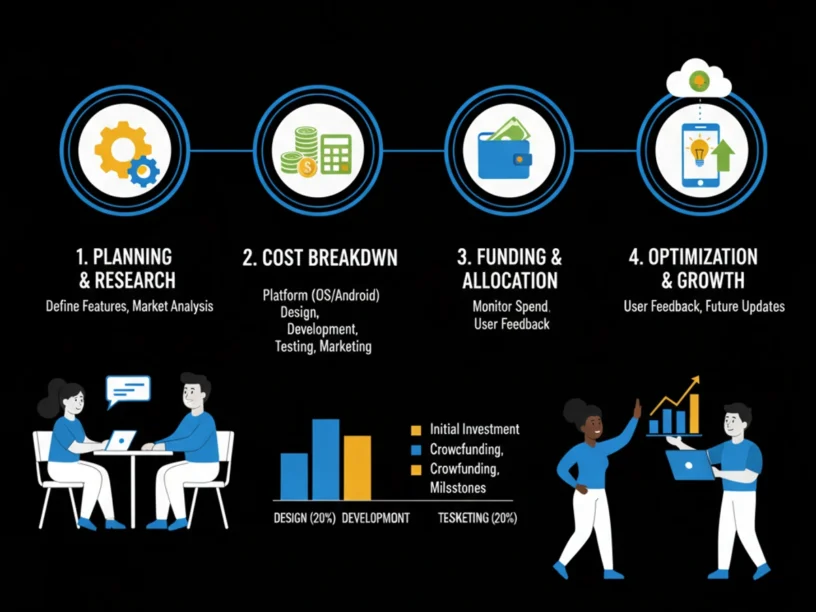
What You’ll Learn
Before you talk to any developer, you need to know how much your app will actually cost. Sounds obvious, right? Yet most first-time founders skip this step and end up in one of two painful places: they run out of money halfway through the build, or they’ve spent a fortune on features nobody asked for. This guide walks you through a realistic, phased approach to budgeting — from your first strategy session all the way through to launch and beyond — so you can have real conversations with developers instead of guessing in the dark.
- Understand each cost phase: discovery, prototype, MVP build, and post-launch.
- Know realistic 2026 price ranges for Australian app development at every stage.
- Spot the hidden costs that catch first-time founders off guard.
- Build a complete budget that includes marketing and ongoing maintenance.
Prerequisites: A validated app idea or problem statement, a rough sense of your target users, and at least a preliminary budget range in mind. No technical knowledge is required.
Why Budgeting for App Development Matters in 2026
Australia’s mobile app market generated around $3 billion AUD in revenue in 2024 and is growing at 15.3% year-on-year, on track to hit $5.6 billion by 2026. That’s the good news. The catch? The market rewards well-built, well-funded products and punishes under-capitalised ones that run out of runway before they find traction.
Here’s the real challenge: app development costs in Australia vary wildly, and developers will quote you anything from $30K to $300K+ depending on what you’re building. Without a structured approach, most first-time founders either underestimate what they need or pour money into the wrong phase. We’ve seen it happen repeatedly — a founder skips a $7,000 discovery phase, then spends $50,000 fixing scope problems that discovery would have caught on day one.
This guide mirrors how professional development partners actually structure real projects. That means you’ll never get surprised by a line item, and you’ll always know where your money is going.
Key Takeaway: The Australian app market is growing fast, but your success depends on a structured budget that accounts for variable costs and avoids common traps like underestimating needs or over-investing in the wrong phases. For supporting data, see App Development Cost (2026).
The Process at a Glance
| Step | Action | Time | Outcome |
|---|---|---|---|
| 1 | Budget for discovery and strategy | 1–3 weeks | Validated scope and cost blueprint |
| 2 | Allocate funds for a prototype | 2–4 weeks | Clickable proof-of-concept to show users |
| 3 | Plan your MVP build budget | 6–16 weeks | Launchable product with core features |
| 4 | Reserve for maintenance and operations | Ongoing annually | Stable, secure, up-to-date app |
| 5 | Set a go-to-market marketing budget | From launch onward | Users acquired, traction demonstrated |
Total estimated investment to launch: AUD $40,000–$120,000+ for a well-scoped MVP, depending on complexity, platform choice, and team model.
Step 1: Budget for Discovery and Strategy ($5,000–$15,000)
What You’re Doing
Before code gets written, you need to define exactly what you’re building, who needs it, and why it matters. The discovery phase translates your app idea into a documented technical scope, user flows, and architecture plan — the blueprint that every budget decision after this one depends on. Skip it, and you’re building in the fog.
How to Do It
- Engage a development partner or independent product strategist for a structured discovery engagement. Expect to invest $5,000–$15,000 for requirements gathering, architecture planning, and technology recommendations before any development begins.
- Insist on deliverables you can actually use: a written technical specification, wireframes or user flow diagrams, and a prioritised feature list. If a partner quotes you without providing these, they’re guessing — and you’ll pay for their guesses later.
- Use this phase to validate your idea with real potential users before you lock in your build budget. The most common founder mistake is building first and validating second. It’s expensive, slow, and usually ends with a product nobody wants.
- Ask about the Australian R&D Tax Incentive early. Eligible companies under $20M turnover can access a refundable offset of 43.5% of eligible R&D expenditure — which can materially improve your runway when you plan for it from the start.
Best Practices
- Think of the discovery fee as the cheapest insurance you can buy. Teams that dedicate at least 20% of their total budget to pre-development activities like discovery and design are three times more likely to build a successful product.
- Shortlist 2–3 partners and compare their discovery deliverables, not just their headline quotes.
- Appomate believes in empowering founders — especially those without a technical background — to innovate and turn their ideas into market-ready apps quickly and safely. Their discovery process, called Spark, is designed specifically for first-time founders who need clarity before committing capital. Their philosophy is simple: get further faster, from validation to launch, growth and exit — one partner for the whole journey.
Common Mistakes
- Skipping discovery to save money. This is the most expensive mistake in app development. A skipped discovery phase almost always results in scope creep, budget blowouts, and rework that costs far more than the discovery would have.
- Accepting a quote without a written spec. A quote without a technical specification isn’t a quote — it’s an estimate based on assumptions that will change the moment development starts.
What Done Looks Like
You have a detailed written scope document, a prioritised feature list, and a reliable cost estimate for your MVP — giving you the confidence to move forward (or pivot) before spending serious money.
Example
| Discovery Activity | Typical Cost (AUD) | Output |
|---|---|---|
| Stakeholder workshops and user interviews | $2,000–$5,000 | Validated problem statement |
| Technical feasibility and architecture review | $2,000–$5,000 | Stack recommendation and risk log |
| Written scope and feature priority list | $1,000–$5,000 | Development-ready brief |
Key Takeaway: The discovery phase ($5,000–$15,000) is a critical upfront investment that produces a detailed technical specification and validated scope — acting as essential insurance against costly mistakes and ensuring reliable budgeting for what comes next. For a more detailed walkthrough, see How Much Does App Development Cost in Australia in 2026?.
Ready to build your app?
Book a free Visioning Call with our team today and walk away with a clear roadmap, expert feedback, and a plan to bring your idea to life. No technical knowledge required.
Step 2: Allocate Funds for a Prototype ($5,000–$15,000)
What You’re Doing
A prototype is a clickable, visual walkthrough of your app — not working code, but a realistic simulation of how users will navigate it. It’s your most cost-effective tool for testing assumptions, getting user feedback, and securing buy-in from investors or co-founders.
How to Do It
- Brief your design team using the scope document from Step 1. Without a clear scope, prototype costs spiral quickly as direction keeps changing.
- Focus on high-fidelity mockups of your core user journeys only — the screens that prove your product’s primary value. Resist the temptation to design every screen you can imagine.
- Test the prototype with 10–20 real potential users. Their feedback at this stage costs almost nothing to act on; the same feedback after the build is complete costs a fortune.
- Use the prototype in conversations with investors, advisors, and development partners to get more accurate fixed-price quotes for your MVP.
Best Practices
- Tools like Figma allow real-time collaborative design reviews — ask your partner to share the working file so you can see progress as it happens.
- Keep prototype scope tight: 5–10 core screens is enough to test a concept. Scope creep here inflates costs and delays the actual build unnecessarily.
What Done Looks Like
You have a clickable prototype that clearly communicates your product’s core value, user-tested feedback incorporated into the design, and a refined brief ready for MVP development.
Step 3: Plan Your MVP Build Budget ($25,000–$80,000)
What You’re Doing
This is where the majority of your capital gets deployed, and where first-time founders run the highest risk of under-budgeting or over-scoping. The Minimum Viable Product is the smallest working version of your app that delivers real value to real users — and getting this phase right is the most critical decision you’ll make in how to budget for app development.
How to Do It
- Get at least two fixed-price quotes using your scope document. Ask each partner explicitly: what’s included in this price? Is it design, QA, testing, project management, and deployment? Ask whether this is a fixed-price or time-and-materials contract, and confirm what’s covered.
- Choose your platform strategy deliberately. Cross-platform frameworks like React Native and Flutter save 30–40% compared to building separate native iOS and Android apps. For most first-time founders, cross-platform is the smart starting point.
- Prioritise ruthlessly: your MVP should contain only the features that prove your core value proposition. Build that first, get feedback from real users, then invest in what the data tells you actually matters.
- Build in a 10–15% contingency buffer on top of your quoted price. Scope refinements, integration complexity, and third-party API surprises are common in live builds.
Best Practices
- Partner with a team that has startup experience — not just coding skills. A partner who challenges your feature list is more valuable than one who builds everything you ask for without question.
- Appomate combines AI-driven development with hybrid delivery — Australia-based strategy and product design paired with a world-class global development team. They’ve helped founders go from idea to market in as little as 6 weeks, building products that are AI-native rather than just AI wrappers, using the latest AI-driven development tools to deliver faster and smarter.
- Rather than allocating your entire budget to version 1.0, consider building iteration into your plan. For example, if your total app budget is $200K, invest $150K in the initial release and reserve $50K for improvements — this lets you respond to real user feedback instead of guessing what users want.
Common Mistakes
- Over-scoping the MVP. Many first-time founders try to build every feature they can dream up, resulting in costly delays, a blown budget, and an app that still misses the mark on core user needs.
- Choosing the cheapest quote. The lowest price often delivers poor-quality code and constant delays. A $30K offshore build that fails and needs rebuilding has cost you far more than the savings.
What Done Looks Like
A working, tested, deployed app available on your chosen platform(s) with your core feature set live — ready for real users to interact with and give feedback on.
Example: MVP Budget Scenarios
| Scenario | Description | Estimated Cost (AUD) |
|---|---|---|
| Simple MVP | Single core feature, basic UI, one platform | $25,000–$50,000 |
| Standard SaaS MVP | Multiple features, dashboard, payment integration | $50,000–$80,000 |
| Complex or AI-native MVP | Agentic workflows, third-party integrations, automation | $80,000–$150,000+ |
Key Takeaway: The MVP build ($25,000–$80,000+) is your largest initial investment. Success depends on ruthless prioritisation of core features, deliberate platform choice (cross-platform saves 30-40%), and a 10-15% contingency to avoid over-scoping and budget overruns. For related guidance, see Pdlc Vs Sdlc Explained Making The Right Choice For Faster Smarter Product Development.
Step 4: Reserve Budget for Maintenance and Operations (15–20% Annually)
What You’re Doing
Launching your app isn’t the finish line — it’s the starting gun. Your app needs ongoing updates for operating system compatibility, security patches, bug fixes, server infrastructure, and app store fees. Hidden ongoing costs can add 20–50% annually when you factor in infrastructure, maintenance, third-party APIs, compliance, and store fees. First-time founders who don’t budget for this phase often watch their product degrade within 6–12 months of launch.
How to Do It
- Set aside 15–20% of your initial development cost as an annual maintenance reserve. Most agencies charge this range for maintenance, bug fixes, OS updates, and security patches.
- Account for infrastructure costs: cloud hosting, database fees, and content delivery. Budget for cloud hosting ($50–$500+/month depending on scale), App Store fees ($149 AUD/year for Apple), and any third-party API usage costs.
- If your app handles personal data, budget for compliance work. From December 2026, Australia’s Privacy Act introduces new transparency requirements for apps using automated decision-making on personal data — for fintech, healthcare, or real estate apps, this adds governance and documentation work to your build.
- Negotiate a post-launch support retainer with your development partner before you sign the initial contract. Guaranteed capacity when issues arise is worth its weight in gold.
What Done Looks Like
Your annual budget includes a maintenance line item — typically $5,000–$20,000 per year for most MVP-scale apps — and you have a support arrangement in place with your development partner before launch day.
Key Takeaway: Post-launch maintenance and operations aren’t optional; budget 15-20% of your initial development cost annually for updates, security, infrastructure, and compliance to prevent product degradation and ensure long-term stability.
Step 5: Set a Go-to-Market Marketing Budget ($1,000–$10,000/month)
What You’re Doing
Here’s where most first-time founders stumble: they allocate the entire budget to development and hope users will somehow find their app. One of the most predictable financial mistakes is neglecting marketing while pouring money into the build. Even the most innovative app struggles to gain traction if potential users don’t know it exists. A dedicated go-to-market budget isn’t optional — it’s part of your core app investment.
How to Do It
- Define your marketing channels before launch. For most Australian consumer apps in 2026, the primary channels are App Store Optimisation (ASO) — the process of improving app visibility within the app stores and increasing conversions — paid social, content marketing, and community-led growth.
- Start your marketing activity before your app launches. Marketing an app on a budget in 2026 starts with distribution — building a channel, waitlist, or following before the app ships, then matching content to each platform rather than posting the same thing everywhere.
- For early-stage Australian startups, a monthly marketing budget of $1,000–$5,000 is a reasonable starting range, scaling to $5,000–$10,000/month once you’ve validated your acquisition channels.
- Track your Customer Acquisition Cost (CAC) — the total cost of acquiring a new customer — from day one and benchmark it against your users’ Lifetime Value (LTV) — the predicted revenue a customer will generate over their relationship with your product. Every dollar of marketing spend should be traceable to an outcome.
Best Practices
- Don’t wait until post-launch to think about growth. Building your app is only part of the investment — you also need a plan to attract users, which may include branding, app store optimisation, digital advertising, content creation, public relations, or ongoing marketing campaigns.
- Use Google Search Console and Google Analytics from day one so you have baseline data to optimise against.
What Done Looks Like
Your launch plan includes a written go-to-market strategy, a monthly marketing budget allocation, and at least two acquisition channels actively running by the time your app reaches users’ hands.
Key Takeaway: A dedicated marketing budget ($1,000–$10,000/month) is crucial for app success; begin building your audience pre-launch and rigorously track CAC and LTV to ensure efficient user acquisition.
What to Do After Your Budget Is Set
Phase 1 — Validate Before You Spend
With your budget framework in place, your first action is validation — not development. Run user interviews, build a landing page, and collect pre-launch sign-ups before committing to the MVP build. This costs almost nothing and protects your most significant investment.
Phase 2 — Launch and Iterate
Once your MVP is live, shift your focus to data-informed iteration. Reserve at least 20–25% of your original build budget for version 1.1 improvements based on real user feedback. The founders who succeed treat launch as the beginning of the learning process, not the end of the build process.
Phase 3 — Scale With Evidence
Once you’ve demonstrated user retention and a repeatable acquisition channel, you’re in a position to raise capital or re-invest revenue into a full feature roadmap. Scale your marketing budget in proportion to validated CAC and LTV data — not instinct. This is also the moment to explore whether your development expenditure qualifies for the R&D Tax Incentive, which can return meaningful non-dilutive cash to your business.
Resources You’ll Need
| Resource | Role in the Process | Required / Recommended | Cost |
|---|---|---|---|
| Appomate | Full-service development partner: strategy, design, build, launch, and growth | Recommended | Project-based (contact for quote) |
| Figma | Prototype and UI design collaboration tool | Recommended | Free tier available; from AUD $18/month |
| AusIndustry R&D Tax Incentive | Government program to offset eligible development costs | Recommended | Free to apply |
| Notion | Budget tracking, project documentation, and roadmap planning | Optional | Free tier available; from AUD $12/month |
| Google Analytics | Post-launch user behaviour and acquisition tracking | Required | Free |
See also, see How much does it cost to make an app in 2026? A guide ….
Troubleshooting Common Issues
Problem: Quotes from developers vary wildly — from $15,000 to $200,000 for the same brief
Likely cause: Your brief lacks enough detail for partners to scope accurately, so each agency is making different assumptions about features, platforms, integrations, and quality standards.
Fix: Complete Step 1 (discovery and specification) before requesting quotes. A written scope document forces all partners to price the same thing, making quotes genuinely comparable. Always ask what is and isn’t included in each line item.
Problem: Budget runs out before launch
Likely cause: Scope creep — features were added during development without a corresponding budget increase, or the contingency buffer was too small.
Fix: Lock your MVP feature list before development begins and apply a formal change request process for any additions. Build a minimum 15% contingency into your budget from day one and treat it as untouchable unless a change is formally scoped and approved.
Problem: App launches but gets no users
Likely cause: The entire budget was allocated to development while marketing and user acquisition were neglected. This is one of the most predictable and avoidable outcomes for first-time founders.
Fix: Allocate Step 5 (marketing budget) from day one — not after launch. Begin building your audience and waitlist at least 60 days before your app goes live.
Problem: Post-launch maintenance costs are higher than expected
Likely cause: Ongoing infrastructure, third-party API fees, and OS update requirements weren’t included in the original budget model.
Fix: Before signing any development contract, ask your partner for an itemised estimate of annual running costs: server hosting, app store fees, API subscriptions, and estimated maintenance hours. Budget for 15–20% of your build cost annually from the outset. For more troubleshooting advice, see Startup App Development Mistakes That Burn Budget Early.
Conclusion
Key Takeaways
- Outcome recap: A well-structured app budget in Australia moves through five phases — discovery ($5K–$15K), prototype ($5K–$15K), MVP build ($25K–$80K+), ongoing maintenance (15–20% per year), and marketing ($1K–$10K/month). Knowing how to budget for app development as a first-time founder in Australia means planning for all five before you start, not discovering them one by one.
- Key insight: The discovery phase isn’t an optional cost — it’s the investment that makes every subsequent dollar more efficient. Founders who skip it consistently overspend and underdeliver.
- Next action: Book a discovery consultation with a development partner who understands startup budgets and can give you a documented scope, not just a ballpark figure. If you want to get from idea to market faster and safer, Appomate — with 250+ apps delivered and a full-service model from validation to launch — is a strong starting point for Australian founders ready to move with confidence.
FAQ
How do you budget for app development as a first-time founder in Australia in 2026?
To budget for app development as a first-time founder in Australia in 2026, structure your investment across five phases: discovery and strategy ($5,000–$15,000), prototype design ($5,000–$15,000), MVP build ($25,000–$80,000+ depending on complexity and platform), annual maintenance (15–20% of your build cost per year), and go-to-market marketing ($1,000–$10,000/month). Start with a formal discovery engagement — this produces the technical specification that makes every subsequent budget decision reliable. Add a 10–15% contingency buffer on top of your MVP quote, and never allocate your entire capital to the build phase alone. Marketing and maintenance are not extras; they are core budget lines.
What is the average cost to build an app in Australia in 2026?
In 2026, mobile app development in Australia typically costs between AUD $40,000 for a simple single-platform MVP and AUD $400,000+ for a feature-rich cross-platform product, with most mid-complexity apps landing between AUD $80,000 and $200,000. For first-time founders targeting a lean MVP, the realistic starting range is AUD $25,000–$80,000 with a well-scoped brief and a cross-platform framework.
What is a discovery phase and why does it matter for your budget?
A discovery phase is a structured engagement — typically costing $5,000–$15,000 — where a development partner works with you to document your requirements, map user journeys, review technical feasibility, and produce a written specification. It matters because without one, every quote you receive is based on assumptions that will change mid-build. Founders who skip a discovery phase routinely spend AUD $50,000 fixing scope issues that a proper discovery would have caught on day one. It’s the cheapest insurance available in the app development process.
How much should I budget for app maintenance after launch?
The majority of agencies charge 15–20% of the initial development cost per year for maintenance, bug fixes, OS updates, and security patches. On a $60,000 MVP, that means budgeting $9,000–$12,000 per year for maintenance alone, before you add cloud hosting, app store fees, and third-party API costs. Budget for the maintenance years from day one — not as an afterthought once the app is live.
Can I reduce app development costs in Australia using an offshore team?
Yes, but with important caveats. Hybrid delivery models — where strategy, product design, and project management are handled locally in Australia, and development is executed by a skilled global team — can deliver meaningful cost savings without sacrificing quality or accountability. Cross-platform frameworks like React Native and Flutter save 30–40% compared to building separate native iOS and Android apps, and offshore-hybrid models can reduce development rates significantly. The key is ensuring the strategic and quality oversight layer remains Australia-based so your product meets local market standards.
Is the Australian R&D Tax Incentive available for app development?
Yes. The R&D Tax Incentive helps companies innovate and grow by offsetting some of the costs of eligible research and development. For eligible companies under $20M turnover, the offset is 43.5 cents per dollar of eligible R&D expenditure — and for loss-making startups, this offset is refundable, meaning you receive cash back rather than just a future tax reduction. App development that involves novel technical approaches, experimental architectures, or AI/ML model development can qualify. Engage a specialist adviser early in your project to structure your documentation correctly.
What is the biggest budgeting mistake first-time app founders make in Australia?
The most common and most expensive mistake is building without validating the problem first — founders invest $50,000–$150,000 in development before confirming that real users have an urgent, underserved need and are willing to pay to solve it. The second most common mistake is allocating all capital to the build phase and arriving at launch with no marketing budget and no runway for iteration. A well-structured budget addresses both risks: it funds validation before build, and it reserves capital for post-launch growth.
How long does it take to build and launch an MVP app in Australia?
For a well-scoped, lean MVP using a cross-platform framework and an experienced development partner, a realistic timeline from discovery to launch is 12–20 weeks. This includes 1–3 weeks for discovery, 2–4 weeks for prototype and design, 6–12 weeks for development and QA, and 1–2 weeks for deployment and app store review. Development partners using AI-driven development tools and agile delivery models can compress this further — some experienced partners have helped founders go from idea to market in as little as 6 weeks for tightly scoped products.
Methodology: Cost ranges cited in this guide are sourced from publicly available 2026 Australian market data, industry pricing guides, and development agency benchmarks. All figures are in Australian dollars (AUD) and reflect market conditions as of mid-2026. Individual project costs will vary based on complexity, feature scope, platform strategy, team model, and compliance requirements. This guide is intended for informational purposes only and does not constitute financial or legal advice. Consult a qualified adviser before making investment decisions related to app development.