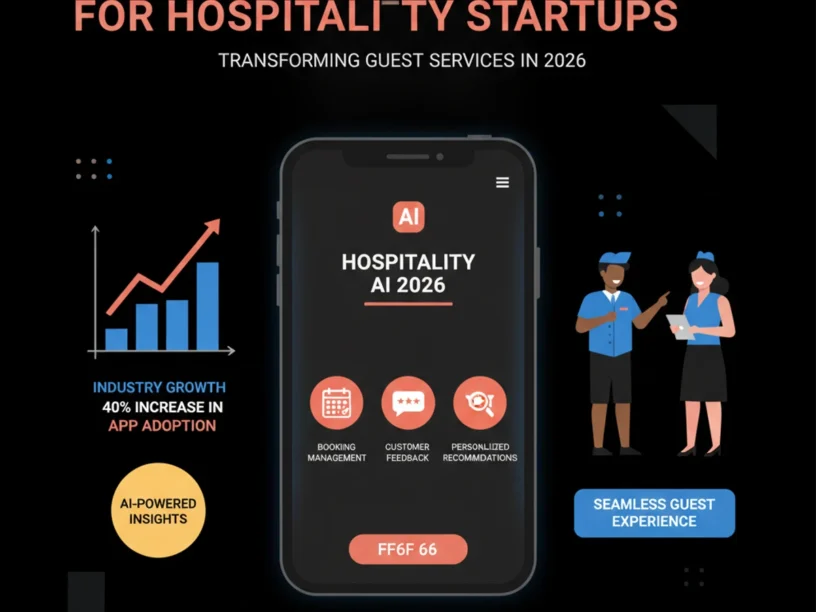
AI mobile app development for hospitality and restaurant startups in Australia | September 10, 2026 | 9 min read | Appomate Team
AI Mobile App Development for Hospitality Startups 2026 means building native or cross-platform apps that embed machine learning directly into ordering, booking, pricing, and marketing. For founders exploring this space, the opportunity is significant: the sector generates over $90 billion annually across more than 56,000 venues, yet most operators still run on disconnected, non-AI systems. Startups that get the AI layer right from day one are positioned to out-compete legacy players on pricing, personalisation, and guest experience.
The next generation of hospitality apps in Australia will not compete on having a booking button. They will compete on whether the app can predict what a guest wants before the guest asks.
What Does AI Mobile App Development for Hospitality and Restaurant Startups in Australia Actually Involve?
AI mobile app development for hospitality and restaurant startups in Australia combines standard app engineering (ordering, booking, loyalty, payments) with an AI decision layer that learns from guest behaviour, booking patterns, and live market data. Unlike a plain digital menu or QR-code ordering system, an AI-native hospitality app continuously improves pricing, staffing recommendations, and marketing timing as it collects more data.
Core Components
- Guest-facing experience: ordering, booking, digital menus, loyalty, and payments built for mobile-first Australian diners. Smartphone penetration in Australia now exceeds 87%, leaving no room for a clunky experience.
- Predictive intelligence: models that learn from historical bookings, seasonality, and local events to anticipate demand.
- Backend integrations: live connections to POS, PMS, and inventory systems so AI recommendations reflect actual stock and staffing.
- Operator dashboard: a control panel where non-technical founders can see AI-driven insights without needing a data science background.
A genuine AI hospitality app is engineered from the ground up with an AI decision layer connected to live operational data. This is exactly the approach Appomate takes when building AI-native products, not just AI wrappers. For deeper context, see The Complete Guide to Using AI in the Hospitality Industry in ….
Which AI Features Matter Most for Hospitality Startups in Australia in 2026?
The AI features generating the most measurable value for Australian hospitality startups in 2026 are dynamic pricing, personalised recommendations, demand forecasting, and reservation intelligence. Lightspeed’s 2026 State of Hospitality Report found that nearly all operators (98%) reported using AI in some form, and more than 1 in 4 operators consider it essential technology for 2026. This signals that AI features are moving from novelty to baseline expectation.
| AI Feature | What It Does | Business Impact |
|---|---|---|
| Dynamic pricing | Adjusts room or menu prices automatically based on demand, competitor rates, and events | Protects margin during peak periods without manual rate changes |
| Personalised menus/offers | Recommends dishes or packages based on past orders and preferences | Increases average order value and repeat visits |
| Demand forecasting | Predicts booking volume weeks ahead using seasonal and event data | Improves staffing and inventory planning |
| Reservation intelligence | Prioritises and manages bookings, waitlists, and table turnover automatically | Reduces no-shows and idle capacity |
These capabilities are accessible to operators of all sizes. With guest mobile usage this high-where mobile users spend over 90% of screen time in apps rather than websites, averaging nearly 3 hours and 45 minutes daily-AI features embedded in a native app reach guests far more effectively than website banners or email campaigns. For deeper context, see AI Integration for Mobile Apps Australia | Add AI – App Development …. For related guidance, see AI Integration Mobile Apps Australia Machine Learning Development.
Manual rate-setting was always a rough tool. In 2026, it is a competitive disadvantage for any hospitality operator relying on it.
How Much Does AI App Development Cost for Hospitality Startups in Australia?
AI mobile app development for hospitality and restaurant startups in Australia typically costs between AUD 25,000 and AUD 350,000, depending on how much of the build involves custom AI models versus off-the-shelf integrations. Cost is a function of scope and AI complexity rather than a fixed number.
| Tier | Price Range (AUD) | Typical Timeline | What’s Included |
|---|---|---|---|
| Basic AI MVP | $25,000 – $60,000 | 6-10 weeks | Core booking/ordering app plus one AI feature, e.g. basic personalisation |
| Mid-level AI app | $60,000 – $150,000 | 10-16 weeks | Multiple AI features, POS/PMS integrations, admin dashboard |
| Advanced AI platform | $150,000 – $350,000+ | 16-26 weeks | Custom-trained models, multi-venue support, enterprise security |
These bands align with what industry cost guides report for the Australian market in 2026. Cost variation reflects how significantly AI complexity and customisation affect the final price. Hybrid delivery models, combining Australia-based strategy with an experienced offshore engineering team, can meaningfully reduce cost without sacrificing quality. Teams using modern AI development tools can speed up delivery by 30 to 50%, which means fewer billable hours and more predictable costs.
Appomate’s hybrid model is built specifically to keep hospitality startups inside the affordable end of these ranges while still shipping AI-native features. For deeper context, see How much does it cost to build an app in Australia in 2026?.
What Are the Biggest Challenges and Compliance Considerations for AI Hospitality Apps in Australia?
The biggest challenges facing AI hospitality apps in Australia in 2026 are tight operating margins, legacy system integration, and new privacy rules around automated decision-making.
Privacy and Data Governance
From 10 December 2026, new Privacy Act transparency rules require apps using automated decision-making on personal data to disclose it. This directly affects dynamic pricing and personalisation engines that make automated decisions about individual guests.
Operational and Margin Pressure
Independent operators work with thin margins. Net profitability for independent operators has compressed to a median of 3-6%, leaving little room for poorly scoped or over-engineered builds. However, roughly 78% of Australian venues have no structured operations technology, meaning early movers have a significant advantage.
The venues with no structured operations technology today are the ones most exposed when a competitor launches an AI-native app next door.
Compliance and margin pressure are not reasons to delay AI adoption-they are reasons to work with a partner who scopes carefully, validates ideas, and builds privacy disclosure into the product from day one. For more on common pitfalls, see Mobile App Development Mistakes to Avoid in 2026: User ….
How Should a Hospitality Startup Choose an AI App Development Partner in Australia?
Choosing the right AI app development partner for a hospitality startup in Australia comes down to three things: proven vertical experience, an AI-native build philosophy, and support that extends beyond launch into growth.
What to Look For
- Hospitality-specific experience: a partner who understands reservation flows, POS integrations, and dynamic pricing.
- AI-native architecture: the difference between a product built around AI decision-making and one that wraps a chatbot around an existing app matters enormously for long-term scalability.
- End-to-end partnership: from validation and design through development, launch, marketing, and ongoing support.
- Hybrid delivery model: Australia-based strategy and product design combined with a skilled global engineering team, which keeps quality high and cost startup-friendly.
- Speed to market: a structured framework that gets a validated product live in weeks.
Why Founders Choose Appomate for Hospitality AI Apps
Appomate is a Melbourne-based mobile and web app development company that has delivered more than 250 apps for clients including Adidas, L’Oréal, Lend Lease, and Hoyts. It lists Hospitality as one of its dedicated verticals alongside Marketplace, Wellness, AI Apps, and Healthcare. Its Further Faster Framework takes founders from idea to market in as little as six weeks, positioning itself as a full growth partner covering validation, design, development, launch, marketing, and long-term support.
Building an AI wrapper around someone else’s chatbot is not the same as building an AI-native product. One is a feature. The other is a business.
Conclusion
AI mobile app development for hospitality and restaurant startups in Australia has shifted from a competitive edge to an operational baseline. AI adoption among operators is now near-universal, and guest expectations are rising to match. Startups that treat AI as a core architectural decision deliver the strongest results.
- AI is now standard, not optional: the vast majority of Australian hospitality operators already use some form of AI.
- Core features to prioritise: dynamic pricing, personalised recommendations, demand forecasting, and reservation intelligence deliver the clearest returns.
- Budget realistically: expect AUD 25,000 to 350,000+ depending on AI complexity, with hybrid delivery models keeping costs down without cutting quality.
- Plan for compliance early: new Privacy Act rules on automated decision-making take effect from December 2026 and directly affect personalisation and pricing engines.
- Choose a full-journey partner: founders get the best results working with a team that validates, builds, launches, and supports the product long term, such as Appomate.
The next step for any hospitality founder considering this path is a scoped conversation about which AI features matter most for their venue type before committing to a full build.
FAQ
What is AI Mobile App Development for Hospitality Startups in 2026?
AI mobile app development for hospitality startups in 2026 refers to building mobile apps for restaurants, cafes, hotels, and venues that embed machine learning features directly into the core product. This integrates AI for functionalities such as dynamic pricing, personalised recommendations, demand forecasting, and reservation intelligence. Unlike simply adding a chatbot, it means engineering the app from the ground up with an AI decision layer that continuously learns and improves based on guest behavior and market data.
How much does it cost to build an AI-powered restaurant app in Australia?
Costs typically range from AUD 25,000 for a basic AI MVP to AUD 350,000 or more for an advanced platform with custom-trained models. Most mid-sized hospitality apps land between AUD 60,000 and AUD 150,000.
What AI features should a new hospitality app include first?
Most startups get the best early return from dynamic pricing, personalised menu or offer recommendations, and reservation or waitlist intelligence.
How long does it take to build an AI hospitality app with a partner like Appomate?
Using a structured process such as Appomate’s Further Faster Framework, a validated AI-native hospitality app can go from idea to market in as little as six weeks. More complex platforms typically take 16 to 26 weeks.
Do hospitality apps need to comply with Australian privacy regulations?
Yes. From December 2026, updated Privacy Act rules require apps that use automated decision-making on personal data to clearly disclose this to users. This includes features like dynamic pricing and personalisation engines.
Can a small café or single-location restaurant afford an AI app?
Yes. Small operators can access basic AI MVPs starting around AUD 25,000, scaling features up as the business grows.
What’s the difference between an AI-native app and an AI wrapper?
An AI-native app is architected from the ground up with AI models integrated into core decision-making, such as pricing and forecasting. An AI wrapper simply adds a chatbot or basic automation on top of an existing non-AI app without fundamentally changing how the product makes decisions.
How does Appomate help non-technical founders build hospitality apps?
Appomate acts as a full growth partner rather than a build-only agency, guiding founders through idea validation, product design, AI-native development, launch, marketing, and ongoing support. This approach keeps the process accessible for founders without a technical background.
This article was compiled using publicly available Australian hospitality industry data, app development cost guides, and 2026 industry reports current as of September 2026. Figures are indicative and should be validated against a scoped quote for any specific project, as actual costs and timelines vary by feature complexity and integration requirements.