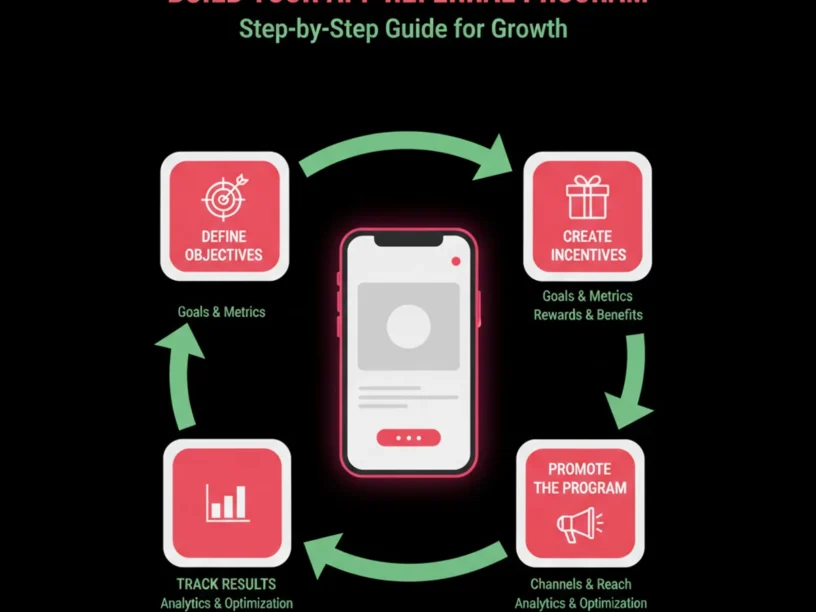
how to build a referral program for a mobile app | September 11, 2026 | Appomate Team | 2-4 weeks to launch, 8-12 weeks to optimize | Beginner
What You’ll Learn
If you’re wondering how to build a referral program for a mobile app in 2026, here’s the honest answer: pick a simple incentive that matches your app’s core value, wire it into your app with a mobile-native SDK, make sharing a one-tap action inside the product, track it properly, and optimize the reward based on real conversion data. This guide walks Australian founders and first-time app owners through the exact five-step process, using the same logic that powered Uber, Dropbox, and Airbnb’s early growth loops. You don’t need to be technical to follow it, and you don’t need a huge marketing budget to get started.
- Choose a referral incentive structure that fits your app category, such as utility, fintech, social, or marketplace.
- Identify mobile referral tools and SDKs that actually work for iOS and Android apps in 2026.
- Design a friction-free, in-app sharing flow that doesn’t break the user experience.
- Track, prevent fraud, and A/B test your referral program for measurable ROI.
Prerequisites: a live or near-launch mobile app, a defined “aha moment” or core action you want new users to reach, and basic access to your app’s backend or a development partner who can implement the SDK.
Why Building a Referral Program Matters in 2026
Referral programs have quietly become one of the highest-leverage growth channels available to app founders. Research from GrowSurf shows mobile app referral programs generate 20-35% of all app installs for apps with mature programs, and just as importantly, referral-acquired app users have a 37% higher Day-30 retention rate than paid-acquired users. That retention gap matters more than the install number itself, because it means referred users stick around and generate more lifetime value.
The economics have also shifted in referral’s favor. Privacy changes have made paid acquisition harder and pricier: Apple’s ATT framework, or App Tracking Transparency, and Google’s Privacy Sandbox initiative to create web technologies that protect people’s privacy online have significantly impacted paid user acquisition, increasing costs by 30-40% and reducing targeting accuracy by 35-45%. Meanwhile, referral programs are largely unaffected by these changes because they rely on first-party, user-initiated sharing rather than third-party tracking. On top of that, Deloitte’s research found that mobile-optimized referral programs see 56% higher engagement rates.
For Australian startups competing against well-funded global apps, a well-built referral program is one of the few growth levers that gets cheaper as it scales, not more expensive. That’s exactly why Appomate, a Melbourne-based app development partner, treats referral and viral loop mechanics as a core part of its product-led growth strategy for founders building their first app.
Key Takeaway: Mobile app referral programs are a high-leverage growth channel, generating 20-35% of installs and 37% higher Day-30 retention for referred users, while being less affected by privacy changes and scaling more cost-effectively than paid acquisition. For supporting data, see 58 Referral Marketing Statistics You Need to Know in 2026.
The Process at a Glance
| Step | Action | Time | Outcome |
|---|---|---|---|
| 1 | Define your referral goal and incentive structure | 2-3 days | Clear reward model tied to your app’s value |
| 2 | Choose a mobile-native referral SDK or platform | 3-5 days | Technical foundation ready for integration |
| 3 | Design the in-app sharing flow and prompts | 1-2 weeks | Frictionless, one-tap referral experience live |
| 4 | Set up tracking, attribution, and fraud prevention | 3-5 days | Reliable data on who referred whom |
| 5 | Launch, test, and optimize rewards | Ongoing, 8-12 weeks | Data-backed referral program with rising ROI |
Total time to launch: approximately 2-4 weeks for a working program, with 8-12 weeks of testing to reach a mature, optimized version.
Step 1: Define Your Referral Goal and Incentive Structure
What You’re Doing
Before writing a single line of code, you need to lock in what success actually looks like. Decide what a “successful referral” actually means for your app and what reward will motivate both the referrer and the new user to act. Get this right, and the rest falls into place. Get it wrong, and you’ll spend weeks building something nobody wants to share.
How to Do It
- Identify the single action that proves value in your app: a first booking, first transaction, or first completed workout.
- Decide whether the referral converts on signup, app download, or a deeper action like a purchase. Extole’s 2026 referral research notes 62% of referral programs define a successful conversion as a purchase by the referred customer, though many apps also track signups or engagement milestones.
- Choose a reward type: cash, credits, feature unlocks, or gamified perks. GrowSurf’s data shows in-app currency or credits are the most effective reward, used by 52% of top-performing programs, while feature unlocks and premium access drive 35% higher referral quality than cash rewards.
- Set the reward value for both sides, double-sided incentives consistently outperform single-sided ones.
Best Practices
- Match the reward to your app category: gaming apps do well with in-game currency, utility apps with premium feature access, as GrowSurf notes.
- Keep the reward simple to explain in one sentence; complexity kills sharing intent.
Common Mistakes
Founders often set the reward too low to move behavior, or too generous to sustain financially. Model the cost per acquired user against your existing paid acquisition cost before locking in numbers.
What Done Looks Like
You have a one-page document stating: trigger action, reward type, reward value for referrer and referee, and how the reward is delivered.
Example
| App Type | Trigger | Referrer Reward | Referee Reward |
|---|---|---|---|
| Ride-share / delivery | First completed ride/order | $5-$20 credit | $5-$20 credit |
| Fintech / neobank | Identity verification + transaction | $10-$60 cash | $10-$60 cash |
| Subscription / SaaS-style app | Free trial signup | Extra storage/credits | Extra storage/credits |
These figures reflect patterns seen in real programs from Uber and Revolut, where users share referral links from the app, new users download the app, complete identity verification, and make qualifying transactions, and both parties receive cash rewards.
Key Takeaway: Define a clear “successful referral” action and choose a double-sided incentive, like in-app credits or feature unlocks, that aligns with your app’s value and category, while carefully modeling the reward cost against your acquisition budget.
Step 2: Choose a Mobile-Native Referral SDK or Platform
What You’re Doing
Now you need to pick the technical backbone. You’re selecting the technical foundation that will track referrals, generate shareable links, and attribute installs back to the right user, directly inside your app rather than through a clunky web portal. This is the difference between a referral program that feels native and one that feels bolted-on.
How to Do It
- Shortlist platforms built for native mobile integration, such as Cello, GrowSurf, or Voucherify, all of which support iOS, Android, and cross-platform frameworks like React Native and Flutter. A mobile-native SDK, or Software Development Kit, is a set of tools and libraries specifically designed for building applications on a particular mobile platform, like iOS or Android, ensuring seamless integration and performance.
- Confirm deep-linking support so a shared link opens directly to the right in-app screen rather than a generic app store page. Deep-linking is a method of launching a mobile app and directing a user to a specific piece of content or screen within the app, rather than just opening the app to its homepage.
- Check attribution accuracy: does the SDK track installs even in a post-IDFA, privacy-restricted environment? IDFA, or Identifier for Advertisers, is a random device identifier assigned by Apple to a user’s device, used by advertisers to track user activity, which has been impacted by privacy changes.
- If you’re not technical, brief your development partner, or a team like Appomate, on the reward logic from Step 1 so they can scope the integration correctly.
Best Practices
- Prioritize SDK-based, in-product integration over redirect-based portals. Cello’s research found that mobile referral programs require native SDK integration, not redirect links, to capture sharing in iOS, Android, and cross-platform environments.
- Use deep links wherever possible: GrowSurf notes deep link conversion sees apps using deep links for referrals achieve 2-3x higher conversion than those using generic app store links.
What Done Looks Like
Your app can generate a unique, trackable referral link or code per user, and that link opens directly inside the app experience for the new user, with no external web page interruption.
Step 3: Design the In-App Sharing Flow and Prompts
What You’re Doing
This is where your referral program becomes visible to users. You’re designing the moment, message, and mechanism through which someone shares your app with a friend. Get the timing and the friction wrong, and even the best incentive won’t move people to act.
How to Do It
- Place referral prompts at moments of high satisfaction, right after a completed order, a milestone, or a positive in-app action.
- Make sharing a single tap: pre-filled message, one-tap share sheet to SMS, WhatsApp, or social apps.
- Add a visible referral hub or dashboard where users can see their invites, status, and rewards earned.
- Consider light gamification, progress bars, streaks, or leaderboards, to increase motivation.
Best Practices
- Prompt early: Mixpanel data cited by GrowSurf shows onboarding-stage referral prompts generate 3x more shares than post-usage prompts.
- Remove friction: Branch’s research found referral programs with friction-free sharing and one-tap invite see 60% higher participation rates.
- Add gamified elements carefully; gamified elements like leaderboards and milestones increase referral volume by 45%.
Common Mistakes
Burying the referral feature three menus deep, or only surfacing it once, guarantees low participation. Treat it as a recurring, visible feature, not a one-off banner.
What Done Looks Like
A first-time user can find, understand, and act on the referral offer within seconds of opening the relevant screen, without reading instructions.
Step 4: Set Up Tracking, Attribution, and Fraud Prevention
What You’re Doing
You’ve built something people want to share. Now you need to make sure you can actually measure it. You need reliable data on who referred whom, whether the referred user completed the trigger action, and protection against people gaming the system for free rewards.
How to Do It
- Confirm your SDK or platform logs the full funnel: link click, install, signup, and the trigger action from Step 1.
- Set reward release rules so payouts only trigger after the genuine action, not just an install, reducing fraud risk.
- Cap rewards per user or per time period to prevent abuse from repeat self-referrals.
- Review your dashboard weekly in the first month to catch anomalies early, for example, spikes from a single device or IP range.
Best Practices
- Track referral quality, not just volume; a smaller number of high-quality referrals often outperforms a flood of low-intent ones.
- Segment referred users into your analytics separately so you can compare their retention against paid or organic users.
What Done Looks Like
You can pull a report at any time showing total referrals sent, converted, and rewarded, with fraud-flagged entries automatically excluded.
Step 5: Launch, Test, and Optimize Your Referral Rewards
What You’re Doing
You have a working program. Now it’s time to make it actually work well. You’re moving from a working program to an optimized one, using real user data to refine reward values, messaging, and placement over time. This is where you stop guessing and start iterating.
How to Do It
- Soft-launch to a subset of users or a single market segment before rolling out app-wide.
- A/B test reward values, messaging copy, and prompt timing against your baseline conversion rate.
- Track cost per referred user against your existing paid acquisition cost to confirm ROI.
- Iterate monthly based on data, retiring underperforming variants and scaling what works.
Best Practices
- Test methodically: Optimizely-backed data shows A/B testing referral reward values can increase program ROI by 25-40%.
- Give the program at least one full quarter before declaring it a success or failure; referral loops compound over time rather than spiking immediately.
Example
One growth agency documented that a referral program with gamification features for a client generated 628 new users, of whom 34 converted to paid customers, a referral-to-paid conversion rate meaningfully higher than their paid acquisition channels. That’s the kind of quality-over-volume result a well-tested program can produce.
What Done Looks Like
Your referral program has a stable, positive ROI, a documented reward structure that’s been tested at least twice, and a monthly review process to keep improving it.
Key Takeaway: Launch your referral program with a soft launch, then continuously A/B test reward values and messaging, track cost per referred user, and iterate monthly to achieve a stable, positive ROI over time.
What to Do After Launching Your Referral Program
Phase 1 (Month 1-2): Stabilize. Confirm tracking accuracy, fix any friction points in the sharing flow, and monitor for fraud or unexpected reward costs.
Phase 2 (Month 3-4): Expand. Introduce tiered rewards for repeat referrers, add new sharing channels, such as WhatsApp, email, or social, and consider a referral leaderboard.
Phase 3 (Month 5+): Scale and integrate. Feed referral performance data into your broader user acquisition mix. If you’re planning new features or a second product line, bring in a full-service partner like Appomate, which helps founders take an idea from validation through to launch, growth, and beyond, acting as a genuine growth partner, not just building what’s asked.
Ready to build your app?
Book a free Visioning Call with our team today and walk away with a clear roadmap, expert feedback, and a plan to bring your idea to life. No technical knowledge required.
Resources You’ll Need
| Resource | Role | Requirement Level | Price |
|---|---|---|---|
| Appomate | Full-service app development and product-led growth partner for building and integrating the referral program | Recommended | Custom quote |
| GrowSurf | Referral program platform with mobile SDK support | Recommended | Paid plans, free trial available |
| Cello | Native mobile referral SDK for iOS, Android, React Native, Flutter | Optional | Custom pricing |
| Voucherify | API-first promotion and referral management platform | Optional | Paid plans |
| AppsFlyer | Mobile attribution and deep-link tracking | Recommended | Free tier and paid plans |
As a Melbourne-based technology partner, Appomate believes in empowering founders, especially those without a technical background, to innovate and transform their concepts into market-ready apps quickly and safely, leveraging years of proven expertise and a founder-focused approach. Their positioning is simple: get further faster, and help founders turn app ideas into successful, scalable businesses, not just apps. See also, see Best Buy | Official Online Store | Shop Now & Save.
Common Plateaus and How to Break Through
Low Referral Participation Despite a Live Program
Likely cause: the referral feature is hidden too deep in the app, or the prompt appears at the wrong moment.
Fix: surface the referral prompt right after a positive action and make sharing a single tap; onboarding-stage prompts consistently outperform later ones.
Referrals Convert but Referred Users Churn Quickly
Likely cause: the reward is attracting reward-seekers rather than genuinely interested users.
Fix: shift the trigger action deeper into the funnel, a completed transaction rather than just a signup, so only genuinely engaged users convert.
Suspiciously High Referral Numbers with No Revenue Impact
Likely cause: referral fraud, self-referrals, or bot activity gaming the reward.
Fix: add device and IP-level caps, delay reward payout until the trigger action is verified, and audit your top referrers monthly.
Program Works But ROI Is Unclear
Likely cause: referred users aren’t tagged separately in analytics, so their performance blends into your general user base.
Fix: segment referred users at the attribution layer and compare their retention and lifetime value against paid and organic cohorts monthly.
Key Takeaway: Address low participation by improving prompt visibility and timing, combat churn by deepening the referral trigger, prevent fraud with caps and verification, and clarify ROI by segmenting referred users in analytics. For more troubleshooting advice, see How to build a referral program for your app.
Conclusion
Building a referral program for a mobile app in 2026 isn’t about copying Dropbox or Uber exactly. It’s about applying the same underlying logic: a clear incentive, frictionless in-app sharing, reliable tracking, and continuous testing. Done well, a referral program becomes a compounding growth channel that gets cheaper and more valuable over time, unlike paid acquisition.
Key Takeaways
- A referral program built on a native mobile SDK, a matched incentive, and one-tap sharing can drive 20-35% of installs for mature apps.
- Referred users retain better and convert better than paid users, making referral one of the highest-ROI channels available to Australian app founders in 2026.
- Your next action: define your incentive structure this week, then brief a development partner like Appomate on integrating a mobile-native referral SDK into your app.
FAQ
How do you build a referral program for a mobile app in 2026?
You build a mobile app referral program in 2026 by first defining a reward that matches your app’s core value, then integrating a mobile-native SDK, not a web redirect, so sharing happens inside the app. Design a one-tap sharing flow triggered at high-satisfaction moments, set up attribution and fraud controls, and continuously A/B test your reward values. This five-step approach, covered in detail above, reflects how apps like Uber, Dropbox, and Revolut built some of the most successful referral loops in mobile history.
What is the best incentive for a mobile app referral program?
The best incentive depends on your app category, but data shows in-app currency or credits are the most effective reward, used by 52% of top-performing programs, while feature unlocks tend to attract higher-quality referrals than cash. Double-sided rewards, where both referrer and referee get something, consistently outperform single-sided offers.
How much does it cost to build a referral program for an app?
Costs vary widely depending on whether you use a third-party SDK or build custom logic. Off-the-shelf platforms like GrowSurf or Voucherify typically run on monthly subscription tiers, while custom integration through a development partner like Appomate is quoted per project based on scope and complexity.
Do referral programs actually increase app downloads?
Yes. Mature referral programs generate 20-35% of all app installs for apps with mature programs, and referral-driven users show significantly stronger retention than users acquired through paid ads, making referral one of the more reliable ways to increase app downloads sustainably.
What mobile app referral strategies work best for startups?
For early-stage apps, the most effective mobile app referral strategies are onboarding-stage prompts, which generate far more shares than post-usage prompts, one-tap sharing via SMS or messaging apps, and deep links that take the new user straight into the app experience rather than a generic store page. Startups should also avoid overcomplicating the reward structure in the first version.
How long does it take to see results from a referral program?
Most founders can launch a basic referral program within 2-4 weeks, but meaningful, optimized results typically take 8-12 weeks of testing and iteration as reward values, prompts, and targeting are refined based on real conversion data.
Should I build a custom referral system or use a third-party platform?
For most first-time founders, a third-party referral platform with mobile SDK support is faster and more cost-effective to launch than custom-built logic. As your app scales and your reward rules become more complex, a development partner can help you migrate to a more tailored, in-house system.
How do you prevent fraud in a mobile app referral program?
Prevent referral fraud by delaying reward payout until the referred user completes a genuine trigger action, not just an install, capping rewards per user or device, and reviewing your top referrers regularly for suspicious patterns like repeated signups from the same IP address.
This guide is based on publicly available industry data, platform documentation, and referral marketing research current as of 2026. Reward figures and benchmarks are illustrative examples drawn from cited industry sources and may vary by market, app category, and business model; always model your own unit economics before finalizing reward values.