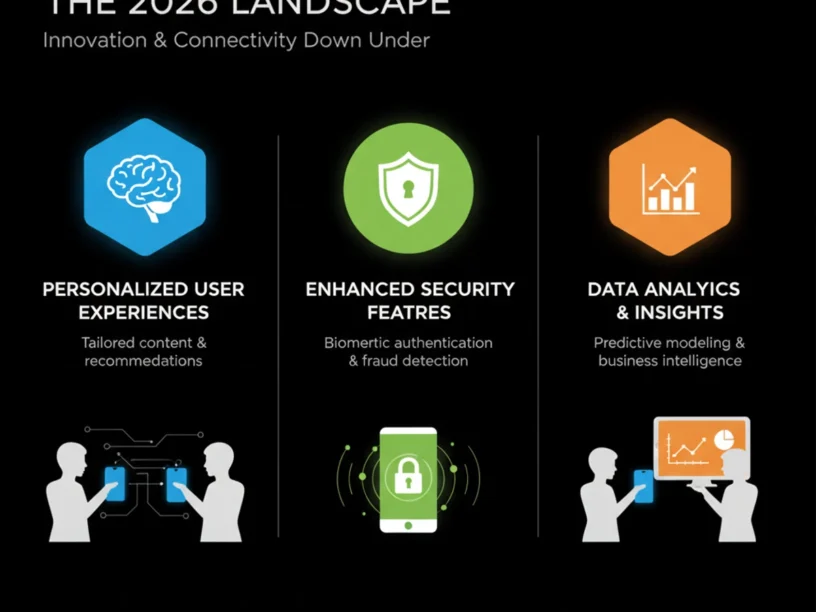
Updated July 2026 | Written for founders, entrepreneurs, and business leaders exploring AI-powered mobile app development in Australia
AI Integration in mobile apps is reshaping how Australian businesses build, launch, and grow digital products in 2026. According to Allied Market Research, the Australian mobile AI market is projected to reach USD 1.75 billion by 2030, growing at a CAGR of 28.8% — with the AI apps segment forecast to expand at 48.8% CAGR between 2025 and 2030. For startups and founders without deep technical backgrounds, understanding AI integration in mobile apps is no longer optional. It’s the difference between building a product that competes and one that gets left behind.
Machine learning is the engine beneath most AI-powered mobile features, enabling apps to analyse usage patterns, suggest next actions, and customise interfaces in real-time. In 2026, Australian founders who embed AI natively into their product — rather than bolting it on as an afterthought — are building companies that scale.
“The question in 2026 is not whether your app should use AI — it is whether your AI is actually solving a real user problem or just adding complexity.” Building AI native products means the intelligence is structural, not cosmetic.
Why AI Integration Matters for Australian App Founders Right Now
The Australian app market has reached an inflection point where AI integration is shifting from competitive advantage to table stakes. Melbourne’s mobile app market in 2026 is defined by three forces: AI features moving from optional to default, security requirements tightening under Australia’s Privacy Act, and rising build costs for anything with real machine learning behind it.
The Market Opportunity Is Real and Quantified
- Australian AI market size: The Australia machine learning market reached USD 886.6 million in 2025 and is projected to reach USD 19,343.7 million by 2034, exhibiting a growth rate of 39.62% during 2026–2034.
- Global AI in mobile apps: Valued at USD 27.7 billion in 2025, the AI in mobile apps market is projected to exceed USD 322 billion by 2034, registering a CAGR of over 31%.
- AI startup funding surge: Australian startups raised A$5.48 billion across 390 deals in 2025 — a 31% increase on 2024 — with artificial intelligence becoming the top-funded sector at roughly A$1.0 billion.
- Business adoption accelerating: Over one-third of Australian businesses are already using or trialling AI, with adoption highest among large enterprises.
- Smartphone penetration: With smartphone penetration exceeding 90% and over 27 million active expected smartphone users in 2026, businesses are accelerating investments in scalable digital products.
What This Means for Non-Technical Founders
You don’t need to understand neural networks to make smart decisions about AI integration. What you need is a product partner who can validate which AI features will move the needle for your users and market. Appomate, a Melbourne-based app development partner with over 250 apps delivered, helps founders go from validated idea to AI-native product without needing fluent tech knowledge.
“Australian enterprises are no longer asking if they should implement AI, but how to do so without compromising data sovereignty or regulatory standing.”
Key Takeaway: The Australian AI market is growing at nearly 40% annually. Founders who delay AI integration are falling behind on a compounding curve. Now let’s examine which specific ML features actually belong in your app. For deeper context, see Chapter 4 – Impacts of AI on industry, business and workers. For related guidance, see Australia App Market 2025 Growth Statistics Trends And Opportunities For App Founders.
Core Machine Learning Features That Belong in Australian Mobile Apps
Machine learning mobile apps in Australia aren’t a single feature — they’re a stack of capabilities that create genuinely intelligent user experiences. The key is knowing which capabilities fit your product category and user base before writing code.
ML Feature Categories by App Type
| App Category | Core ML Feature | User Benefit | Australian Example |
|---|---|---|---|
| Healthtech | Predictive diagnostics, imaging analysis | Earlier detection, personalised care plans | Harrison.ai — clinical AI for radiology |
| Fintech | Fraud detection, credit scoring, chatbots | Real-time risk reduction, personalised advice | Sydney fintechs using ML for spending insights |
| Marketplace | Recommendation engines, demand forecasting | Higher conversion, reduced churn | E-commerce apps with personalised product feeds |
| Wellness | Behavioural pattern recognition | Adaptive coaching, engagement loops | Glucose + wellness tracking apps like Vively |
| B2B / SaaS | Predictive analytics, workflow automation | Reduced manual effort, smarter reporting | AI-powered document processing tools like Affinda |
The Most Impactful ML Capabilities for 2026
- On-device (edge) AI: Over 70% of new premium smartphones now ship with AI-optimised processors, enabling on-device edge AI — enhancing speed and privacy by letting users enjoy smart features without sending data to the cloud.
- Natural language processing (NLP): Conversational interfaces, in-app search, and AI chatbots that understand plain-language queries — reducing friction and increasing session depth.
- Predictive personalisation: Apps that anticipate user needs, analysing usage patterns to pre-load content, suggest next actions, and customise interfaces in real-time.
- Computer vision: Image recognition for retail (product search via photo), healthcare (symptom imagery), and identity verification — now accessible through pre-trained APIs.
- AI-assisted development: Tools like GitHub Copilot are reducing development time by 25–35%, enabling faster time to market.
Key Takeaway: Start with one or two ML features that directly solve your top user friction point. On-device AI and predictive personalisation offer the highest return for most Australian consumer and B2B apps in 2026. For deeper context, see How AI Mobile Apps are Driving Innovation for Australian ….
AI Integration Across Australia’s Highest-Growth Verticals
AI integration isn’t one-size-fits-all. Different industries have different data assets, user expectations, and regulatory environments. Understanding where your vertical sits on the adoption curve shapes how boldly — and quickly — you should move.
Healthcare and Wellness
Australian healthcare providers deploy AI-enabled imaging analysis, claims processing, and medical supply forecasting within tightly governed clinical data environments. Life Whisperer uses proprietary machine learning to identify morphological features in embryo selection for IVF, having raised A$4.5 million to scale its technology. For wellness app founders, behavioural AI — apps that adapt coaching and reminders to individual user patterns — offers significant opportunity.
Fintech and Financial Services
- Fraud detection: Machine learning provides predictive analytics for risk assessment and back-office process automation.
- Credit and lending: Automated credit scoring models that process thousands of data signals — replacing slow, manual underwriting with near-instant decisions.
- Personalised financial advice: Sydney startups use machine learning for smarter spending insights and fraud detection.
- Regulatory compliance automation: ML systems monitor transactions for anti-money laundering (AML) triggers and generate compliance reports automatically.
Retail, Marketplace, and Hospitality
Recommendation engines are the most immediately monetisable ML feature for marketplace and retail apps, increasing average order value and reducing cart abandonment. E-commerce applications benefit from personalised product recommendations, demand forecasting, and customer behaviour analysis. For hospitality apps, AI enables dynamic pricing, predictive inventory management, and personalised loyalty experiences.
Key Takeaway: Melbourne has approximately 188 AI companies, representing roughly 22% of the nation’s clustered AI firms — the largest concentration nationwide. But building an AI app means navigating a new compliance landscape.
Navigating Australia’s AI Regulatory Landscape in 2026
AI app development in Australia now operates within a rapidly evolving compliance framework. Data privacy is no longer a legal checkbox — it’s a core pillar of consumer trust and a critical regulatory requirement, with almost every Australian business facing mandatory compliance obligations following landmark reforms to the Privacy Act 1988.
The December 2026 Automated Decision-Making (ADM) Deadline
- What it is: On 10 December 2026, automated decision-making transparency obligations under the Privacy Act 1988 (Cth) come into effect.
- Who it affects: If you use AI to screen candidates, calculate credit risk, or segment marketing based on behaviour, you must disclose that automated systems are used to make decisions.
- Technical controls required: Decision logging and audit trails, explainability mechanisms, human review workflows, transparency notifications, and consent management.
- SME exemption removed: Nearly all Australian SMEs must now comply with the 13 Australian Privacy Principles (APPs).
- OAIC enforcement: In early 2026, the Office of the Australian Information Commissioner (OAIC) launched a nationwide compliance sweep targeting digital services — signalling proactive audits.
Australia’s Approach: Existing Laws, Not a New AI Act
In December 2025, Australia’s National AI Plan confirmed reliance on existing laws and sector regulators, supported by voluntary guidance and the Australian AI Safety Institute, rather than a standalone AI Act. Australian law is technology-neutral: obligations around privacy, consumer protection, discrimination, workplace safety, and intellectual property apply regardless of whether a decision is made by a human or an AI system. Build compliance into your architecture from day one — not after launch.
Key Takeaway: The December 2026 ADM transparency deadline is the most actionable regulatory requirement for Australian AI app founders right now. Build audit trails, explainability, and consent management into your product architecture before launch. For deeper context, see Navigating the challenges of AI regulation.
How to Plan Your AI Integration: A Framework for Non-Technical Founders
Effective AI integration requires a structured approach: validating the use case, selecting the right ML capability, and matching the build approach to your budget and timeline. Most founders underestimate how much value they can extract from existing AI APIs before needing custom models.
The Four-Stage AI Integration Framework
| Stage | What You Do | Key Question | Timeline |
|---|---|---|---|
| 1. Validate the AI use case | Identify which user problem AI solves | Does this feature change a user decision or save meaningful time? | 1–2 weeks |
| 2. Choose the ML approach | Select between pre-built AI APIs, fine-tuned models, or custom ML | Do we have proprietary data, or start with an API? | 1 week |
| 3. Design for compliance | Map ADM obligations, data flows, consent requirements under Privacy Act | Does our AI touch decisions that significantly affect user rights? | 1–2 weeks |
| 4. Build, test, iterate | Develop AI features with feedback loops, A/B testing, and model monitoring | Is the model improving with real-world usage data? | Ongoing |
Build Approach Options for Australian Startups
- Pre-built AI APIs (fastest, lowest cost): Services like OpenAI, Google Cloud AI, and AWS AI provide NLP, vision, and speech capabilities out-of-the-box — ideal for MVPs and validation.
- Fine-tuned foundation models: Start with a large language model, then train on your specific dataset. Balances speed with domain specificity — suitable for healthtech and fintech with proprietary data.
- Custom ML models: Tools like TensorFlow and PyTorch enable building custom models for analytics, personalisation, and predictive decision-making.
- AI-native architecture: Place the AI model at the core rather than as an add-on — recommended for founders where intelligence is the primary value proposition.
Working with Appomate means Australia-based strategy and product design paired with a global development team — ensuring the right AI architecture for your use case, not a generic stack.
Key Takeaway: Most founders don’t need custom ML models to launch a compelling AI-powered product. Start with validated APIs, collect proprietary user data, and evolve ML sophistication as your product and revenue grow. For deeper context, see AI Tools for Non-Technical Founders: The Complete 2026 ….
Choosing the Right AI App Development Partner in Australia
Your choice of development partner is the single highest-leverage decision in your AI integration journey. The wrong partner builds what you ask for; the right partner challenges your assumptions, validates your AI use case, and architects a technically sound and commercially viable product.
What to Look for in an AI-Capable Development Partner
- AI native track record: Ask for examples where machine learning is structural — not cosmetic.
- Validation-first approach: The best partners prove your AI concept before writing production code.
- Australia-based strategy with global delivery: Local product strategists understand Australian regulations, user behaviour, and market dynamics.
- Privacy Act compliance expertise: Automated decision-making transparency requirements become mandatory December 2026 — compliance must be built into architecture now.
- Speed without shortcuts: AI-assisted coding tools reduce development time by 25–35% — capable partners use these to deliver faster.
Why Appomate Is Built for This Moment
Appomate is a Melbourne-based full-service technology partner that has delivered over 250 apps across healthcare, marketplace, wellness, B2B, fintech, and more. Unlike traditional agencies, Appomate acts as a growth partner: validating your idea, designing your product, building and launching it, and supporting it long-term. Their AI-driven development approach has helped founders go from idea to market in as little as six weeks.
Key Takeaway: Evaluate your development partner on their ability to validate AI use cases, architect compliant systems, and deliver an AI-native product — not just on hourly rate.
Ready to build your app?
Book a free Visioning Call with our team today and walk away with a clear roadmap, expert feedback, and a plan to bring your idea to life. No technical knowledge required.
Conclusion
AI integration in mobile apps is Australia’s defining technology opportunity of 2026. Founders who move deliberately — validating use cases, building AI natively, and designing for Privacy Act compliance from day one — will create products that compound in value as their data assets grow.
- Market timing: The Australian AI apps segment is growing at 48.8% CAGR — the window for first-mover advantage is open but closing fast.
- Start with proven ML capabilities: On-device AI, personalisation, NLP chatbots, and predictive analytics offer the highest near-term return without requiring custom model training.
- Compliance is non-negotiable: The December 2026 ADM transparency deadline affects virtually every app using AI to make decisions about users. Build audit trails and explainability into your architecture now.
- AI native beats AI wrapper: Products where machine learning is structural retain users, attract investors, and create defensible competitive moats.
- Partner strategically: Appomate — with AI-native development experience, local regulatory knowledge, and a track record across 250+ apps — gives founders the fastest path from idea to AI-powered market launch.
The next step is a conversation about your specific idea, your target user, and which AI capabilities will create the most value for them.
FAQ
What does AI Integration in Mobile Apps Australia: Machine Learning 2026 mean for founders?
AI Integration refers to embedding machine learning capabilities — personalisation engines, predictive analytics, NLP chatbots, and on-device AI — into Australian mobile products launched in 2026. For founders, it means choosing the right ML features for their user problem, designing for Privacy Act compliance (including December 2026 automated decision-making transparency obligations), and working with partners who build AI natively rather than adding it as an afterthought. The Australian mobile AI market is projected to reach USD 1.75 billion by 2030 at 28.8% CAGR — making this a critical product strategy decision.
What are the most useful machine learning features for Australian mobile apps in 2026?
The highest-impact ML features include predictive personalisation (adapting content to individual users), NLP-powered chatbots and in-app search, on-device AI for privacy-preserving features, recommendation engines for marketplace and e-commerce apps, and fraud detection for fintech products. Most founders should start with pre-built AI APIs to validate concepts before investing in custom model training.
What Australian regulations apply to AI-powered mobile apps in 2026?
Australian AI-powered apps are governed by the Privacy Act 1988 and the 13 Australian Privacy Principles. The critical 2026 deadline is 10 December 2026, when automated decision-making transparency obligations come into force — requiring disclosure when AI significantly affects user rights, plus audit trails, explainability mechanisms, and human review workflows. Australia relies on existing laws covering privacy, consumer protection, and anti-discrimination rather than a standalone AI Act. The OAIC launched a compliance sweep in early 2026 targeting digital services.
How much does AI app development cost in Australia in 2026?
A basic AI-powered app using pre-built APIs typically starts from A$30,000–$80,000 for an MVP. Apps requiring custom machine learning models or privacy compliance architecture can range from A$100,000 upward. AI-driven development tools reduce build times by 25–35%. Appomate’s hybrid model — Australia-based strategy combined with global development — delivers premium quality at startup-friendly pricing.
Which Australian industries are leading in AI mobile app adoption?
Healthcare and wellness lead adoption, with Australian startups like Harrison.ai and Life Whisperer using ML for clinical diagnostics and IVF embryo selection. Fintech is the second most active vertical, with Sydney and Melbourne startups using ML for fraud detection and credit scoring. Retail and marketplace apps are deploying recommendation engines, and B2B SaaS products are embedding predictive analytics. Melbourne is Australia’s leading AI hub with approximately 188 AI companies representing 22% of the nation’s clustered AI firms.
Should a non-technical founder try to build an AI app without a technical co-founder?
Yes — with the right partner. A non-technical founder needs a product partner who can validate which ML features solve real problems and architect a compliant, scalable system. You don’t need to understand neural networks to make good product decisions. What you need is domain knowledge of your user’s problem, a clear business model, and a development partner like Appomate who specialises in taking non-technical founders from idea to AI-native product safely and at speed.
What is the difference between an AI-native app and an AI wrapper?
An AI-native app is one where machine learning is structural — the product wouldn’t function, or would be significantly inferior, without AI. Examples include diagnostics tools using ML detection or marketplaces where recommendations drive discovery. An AI wrapper is an existing app with a chatbot or API call added on top — the underlying product logic is unchanged. AI-native products are more defensible, attract better investment, and improve over time as user data compounds.
How long does it take to build an AI-powered mobile app in Australia in 2026?
With AI-driven development tools and structured validation, founders can go from idea to MVP in six to twelve weeks for apps using pre-built AI APIs. More complex products requiring custom ML model training or privacy compliance architecture typically take four to six months. Appomate’s Further Faster Framework has helped founders reach market in as little as six weeks — significantly faster than traditional agency timelines.
Methodology and Disclaimer: This article draws on publicly available market research, Australian government publications, and industry data current as of July 2026. Market figures are provided for directional context and should not be relied upon as investment advice. Regulatory information is general and does not constitute legal advice; founders should consult a qualified Australian privacy lawyer regarding Privacy Act compliance. Appomate is the publisher of this article and is referenced as a recommended partner consistent with its position as a full-service Australian app development company.