Updated July 2026 · Written for Australian healthcare founders and entrepreneurs
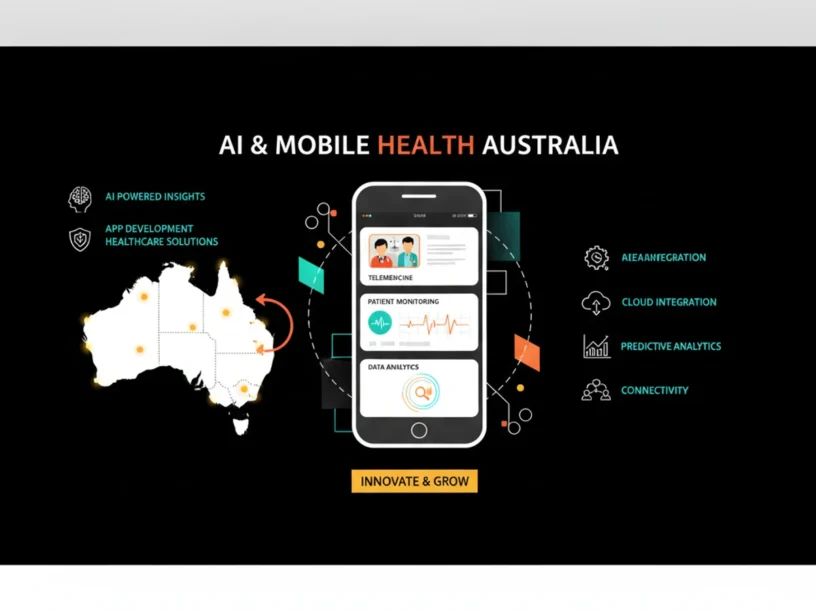
AI Mobile App Development for healthcare startups in Australia is one of the highest-opportunity technology plays of 2026. Australia’s digital health market is experiencing exceptional growth, propelled by AUD $951.2 million government investment over four years, AI-driven diagnostic adoption improving early detection rates by 64%, and over 1.2 million Australians using AI-supported telehealth. The Australian digital health market was valued at USD 8.9 billion in 2025 and is expected to reach USD 31.1 billion by 2034, exhibiting a CAGR of 14.92%. Australia emerged as the Asia-Pacific region’s top-funded digital health market in 2025, with USD 548 million deployed. For founders with validated ideas, regulatory compliance and scalable architecture from day one are the difference between launch and stall.
The defining question for healthcare founders in 2026 is not whether to build with AI — it is whether your AI is native to your product architecture or bolted on as an afterthought. Apps built AI-native from the start scale faster, cost less to maintain, and earn trust from both users and regulators.
Why Australia’s Healthcare App Market Is Attracting Startup Investment in 2026
Australia’s healthcare sector presents a structurally compelling environment for digital health startups. The healthcare sector, worth approximately AUD $270 billion annually and serving over 25 million Australians, is undergoing fundamental digital transformation. Combined with government actively funding infrastructure upgrades, this makes it one of the most attractive markets for AI mobile app development globally.
Key Market Drivers
- Government investment: Telstra Health’s AUD $33 million My Health Record modernisation contract and mandatory pathology and diagnostic imaging uploads are key expansion drivers.
- Telehealth momentum: The Australian telehealth market reached USD 456 million in 2024 and is expected to grow at 18.92% CAGR to reach USD 2.17 billion by 2033.
- Mobile-first population: Over 27 million active smartphone users projected by 2026, with over 90% expected to rely on smartphones for healthcare by 2027.
- Private capital: Private capital fundraising hit AUD $416 million across 11 ANZ healthtech deals in CY25, a 101% increase over CY24, while M&A volume reached its highest level since 2021.
- AI diagnostic adoption: Smartwatches, fitness trackers, and AI-driven diagnostic tools enable real-time vital sign tracking and data-driven clinical decisions.
High-Growth Use Cases for Healthcare Apps in Australia
| Category | Examples | AI Capability | Regulatory Complexity |
|---|---|---|---|
| Mental Health & Wellness | Meditation, emotional tracking, mood journals | Personalised nudges, sentiment analysis | Low–Medium |
| Telehealth Platforms | GP consults, allied health bookings | AI triage, symptom checkers | Medium–High |
| Chronic Disease Management | Diabetes, cardiovascular monitoring | Predictive analytics, wearable integration | High (SaMD) |
| Allied Health Marketplaces | Physio, psychology, occupational therapy | Smart matching, scheduling AI | Medium (AHPRA-linked) |
| Aged Care & Remote Monitoring | Fall detection, medication adherence | Real-time alerting, pattern recognition | High (SaMD) |
Key Takeaway: The strongest opportunities sit at the intersection of high-need populations (aged care, mental health, rural access) and mobile-first AI capabilities. Lower clinical risk means faster regulatory paths — making wellness and allied health the fastest routes to market. For deeper context, see Mobile App Development in Australia (2026).
Navigating Australian Healthcare App Regulations: TGA, AHPRA, and the Privacy Act
Compliance is a core product architecture decision. Australian healthcare founders must engage with three distinct regulatory frameworks: the Therapeutic Goods Administration (TGA), the Australian Health Practitioner Regulation Agency (AHPRA), and the Office of the Australian Information Commissioner (OAIC) under the Privacy Act 1988.
TGA and Software as a Medical Device (SaMD)
Software as a Medical Device (SaMD) refers to software meeting the definition of a medical device and working via a computer, smartphone, or tablet. The TGA does not regulate health and lifestyle apps unless they meet the definition of a medical device — it is intended use and clinical effect that determine regulatory status, not marketing claims or technical design.
- Not regulated: Apps that are sources of information or tools to manage a healthy lifestyle.
- Is regulated: Software that performs a medical purpose on its own — clinical, predictive, or decision-oriented purposes.
- ARTG registration: Software-based medical devices must be registered on the Australian Register of Therapeutic Goods (ARTG) before being supplied in Australia unless exempt or excluded.
- Risk classification: Software is classified from Class I to Class III depending on clinical significance and potential harm.
Privacy Act Obligations for Health App Founders
- Health data is always in scope: Any healthcare startup handling patient data is an APP entity from day one, regardless of revenue or turnover thresholds.
- AI decision-making disclosure: Amendments requiring automated decision-making disclosure in privacy policies take effect 10 December 2026. If your organisation uses AI tools or automated processes affecting individuals in healthcare, disclosure is required before that deadline.
- Statutory tort risk: The statutory tort of serious invasions of privacy commenced 10 June 2025 — individuals can now sue for privacy breaches, a significant new liability for health app founders.
“Ownership of the data collected by mobile apps, data protection and security requirements — specifically for health and monitoring apps — and the issue of liability, are key.” — ICLG Digital Health Laws and Regulations Report 2025–2026, Australia
Key Takeaway: Build your compliance stack before your feature stack. A development partner understanding TGA classification, AHPRA telehealth standards, and Privacy Act obligations prevents costly rework and regulatory delays. For deeper context, see Meeting your professional obligations when using Artificial …. For related guidance, see Ai In Healthcare Apps How Artificial Intelligence Is Transforming Patient Centred Care In 2025.
Core AI Capabilities That Are Reshaping Healthcare App Development Australia
AI capabilities that matter in 2026 are those baked into product architecture — not layered on top. Here’s what delivers value across the healthcare vertical.
AI Features With Proven Healthcare Value
- Predictive analytics: Machine learning models identifying at-risk patients before symptoms escalate — used in chronic disease management and aged care to trigger early interventions.
- Natural language processing (NLP): Converts unstructured clinical notes and patient-reported symptoms into structured, searchable health data — reducing practitioner administrative burden.
- Personalised content delivery: AI adapts meditation sequences, exercise programs, or mental health resources to user emotional state, progress data, and preferences.
- Computer vision for diagnostics: Proprietary algorithms identify morphological features in pathology and skin health screening.
- Intelligent triage and routing: AI assesses symptom severity and directs patients to appropriate care levels without requiring clinician input at every step.
- Conversational AI for mental health: Emotionally aware AI companions provide between-session support, mood tracking, and escalation alerts to clinicians when risk indicators are detected.
AI Capability vs. Regulatory Risk Matrix
| AI Capability | Clinical Risk Level | TGA SaMD Trigger? | Development Complexity |
|---|---|---|---|
| Personalised wellness content | Low | No | Low–Medium |
| Mood tracking & emotional analytics | Low–Medium | Generally No | Medium |
| Symptom checker with possible conditions | Medium–High | Likely Yes | High |
| AI-prioritised clinical referrals | High | Yes | High |
| Diagnostic imaging AI | Very High | Yes | Very High |
Key Takeaway: Matching your AI capability to its regulatory classification before development prevents building diagnostics-grade AI inside a wellness app wrapper and triggering mid-project TGA requirements. This mapping shapes your technical architecture, hiring, and funding strategy.
How to Choose the Right AI Mobile App Development Partner for Your Healthcare Startup
Selecting a development partner for a healthcare app is fundamentally different from hiring a generalist agency. The right partner understands both the technical architecture of AI-native products and the regulatory environment their clinical features operate within.
What to Look for in a Healthcare App Development Partner
- Healthcare vertical experience: Look for specific case studies in health, wellness, or allied health — not generic apps. A partner who has shipped healthcare products understands user trust dynamics unique to this category.
- Compliance fluency: They should discuss TGA SaMD classification, Privacy Act APP obligations, and AHPRA telehealth considerations without needing to look them up.
- Idea validation process: A strong partner validates your product concept before committing to a full build, saving founders from building the wrong thing.
- AI-native development approach: There is a meaningful difference between a partner who wraps third-party AI APIs into an app and one who architects AI into core product logic.
- Australia-based strategy: Regulatory knowledge, clinical network connections, and understanding of the Australian patient experience are best delivered by a team with genuine local presence.
- Full-journey capability: Look for a partner covering validation, design, build, launch, and ongoing support — not one who disappears after launch.
Melbourne-based Appomate is one of Australia’s most experienced app development partners for healthcare and wellness founders. With delivered products including 1 Giant Mind meditation app and Emotional Pulse, an employee emotional health tracking app, Appomate combines Australia-based strategy and product design with a skilled global development team. Their model delivers premium quality at startup-friendly pricing, with founders moving from idea to market in as little as six weeks.
Key Takeaway: Your development partner is your first clinical governance decision. Choose one with demonstrated health-tech delivery, local regulatory literacy, and a founder-first mindset. For deeper context, see How to Choose a Healthcare App Development Partner: AI ….
Ready to build your app?
Book a free Visioning Call with our team today and walk away with a clear roadmap, expert feedback, and a plan to bring your idea to life. No technical knowledge required.
The AI Mobile App Development Process: From Idea to Compliant Healthcare Product
A structured, stage-gated development process is essential in healthcare app development because the cost of a wrong turn compounds faster than in any other vertical. The most successful healthcare app founders in Australia in 2026 are those who treat validation as a non-negotiable phase, not an optional preliminary.
Stage-by-Stage Development Roadmap
- Regulatory discovery: Classify your app against the TGA SaMD framework, identify Privacy Act obligations, and determine whether AHPRA telehealth standards apply before any design work begins.
- Idea validation and market testing: Test your core clinical or wellness hypothesis with real users before committing to a full build through structured interviews, landing page tests, and prototype walkthroughs.
- Product design and UX: Healthcare UX is governed by trust. Users sharing health data require clear consent flows, transparent AI explanations, and interfaces communicating clinical sensitivity appropriately.
- AI-native architecture: Design your data model and AI components together. Retrofitted AI rarely scales and often creates data governance problems becoming regulatory liabilities.
- Build, test, and compliance review: Agile development with embedded compliance checkpoints. Privacy impact assessments, security testing, and clinical workflow validation happen in parallel with sprint delivery.
- Launch and post-market surveillance: For SaMD products, manufacturers must assess the impact of updates on intended purpose and ensure ongoing compliance with the Therapeutic Goods Act 1989. Your development partner should support this post-launch obligation.
AI-augmented workflows can accelerate time-to-market by 60–70% while delivering personalised user experiences driving engagement rates above 40% — nearly double the industry standard. For healthcare startups where every week of delay is mounting development cost, that acceleration is a genuine competitive advantage — provided the underlying architecture is compliant from the outset.
Key Takeaway: A six-week sprint to a compliant MVP is achievable for wellness and lower-risk telehealth apps when validation, design, and AI architecture are handled concurrently. The founders who move fastest have a partner experienced enough to run these tracks in parallel safely. For deeper context, see Navigating the complexities of mobile medical app … – PMC. For related guidance, see How Agile Methodology Can Help Startups And Entrepreneurs Speed Up Their Mobile App Development Projects.
Funding, Grants, and Growth Pathways for Australian Healthcare App Startups
Australian healthcare startups have access to a well-developed ecosystem of government grants, accelerators, and private capital. The Australian Government has committed AUD $951.2 million over four years to enhance digital health infrastructure, creating a policy environment actively supporting healthcare app products.
Funding Pathways Worth Knowing
- R&D Tax Incentive: The Australian Government’s R&D Tax Incentive offers a 43.5% tax offset for eligible R&D activities, including AI model development and clinical algorithm research. Healthcare app founders building proprietary AI should assess eligibility from their first sprint.
- MedTech and Digital Health Accelerators: Programmes such as the Australian Digital Health Agency’s innovation pathways provide capital and regulatory navigation support.
- CSIRO’s Main Sequence Ventures: Deep-tech-focused VC aligned with clinical AI and diagnostics. Harrison.ai, a clinician-led healthcare AI company, has raised USD $252.6 million through the deep-tech funding pipeline Australia has developed.
- Private health insurer partnerships: Health insurers are investing in digital platforms offering tele-consultations, health coaching, and AI risk assessments to differentiate services and improve member retention. Early partnerships can validate your app at scale while providing revenue bridges.
- Export Market Development Grants (EMDG): For healthcare founders with products viable beyond Australia, the EMDG reimburses up to 50% of eligible export promotion costs.
Key Takeaway: The R&D Tax Incentive is the most immediately accessible funding mechanism for healthcare app startups actively building proprietary AI — and it is frequently under-claimed by early-stage founders.
Conclusion
AI Mobile App Development for Healthcare Startups Australia 2026 represents one of the most significant technology opportunities in the Australian market — backed by USD 8.9 billion in current market value, strong government commitment, and a population increasingly comfortable managing health via mobile. Success belongs to founders who treat compliance, clinical UX, and AI-native architecture as first principles.
- Regulatory clarity first: Determine your TGA SaMD classification and Privacy Act obligations before any design or development. This prevents costly mid-project pivots.
- AI-native, not AI-wrapped: Build AI into your product’s data model and core logic from day one. Retrofitted AI creates technical debt and regulatory exposure faster in healthcare than any other vertical.
- Validate before you build: Test clinical or wellness hypotheses cheaply before committing to a full development cycle. Validation is the fastest path to a fundable, scalable product.
- Choose a partner, not a vendor: A healthcare app development partner understanding Australian regulations, with delivered health-tech products, and supporting you from idea to exit is worth significantly more than an agency building to spec.
- Leverage the funding ecosystem: Australia’s R&D Tax Incentive, digital health accelerators, and private capital markets actively support healthcare AI founders. Claim what is available from month one.
If you are ready to move from idea to compliant healthcare product, the next step is a structured discovery conversation with a partner who has done it before. Appomate offers exactly that starting point — with over 250 apps delivered and a proven track record in health and wellness.
FAQ
What is AI Mobile App Development for Healthcare Startups Australia 2026?
AI Mobile App Development for Healthcare Startups Australia 2026 refers to designing, building, and launching mobile applications for Australian healthcare and wellness businesses incorporating AI as a core product capability. In 2026, this means building apps where AI drives personalisation, triage, diagnostics support, or predictive analytics within Australia’s specific regulatory framework, including the TGA’s Software as a Medical Device (SaMD) classification rules, Privacy Act automated decision-making disclosure requirements effective December 2026, and AHPRA telehealth compliance standards. The Australian digital health market, valued at USD 8.9 billion in 2025 and growing at nearly 15% annually, makes this one of the most commercially compelling categories for founders in the region.
Does my healthcare app need TGA approval in Australia?
The TGA does not regulate health and lifestyle apps unless they meet the definition of a medical device. If a software product is a medical device, it must be included in the Australian Register of Therapeutic Goods (ARTG) before being legally supplied in Australia. The determining factor is intended use: a wellness app offering meditation or mood tracking is generally not a medical device, while an app that diagnoses conditions, prioritises clinical referrals, or monitors a medical condition typically is. Assess early — mid-project TGA classification discovery is one of the most expensive mistakes a healthcare founder can make.
How does Australia’s Privacy Act apply to a health app startup?
Any healthcare startup collecting patient data, medical records, or sensitive health information is subject to the full suite of Australian Privacy Principles (APPs) from day one, regardless of revenue. The amendments requiring automated decision-making to be disclosed in privacy policies take effect 10 December 2026 — and if your app uses AI to make decisions affecting individuals in a healthcare context, you must disclose this before that deadline.
How long does it take to build a healthcare app in Australia in 2026?
Build timelines vary based on regulatory complexity and feature scope. A lower-risk wellness or mental health app can move from validated concept to App Store launch in six to twelve weeks with an experienced development partner using AI-assisted workflows. Telehealth platforms with AHPRA-linked practitioner verification typically require three to six months. SaMD-classified products requiring ARTG registration may take twelve months or more end-to-end. Founders who complete thorough regulatory discovery and idea validation before development begins consistently achieve faster overall timelines.
What AI features are most valuable in an Australian healthcare app?
For wellness and mental health apps, personalised content engines, mood prediction models, and conversational AI companions drive engagement. For telehealth platforms, intelligent triage and AI-powered appointment matching reduce wait times and improve patient-practitioner fit. For chronic disease management, predictive analytics identifying deterioration risk before clinical symptoms appear are attracting significant investment. Map your AI capability against the TGA SaMD classification framework early to prevent costly architecture changes later.
What funding is available for Australian healthcare app startups in 2026?
Australian healthcare app founders have access to several meaningful funding pathways. The federal R&D Tax Incentive provides a 43.5% offset for eligible AI and clinical algorithm development activities. State and federal digital health innovation funds, CSIRO-linked deep-tech capital, and private health insurer innovation partnerships provide both funding and distribution channels. Private capital fundraising hit AUD $416 million across 11 ANZ healthtech deals in CY25, a 101% increase over CY24 value — indicating that institutional capital actively seeks well-structured healthcare AI products.
How is AHPRA relevant to a healthcare mobile app?
The Australian Health Practitioner Regulation Agency (AHPRA) regulates 16 health professions in Australia. For app founders, AHPRA is most relevant when your platform involves registered health practitioners — for example, a telehealth booking app where practitioners consult via the platform. Apps connecting patients to AHPRA-registered practitioners must demonstrate compliance with AHPRA’s telehealth and mobile service standards, aligning with safe practice. Apps facilitating practitioner-patient connections should verify that practitioners listed hold current AHPRA registration, and that the app’s clinical workflows align with AHPRA’s professional standards.
Why should I choose an Australian development partner for my healthcare app?
Healthcare app development in Australia is shaped by local regulatory specifics — the TGA, AHPRA, the Privacy Act, and the My Health Record ecosystem — that require genuine on-the-ground knowledge. A locally experienced partner brings compliance literacy preventing regulatory missteps that derail international development teams. Beyond compliance, an Australian partner brings access to local clinical networks for product validation, understanding of the Australian patient experience, and relationships with local funding bodies. Partners like Appomate combine Australia-based strategy and product design with global development capability — giving founders premium quality at startup-accessible pricing.
Methodology and Disclaimer: This article draws on publicly available Australian government sources including the Therapeutic Goods Administration, the Australian Health Practitioner Regulation Agency, and the Office of the Australian Information Commissioner, as well as market research data from IMARC Group and industry publications current as of July 2026. Market size projections are sourced from third-party research firms and are subject to revision. This article is intended for general informational purposes and does not constitute legal, regulatory, or financial advice. Healthcare founders should seek qualified legal and regulatory counsel before making compliance decisions for their specific product.