Updated July 2026 | 8 min read | By the Appomate Editorial Team
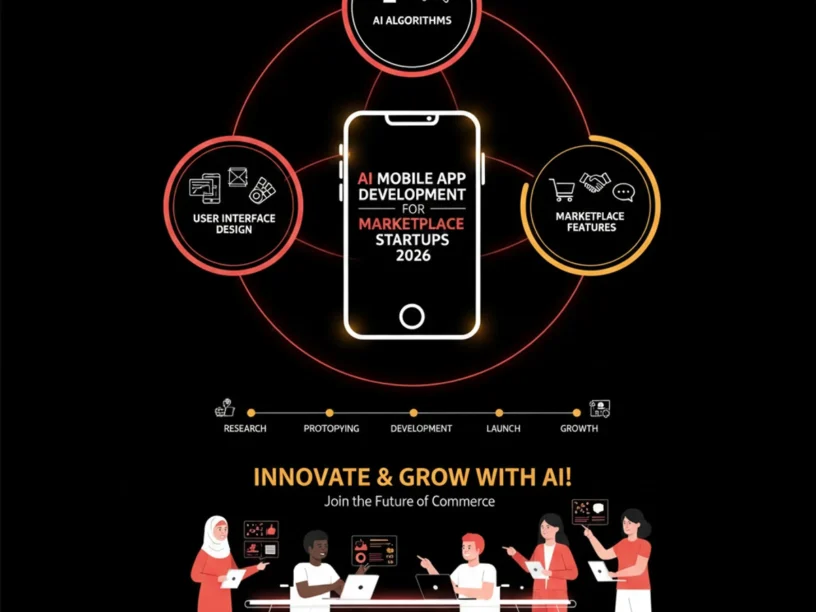
AI Mobile App Development for Marketplace Startups 2026 is the most strategically important intersection in Australia’s startup landscape right now. A marketplace app connects two or more user groups — buyers and sellers, hirers and workers, hosts and guests — and AI turns that connection from a simple transaction into an intelligent, self-improving platform. For Australian founders preparing to build in 2026, understanding how AI features like recommendation engines, dynamic pricing, smart matching, and fraud detection fit into a marketplace architecture isn’t optional:
AI-driven features are no longer differentiators for marketplace applications — they’re table stakes, because platforms built on static catalogues, keyword search, and manual fraud review are competing against systems that learn, adapt, and optimise in real time.
The timing has never been better for Australian founders.
Australian startups raised $5.1 billion in venture capital in 2025 — a 24% increase on the prior year — and over 60% of all that capital went to startups with AI in their tech stack.
With smartphone penetration exceeding 90% and over 27 million active smartphone users expected in 2026, businesses are accelerating investments in scalable digital products.
For marketplace founders, this creates a window to build AI-native platforms that capture a market primed for exactly this kind of innovation.
This article is a practical guide for first-time founders, non-technical entrepreneurs, and seasoned business owners stepping into AI mobile app development for the first time. It covers the AI features that move the needle on two-sided platforms, what they cost in Australian dollars, how Australian privacy law affects your build decisions, and how to find the right development partner to get your marketplace to market quickly and safely.
“The most defensible marketplace apps in 2026 are not the ones with the most features — they are the ones where AI quietly makes every interaction smarter than the last. Build for that compounding loop from day one.”
Why AI Is Now Central to Marketplace App Development
Building a two-sided marketplace without AI in 2026 means starting the race with a structural disadvantage.
AI-driven features like recommendation engines, fraud detection, dynamic pricing, NLP-powered search, and conversational assistants have become core infrastructure for modern marketplace applications.
For Australian founders, embedding these capabilities from the architecture stage — rather than bolting them on later — is the clearest path to a platform that scales without proportionally scaling your team.
The Four AI Pillars for Two-Sided Marketplaces
- Recommendation engines: Personalisation algorithms analyse user behaviour, browsing history, and transaction patterns to surface the most relevant listings for each individual user, directly lifting conversion rates and session depth.
- Dynamic pricing:
Pricing is one of the most difficult levers to pull in a two-sided market.
AI pricing models analyse supply, demand, seasonality, and competitor signals in real time to suggest optimal price points to sellers — without automating changes without seller consent. - Fraud detection:
AI fraud detection can cut fraud rates by 50–70%, protecting both revenue and brand reputation.
For consumer-to-consumer platforms in particular, this is the feature that makes the difference between a trusted marketplace and a platform users abandon. - Smart matching: Rather than relying on keyword search alone, AI matching engines use contextual signals — location, timing, preference history, review sentiment — to connect the right buyer with the right seller automatically.
The Three-Stage AI Rollout Model
Not every AI feature needs to ship on day one. A phased approach keeps your MVP lean while preserving a clear upgrade path:
| Stage | Platform Maturity | AI Features to Deploy | Primary Goal |
|---|---|---|---|
| MVP | 0–500 users | Basic search, rule-based fraud checks, NLP filters | Validate core transaction flow |
| Growth | 500–10,000 users | Intelligent matching, dynamic pricing suggestions, automated trust scoring | Improve liquidity and retention |
| Scale | 10,000+ users | Conversational search, predictive analytics, agentic onboarding bots | Maximise LTV and operational efficiency |
Framework adapted from Cobbleweb’s AI-Native Marketplace Features research.
Key Takeaway: Start your marketplace MVP with rule-based AI features that work on thin data, then layer in ML-driven personalisation and dynamic pricing as your dataset grows. This approach keeps launch costs predictable while building the data flywheel your future AI depends on. The real challenge isn’t picking which AI features to use — it’s knowing which ones to skip until you actually need them. For deeper context, see AI in Mobile App Development New Era of Innovation and ….
AI Mobile App Development Costs and Timelines for Australian Marketplace Founders
One of the most common questions from non-technical founders is: “What does this actually cost in Australia?” The honest answer is that cost is primarily a function of feature complexity and team structure — not the AI components themselves. API-based AI integrations (like recommendation feeds or chatbots powered by OpenAI or Hugging Face) are far more affordable than custom-trained models, making them ideal for marketplace MVPs.
Realistic Cost Ranges in AUD (2026)
| Build Type | Estimated Cost (AUD) | Timeline | AI Complexity | Best For |
|---|---|---|---|---|
| Lean MVP | $35,000 – $60,000 | 6 – 12 weeks | API-based (rules + NLP) | First-time founders validating demand |
| Mid-tier Marketplace | $60,000 – $150,000 | 3 – 6 months | ML matching + dynamic pricing | Funded startups with early user data |
| Full AI-Native Platform | $150,000 – $300,000+ | 6 – 12 months | Custom models + real-time inference | Series A+ companies scaling fast |
Using AI coding tools like Claude Code, Cursor, and GitHub Copilot across the build can speed up delivery by 30 to 50%, which means fewer billable hours and a more predictable final cost without cutting quality.
This is precisely why choosing a development partner with an AI-driven development workflow — not just AI features in the final product — materially reduces your cost to launch.
- API-based AI features: Connecting to established models via APIs (OpenAI, Hugging Face, Google Vertex AI) is the fastest and most affordable entry point. A chatbot or basic recommendation feed can add as little as AUD $5,000–$15,000 to a build.
- Cross-platform frameworks:
Cross-platform frameworks like React Native or Flutter can reduce costs by 30 to 40% compared to building separate native iOS and Android apps.
For marketplace startups, this is a significant saving at the MVP stage. - Hybrid delivery models: Australia-based strategy and product design paired with a skilled global development team delivers premium quality at startup-friendly pricing — the model Appomate uses to help founders launch faster without compromising on quality.
- Phased AI roadmap: Committing only to the AI features your MVP requires — and planning the rest for post-launch — keeps your initial build lean while preserving optionality.
Key Takeaway: For most Australian marketplace startups, a well-scoped MVP with API-based AI features can be built and launched within 6–12 weeks for AUD $35,000–$60,000. The key is partnering with a team that uses AI-driven development tools internally, so the speed advantage compounds from day one. Getting your first 500 users matters more than getting every feature perfect. For deeper context, see AI App Development Cost in 2026 – A Complete Guide for …. For related guidance, see Ai Development Lifecycle A Startup Founders Guide To Using Ai At Every Stage.
Core AI Features That Drive Marketplace Growth
The AI features that deliver measurable ROI on marketplace platforms cluster around three outcomes: helping users find what they want faster, building trust between strangers, and optimising the economics of the platform itself.
AI enables personalised product recommendations, real-time fraud detection, dynamic pricing, smart customer support, and optimised logistics.
Here is how each translates into a marketplace context for Australian founders.
Discovery and Personalisation
- Personalised recommendation feeds: Machine learning analyses each user’s click history, dwell time, and transaction data to surface listings they are most likely to act on. This directly increases session depth and average order value.
- NLP-powered search: Natural language processing lets buyers search conversationally (“casual work near me this weekend”) rather than navigating rigid category trees.
Search engines can adapt to language variations, misspellings, and browsing habits, which shortens paths to purchase, especially for large catalogues. - Smart filters and sorting: AI learns which filter combinations produce the highest conversion rates for specific user segments and surfaces them proactively, reducing friction in the discovery flow.
Trust, Safety, and Platform Integrity
- Real-time fraud detection:
AI proactively monitors the system to check for unusual behaviour that might lead to fraudulent transactions.
On a two-sided marketplace, protecting both buyers and sellers from bad actors is directly tied to platform liquidity and user retention. - Automated listing moderation: AI models flag policy-violating listings, counterfeit product signals, and duplicate accounts before they reach end users, keeping moderation costs low at scale.
- Review sentiment analysis: NLP models extract genuine trust signals from written reviews, helping the platform surface quality providers and deprioritise bad actors more accurately than star ratings alone.
Global ecommerce fraud losses reached a record $48 billion in 2025. According to LexisNexis, merchants now lose $4.61 for every $1 of direct fraud due to the compounding costs of chargebacks, customer churn, and operational overhead.
For a marketplace startup, AI fraud detection is not a luxury — it is the feature that protects the network effects you are trying to build.
Key Takeaway: Prioritise AI features in the order that matches your marketplace’s primary risk: discovery-first for catalogues and product marketplaces; trust-and-safety first for service and peer-to-peer platforms. The two pillars compound each other — better matching reduces friction, and lower fraud rates make users trust the matches they receive. Getting this priority order right from the start saves you from building the wrong thing.
Australian Privacy Law and AI: What Marketplace Founders Must Know
AI-powered marketplace apps collect, process, and act on large volumes of personal data. In Australia, this sits squarely within the framework of the Privacy Act 1988 (Cth) and the Australian Privacy Principles (APPs). Getting this wrong is not just a legal risk — it destroys user trust, which is the single most important asset a marketplace has.
The 2024–2026 Privacy Reform Timeline
On 10 December 2024, the Privacy and Other Legislation Amendment Act 2024 received Royal Assent, introducing new requirements including organisational and technical measures for protection of personal information and disclosure requirements related to the use of AI.
For founders building AI marketplace apps, two deadlines matter most:
- December 2024 (already in force):
Enhanced security and breach reporting duties — updated “reasonable steps” and notification details — came into force in December 2024.
Your marketplace must have documented security controls and a notifiable data breach plan before launch. - December 2026 (coming):
Entities must state when personal data is used for significant automated decisions.
This means your AI matching engine, dynamic pricing logic, and fraud scoring systems will all require transparent disclosure in your privacy policy. - Automated decision transparency (APP 1.7):
Under new APP 1.7, an APP entity must comply with the new transparency requirements if it arranges a computer program, using personal information about an individual, to make or directly support a decision that could reasonably be expected to significantly affect the individual’s rights or interests. - Small business threshold:
Many startups sit under the $3 million threshold but are still caught because they process health data, enable identity verification, or commercialise user data. Even if you don’t strictly meet the criteria today, privacy compliance is often required by enterprise customers via contract.
Practical guidance:
Data privacy, trust, and security must be built in from day one, not bolted on.
Build your data architecture with the APP framework in mind from the start — it is significantly cheaper than a compliance retrofit after launch.
Key Takeaway: Australia’s privacy reforms directly affect every AI-powered marketplace app that makes automated decisions about users. Treat OAIC compliance as a product requirement, not an afterthought — and ensure your development partner understands what this means for your data pipeline and privacy policy. This isn’t bureaucracy; it’s the foundation of user trust in your two-sided platform. For deeper context, see Guidance on privacy and the use of commercially available ….
Startup App Development Strategies: Building a Two-Sided Marketplace That Actually Scales
The most common failure mode for marketplace startups is not technical — it is strategic. Founders over-build features before validating demand, or under-invest in the AI infrastructure that turns a transactional app into a platform with defensible network effects. The right startup app development strategy for a marketplace in 2026 is rooted in tight MVP discipline, data pipeline thinking from day one, and a launch sequence designed to solve the chicken-and-egg problem systematically.
The Marketplace MVP Checklist
- Solve one side first: The biggest mistake marketplace founders make is trying to onboard buyers and sellers simultaneously from launch. Focus on supply-side depth first — once you have compelling inventory, buyer acquisition becomes dramatically easier.
- Build for data collection:
As AI models rely on data, plan early — deciding what data to collect and designing pipelines that collect and clean data continuously.
Your recommendation engine is only as good as the data you feed it from day one. - Validate before you automate: Run matching and moderation manually for your first 100 transactions. The patterns you discover manually will inform far better AI models than a system trained on theoretical workflows.
- Ship a lean back office too:
Before jumping into user-facing features, look at repetitive internal tasks such as reviewing flagged listings, moderating content, or assigning support tickets. Automating just one of these can make your operations scale-ready from day one. - Choose cross-platform from the start: For a marketplace targeting Australian consumers, React Native or Flutter gives you iOS and Android coverage from a single codebase, reducing your launch costs and ongoing maintenance overhead significantly.
What Appomate’s Marketplace Portfolio Demonstrates
Appomate, a Melbourne-based app development company with over 250 apps delivered, has built its marketplace vertical across platforms like Hospool (hospitality workforce matching), ShareTree (skills and culture discovery), HouseHub (property), and Stokd (inventory marketplace).
The founder of Hospool’s main priority was to launch within two months without compromising quality — and Appomate helped him go live in only 6 weeks.
That speed is not accidental: it reflects an AI-driven development workflow and a validated delivery process built specifically for founders who need to move fast without burning budget.
Unlike agencies that build exactly what you ask for, Appomate acts as a full growth partner — validating your idea, designing the product, building and launching it, and supporting it long term. Their Further Faster Framework is designed to get founders from idea to market predictably, with less risk and more confidence at every stage. This kind of partnership model is what separates a successful marketplace launch from one that ships late and over budget.
Key Takeaway: The best marketplace apps are not the most feature-rich at launch — they are the ones built on the clearest problem, the leanest possible transaction flow, and an architecture designed for AI to learn from every interaction. Partner with a team that has built marketplaces before, so you inherit their hard-won pattern recognition rather than paying for lessons already learned. For further reading, see The Complete Guide to Mobile App Development for 2026 …. For related guidance, see Best Paid User Acquisition Strategies For Mobile Apps In 2026.
How to Choose an AI App Development Services Partner in Australia
Choosing the right AI app development services partner is one of the highest-leverage decisions a marketplace founder will make. A wrong choice costs six to twelve months and hundreds of thousands of dollars. The right partner compresses your timeline, de-risks your architecture, and brings marketplace-specific pattern recognition that no amount of documentation can replace.
Evaluation Criteria for Marketplace Founders
- Marketplace-specific portfolio: General app development experience does not transfer cleanly to two-sided platforms. Ask specifically for examples of marketplace apps the partner has shipped — ideally across multiple verticals, so you can assess their range and depth.
- AI-native vs AI-wrapper approach: There is a meaningful difference between an agency that adds a chatbot to a conventional app and one that builds AI into the data model, matching logic, and operational infrastructure from the start. Ask how AI is embedded in their delivery process itself, not just the final product.
- Validation process:
A clear, stepwise development process is critical to balancing speed, cost, and compliance. Lean MVPs allow fast validation — avoid over-engineering in early stages.
A good partner will push back on feature scope before committing to build. - Australia-based strategy: Having strategy, product management, and design anchored locally means you can have real conversations about Australian market dynamics, regulatory requirements, and user behaviour — without the translation lag of a fully offshore team.
- Post-launch support model: Marketplace platforms require ongoing iteration. Ensure your partner offers structured ongoing support, not just a handover package once the app is live.
Questions to Ask in Discovery
| Question | What a Strong Answer Looks Like | Red Flag |
|---|---|---|
| Have you built a two-sided marketplace before? | Specific examples with client names and outcomes | Vague references to “similar projects” |
| How do you handle the chicken-and-egg problem? | Structured supply-first onboarding strategy | “That’s a marketing question, not development” |
| How is AI built into your own development process? | Named tools (Cursor, GitHub Copilot) and specific time savings | “We use the latest AI tools” with no specifics |
| How do you handle Australia’s Privacy Act compliance? | References APP 1.7, December 2026 changes, OAIC guidance | “We follow GDPR” with no mention of Australian APPs |
| What is your typical MVP timeline for a marketplace? | 6–12 weeks with clear scope dependencies | Refuses to give a range without full specifications |
Key Takeaway: The right AI marketplace app development partner will challenge your assumptions, constrain your scope, and bring a validated delivery model to the engagement — not just skilled developers. Marketplace-specific experience is non-negotiable: the architecture, the matching logic, and the trust-and-safety systems are all substantially different from single-sided apps. Spend the time upfront to get the partnership right, and everything downstream becomes easier.
Ready to build your app?
Book a free Visioning Call with our team today and walk away with a clear roadmap, expert feedback, and a plan to bring your idea to life. No technical knowledge required.
Conclusion
AI Mobile App Development for marketplace startups in Australia in 2026 is an opportunity defined by timing, architecture, and partnership.
AI-augmented workflows can accelerate time-to-market by 60–70% while delivering personalised user experiences that drive engagement rates significantly above the industry standard.
For founders building two-sided platforms, this is the year to build AI-native — not AI-added — and to do it with a partner who has delivered real marketplaces before.
The competitive window is open, the capital is flowing, and the regulatory environment — while evolving — is navigable with the right guidance built into your development process from day one.
- AI is infrastructure, not a feature: Build recommendation engines, fraud detection, and smart matching into your data architecture from the start — they become harder and more expensive to retrofit.
- Australian privacy law is a build requirement: The December 2026 automated decision-making transparency obligations under APP 1.7 apply directly to AI marketplace apps. Compliance should be designed in, not added on.
- Lean MVP first, AI depth second: Validate your core transaction flow with rule-based AI, collect clean data, then layer in ML-driven personalisation as your user base grows.
- Partner selection is the highest-leverage decision: Marketplace-specific development experience, an AI-native delivery workflow, and Australia-based strategy are the three non-negotiables when choosing your app development partner.
- Speed is achievable without compromise: As Appomate’s portfolio demonstrates, a well-scoped marketplace MVP can go from idea to live product in as little as six weeks — when the process and the partner are right.
If you are ready to move from idea to market, Appomate offers a structured discovery process that validates your concept, defines your MVP scope, and gives you a clear path to launch — without the guesswork.
FAQ
What is AI Mobile App Development for Marketplace Startups in 2026?
AI Mobile App Development for Marketplace Startups 2026 refers to the practice of building two-sided platform applications — connecting buyers with sellers, workers with employers, or service providers with clients — using artificial intelligence as a core architectural component rather than a surface-level feature. In 2026, this means embedding recommendation engines, smart matching algorithms, dynamic pricing models, fraud detection systems, and NLP-powered search into the marketplace from the initial build. For Australian founders, this approach is now standard practice: over 60% of Australian startup venture capital in 2025 went to startups with AI in their tech stack, and platforms without AI features are structurally disadvantaged against competitors that learn and optimise in real time. The practical entry point for most marketplace MVPs is API-based AI integration — connecting to established models via OpenAI, Hugging Face, or Google Vertex AI — which can be built into an Australian marketplace MVP for AUD $35,000–$60,000 and launched within 6–12 weeks.
What AI features should a marketplace app include at MVP stage?
At MVP stage, focus on AI features that deliver value on thin data and validate quickly. Rule-based fraud checks protect your platform integrity before you have enough data for machine learning models. NLP-powered search lets buyers search conversationally rather than navigating rigid filters. Basic content moderation AI keeps listing quality high without a manual review team. These three features are achievable via API integration, keep your build lean, and generate the user behaviour data your post-MVP recommendation engine will need to be effective.
How much does it cost to build an AI marketplace app in Australia in 2026?
In 2026, a lean marketplace MVP with API-based AI features in Australia typically costs AUD $35,000–$60,000 and takes 6–12 weeks to build using a cross-platform framework like React Native or Flutter. A mid-tier marketplace with ML-driven matching and dynamic pricing ranges from AUD $60,000–$150,000 over 3–6 months. Full AI-native platforms with custom model training and real-time inference can reach AUD $150,000–$300,000 or more. The largest cost variable is team structure: agencies using AI-assisted development tools internally can reduce billable hours by 30–50% compared to traditional development shops, making partner selection one of the most important cost levers available to founders.
How does Australia’s Privacy Act affect AI marketplace apps?
Australia’s Privacy Act 1988 and the Australian Privacy Principles (APPs) directly govern how AI marketplace apps collect, process, and act on personal data. The December 2024 Privacy and Other Legislation Amendment Act introduced enhanced breach notification requirements and new technical security obligations already in force. From December 2026, new APP 1.7 transparency obligations require marketplace apps that use personal data in automated decision-making — such as AI matching, fraud scoring, or dynamic pricing — to explicitly disclose this in their privacy policy. Founders should treat these requirements as build specifications, not post-launch additions, as compliance retrofits are significantly more expensive than designing data pipelines correctly from the start.
What is the chicken-and-egg problem and how does AI help solve it?
The chicken-and-egg problem is the core challenge of every two-sided marketplace: buyers won’t join without sellers, and sellers won’t join without buyers. AI helps address this in two ways. First, AI-powered matching makes a marketplace useful even with a thin supply side, because smart matching surfaces the best available options rather than an empty or irrelevant results page. Second, AI-driven personalisation improves engagement rates and return visits from early adopters on both sides, creating the data volume needed to improve matching quality — which in turn attracts more users. The standard strategic advice is to focus on supply-side depth first, then use AI matching to extract maximum value from that supply for early buyers.
How long does it take to build a marketplace MVP with AI in Australia?
A well-scoped marketplace MVP with API-based AI features can be built and launched in 6–12 weeks when the scope is tightly defined and the development partner uses AI-assisted coding tools internally. Appomate, for example, helped the founder of Hospool — a hospitality workforce marketplace — go live in just 6 weeks. More complex platforms incorporating custom ML models, dynamic pricing engines, or real-time fraud scoring typically require 3–6 months. The most reliable way to compress your timeline is to lock your MVP scope tightly before development begins and choose a partner with a proven marketplace delivery process rather than a general-purpose agency.
What should non-technical founders look for in an AI marketplace app development partner?
Non-technical founders should prioritise four things: demonstrated marketplace-specific portfolio (not just app development generally), an AI-native development workflow that uses AI tools internally to accelerate delivery, Australia-based strategy and product management so market-specific decisions are made with local context, and a structured validation process that challenges scope before committing to build. Partners that simply build what you ask for without validating demand, testing assumptions, or designing for the two-sided platform’s unique architecture challenges are a significant risk for first-time founders. A full growth partner — one that covers validation, design, build, launch, and ongoing support — reduces the number of handoffs and gives you a single point of accountability for the entire product journey.
Is it worth building a niche marketplace in Australia in 2026?
Yes — niche marketplaces have structural advantages over generalist platforms in the Australian market. Australia’s relatively compact population means that niche platforms can achieve meaningful liquidity in a specific vertical without the capital requirements of a horizontal marketplace. Platforms like Hospool (hospitality workforce), HouseHub (property), and Stokd (inventory) demonstrate that vertically focused marketplaces can reach viability faster, build stronger community trust, and attract more loyal users on both sides of the platform than generalist alternatives. AI makes niche marketplaces more defensible over time: the more specialised your user base, the more relevant your recommendation and matching models become as the dataset grows.
Methodology and Disclaimer: This article draws on publicly available research including data from the Appomate blog, Statista, McKinsey Global Tech Survey 2025, the Office of the Australian Information Commissioner (OAIC), and multiple Australian app development industry sources current as of July 2026. Cost ranges cited are indicative and vary based on project scope, team structure, and feature complexity. This article is published by Appomate and reflects the company’s perspective on AI marketplace app development. It is intended for informational purposes and does not constitute legal, financial, or technology procurement advice. For privacy compliance matters specific to your product, consult a qualified Australian legal professional.