How to build an AI healthcare app in Australia | Updated August 2026 | Appomate Editorial Team
To successfully build an AI healthcare app in Australia in 2026, founders must navigate regulatory compliance, validate their product rigorously, and partner with a development team understanding both AI and Australia’s health system. Australia’s digital health market, valued at USD $8.9 billion in 2025, is projected to reach USD $31.1 billion by 2034 with a CAGR of 14.92%, driven by AI diagnostics, remote patient monitoring, and aged care digitisation. This guide covers regulatory foundations, MVP development, and confident launch without costly detours.
“In 2026, building an AI healthcare app in Australia is no longer just a technology challenge — it’s a trust challenge. The founders who win build compliance, clinical credibility, and genuine user value into the product from the first sprint.”
Understanding the Australian Regulatory Landscape for AI Healthcare Apps
Before coding, understand how the Therapeutic Goods Administration (TGA) and the Office of the Australian Information Commissioner (OAIC) classify AI-driven health software. On February 5, 2026, the TGA published updated guidance clarifying how AI-enabled software is regulated as a medical device, setting expectations for regulatory classification, evidence generation, and lifecycle management.
TGA Classification: Are You Building a SaMD?
Software as a Medical Device (SaMD) is defined as software that performs a medical function autonomously, without being embedded in a physical device. If your software is intended for diagnosis, monitoring, or treatment, it must be registered on the Australian Register of Therapeutic Goods (ARTG) before supply in Australia.
- Clinical decision support: If your AI provides independent information leading to a clinical decision for a specific patient, it’s almost certainly SaMD and subject to TGA registration.
- Wellness and general health: Apps used for communication, administration, or general wellness probably won’t be regulated by the TGA.
- Scope creep risk: Changes altering intended use or performance may trigger regulatory approval before release.
- Early scoping is mandatory: Regulatory scoping must occur early — don’t wait until launch.
Privacy Compliance: The Privacy Act and APPs
The Privacy Act 1988 and Australian Privacy Principles (APPs) impose strict obligations on health information protection, use, and transparent management. Small businesses, including private sector health service providers, must adhere to the APPs.
- Automated decision-making disclosure: From 10 December 2026, organisations using AI tools for decisions affecting individuals must disclose this in their privacy policy.
- Data protection: Health information must be protected against misuse, loss, unauthorised access, modification, or disclosure.
- Defined purpose: Health information can only be collected for a primary purpose and used or disclosed for secondary purposes with consent or under specific exceptions.
- Transparent privacy policy: You must have a clearly articulated, easily accessible privacy policy.
| Regulator | Framework | When It Applies | Key Obligation |
|---|---|---|---|
| TGA | SaMD / ARTG | App makes or contributes to clinical decisions | Register on ARTG before supply; meet IEC 62304 & ISO 14971 |
| OAIC | Privacy Act 1988 / APPs | App collects or handles health information | Compliant privacy policy, consent flows, breach procedures |
| ADHA | My Health Record / FHIR | App integrates with national health records | FHIR Gateway registration and conformance testing |
| ACSQHC | AI Safety in Clinical Settings | AI used in clinical environments | Safety and performance calibration guidance |
Key Takeaway: Map compliance obligations across all relevant regulators before design work begins. Understanding regulatory breadth prevents months of rework. For deeper context, see Meeting your professional obligations when using Artificial ….
Validating Your AI Healthcare App Idea in the Australian Market
The costliest mistake is building a product solving a problem nobody pays for. Validation requires establishing clinical fit, regulatory fit, and commercial fit before development. In 2025, healthtech companies in Australia raised $187 million in equity funding across 13 rounds — a 230% jump from the same period in 2024. The money flows to validated products with clear clinical or commercial use cases. According to PwC’s FY26 Outlook, 10% of Australians have already used ChatGPT for health information, and 40% say they’re willing to.
Validation Steps Before You Build
- Problem interviews: Talk to at least 20 potential users and document workflows, pain points, and current solutions. Look for consistent, urgent, under-served problems.
- Regulatory pre-screening: Determine whether your concept falls inside or outside TGA regulation before finalising features. One regulatory consultation here saves months of rebuilds.
- Clinical advisor engagement: Involve an Australian clinician early. Their endorsement improves your product and strengthens your evidence base for regulators.
- Competitor landscape review: With over 4,100 healthtech startups in Australia, identify genuine whitespace and validate that users would switch to your solution.
- Revenue model testing: Confirm who pays and how — patients, private health insurers, employers, or health services. Test payment models before assuming one.
Appomate integrates validation into the product journey from day one. Rather than building what you ask for, Appomate’s validation process stress-tests your idea, features, and go-to-market approach before development budget is committed — helping founders move further, faster, with less risk. For deeper context, see Artificial intelligence (AI) in health care.
Ready to build your app?
Book a free Visioning Call with our team today and walk away with a clear roadmap, expert feedback, and a plan to bring your idea to life. No technical knowledge required.
Core Features and Tech Stack for an Australian AI Healthcare App
Features and technology determine clinical utility, security posture, and scalability. In Australia, data sovereignty, My Health Record integration, and Australian Digital Health Agency (ADHA) compliance apply.
Essential Features
- Secure authentication: Multi-factor authentication and role-based access control are non-negotiable for health data in Australia.
- AI symptom triage or decision support: Scope only what your regulatory classification allows. Clinical AI crossing into SaMD territory requires ARTG registration.
- My Health Record integration: The FHIR Gateway connects consumer apps to Australia’s national electronic health record system.
- Telehealth and secure messaging: Australia’s telehealth segment reached USD $542 million in 2025 and is forecast to grow at 18.16% CAGR to USD $2.56 billion by 2034. Video consultation and asynchronous messaging are core features for most clinical apps.
- Data sovereignty: End-to-end encryption, secure Australian data storage, access logging, and penetration testing are mandatory. Use cloud providers with Australian data regions (AWS Sydney, Azure Australia East, Google Cloud Sydney).
Recommended Tech Stack
| Layer | Recommended Technologies | Why It Fits Australian Healthtech |
|---|---|---|
| Mobile frontend | React Native or Flutter | Cross-platform iOS and Android from single codebase; reduces build cost |
| Web frontend | React or Next.js | Widely supported by Australian dev teams; strong accessibility tooling for clinical UIs |
| Backend | Node.js or Python (Django/FastAPI) | Python preferred for AI/ML model integration; Node.js for real-time features |
| Database | PostgreSQL or MongoDB | PostgreSQL preferred for structured clinical data; MongoDB for flexible schemas |
| Cloud infrastructure | AWS Sydney or Azure Australia East | Australian data residency; healthcare-specific compliance certifications available |
| AI / ML | OpenAI API, Google Vertex AI, or custom models | Evaluate carefully — black-box AI in clinical decision-making triggers TGA SaMD classification |
| Interoperability | HL7 FHIR AU, ADHA FHIR Gateway | Required for My Health Record integration; aligns with Australia’s National Interoperability Plan |
Key Takeaway: Prioritise security, Australian data residency, and FHIR interoperability from the outset. Retrofitting these later costs significantly more. For deeper context, see How AI in healthcare is reshaping the future of medicine.
Development Costs and Timelines for an Australian AI Healthcare App
Healthcare apps typically cost AUD $100K to $500K+ in Australia. Compliance architecture, clinical integrations, and security requirements add material cost. Key cost drivers specific to Australia include:
- Security architecture and testing: Budget AUD $20K to $60K for security architecture and penetration testing — a baseline requirement, not optional.
- Privacy compliance and legal: Legal and compliance consultation adds $10K to $30K for privacy policies, consent flows, breach procedures, and data retention policies.
- Clinical system integrations: Connecting to electronic health records (Best Practice, Medical Director, Genie), pathology systems, or pharmacy networks costs $20K to $50K per integration.
- TGA SaMD registration: Achieving TGA registration requires documentation, a quality management system (ISO 13485), and potentially clinical evidence — adding $100K to $200K and ongoing compliance overhead.
- Ongoing maintenance: Budget 15–20% of build cost annually for OS updates, security patches, and compliance audits.
Cost Tiers at a Glance
| App Type | Estimated AUD Cost | TGA Regulated? | Typical Timeline |
|---|---|---|---|
| Wellness / general health app (MVP) | $60K – $120K | No | 3 – 5 months |
| Telehealth platform with AI triage | $150K – $300K | Possibly | 6 – 10 months |
| Clinical decision support / SaMD | $300K – $500K+ | Yes | 12 – 18+ months |
| Remote patient monitoring with wearables | $80K – $150K | Possibly | 5 – 9 months |
Appomate pairs Australia-based strategy and product design with a global development team, delivering healthcare apps at startup-friendly pricing without compromising compliance. Their AI-driven development compresses timelines significantly, with some products moving from validated idea to market in six weeks for well-scoped MVPs.
Key Takeaway: The biggest budget risk isn’t development cost — it’s discovering compliance gaps mid-build. Scope regulatory obligations fully before writing requirements. For deeper context, see AI App Development Cost Australia 2026. For related guidance, see What Type Of Mobile Apps Does Appomate Build.
How to Launch and Scale Your AI Healthcare App in Australia
Launching effectively requires a go-to-market strategy tuned to Australian healthcare dynamics — procurement cycles, clinical champion strategies, and funding pathways that accelerate growth.
Go-to-Market Strategies
- Clinical champion model: Identify respected clinicians or health services willing to pilot your product. Peer-to-peer endorsement from trusted clinicians carries more weight than marketing campaigns.
- MBS and private health insurer pathways: If your product reduces clinical time or improves measurable outcomes under Medicare Benefits Schedule (MBS) items, align with existing billing structures. Private health insurers increasingly fund digital therapeutics reducing claims.
- Government and grant funding: The $400 million Strengthening Medicare Fund in the 2025-26 federal budget includes digital health allocations, prioritising technologies reducing general practice pressure. The Australian Government’s R&D Tax Incentive offsets development costs significantly.
- App Store optimisation: Mobile health app downloads rose 150% between 2022 and 2024. Invest in ASO, content marketing, and partnerships with health media.
- Post-launch compliance monitoring: Build processes for capturing user safety feedback, monitoring model performance, and responding to regulatory changes.
Australia’s national digital health strategy aims for 100% healthcare interoperability by 2027, making FHIR-native apps structurally advantaged in enterprise procurement.
Appomate supports founders through the entire journey — from validation and launch through growth and long-term support. Key Takeaway: Successful launches anchor in strong clinical champions, clear reimbursement pathways, and FHIR-native interoperability. Plan go-to-market strategy before your MVP is complete. For related guidance, see The Ultimate Guide To App Store Optimisation How To Rank Higher And Get More Downloads In 2023.
Conclusion
Building an AI healthcare app in Australia in 2026 means balancing market opportunity with a compliance-first mindset, validated product thinking, and speed-focused development. Successful founders treat regulatory clarity, clinical credibility, and user value as core features.
- Regulatory clarity first: Determine your TGA SaMD classification and privacy obligations before design or development. February 2026 TGA guidance raised the bar — enforcement is active.
- Validate before you build: With over 4,100 Australian healthtech startups, validate your problem, users, and revenue model with real evidence before committing development budget.
- Design for Australian interoperability: Build FHIR AU compliance and My Health Record integration into architecture from day one — it’s a competitive advantage and prerequisite for national interoperability.
- Budget for the full picture: Healthcare apps cost $60K to $500K+ depending on regulatory complexity. Factor in security, compliance, clinical integrations, and ongoing maintenance.
- Choose the right partner: Success often depends on your development partner. Work with a team validating your idea, understanding Australian regulation, and supporting you from concept through growth.
Appomate is Australia’s trusted full-service technology partner for founders building AI healthcare apps.
FAQ
How do you build an AI healthcare app in Australia in 2026?
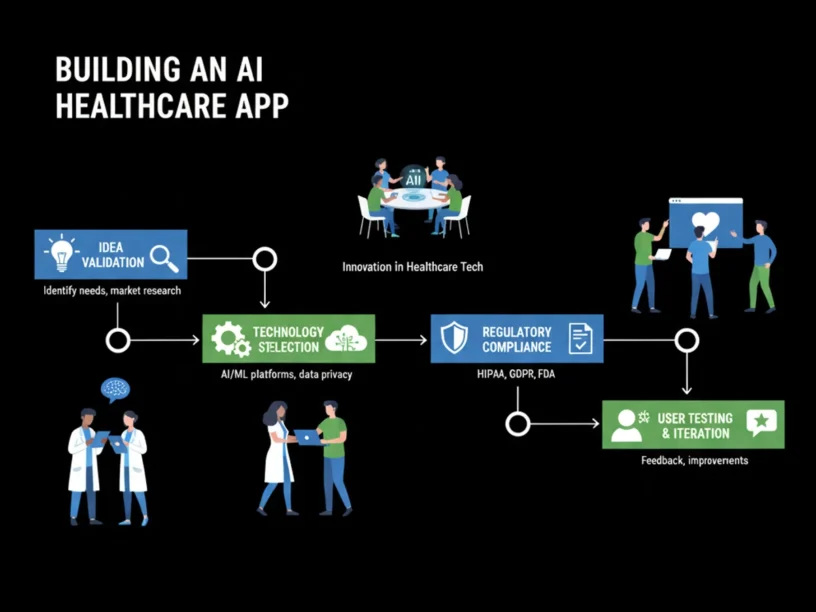
Building involves five stages: (1) regulatory scoping — determining whether your app qualifies as Software as a Medical Device (SaMD) under TGA guidelines and Privacy Act obligations; (2) idea validation — confirming product-market fit, clinical use case, and revenue model with real users; (3) feature design and tech stack selection — prioritising secure architecture, Australian data sovereignty, and FHIR interoperability; (4) compliant development — embedding security and privacy from the first sprint; and (5) launch and scaling — using clinical champion strategies and FHIR-native interoperability. Appomate reduces risk and time-to-market at every stage.
Does my health app need TGA approval in Australia?
Regulation is triggered by intended purpose, not AI presence. If your app generates independent clinical information influencing diagnosis, treatment, or monitoring decisions for a specific patient, it qualifies as SaMD and requires ARTG registration. General wellness, administration, and communication apps typically fall outside TGA regulation. Seek formal classification assessment early.
What does it cost to build an AI healthcare app in Australia?
Healthcare apps cost $100,000 to $500,000+. Wellness apps start around $60K to $120K; health record or clinical integration apps run $150K to $300K; TGA-regulated Software as a Medical Device can exceed $400K. Add 15–20% of build cost annually for maintenance and compliance.
What is the Privacy Act obligation for a health app in Australia?
The Privacy Act 1988 and Australian Privacy Principles impose obligations on health information protection, use, and transparent management. From 10 December 2026, apps using AI or automated processes for decisions must disclose this in privacy policies. Apps collecting health data must implement consent flows, breach notification, and retention policies aligned with the 13 Australian Privacy Principles.
How does My Health Record integration work for app developers?
The Australian Digital Health Agency connects My Health Record to mobile applications through industry-standard APIs. Developers access the system via the FHIR Gateway, which uses HL7 FHIR to enable real-time health data exchange. Authentication uses MyGov credentials, and developers must register as conformant software vendors and complete testing in the Software Vendor Test environment before accessing production data.
What AI features are viable in an Australian health app right now?
As of November 2025, 40% of Australian GPs use AI clinical scribes — nearly double the 22% from August 2024 — making documentation automation proven. Other validated AI uses include appointment and recall automation, symptom triage (scoped outside SaMD classification), wearable data analytics for wellness, and personalised health content. Clinical decision support AI operating autonomously requires TGA SaMD regulation and robust evidence.
How long does it take to build and launch an AI healthcare app in Australia?
Timelines vary by regulatory complexity and feature scope. Wellness MVPs with AI features launch in three to five months. Telehealth platforms with clinical AI take six to ten months. TGA-regulated SaMD — including documentation, quality management, and ARTG registration — takes twelve to eighteen months or more. Appomate’s AI-driven development significantly compresses timelines without sacrificing quality or compliance.
What government funding is available for healthtech startups in Australia?
The $400 million Strengthening Medicare Fund in the 2025-26 federal budget includes digital health allocations prioritising technologies reducing general practice pressure. Additional pathways include the Australian Government’s R&D Tax Incentive (offsetting up to 43.5% of eligible R&D expenditure), Entrepreneurs’ Programme grants, and state-based innovation grants through Investment NSW and LaunchVic.
This article is based on publicly available regulatory guidance from the Therapeutic Goods Administration (TGA), the Office of the Australian Information Commissioner (OAIC), and the Australian Digital Health Agency (ADHA), current as of August 2026. Cost estimates are indicative and should not be treated as quotes. Always seek qualified legal and regulatory advice specific to your product before commencing development.