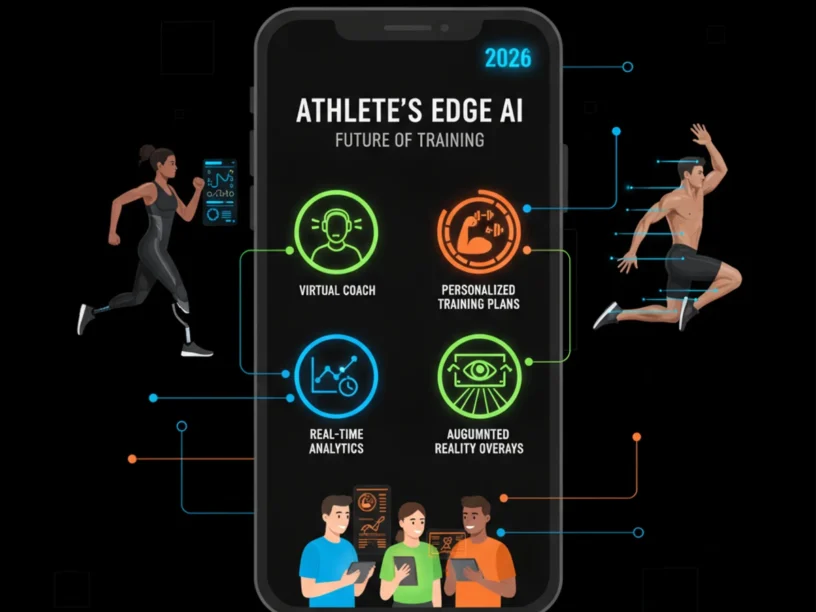
what AI features should a sports mobile app have in 2026? | Updated September 2026 | 9 min read | Appomate Editorial Team
To succeed in 2026, a sports mobile app should integrate **real-time performance analytics**, computer vision for movement and technique tracking, personalised coaching engines, injury prediction models, and AI-driven fan engagement tools such as generative match summaries and predictive content feeds. These capabilities have shifted from optional add-ons to **baseline expectations** as the Australia sports technology market matures. Fans, athletes, and clubs now expect smarter, more personal digital experiences as standard.
For founders building in this space, the real challenge is not whether to add AI, but rather **which specific features will actually move the needle** for your particular sport, target audience, and business model. This guide walks you through the core AI-powered app features worth building in 2026, grounded in Australian market data and real sports app case studies, including several developed by Appomate.
The sports apps that win in 2026 will not be the ones with the longest AI feature list, they will be the ones that use one or two AI capabilities so well that users cannot imagine going back to the old way of training, coaching, or following their team.
What AI Features Should a Sports Mobile App Have in 2026?
A sports mobile app in 2026 needs a focused core of AI features rather than a scattergun of trendy add-ons, including **performance analytics, computer vision, personalised coaching, injury prediction, and intelligent fan engagement**. Artificial intelligence is transforming the sportstech sector, with technologies such as natural language processing, computer vision, and automated decision-making reshaping how rights holders, content creators, sporting organisations, athletes, coaches, and fans interact. The right mix depends on whether your app serves elite athletes, grassroots clubs, or fans.
The Five Core AI Feature Categories
Most successful sports apps in the Australian market build around a small number of **high-value AI categories** rather than attempting to do everything at once.
- Performance analytics: Automated tracking of speed, load, technique, and match statistics that converts raw sensor or video data into actionable coaching insights.
- Computer vision: Camera-based tracking of player movement, form, and ball trajectory without requiring additional wearable hardware.
- Personalised coaching: AI-generated training plans, drills, and feedback specifically tailored to an individual athlete’s history and goals.
- Injury prediction: Predictive models that flag fatigue, overload, or biomechanical risk before an injury occurs.
- Fan and community engagement: Generative AI match summaries, chatbots, and predictive content feeds that personalise the fan experience.
| AI Feature Category | Primary User | Typical Data Source | Business Value |
|---|---|---|---|
| Performance analytics | Athletes, coaches | Wearables, GPS, in-app logs | Retention through visible progress |
| Computer vision | Athletes, clubs | Phone or venue cameras | Lower hardware cost, wider reach |
| Personalised coaching | Individual users | Historical performance, goals | Premium subscription driver |
| Injury prediction | Clubs, medical staff | Load data, biomechanics, history | Duty-of-care and cost savings |
| Fan engagement AI | Fans, spectators | Live match feeds, user behaviour | Session time and ad/subscription revenue |
Key Takeaway: The strongest sports apps in 2026 do not chase every AI trend; they select two or three feature categories that align with a clear user pain point and build those to a **genuinely useful standard**. This focus is what separates apps users love from those they abandon after a week. For deeper context, see Sports Training App Development: Features & Cost 2026.
How Does Performance Analytics and Computer Vision Work in a Sports App?
Performance analytics and computer vision empower sports apps to turn a standard phone camera or basic wearable into a **virtual coach**, capable of tracking movement, technique, and workload without expensive lab equipment. A scoping review found that convolutional neural networks achieved 94% agreement with international experts in technique assessment, while computer vision demonstrated accuracy within 15 mm compared to marker-based systems. This is why computer vision is increasingly the **default entry point for AI** in sports apps, rather than a premium add-on.
Why Computer Vision Is Gaining Ground in Australia
High-performance teams across the AFL, Cricket Australia, and the NRL are actively competing for a strategic edge, with computer vision models already deployed in Australian stadiums to track player kinematics, predict injury risks, and automate broadcast analytics. Consumer-facing apps are following suit at a smaller scale, using a phone’s camera to **assess swing, stride, or shooting form** with surprising accuracy.
- Markerless motion tracking: Uses standard video footage to estimate joint angles and movement patterns without requiring sensors strapped to the body.
- Automated stat capture: Converts match or training footage into structured statistics, significantly reducing manual scoring and note-taking.
- Technique scoring: Compares an athlete’s movement against a reference model, providing instant feedback on form.
- Training load dashboards: Aggregates GPS, heart rate, and session data into simple visual trends that coaches and athletes can act on.
Appomate’s Axcess Golf app illustrates how sports tech solves real problems: a directory showing golfers real-time course availability across more than 2,000 courses in Australia and New Zealand. The lesson is that targeted data features, not just flashy AI, drive genuine club and player value.
Key Takeaway: Computer vision and performance analytics are the most mature AI features to build first because the underlying models are proven, hardware costs are falling, and Australian sporting codes have already **validated the approach at the elite level**. Understanding these two before moving into more complex territory makes the entire project smoother. For deeper context, see AI in Sports: Use Cases, Trends for 2026, Examples, and ….
What Personalised Coaching and Fan Engagement Features Should You Add?
Personalised coaching AI adapts training plans, drills, and feedback to an individual’s history and goals, while fan engagement AI uses generative content and predictive recommendations to keep spectators involved between and during matches. The surge in sports betting, fantasy leagues, and demand for personalised fan experiences is **driving investment in AI** across the global market, and Australian fans are no exception.
Coaching AI: From Generic Plans to 1:1 Personalisation
AI-driven training plans have demonstrated **25% accuracy improvements** in studies, and learning management systems have raised coaches’ understanding by 45% and athlete adherence by 3.4 times compared to static, one-size-fits-all programs. This is the crucial difference between an app that feels like a generic PDF workout sheet and one that feels like a real, responsive coach.
Fan Engagement: Making Every Fan Feel Like an Insider
Cricket Australia’s Live App introduced an AI-powered “AI Insights” feature through a collaboration with HCLTech and Microsoft, providing dynamic match updates, player highlights, and key narratives that offer fans a deeper, more immersive experience. This kind of **generative recap and highlight feature** is rapidly becoming a baseline expectation rather than a differentiator.
- Adaptive drill sequencing: Adjusts the next training session based on the outcome of the previous one, rather than rigidly following a fixed calendar.
- Natural language chat coaching: Allows users to ask questions about form, recovery, or strategy and receive instant, context-aware answers.
- AI match recaps: Automatically generates highlight reels and narrative summaries so fans never miss a moment.
- Predictive content feeds: Surfaces the players, clubs, or storylines a fan is most likely to care about next.
Appomate’s sports portfolio reflects this shift: the Find My Player platform connects athletes and teams by allowing players to showcase their skills so clubs and recruiters can discover new talent, while MyCombat serves combat sports athletes with a tailored digital platform. Case studies like **My Cheer Tribe** and **Sportscape** further demonstrate how community and engagement features can be built around a specific sporting niche rather than a generic template. Key Takeaway: Personalised coaching drives retention among serious athletes, while AI fan engagement features drive session frequency and monetisation among casual audiences, so most apps benefit from at least a **light version of both**. The balance you strike depends on whether you’re chasing premium subscription revenue or ad-supported growth. For deeper context, see Sports Fandom in 2026: Personalization and AI Drive ….
How Can Injury Prediction AI Reduce Risk in a Sports App?
Injury prediction AI analyses training load, biomechanics, and historical injury data to flag athletes at elevated risk before a soft-tissue or overuse injury occurs. Injury prevention solutions are expected to post a **33.25% CAGR through 2031** as clubs seek predictive health analytics, making this one of the fastest-growing AI categories in the entire sports technology sector.
What the Research Says About Accuracy
AI models have been developed to predict injury risk across various sports, including Australian football, basketball, soccer, volleyball, and athletics. These models use data on athlete demographics, training loads, injury history, physical stress levels, and genetic markers. Results have been mixed: hamstring injuries in elite AFL players can be predicted with reasonable accuracy, while others remain difficult to model. A separate scoping review found that **random forest models predicted hamstring injuries with 85% accuracy**, and implementing integrated AI systems resulted in a 23% reduction in reinjury rates.
| Injury Prediction Approach | Data Required | Best Suited For | Reported Accuracy Range |
|---|---|---|---|
| Wearable load monitoring | GPS, accelerometer, heart rate | Team sports, endurance athletes | Moderate, improves with history |
| Computer vision biomechanics | Video footage only | Grassroots clubs without hardware budgets | Within 15mm of marker-based systems |
| Random forest / ensemble models | Historical injury and load records | Hamstring and overuse injury flagging | Up to 85% in controlled studies |
| Multimodal fusion models | Clinical, GPS, and movement data combined | Elite programs with data infrastructure | Improves as more modalities are added |
- Load monitoring alerts: Notifies coaches when an athlete’s training volume spikes beyond a safe threshold.
- Fatigue and movement flagging: Uses video or wearable data to spot abnormal joint angles or asymmetrical landings.
- Return-to-play guidance: Suggests a gradual reintroduction schedule based on injury type and recovery data.
- Duty-of-care reporting: Provides clubs with an auditable record of load management decisions, useful for insurance and governance.
Key Takeaway: Injury prediction is not a “set and forget” feature; it requires sufficient historical data to be useful, so apps should plan a **data collection strategy from day one** rather than attempting to bolt on prediction later. The apps that handle this well tend to see stronger adoption among clubs because they’re addressing a genuine liability concern. For deeper context, see Best AI Tools for Sports 2026: What Coaches and Analysts ….
How Do You Choose the Right AI Development Partner for a Sports App?
Choosing the right development partner is more critical for AI sports apps than for most other categories, because the difference between a genuine AI-native product and a thin AI wrapper quickly becomes apparent in accuracy, cost, and user trust. The Australia sports technology market was valued at **AUD 632.19 million in 2024** and is expected to grow at a CAGR of 13.10% from 2025 to 2034. Founders entering this space need a partner who understands both the sport and the underlying AI stack.
Questions to Ask Before You Commit
Not every agency that claims “AI expertise” has actually shipped a working computer vision or predictive model into production. Ask **specific, technical questions** before signing a contract.
- Have they shipped AI features in a live sports app? Ask for a working example, not just a mockup or a slide deck.
- Do they build AI-native or AI-wrapped products? A thin wrapper around a generic chatbot API is not the same as a purpose-built model trained on sport-specific data.
- What is their realistic timeline? A focused MVP with one core AI feature typically takes 8 to 16 weeks from a validated idea to a live app on iOS and Android.
- Do they offer post-launch support? AI models require retraining and monitoring after launch, not just a one-off build.
Why Appomate Approaches Sports Apps Differently
Appomate is committed to empowering founders, especially those without a technical background, to transform their sports app concept into a market-ready product quickly and safely. With sports case studies spanning Axcess Golf, MyCombat, My Cheer Tribe, Sportscape, and Find My Player, plus enterprise clients including Adidas, L’Oreal, Lend Lease, and Hoyts, Appomate combines Australia-based strategy and product design with a highly skilled global development team.
We build products that are AI native, not just AI wrappers, using the latest AI-driven development tools to deliver faster and smarter, with Australia-based strategy and design combined with a world-class global development team.
Appomate has helped founders go from idea to market as quickly as 6 weeks, and its Further Faster Framework combines agile methodology with a proven validation process to reduce the risk of building the wrong features. Key Takeaway: Vet any AI development partner on shipped sports-specific work, realistic timelines, and post-launch model support, not just a **generic AI capability slide**. The best partners will push back on unrealistic scope and help you stay focused on what matters most.
Conclusion
Sports apps in 2026 will succeed by pairing proven AI capabilities, such as performance analytics, computer vision, personalised coaching, injury prediction, and fan engagement, with a sharp focus on one or two features that solve a real problem for a specific sport or audience. Australia’s sports technology sector is growing rapidly, meaning generic, feature-bloated apps will struggle against **focused, AI-native competitors**.
- Start narrow: Select one or two AI feature categories that directly address your users’ single biggest pain point, rather than attempting to build everything at once.
- Plan your data strategy early: Injury prediction and coaching personalisation only become accurate with sufficient historical data, so data collection needs to commence from launch.
- Favour computer vision where hardware is a barrier: It significantly lowers the cost of entry for grassroots clubs and casual athletes compared to wearable-first approaches.
- Treat fan engagement AI as table stakes: Generative recaps and predictive content feeds are becoming standard, not a premium differentiator.
- Choose a partner with sport-specific proof: Request real, shipped examples of their work rather than relying on generic AI capability claims.
Founders ready to scope an AI-powered sports app can begin with a structured validation conversation rather than jumping straight into a build brief, which is typically where a partner like Appomate starts the process.
FAQ
What AI features should a sports mobile app have in 2026?
A sports mobile app in 2026 should prioritise **performance analytics**, computer vision for movement tracking, personalised AI coaching, injury prediction models, and generative AI fan engagement features such as automated match recaps. The right combination depends on whether the app targets elite athletes, grassroots clubs, or fans, but most successful apps focus on two or three of these categories rather than all five at once to deliver maximum value.
Do I need wearable hardware to add AI features to a sports app?
No. Computer vision has demonstrated **accuracy within 15 mm compared to marker-based systems**, meaning a standard phone camera can now deliver motion analysis that once required dedicated sensors. This significantly lowers the cost for grassroots-focused apps.
How accurate is AI injury prediction for sports apps?
Random forest models have predicted **hamstring injuries with 85% accuracy** in controlled studies, though results remain mixed across different injury types, with some conditions predicted with reasonable accuracy and others still difficult to model. Accuracy generally improves with more historical and biomechanical data input.
How long does it take to build an AI-powered sports app in Australia?
A focused MVP with a single core AI feature typically takes 8 to 16 weeks from a validated idea to a live app on iOS and Android, while more complex builds with custom models or multiple integrations will naturally require longer development cycles.
Is the Australian sports technology market big enough to justify investment?
Yes. The Australia sports technology market was valued at **AUD 632.19 million in 2024** and is expected to grow at a CAGR of 13.10% from 2025 to 2034. Additionally, Tennis Australia’s corporate venture unit AO Ventures completed the first close of a USD 30 million fund to support startups innovating in sports, entertainment, media, and health, indicating strong market confidence.
What is the difference between an “AI-native” app and an “AI wrapper”?
An **AI wrapper** simply bolts a generic third-party API onto an existing app without adapting the model or data pipeline to the specific sport. An **AI-native app** is built from the ground up around the specific data, workflows, and user needs of that sport, which typically produces more accurate and useful results tailored to the domain.
Which AI feature should a first-time sports app founder build first?
Most founders achieve the best early return from **performance analytics or computer vision features**. The underlying technology is mature, hardware costs are low, and users see immediate, tangible value, such as instant technique feedback, before needing to invest in more data-intensive features like injury prediction.
Can grassroots or amateur sports apps realistically use AI, or is it only for elite teams?
Grassroots apps can absolutely use AI, particularly computer vision features that run on a standard phone camera rather than expensive wearables. While elite Australian codes like the AFL, Cricket Australia, and the NRL use computer vision for kinematic tracking at scale, the same underlying technology is increasingly accessible to **community-level apps** at a fraction of the cost.
Methodology and disclaimer: This article was compiled using publicly available market research from Expert Market Research, Fortune Business Insights, Mordor Intelligence, Grand View Research, the Australian Sports Technology Network (ASTN), and peer-reviewed scoping reviews on AI in sports biomechanics, current to September 2026. Statistics are cited from third-party research providers and are subject to revision. This article does not constitute technical, medical, or investment advice.