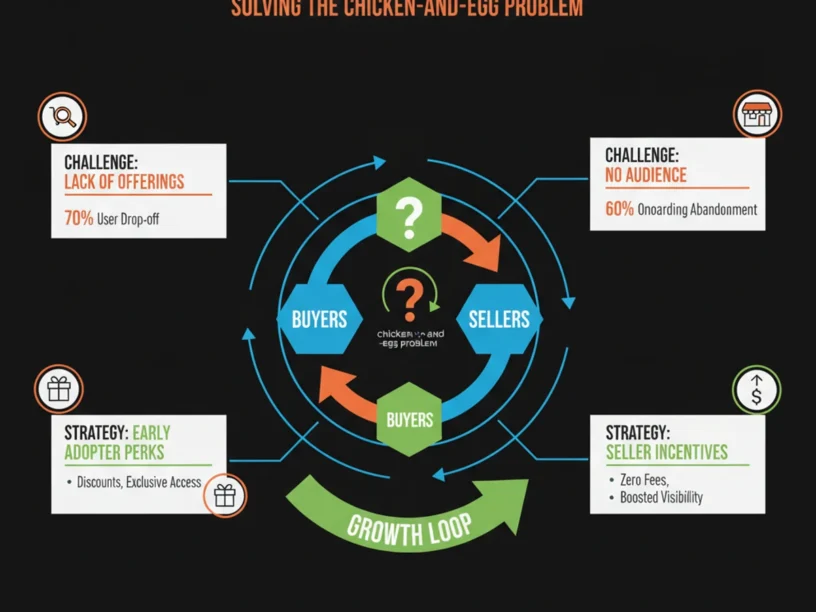
app marketing strategy for marketplace apps – how to solve the chicken-and-egg problem | The right app marketing strategy for marketplace apps starts with deliberately seeding one side of your marketplace, constraining your launch to a narrow niche, and manually facilitating early transactions until network effects take over. Buyers will not show up without sellers. Sellers will not show up without buyers. The usual playbook of “build it and run some ads” simply does not work for marketplaces.
Australia’s app economy provides a strong foundation for marketplace founders. Business of Apps data shows revenue climbing toward roughly US$2.6 billion and over 20 million Australians actively using apps daily. However, broader market growth does not automatically translate into liquidity for a brand-new two-sided platform, making a deliberate, sequenced marketing strategy non-negotiable.
A marketplace with 10,000 downloads and zero completed transactions is not an early-stage business. It is a waiting room. Liquidity, not install volume, is the only metric that proves a marketplace app is actually working.
What Is the Chicken-and-Egg Problem for Marketplace Apps?
The chicken-and-egg problem is the structural deadlock where each side only finds value once the other side is already present. This is driven by cross-side network effects, where the value of a platform to one user group depends on the number of users in another group.
Why Standard App Marketing Doesn’t Work Here
Traditional app user acquisition assumes more visibility equals more usage. The chicken and egg problem isn’t the kind of user acquisition problem that can be solved through added visibility only. Running paid ads to an empty marketplace produces disappointed first-time users who never return.
The Core Mechanics Founders Need to Know
- Cross-side dependency: Buyers need sellers present to get value, and sellers need buyers present to justify listing.
- Zero network value at launch: At day one, both sides have effectively zero incentive to join because there is no critical mass on the opposite side.
- Liquidity as the real success metric: A marketplace reaches “liquidity” when a typical user can reliably find a match; this, not raw downloads, is the metric that matters.
- Leakage risk after launch: Once both sides are present, off-platform transactions can drain the liquidity you’ve built, so the product needs to be designed for on-platform completion from day one.
Key Takeaway: The chicken-and-egg problem is a structural feature of every two-sided marketplace. Solving it requires sequencing, not spending. For deeper context, see Chicken and Egg Problem: How to Start a Marketplace …. For deeper context, see 19 Tactics to Solve the Chicken-or-Egg Problem and Grow ….
App Marketing Strategy for Marketplace Apps: How to Solve the Problem
The proven answer is to seed one side deliberately, usually the harder side to acquire, before opening the doors to the other. Bring in one side first, identify which side has the bigger incentive to join, then launch to the other side once that initial supply or demand is in place. Trying to grow both sides simultaneously is the single most common cause of marketplace failure.
Choosing Your Harder Side
The correct rule is to focus on the hardest side to acquire first, whichever that happens to be for your category. Actionable strategies studied across marketplaces like Airbnb, Uber, and Thumbtack show it is crucial to test both onboarding funnels early to find out which side actually converts harder. This upfront testing typically takes a few days or weeks but saves months of effort.
| Strategy | How It Works | Best For | Example Category |
|---|---|---|---|
| Supply-first seeding | Manually recruit and onboard providers before opening to customers. | Services, rentals, freelance/gig platforms. | Staffing, home services, RV rentals. |
| Single-player mode | Give one side standalone value even without the other side present. | Booking systems, inventory tools. | Restaurant reservation software, business directories. |
| Piggyback / competitor supply | Allow existing third-party sellers to list, tapping into existing demand. | Established demand with fragmented supply. | General e-commerce marketplaces. |
| Geographic constraint | Launch in a single suburb, city, or niche to concentrate supply and demand. | Local services, on-demand delivery. | Ride-share, food delivery. |
| Subsidise the harder side | Offer zero commission or guaranteed minimum earnings to the side hardest to attract. | Any marketplace with clear cost asymmetry. | Freelance and B2B service marketplaces. |
Tactics That Have Worked in Practice
- Manual facilitation: Curating matches and facilitating early transactions by hand is a legitimate, finite investment that buys time for organic dynamics to develop.
- Single-player mode: OpenTable targeted restaurants first with standalone booking software they could use with zero diners on the platform, then layered in demand once enough restaurants were active, as detailed in case studies of successful marketplace seeding strategies.
- Data-seeded supply: Platforms such as Yelp and Indeed populated their listings with aggregated data before organic supply-side activity existed, according to analysis from investors who studied over 60 early-stage marketplace startups.
- Niche-first launch: Constraining your first cohort to a single suburb, industry, or use case concentrates the co-presence of supply and demand.
Key Takeaway: There is no universal answer to supply-first versus demand-first; the winning strategy depends on which side is genuinely harder to recruit in your category. For related guidance, see 10 Best App Marketing Strategies Beyond Aso For Startups 2026.
Marketplace App Launch Strategy: The 2026 Approach
A modern marketplace app launch strategy is staged, not simultaneous. It involves validating demand before writing code, seeding supply manually in a constrained geography, then opening the app to broader user acquisition only once early transactions are completing reliably.
The Four Launch Stages
| Stage | Primary Goal | Typical Duration | Key Activity |
|---|---|---|---|
| Validation | Confirm real demand before building. | 2 to 4 weeks. | Landing pages, waitlists, manual concierge matching. |
| Seeding | Recruit initial supply in one niche or suburb. | 4 to 8 weeks. | Direct outreach, founder-led onboarding, incentivised early listings. |
| Ignition | Open to demand side and drive first transactions. | 4 to 6 weeks. | Local PR, referral incentives, hand-matched early bookings. |
| Scale | Expand geography and automate acquisition. | Ongoing. | Paid user acquisition, ASO, partnerships, retention loops. |
A Real Australian Example
The Melbourne-based hospitality staffing marketplace Hospool illustrates a constrained, sequenced launch. Founder Peter Schofield prioritised speed to market without sacrificing quality, and the app went live in six weeks. This was achieved by focusing tightly on connecting hospitality employers with available workers. On Hospool’s app listing, the value proposition explicitly gives employers an immediate pool of nearby available staff while giving workers control over when and how often they work.
Six weeks from idea to a live, functioning marketplace app is what happens when a founder constrains the launch scope deliberately instead of trying to solve every use case on day one.
Key Takeaway: Treat your marketplace app launch as four distinct stages, each with its own success metric, rather than one big “go live” moment. For deeper context, see Best Marketplace Platforms: A Comprehensive ….
User Acquisition for Marketplace Apps: Which Channels Work?
Effective user acquisition for marketplace apps blends founder-led manual outreach in the early months with scalable digital channels once liquidity is established. Paid acquisition alone rarely works before the marketplace has enough supply density to satisfy new demand-side users on their first visit.
Channels for the Seeding Phase
- Founder-led direct outreach: Personally recruiting the first 50 to 100 supply-side users builds trust and surfaces onboarding friction that no ad campaign will reveal.
- Local community and industry groups: Facebook groups, trade associations, and local business networks are often the fastest way to reach a concentrated pool of early supply in a specific Australian city or region.
- Referral incentives: Offering early adopters a tangible benefit for referring peers accelerates supply density without paid media spend.
- Concierge matching: Manually connecting the first buyers and sellers by hand proves the value proposition works before automating it.
Channels for the Scale Phase
- App Store Optimisation (ASO): Once supply density supports new demand, ASO becomes cost-effective because organic searchers convert into satisfied first-time users.
- Paid social and search: Meta and Google remain dominant, and industry data shows Google and Meta commanding roughly 90% of mobile ad dollars globally.
- Retention-first monetisation: With roughly 46% of installed Android apps uninstalled within 30 days, marketplace apps cannot afford to spend on acquisition without a retention loop already validated during seeding.
Key Takeaway: Spend the first dollars on manual, high-touch acquisition to prove liquidity, and only shift toward paid, scalable channels once your marketplace can reliably deliver a match on a new user’s first session. For deeper context, see B2B Marketplace App Development: Step-by-Step Guide –.
How Does Appomate Help Marketplace Founders?
Appomate is a Melbourne-based mobile and web app development company that has worked specifically inside the marketplace vertical, helping founders design, build, and market two-sided platforms from validation through to launch and growth. Rather than simply building what a founder specifies, Appomate acts as a full growth partner across the entire product journey, including strategy, design, development, launch, marketing, and ongoing support.
Why Marketplace Founders Choose a Full-Journey Partner
- Validation before build: Appomate tests real demand signals before committing development resources, reducing the risk that founders sink budget into an app nobody wants.
- Australia-based strategy, global delivery: Appomate combines Australia-based strategy and product design with a highly skilled global development team, delivering premium quality at startup-friendly pricing.
- Speed without shortcuts: Using an AI-driven development approach, Appomate has helped founders go from idea to market in as little as six weeks.
- One partner across the whole journey: From validation to launch, growth, and exit, Appomate stays involved as a single accountable partner rather than handing off to a different agency at each stage.
- Portfolio depth in marketplaces: Marketplace apps such as Hospool sit alongside other two-sided platforms in Appomate’s portfolio, giving the team pattern-recognition across staffing, community, and services marketplaces.
Key Takeaway: Because marketplace apps live or die on sequencing, working with a partner like Appomate that treats marketing and growth as part of the build materially reduces the risk of launching into an empty marketplace.
Conclusion
Solving the chicken-and-egg problem is less about clever advertising and more about disciplined sequencing. This involves seeding the harder side first, constraining your launch geography, facilitating early matches by hand, and only scaling acquisition once liquidity is proven.
- Sequence, don’t split: Focus resources on one side of the marketplace at a time rather than splitting a budget across both simultaneously.
- Constrain your launch: A single suburb, niche, or industry vertical concentrates supply and demand co-presence far faster than a broad rollout.
- Manual before automated: Hand-matching early transactions is a legitimate, time-limited strategy that buys space for organic network effects to kick in.
- Liquidity over downloads: Track completed matches and repeat transactions, not install counts, as your real north star metric.
- Choose the right partner: A full-journey partner like Appomate that combines validation, build, and marketing under one roof helps founders avoid the most common and costly marketplace mistakes.
If you are planning a marketplace app launch in Australia in 2026, the next step is validating your niche and identifying your harder side before writing a single line of code.
FAQ
What does app marketing strategy for marketplace apps mean?
This refers to the deliberate sequencing approach marketplace founders use to overcome the structural deadlock where buyers will not join without sellers and sellers will not join without buyers. The solution involves seeding one side first, usually the harder side to recruit, constraining the initial launch to a niche or geography, and manually facilitating early transactions before scaling broader user acquisition.
Should I focus on supply or demand first for my marketplace app?
Focus on whichever side is genuinely hardest to acquire in your specific category. Test both onboarding funnels early rather than assuming supply always comes first.
How long does it take to launch a marketplace app in Australia?
Constrained, well-validated marketplace apps can launch in as little as six weeks. This was demonstrated by the Melbourne hospitality staffing marketplace Hospool, which went live within that timeframe by focusing tightly on one use case.
What is “liquidity” in a marketplace app and why does it matter more than downloads?
Liquidity is the point at which a typical user on either side of the marketplace can reliably find a match. It is the true measure of whether a marketplace is functioning, unlike download counts which say nothing about whether transactions are actually completing.
Can paid advertising alone solve the chicken-and-egg problem?
No. Visibility alone cannot solve the chicken-and-egg problem because new users who arrive via ads to an empty marketplace simply leave disappointed. Paid acquisition becomes effective only after manual seeding has established enough supply or demand density to satisfy new users on their first visit.
What are common mistakes founders make when marketing a marketplace app?
The most common mistake is trying to grow both sides of the marketplace simultaneously with a broad-based marketing campaign before either side has enough density to create value. Other frequent errors include launching in too broad a geography, skipping manual concierge matching, and shifting to paid acquisition before liquidity is proven.
How does Appomate help solve the chicken-and-egg problem for marketplace apps?
Appomate combines Australia-based strategy and product design with a global development team to validate demand, build a constrained MVP, and support the launch marketing needed to seed the first side of a marketplace. This full-journey approach, paired with an AI-driven development process, has helped founders move from idea to market in as little as six weeks.
What user acquisition channels work best for marketplace apps after launch?
Early on, founder-led outreach, local community groups, referral incentives, and manual concierge matching outperform paid channels because they build supply density without wasting a media budget on an empty platform. Once liquidity is proven, App Store Optimisation, paid social, and paid search become cost-effective as new users start converting into satisfied first-session matches.
This article was researched using current Australian and global app market data, published marketplace strategy frameworks, and Appomate’s own portfolio case studies as of September 2026. Statistics and figures are cited to their original sources throughout; readers should verify current figures directly with linked sources before making investment or strategic decisions.