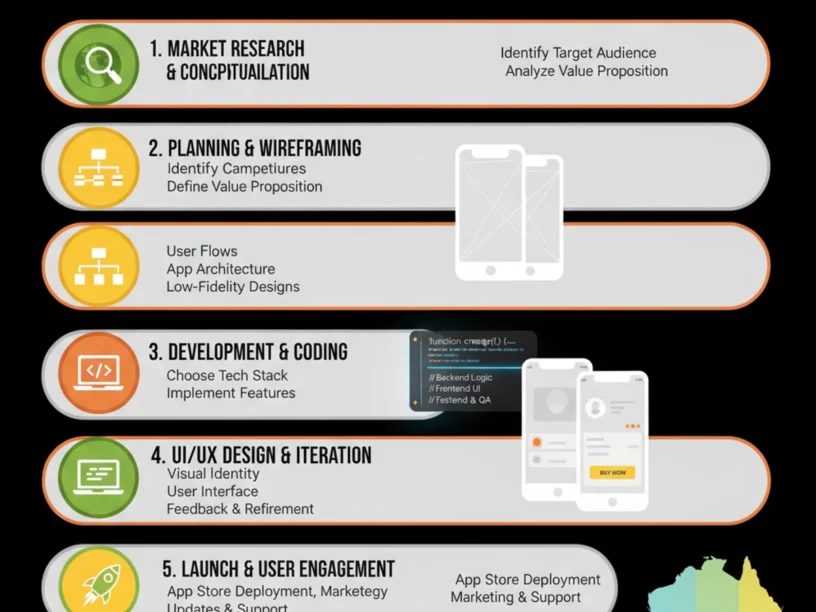
How to build a marketplace app in Australia — what founders need to know | Updated August 2026 | Appomate Editorial Team
Building a marketplace app in Australia requires careful planning across product strategy, technology, legal compliance, and go-to-market execution. Your job is to connect two distinct user groups — buyers and sellers — on a single platform. Australia’s digital marketplace sector is growing at a projected CAGR of 8.4% through 2030, making now an excellent time to enter the market. With smartphone penetration exceeding 90% and over 27 million active expected smartphone users in 2026, and more than 7 million Australians relying on mobile apps for food delivery and online retail, the opportunity is real and measurable. The key is partnering with the right people and following a proven process.
A marketplace is not just an app — it is an ecosystem. The founders who succeed validate the two-sided problem before writing code, then build just enough to generate their first real transaction.
Step 1: Validate Your Marketplace Idea Before You Build
Validation is the most important step before committing significant budget. You need evidence that both sides of your marketplace have a real, urgent problem your platform can solve. About 42% of app failures come from poor market research, making pre-build validation one of the highest-leverage activities a founder can undertake.
What Validation Actually Looks Like
- Problem interviews: Speak directly with 20–30 potential buyers and 20–30 potential sellers about current workarounds. If they have no workaround, the problem may not be urgent enough.
- Competitor mapping: Identify existing platforms serving your niche. Australian platforms like Airtasker, hipages, and Freelancer.com dominate specific segments. A gap in supply-demand match is your entry point.
- Landing page test: Build a simple page describing your platform and collect email sign-ups from both sides. A 15%+ conversion rate signals meaningful interest.
- Manual matchmaking: Before building anything, manually connect buyers and sellers using email or WhatsApp. If people transact, you have proof the model works.
Choosing Your Marketplace Model
| Model | Example (Australia) | Revenue Mechanism | Ideal For |
|---|---|---|---|
| Service marketplace | Airtasker, hipages | Commission on completed jobs | Skilled trades, professional services |
| Product marketplace | Amazon AU, eBay AU | Listing fees + commission | Physical goods, wholesale |
| Rental marketplace | Camplify, PeerFleet | Platform fee on booking value | Assets, vehicles, equipment |
| B2B marketplace | Supply chain, wholesale platforms | Subscription + transaction fee | Trade buyers, procurement teams |
Key Takeaway: Validate demand from both sides before spending on development. A proven manual transaction proves market need more than any prototype. For deeper context, see Start An App In Australia: Legal And Business Checklist For ….
Step 2: Define Your MVP — What to Build First
A Minimum Viable Product (MVP) is the smallest version that can facilitate a real transaction. Most founders either build too much (wasting budget) or too little (failing to generate trust). Two-sided functionality is essential: both buyers and sellers must be able to complete their respective journeys.
The Core Feature Set for a Marketplace MVP
- User registration and profiles: Separate onboarding flows for buyers and sellers with role-specific dashboards.
- Listings and search: Sellers create listings; buyers search and filter. Essential features include onboarding, listings, search and filters, secure payments, messaging, reviews, and admin moderation tools.
- Secure payment and escrow: Money must move through your platform. In Australia, Stripe Connect is the dominant choice, supporting payment splitting and escrow between platform and sellers.
- In-app messaging: Buyers and sellers need reliable communication inside the platform.
- Reviews and rating: A two-way review system after every transaction builds credibility and accountability.
- Admin dashboard: Visibility over listings, users, payments, and disputes from day one.
MVP vs Full Platform: Australian Cost Benchmarks
| Build Stage | Typical Scope | Estimated Cost (AUD) | Timeline |
|---|---|---|---|
| MVP / Pilot | Core two-sided flows, payments, messaging | $80,000 – $150,000 | 8 – 16 weeks |
| Mid-complexity platform | Analytics, advanced search, notifications | $150,000 – $220,000 | 4 – 8 months |
| Full enterprise platform | AI matching, multi-region, SLA support | $300,000 – $700,000+ | 9 – 18 months |
A marketplace introduces user roles, real-time updates, offline mode, analytics dashboards, and payment flows, pushing costs to AUD $150,000+. Plan to spend an additional 15 to 20% of the build cost per year for maintenance and hosting.
Founders who ship fastest are most disciplined about what NOT to build in version one.
Key Takeaway: A well-scoped marketplace MVP costs AUD $80,000–$150,000 and can launch in 8–16 weeks with the right partner. Start lean, validate with real transactions, then scale based on proven demand. For deeper context, see A Path to the Minimum Viable Product | by Steve Blank.
Ready to build your app?
Book a free Visioning Call with our team today and walk away with a clear roadmap, expert feedback, and a plan to bring your idea to life. No technical knowledge required.
Step 3: Choose the Right Technology Approach
Your technology choices shape how fast you launch, how much you spend, and how easily you scale. Cross-platform frameworks like React Native and Flutter save 30 to 40% compared to building separate native apps for iOS and Android.
Three Approaches Compared
- No-code / low-code platforms: Tools like Sharetribe and Bubble enable quick, affordable launches for concept validation. Trade-off: limited customisation and scalability ceiling.
- Cross-platform custom development: Using React Native or Flutter, a single codebase runs on both iOS and Android. This is the sweet spot for most Australian founders. Roughly 55–60% of Australian users are on iOS, with about 40–45% on Android, making cross-platform reach essential.
- Fully custom native development: Separate iOS and Android codebases for maximum performance. Reserved for platforms requiring device-specific features. Highest cost and longest timeline.
Key Technology Decisions
- Payment gateway: Stripe dominates Australian marketplace payments. Alternatives: Braintree and Pin Payments.
- Cloud infrastructure: AWS Sydney region is most common for Australian-hosted apps.
- Identity verification: Providers like GreenID or Stripe Identity handle KYC verification for service providers.
- Analytics: Use Mixpanel or Amplitude to track transaction completion rates and user drop-off.
Key Takeaway: For most Australian marketplace founders, a cross-platform build (React Native or Flutter) on AWS Sydney with Stripe Connect for payments delivers the best balance of quality, speed, and cost. For deeper context, see How to Build an App Marketplace: Strategic Guide for ….
Step 4: Navigate Australian Legal and Compliance Requirements
Building a marketplace in Australia means operating under several layers of regulation that directly affect your product design. Getting compliance wrong can get your app removed from the App Store, trigger ACCC enforcement action, or destroy user trust. The key regulators are the ACCC (Australian Competition and Consumer Commission) and the OAIC (Office of the Australian Information Commissioner).
The Four Compliance Pillars
- Australian Consumer Law (ACL): If your app supplies goods or services to Australian consumers, you must comply with the Australian Consumer Law — including consumer guarantees, refund rights, and advertising rules.
- Privacy Act 1988 and Australian Privacy Principles (APPs): The Privacy Act 1988 is Australia’s main legislation regulating personal information management. It covers Australian Government agencies and organisations with an annual turnover of more than $3 million, though marketplaces handling health data may be covered from day one.
- Pricing transparency: In-app purchases and subscription models must have clear terms and avoid deceptive pricing structures. Display total prices inclusive of GST.
- App store compliance: The ACCC and OAIC take app practices seriously; Apple App Store and Google Play policies increasingly reflect Australian legal expectations — including clear privacy disclosures and honest marketing.
Legal Documents Your Marketplace Needs at Launch
- Terms and Conditions: Core user agreement covering acceptable use, accounts, fees, IP ownership, user content, disclaimers, liability limits, and governing law.
- Privacy Policy: Explanation of what you collect, why, how it is stored, who you share it with, security measures, and user rights.
- Seller / provider agreement: Separate terms covering ABN requirements, insurance obligations, service standards, and dispute resolution.
Key Takeaway: Build compliance into your product from day one. Engage a specialist like Sprintlaw early to get your legal foundations right. For deeper context, see Guide to starting a business.
Step 5: Launch, Grow, and Scale Your Australian Marketplace
Launching is the beginning, not the end. Every two-sided marketplace faces the cold-start problem — you need sellers to attract buyers and buyers to attract sellers. The most successful Australian platforms solved this by seeding supply in one city or category first. Limiting your initial market to one major Australian city helps optimise logistics, marketing spend, and supply-side recruitment before national expansion.
The Cold-Start Playbook
- Seed supply first: Personally recruit your first 20–50 service providers or sellers before launch. Airtasker manually recruited its first Taskers in Sydney before opening publicly.
- Activate demand with a specific niche: Own one buyer persona in one geographic market, not everyone at once.
- Use content and SEO: Marketplace listings are indexable content. Build category landing pages from day one to capture organic search traffic.
- Measure the right metric: Track Gross Merchandise Value (GMV) — total transaction value — not just user registrations. GMV reflects actual business activity.
- Iterate on trust: Success lies in balancing supply and demand, building trust between both sides, and maintaining quality control during scaling.
Appomate is a Melbourne-based app development company helping founders go from idea to market with its Further Faster Framework — covering validation, product design, build, launch, and growth. With over 250 apps delivered and a hybrid delivery model combining Australian strategy with a skilled global development team, Appomate helps non-technical founders launch marketplace apps that are AI-native, scalable, and market-ready — often in as little as 6 weeks for an MVP.
Key Takeaway: Focus on one city, one category, and one user persona first. Measure GMV, iterate on trust, and expand once unit economics are proven.
Conclusion
Building a marketplace app in Australia requires five disciplines: validate before building, scope your MVP tightly, choose technology matching your ambitions, bake compliance in from day one, and launch with a focused go-to-market strategy. Australia’s growing digital economy, high smartphone penetration, and willingness to pay for quality apps make this one of the best markets in the Asia-Pacific region for marketplace founders in 2026.
- Validate first: Prove two-sided demand before investing in development.
- Budget realistically: A marketplace MVP typically costs AUD $80,000–$150,000. Plan for 15–20% of build cost annually in maintenance.
- Prioritise compliance: Australian Consumer Law, the Privacy Act, and ACCC rules apply from day one.
- Start narrow, then expand: Seed supply in one city or category before going national.
- Choose the right partner: A full-lifecycle development partner like Appomate reduces risk, compresses timelines, and keeps founders in control.
The best next step is a structured validation and scoping session before committing to a development budget. Get that right, and the rest becomes far more predictable.
FAQ
How do I build a marketplace app in Australia in 2026?
Building a marketplace app involves five steps: (1) validate demand from both buyers and sellers before spending on development; (2) define a lean MVP scoped to core two-sided features — registration, listings, payments, messaging, and reviews; (3) choose the right technology, typically cross-platform using React Native or Flutter on AWS Sydney with Stripe Connect; (4) address Australian compliance from day one, including the Australian Consumer Law, Privacy Act 1988, and ACCC pricing rules; and (5) launch with a focused go-to-market strategy, seeding supply in one city or category before expanding nationally. Budget AUD $80,000–$150,000 for an MVP taking 8–16 weeks with the right development partner.
How much does it cost to build a marketplace app in Australia?
A marketplace app usually costs between AUD $100,000 and $220,000+ for a complete product. An MVP typically starts at AUD $80,000–$150,000, while a full-feature enterprise platform costs AUD $300,000 to $700,000 or more. Ongoing maintenance and hosting add approximately 15–20% of the initial build cost per year.
What are the must-have features for a marketplace MVP in Australia?
At minimum: separate registration flows for buyers and sellers; product or service listings with search and filters; secure payment with escrow using Stripe Connect; in-platform messaging; two-way review and rating system; and a basic admin dashboard for moderation. These features let you test whether users will actually transact.
What Australian laws apply to marketplace apps?
Marketplace apps must comply with the Australian Consumer Law (ACL), covering consumer guarantees, refund rights, and fair pricing with clear GST-inclusive totals. The Privacy Act 1988 and 13 Australian Privacy Principles govern personal data collection and use. The ACCC monitors online marketplaces for misleading pricing and unfair terms. Your app must meet Apple App Store and Google Play policies reflecting Australian legal expectations. Engage a specialist like Sprintlaw early.
How long does it take to build and launch a marketplace app in Australia?
A lean, well-scoped marketplace MVP takes 8–16 weeks from kickoff to launch with an experienced development partner. Full-featured platforms take 6–18 months. The biggest variable is scope — tighter scope means faster launch and earlier learning from real users.
What is the cold-start problem and how do Australian founders solve it?
The cold-start problem: buyers won’t come without sellers, and sellers won’t join without buyers. Airtasker solved this by manually recruiting Taskers in Sydney first. The proven approach is to seed your supply side first — personally recruit 20–50 providers before launch, often with free or discounted access — then activate buyer demand in a narrow geographic area or category. Expand only once you have consistent transaction volume and proven unit economics.
Should I build natively or use a cross-platform framework for my Australian marketplace?
For most Australian marketplace founders, a cross-platform framework like React Native or Flutter is the right choice. It delivers a high-quality experience on both iOS and Android from a single codebase, matters because Australian users split roughly 55–60% iOS and 40–45% Android, costs 30–40% less than separate native builds, and ships faster. Fully native development is worth considering only when real-time performance is central to the product.
How do I choose the right app development partner for my marketplace in Australia?
Look for a partner with specific marketplace experience, not just general app development. They should understand two-sided platform dynamics, payment flow architecture, and Australian compliance. A partner who acts as a strategic product co-founder — not just a build shop — saves money and time by helping you scope the right MVP, validate before building, and set up scalable infrastructure. Appomate is a Melbourne-based development company with over 250 apps delivered, a founder-focused methodology, and a hybrid delivery model combining Australian strategy with global development talent.
Methodology and disclaimer: This article draws on publicly available market research, industry cost benchmarks, and regulatory guidance current as of August 2026. Cost estimates are indicative ranges and should not be treated as fixed quotes. Legal and compliance information is for general educational purposes and does not constitute legal advice — consult a qualified Australian legal professional for advice specific to your marketplace. All statistics are attributed to their original sources inline.