Why Australian startups are choosing Flutter for cross-platform apps | August 2026 | Appomate
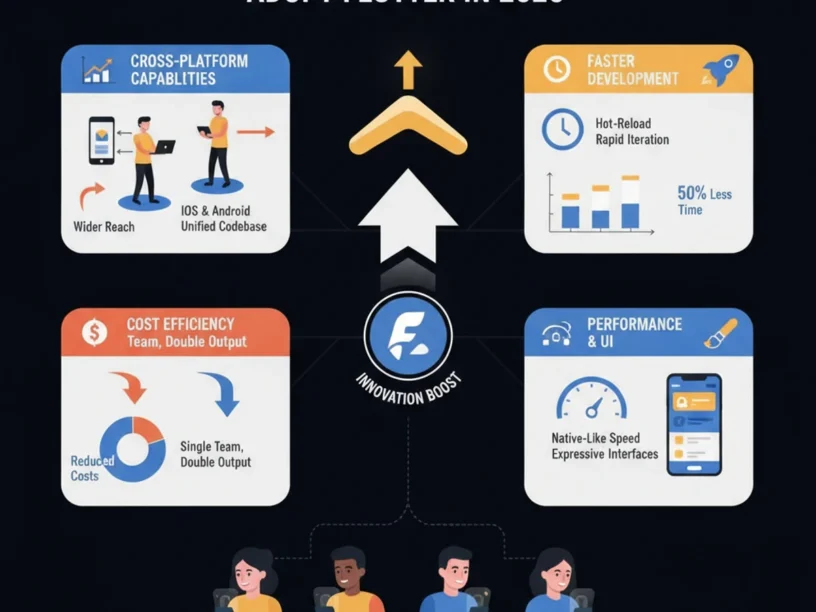
Building a tech product in 2026 comes down to three hard truths: capital is selective, time-to-market is everything, and you cannot afford to build the same app twice. Flutter — Google’s open-source cross-platform framework — lets founders ship a single, pixel-perfect codebase to both iOS and Android, typically saving 30–40% compared to dual native builds. Australia’s startup ecosystem grew 22.9% over the past year against a global average of 10.3%, and ranked fifth globally for return on investment. In 2025, Australian startups raised $5.48 billion across 390 deals — a 31% increase on 2024. When capital flows like that, the framework that compresses your development timeline and stretches your runway is a strategic advantage.
The founders who move fastest aren’t the ones with the biggest teams. They’re the ones who made smarter technology decisions at the start — including choosing a cross-platform framework that lets one team do the work of two.
What Flutter Actually Is — and Why It Matters for Non-Technical Founders
Flutter is an open-source UI framework created by Google that lets developers write one codebase in Dart and deploy it as a fully native-feeling app on iOS, Android, web, and desktop simultaneously. You pay for one team, one codebase, and one testing cycle instead of two.
Key Advantages of Flutter’s Architecture
- Duplicate Development Solved: One codebase runs on Android, iOS, web, and desktop.
- Native Code Compilation: Flutter compiles directly to native code, enabling smooth animations, fast rendering, and performance close to fully native apps.
- Scalable & Production-Grade: Suitable for scalable, production-grade applications meeting modern user demands.
How Flutter Differs from the Alternatives
- Versus native development (Swift/Kotlin): Native apps require two separate development teams, two test cycles, and two maintenance tracks. The quality ceiling is higher, but the cost and time investment are roughly double.
- Versus React Native: React Native relies on a JavaScript runtime that coordinates with native components, while Flutter compiles Dart into native code and renders its own UI through a dedicated engine. These structural differences influence startup time, animation consistency, hiring strategy, and long-term maintenance costs.
- Versus web-only or PWA approaches: Progressive Web Apps offer the cheapest entry point but cannot access native device features — camera, push notifications, and biometrics — at the level quality-conscious Australian consumers expect.
Flutter’s Market Position in 2026
| Framework | Developer Market Share | Performance vs. Native | Code Reuse | Best For |
|---|---|---|---|---|
| Flutter | ~46% | 96% (Android), 91% (iOS) | Up to 95% | Brand-led, design-rich, or fintech apps |
| React Native | ~35% | Good, platform-native UI | ~85% | JS teams, content-heavy apps |
| Native iOS/Android | N/A (per platform) | 100% | 0% | Deep hardware integration, biotech, fintech |
| Ionic / Capacitor | Smaller niche | Moderate | High | Simple business tools, hybrid web apps |
Key Takeaway: Flutter holds the largest developer market share of any cross-platform framework in 2026. Enterprises migrating to Flutter report around 95% code reuse between iOS and Android and nearly 40% lower development costs than with native development. Sources: Cubix, Tech Insider 2026. For deeper context, see Flutter Development Australia | HELLO PEOPLE. For related guidance, see React Native Vs Native Apps In 2026 Which Is Best For Your Business.
The Real Cost Advantage for Australian Startups Choosing Flutter
Flutter development typically costs 40–60% less than equivalent native app development for both platforms. A typical product with user accounts, a clean dashboard, payment processing, and solid UX usually sits between AUD $40,000 and $90,000 — a range many early-stage founders can plan around.
Where the Savings Actually Come From
- Engineering Effort Halved: One Flutter team replaces what would otherwise require separate iOS and Android teams.
- QA Compressed: One fix resolves bugs on both iOS and Android simultaneously rather than requiring two separate patch cycles.
- Faster MVP Timelines: Flutter apps have 50% faster development cycles than traditional frameworks.
- Lower Long-Term Maintenance: Maintenance costs drop by roughly 40% compared to maintaining two native apps.
Australian Privacy Compliance Cost to Factor In
Australian Privacy Principles (APPs) compliance under the Privacy Act 1988 requires a compliant privacy policy, clear data handling disclosures, and reasonable security steps around personal information. Building this in from the start is far cheaper than retrofitting it. Flutter’s architecture supports clean data-handling patterns from day one.
“The 30–40% savings figure is real for business apps. The savings shrink for hardware-heavy apps requiring deep platform APIs — know which category yours falls into before signing a contract.” — Cuebytes Flutter Cost Guide 2026
Key Takeaway: Flutter delivers genuine cost savings of 30–40% on build cost and roughly 40% on ongoing maintenance — both of which directly extend an Australian startup’s runway. For deeper context, see Why Australian Real Estate Startups Choose Flutter.
Flutter’s Performance and Scalability: Built for Australian Market Conditions
Australian startups often need to scale from beta users in Melbourne or Sydney to tens of thousands across multiple states rapidly. Flutter is no longer experimental — it’s running in production at global scale.
Technical Performance That Founders Can Feel
- Impeller Rendering Engine: Smoother UI, lower latency, and improved battery efficiency reduce negative App Store reviews.
- Frame Rate Consistency: Flutter consistently hits 60fps in complex scenarios where React Native occasionally drops to 52–58fps.
- Enterprise-Grade Precedent: Companies like BMW, Google Pay, Nubank, and Toyota run Flutter in production, serving tens of millions of users.
- AI-Native by Design: Adding AI features to a Flutter app is accessible through APIs like OpenAI, Gemini, and on-device ML with TensorFlow Lite.
Scalability for Key Australian Verticals
| Vertical | Flutter Advantage | Australian Example Use Case | Compliance Consideration |
|---|---|---|---|
| Health Tech | On-device AI, offline capability | AI-enabled clinical tools and telehealth booking | TGA, Privacy Act (health records) |
| Fintech | 60–120fps UI, secure Dart compilation | Payment platforms, wealth management apps | AUSTRAC, ASIC, AML/CTF Act |
| Marketplace | Shared codebase for buyer + seller flows | On-demand services, B2B procurement apps | ACL, consumer guarantees |
| Wellness / Fitness | Rich animations, wearable API integration | Coaching apps, habit trackers, meal planners | Privacy Act (health data) |
| Education | Web + mobile from one codebase | LMS platforms, tutor marketplaces | GDPR-adjacent data handling for minors |
Key Takeaway: Flutter’s performance benchmarks and enterprise adoption make it a credible foundation for Australian startups anticipating rapid scaling across multiple states or internationally. For deeper context, see Top Flutter App Developers in Australia.
Why Australian Startups Are Choosing Flutter for Cross-Platform Apps Over Other Options
Flutter has become the framework of choice for Australian startups in 2026 because it directly addresses the three constraints every founder faces: limited runway, pressure to move fast, and the need to look credible on day one. Flutter empowers engineers to build high-fidelity applications for iOS and Android from a unified codebase — effectively halving development lifecycles and optimising capital expenditure.
The Startup-Specific Reasons Flutter Wins
- Speed to First User: Flutter allows faster MVP development, reduced costs, and easy scaling across platforms, letting founders launch quickly and validate ideas without maintaining multiple codebases.
- Investor-Ready Product Quality: Flutter’s custom rendering engine produces pixel-perfect UIs that look polished in a demo or App Store listing.
- Google Backing Reduces Platform Risk: Flutter is open-source and backed by Google, making it cost-effective for MVP development without betting on a niche tool that might be deprecated.
- AI Integration Without a Separate Team: The new Flutter GenUI SDK enables agentic apps and interfaces that adapt dynamically to user intent, meaning a Flutter team can ship AI-native features without hiring a separate ML engineer.
- Design-Led Branding: Flutter’s Impeller rendering engine provides 120fps performance, making it the choice for visually ambitious products.
What This Means for First-Time Founders
The practical question isn’t “which framework is technically superior?” It’s “which framework gives me the fastest path from idea to validated product without overcommitting my budget?” Flutter’s combination of a single codebase, strong visual output, and a large global developer talent pool makes it the lowest-risk, highest-leverage choice for most Australian consumer and B2B product ideas.
Melbourne-based Appomate is a clear example of this philosophy in practice. With over 250 apps delivered across verticals including marketplace, wellness, healthcare, and fintech, Appomate builds Flutter products that are AI-native from day one and has helped founders move from idea to market in as little as six weeks. Their hybrid model pairs Australia-based strategy and product design with a skilled global development team, delivering premium quality at startup-friendly pricing.
Key Takeaway: Flutter reduces the two biggest risks in early-stage product development: time wasted building for the wrong platform, and budget wasted building the same thing twice.
Common Pitfalls When Choosing Flutter (and How to Avoid Them)
Knowing the failure modes in advance is the difference between a product that ships on budget and one that stalls at the first technical review.
The Most Common Flutter Mistakes Australian Founders Make
- Choosing Flutter for the Wrong App Type: For standard apps, you save 35–45% versus dual-native builds. For apps needing deep platform APIs like HealthKit or Bluetooth Low Energy, savings collapse to 10–15%. Discuss this explicitly with your development partner before selecting Flutter.
- Skipping a Validation Phase: Flutter enables fast MVPs, but you still need a defined validation process before writing code.
- Underbudgeting Maintenance: Annual maintenance runs 15–25% of your initial build cost. A $60,000 Flutter app requires AUD $9,000–$15,000 per year just to stay current with OS updates.
- Hiring for Cost, Not Capability: The cheapest Flutter developer quote is almost never the cheapest outcome. Experienced teams complete projects faster with fewer issues.
- Building for Today’s Feature List, Not Tomorrow’s Scale: Insist on modular, clean architecture even for an MVP, so adding users, features, or markets doesn’t require a costly rebuild.
Working with a full-service partner like Appomate — who validates your idea before writing code, then stays with you from launch through growth — removes most of these failure modes by design.
Key Takeaway: Flutter is powerful, but the framework alone doesn’t guarantee success. Choosing the right partner, running genuine validation, and budgeting honestly for maintenance are the three most important decisions a Flutter startup can make. For more on common pitfalls, see Top Mobile App Development Company in Australia 2026. For related guidance, see Australian Startup Success Stories Mobile Apps Case Studies 2026.
Ready to build your app?
Book a free Visioning Call with our team today and walk away with a clear roadmap, expert feedback, and a plan to bring your idea to life. No technical knowledge required.
Conclusion
Flutter has become the framework of choice for Australian startups in 2026 because it directly addresses the three constraints every founder faces: limited runway, pressure to move fast, and the need to look credible on day one. Why Australian startups are choosing Flutter for cross-platform apps is ultimately a story about risk reduction — one codebase, one team, one testing cycle, and a product that reaches both iOS and Android users simultaneously.
- Cost Efficiency That Matters: Flutter saves 30–40% on build cost and roughly 40% on ongoing maintenance — a direct extension of a startup’s runway.
- Speed to Market is Competitive Advantage: A single Flutter codebase compresses a six-month dual-native build into three to four months.
- AI-Native by Architecture: Flutter’s 2026 tooling makes building genuinely intelligent features accessible without a separate AI engineering hire.
- Backed by Google, Proven at Scale: Flutter runs in production at global scale — giving Australian founders a framework they can confidently grow into.
- Partner Selection is as Important as Framework Selection: The right development partner validates your idea, designs for scale, and stays with you beyond launch.
If you’re an Australian founder evaluating your technology stack, the next step is a structured conversation about your product idea, target user, and budget. Appomate offers exactly that starting point: a founder-focused discovery process that turns your idea into a validated, scoped, and buildable product plan.
Key Takeaway: Flutter offers Australian startups a strategic advantage by mitigating key risks associated with early-stage product development, enabling faster, more cost-effective, and scalable app creation.
FAQ
Why are Australian startups choosing Flutter in 2026?
Australian startups are choosing Flutter because it resolves the two biggest pressures facing early-stage founders: budget constraints and speed to market. Flutter allows a single development team to build one codebase that deploys natively on both iOS and Android, saving 30–40% compared to separate native apps. With Australia’s startup ecosystem growing 22.9% and investor scrutiny higher than ever, founders need to show a working product faster and at a lower burn rate. Flutter’s near-native performance, strong visual output, AI integration capabilities, and Google-backed longevity make it the lowest-risk, highest-leverage choice for most Australian consumer and B2B products.
What is Flutter and how does it work?
Flutter is an open-source UI framework created by Google that uses the Dart programming language to build apps for iOS, Android, web, and desktop from a single codebase. Flutter compiles Dart directly to native ARM machine code and renders its own UI using a custom engine called Impeller, producing fast startup times, smooth 60–120fps animations, and consistent visual output across every platform.
How much does Flutter app development cost in Australia?
A typical Flutter MVP in Australia with user accounts, a dashboard, and payment processing costs between AUD $40,000 and $90,000, depending on complexity and integrations. Flutter’s shared codebase means these figures are already 30–40% lower than equivalent dual-native builds. Budget an additional 15–25% of your initial build cost per year for ongoing maintenance and OS updates.
How does Flutter compare to React Native for Australian startups?
Both frameworks save 30–60% in cost compared to separate native iOS and Android development. Flutter holds roughly 46% developer market share versus React Native’s approximately 35%, and Flutter consistently outperforms React Native in raw frame-rate benchmarks. React Native has an advantage if your team already has JavaScript expertise. Flutter is stronger for design-led brands, fintech apps, and products where visual polish is a competitive differentiator.
Is Flutter suitable for AI-powered apps?
Yes. Flutter’s 2026 ecosystem has strong AI integration support through TensorFlow Lite, Google ML Kit, Firebase AI, OpenAI APIs, and the new GenUI SDK. On-device AI capabilities mean features like image recognition, real-time translation, and predictive recommendations can run locally on the user’s device — delivering sub-50 millisecond response times and preserving user privacy. This makes Flutter well-suited for Australian health-tech, wellness, and fintech products needing AI features without separate AI engineering teams.
What Australian government support is available for startup app development?
The R&D Tax Incentive allows eligible companies to claim back 43.5 cents in the dollar on qualifying R&D expenditure, which can include software development. The Export Market Development Grant (EMDG) supports startups entering international markets, with grants up to $80,000. New South Wales founders can explore the MVP Ventures Program, which provides matched funding to help commercialise a minimum viable product and secure early paying customers.
What should I look for in a Flutter development partner in Australia?
Look for a partner who validates your idea before writing code. The best Flutter development partners offer a structured discovery and scoping phase, proven experience across your target vertical, a transparent approach to architecture decisions, and ongoing support after launch. A hybrid model combining Australia-based strategy, product design, and product management with a skilled global development team tends to deliver the best balance of quality and cost-efficiency. Check their delivered app portfolio and ensure they can advise on Australian Privacy Principles compliance from day one.
Can a non-technical founder manage a Flutter development project?
Yes, with the right partner structure. Flutter’s development process produces visible results quickly through hot-reload and rapid iteration cycles, meaning non-technical founders can review working screens early and often. The key is choosing a development partner who communicates in plain language, runs structured sprint reviews, and involves the founder in product decisions. A full-service partner who handles product strategy, design, development, and launch under one roof removes most of the management burden.
Methodology note: Statistics and benchmarks cited in this article are sourced from publicly available research published by StartupBlink, Cut Through Venture and Folklore Ventures, Cubix, AgileSoftLabs, Cuebytes, Appinventiv, and other industry sources as linked inline. Australian dollar cost ranges reflect 2026 local market data. Flutter market share and performance figures reflect developer surveys and benchmark reports from early to mid-2026. This article is published by Appomate and reflects the author’s professional assessment of market conditions; it is intended for informational purposes and does not constitute financial or legal advice.