is app marketing beyond ASO worth it for small app budgets | 9 minute read | Appomate Editorial Team
Yes, for most Australian apps, **marketing beyond App Store Optimization (ASO) is worth it** once you have a validated product and a consistent monthly budget above roughly $3,000 to $5,000. ASO alone cannot generate discovery for a brand-new app with zero organic history. The honest answer depends on your app’s stage, but for almost every founder past validation, adding a small layer of paid or organic-plus activity consistently outperforms ASO in isolation. This article breaks down the real numbers, budget thresholds, and a decision framework to help you spend with confidence.
ASO is the process of optimising your app’s title, keywords, screenshots, and reviews so it ranks and converts inside the App Store and Google Play. It’s genuinely one of the most cost-effective channels available, but it has a structural limitation: it can only convert people who already find your listing. If nobody is searching your category or browsing your competitors’ pages, ASO has nothing to work with. This is exactly why Appomate’s own ASO guide stresses that ranking and conversion have to be treated together, not as a standalone fix.
An app with perfect metadata and zero visibility is like a beautifully designed shopfront on a street nobody walks down. ASO makes the shopfront work; something else has to bring foot traffic.
Is App Marketing Beyond ASO Worth It for Small App Budgets?
For a small-budget Australian app, **marketing beyond ASO is worth it** once the product has passed basic validation and the founder can commit to at least a modest, consistent monthly spend rather than a single burst. Industry budget research suggests teams spending less than roughly $3,000 a month on combined ASO, content, and paid activity typically cannot generate enough signal to make meaningful decisions. Below that floor, effort is often better spent tightening the product than splitting a tiny budget across channels.
When App Marketing Beyond ASO is Worth It
- Post-validation apps: Once you have real users, a functioning onboarding flow, and early retention data, **paid tests and content start returning usable signal** instead of noise.
- Competitive categories: If your category has established players with thousands of reviews, ASO alone rarely breaks through. You need install velocity to even get discovered organically.
- Time-sensitive launches: A product launch, funding announcement, or seasonal window is exactly when paid can compress a timeline that organic simply cannot match.
When App Marketing Beyond ASO is Not Worth It Yet
- Pre-validation products: An app with an untested onboarding flow and under 200 active users has no business spending most of its budget on paid installs, because a broken funnel just burns cash.
- Sub-$3,000/month budgets: Below this threshold, spreading spend across ASO, paid, and content usually means **every channel underperforms**.
Key Takeaway: Beyond-ASO marketing is worth it for small budgets once your app is validated and you can sustain at least $3,000 to $5,000 a month. Below that, fix the product first. Understanding what ASO alone can and cannot deliver is the next logical step. For deeper context, see IS Definition & Meaning.
What Does ASO Alone Actually Get You?
ASO alone provides Australian founders with **improved visibility and conversion** inside the App Store and Google Play, but it cannot create demand that doesn’t already exist in search. It’s the cheapest channel to start with, costing as little as $0 to $100 a month if you handle it in-house. The real cost, though, is time, and results still depend entirely on people actively searching your category.
What DIY ASO Realistically Delivers
Founders using free tools like App Store Connect and Google Play Console can track impressions, conversion rates, and run basic A/B tests at no direct cost. However, industry analysis notes that ASO changes typically take three to four weeks to show measurable impact, with broader gains needing two to three months of consistent iteration.
| Approach | Monthly Cost (AUD) | Time to Results | Best Fit |
|---|---|---|---|
| DIY ASO (founder-led) | $0 to $150 | 3 to 12 weeks | Pre-launch and MVP-stage apps |
| ASO tool subscription | $30 to $300 | 2 to 8 weeks | Solo founders wanting keyword tracking |
| Freelance ASO specialist | $1,000 to $3,000 | 4 to 10 weeks | Apps needing metadata and creative refresh |
| ASO agency retainer | $2,500 to $12,000+ | 1 to 3 months | Growth-stage apps expanding markets |
These ranges align with broader pricing research showing that DIY ASO can cost as little as $0 to $100 a month in hard dollars, while agencies charge from $2,500 upward. This gap illustrates why so many founders assume ASO is “free” when it actually **consumes founder hours** that could go elsewhere. When you’re bootstrapped and moving fast, that’s a hidden cost worth acknowledging.
Key Takeaway: ASO is the cheapest entry point into app marketing, but it only converts existing search demand. It cannot manufacture new demand for a brand-new app. This is where the budget question becomes more complex. For deeper context, see 10 Best App Marketing Strategies Beyond ASO for Startups ….
How Much Should Australian Startups Budget for App Marketing Beyond ASO?
Most Australian founders should think in **growth stages** rather than a single fixed number, because the right spend and channel mix change dramatically as an app moves from validation to scale. Broader budgeting research suggests early-stage startups typically allocate between $5,000 and $20,000 a month for combined ASO, paid user acquisition, and retention work, with anything below $3,000 making it difficult to run meaningful paid experiments alongside ASO.
Budget Allocation by Growth Stage
| Stage | User Base | Suggested Monthly Spend | Channel Mix |
|---|---|---|---|
| Validation | 0 to 1,000 users | $0 to $2,000 | Mostly ASO, founder-led outreach, no paid UA |
| Early Traction | 1K to 10K MAU | $3,000 to $8,000 | 60 to 70% paid, 30 to 40% organic and ASO |
| Growth | 10K to 100K MAU | $8,000 to $20,000 | 50/50 paid and organic, structured to compound |
| Scale | 100K+ MAU | $20,000+ | 30 to 40% paid (retargeting), ASO as a competitive moat |
This allocation mirrors the pattern described in a 2026 analysis of paid versus organic app growth, which frames early traction as 60 to 70% paid weighted, shifting toward balance as the product matures. For Australian founders, local development context matters too. Since building a simple app locally already runs $20,000 to $50,000 AUD, many founders reasonably want to stretch marketing dollars as far as possible. A hybrid delivery approach, combining local strategy with a global development team, can keep more budget available for growth once the product ships.
Key Takeaway: Budget in stages, not lump sums. Validation needs almost no paid spend, while early traction typically demands $3,000 to $8,000 a month split roughly 60/40 toward paid and organic. The real question is whether ASO and paid work better together or separately. For deeper context, see Are you ready to launch your App?.
ASO vs Paid Marketing: Which Delivers Better ROI on a Small Budget?
ASO delivers a **lower cost per install over time** but slower initial traction, while paid marketing delivers immediate volume at a higher and more variable cost per install. Choosing between them, or blending both, depends on your category competitiveness, runway, and how fast you need signal.
Cost Per Install Benchmarks
Recent industry benchmarking shows global average cost per install sitting around $5.84 on iOS and $1.92 on Android in early 2026. The Asia-Pacific region benchmarks lower, around $1.50 to $3.00 per install, than North America or Europe. Event-based campaigns cost considerably more, with sign-ups running $5 to $20 and paying-user acquisition often costing $20 to $80 or more per user.
| Factor | ASO | Paid Marketing |
|---|---|---|
| Upfront cost | Low ($0 to $300/month DIY) | Moderate to high ($1,500+/month minimum viable test) |
| Time to results | 3 weeks to 3 months | Days to weeks |
| Scalability | Limited by existing search demand | Scales with budget, subject to rising CPI |
| Compounding value | High; improvements persist | Low; spend stops, installs stop |
| Best for | Pre-launch to growth stage | Early traction to scale stage |
- ASO strengthens paid: Because your store listing functions as the landing page for every paid click, optimising screenshots, metadata, and product pages compounds the efficiency of paid traffic over time.
- Paid accelerates ASO: Install velocity from paid campaigns feeds ranking signals that improve organic discovery. This is why treating organic and paid as opposing forces is described as a rookie mistake.
- Fintech and trust-sensitive apps: Categories with sceptical users often see organic channels, especially ratings and reviews, convert better than paid, according to vertical-specific budget benchmarking for 2026.
Teams that have invested in ASO and content over 12 or more months operate with a meaningfully lower marginal cost per install than teams relying entirely on paid, according to 2026 vertical budget benchmarking research.
Key Takeaway: ASO and paid marketing are not competitors. On a small budget, the highest-ROI approach is usually a small, consistent paid test layered on top of solid ASO fundamentals, not one instead of the other. So what can you actually expect to see when you combine them? For a side-by-side breakdown, see IS | English meaning – Cambridge Dictionary. For related guidance, see Best Paid User Acquisition Strategies For Mobile Apps In 2026.
What Results Can Small-Budget Australian Apps Realistically Expect?
Small-budget Australian apps that add a modest layer of marketing beyond ASO, such as a founder-run paid test, review generation, or a targeted content push, can see **measurable download and revenue lifts within a few months**, provided the product itself is already retaining users. The results vary widely by category, but the pattern of “ASO plus a small structured push” consistently outperforms “ASO alone” once basic traction exists.
A Client Example
Appomate has worked with founders whose products stalled on ASO alone and needed a broader growth push once the app was live. In one engagement, a client saw **daily downloads increase roughly 5X and revenue grow around 92X** after moving beyond a pure ASO approach into a fuller marketing and growth strategy. This illustrates how much upside exists once a validated product gets paired with structured acquisition and retention work rather than metadata tweaks alone.
Common Pitfalls That Undercut Results
- Buying installs before fixing retention: If day-7 retention sits under roughly 15%, which is the median for many app categories, paid spend just buys churn instead of growth.
- Treating ASO as one-time work: Keywords shift and competitors update listings constantly, so budgeting for ongoing ASO maintenance, not a single setup, is essential.
- Skipping measurement infrastructure: Without a mobile measurement partner in place, founders cannot tell which channel is actually driving value, leading to wasted reallocation.
- Setting the budget once and never revisiting it: Allocation ratios should shift monthly as retention and CPI data change, not be locked in annually.
Key Takeaway: Beyond-ASO marketing pays off fastest when it is layered onto a product that already retains users. Adding spend before fixing the funnel just amplifies the leak. This is exactly the kind of growth-stage decision where a full-service partner like Appomate, one that helps founders validate, build, launch, and market in a single continuous journey rather than handing off between disconnected vendors, tends to protect a small budget better than piecing together freelancers one channel at a time.
Conclusion
So, **is app marketing beyond ASO worth it for small app budgets?** Yes, once your product is validated and you can sustain a modest, consistent monthly spend, layering in paid tests, content, or reputation management alongside ASO consistently outperforms ASO in isolation.
- Start with a floor: Below roughly $3,000 a month, fix the product and onboarding before splitting spend across channels.
- Stage your allocation: Validation needs almost no paid spend; early traction typically runs 60 to 70% paid against 30 to 40% organic.
- Treat ASO and paid as partners: ASO strengthens every paid click by improving the store listing that traffic lands on.
- Fix retention before scaling spend: Day-7 retention under roughly 15% means paid budget is buying churn, not growth.
- Work with a full-journey partner: A partner that spans validation through launch and marketing, like Appomate, helps founders avoid the fragmented, trial-and-error spending that eats small budgets fastest.
The next step is simple: **audit your current retention numbers and category competitiveness** before committing new spend, and use the budget-by-stage table above as your starting benchmark rather than a generic industry average.
FAQ
Is App Marketing Beyond ASO Worth It for Small Budgets in 2026?
Yes, for most Australian founders, **app marketing beyond ASO is worth it** once the app has passed basic validation and the team can commit at least $3,000 to $5,000 a month consistently. Below that threshold, research suggests teams cannot generate enough signal to make meaningful channel decisions. The smarter move is strengthening the product first, then layering in paid or content marketing once real traction is established. This approach ensures marketing spend is effective, rather than wasted on an unvalidated product.
What is the minimum monthly budget for app marketing beyond ASO in Australia?
Most benchmarking places the realistic floor around **$3,000 a month** for combined ASO, paid testing, and basic retention work. Early-stage startups typically allocate between $5,000 and $20,000 a month once they move past pure validation and into growth phases.
How does ASO vs paid marketing ROI compare for a small app budget?
ASO offers a **lower long-term cost per install** and compounding value, since improvements to metadata and screenshots persist. Paid marketing delivers faster volume at a higher and more variable cost, currently averaging around $5.84 per install on iOS and $1.92 on Android globally. The best ROI on a small budget usually comes from combining both rather than choosing one exclusively, leveraging ASO for efficiency and paid for acceleration.
What cost-effective app promotion channels work well for small Australian budgets?
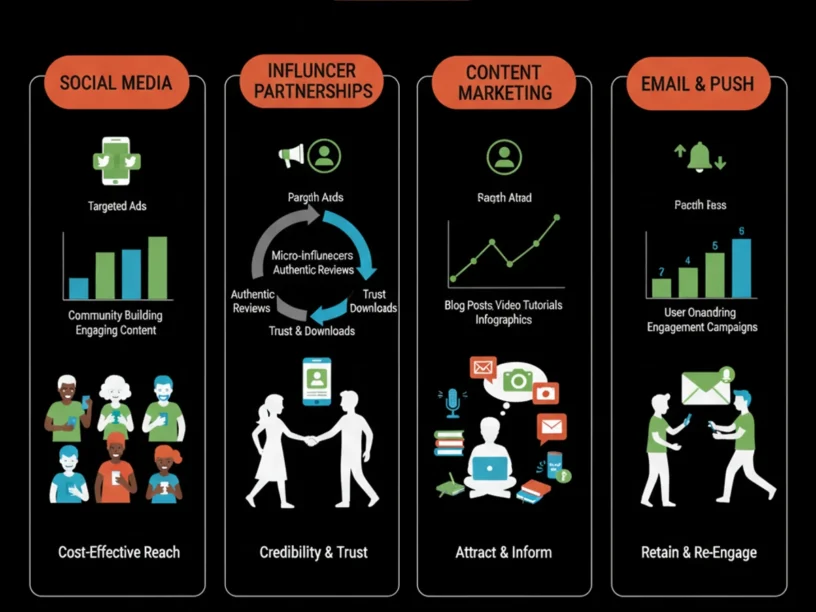
Founder-led content, community building, review generation, and small-scale Google or Apple Search Ads tests tend to be the most cost-effective starting points. For consumer-facing apps, creator-led content can achieve engagement rates three to five times higher than traditional ads, making it a strong low-cost complement to ASO.
Should a pre-revenue startup spend on paid app marketing at all?
Generally no. A pre-revenue app with an untested onboarding flow should focus spend on **validation and ASO** rather than paid installs, since a broken funnel just burns budget on users who churn immediately. Paid marketing becomes worthwhile once you have real retention data to test against and a solid product experience.
How long does it take to see results from app marketing beyond ASO?
Paid campaigns can show install volume within days to weeks. ASO improvements typically need three to four weeks for measurable impact and two to three months for broader gains. Content and community-based strategies tend to take longer, often six to twelve months, to build meaningful momentum and deliver significant results.
What is a realistic app marketing budget allocation between ASO and paid channels?
A common structure for early traction is roughly **60 to 70% toward paid user acquisition** and 30 to 40% toward ASO and organic content. This allocation shifts toward a 50/50 split as the app scales and organic channels start compounding, balancing immediate growth with long-term sustainability.
Can a full-service app development partner help with marketing beyond ASO?
Yes, absolutely. A partner that covers strategy, build, launch, and marketing in one continuous relationship, such as Appomate, helps founders avoid the disjointed spending that happens when validation, development, and marketing are handled by separate, disconnected vendors. This full-journey model is particularly valuable for non-technical founders who need **one accountable partner** rather than piecing together specialists themselves.
This article was compiled using publicly available 2026 industry pricing and benchmarking data from sources including AppFollow, SEM Nexus, Strataigize, and Appalize, alongside Appomate’s own client engagement outcomes. Figures are directional industry benchmarks in AUD/USD as cited; actual costs and results vary by app category, market conditions, and execution quality. This content does not constitute financial or investment advice.