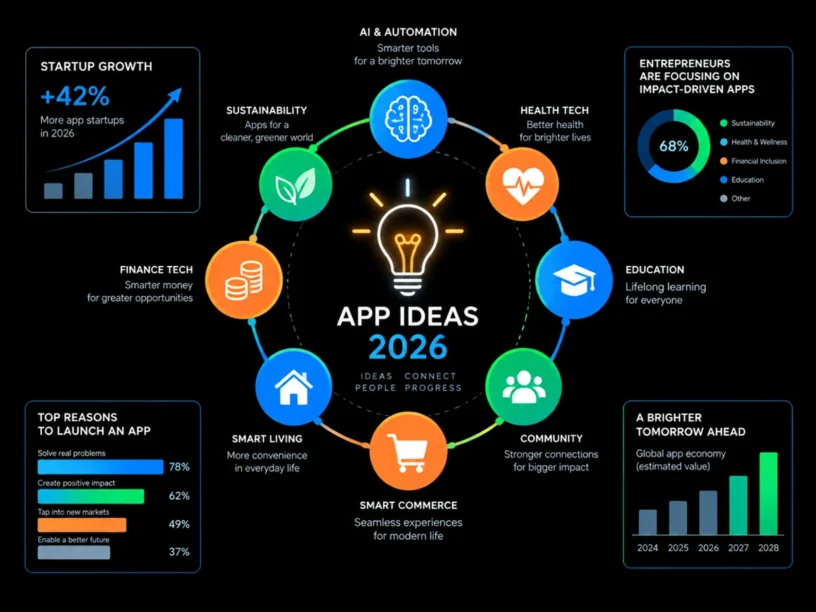
Best App Ideas for Startups and Entrepreneurs to Launch in 2026 | The best app ideas for startups and entrepreneurs in 2026 sit where three things meet: a real customer pain point, a clear way to make money, and a technology shift that makes building faster and cheaper. In Australia, that shift is driven by AI-native development, rising mobile spending, and a startup ecosystem backing founders at a record pace. This guide covers the best app ideas for startups and entrepreneurs to launch in 2026, the trends shaping them, and how to test an app without wasting money on the wrong product.
Australia’s app economy is a serious market. The local market brought in USD 3 billion in app revenue in 2024, a 15.3% jump on the year before, and is projected to reach approximately USD 11.5 billion by 2027. Meanwhile, Australia’s broader startup ecosystem grew by about 24.8% in 2025 and now ranks around #12 globally.
The app ideas that win in 2026 won’t be the ones with the flashiest AI demo. They’ll be the ones that solve a stubborn, everyday problem for a specific Australian audience, then use AI to make the experience feel effortless rather than impressive.
What Makes a Great App Idea for Startups and Entrepreneurs in 2026?
A strong app idea pairs a clear, underserved problem with a business model that earns money quickly. Australia’s smartphone penetration is above 90 percent, with over 27 million active smartphone users expected in 2026, so getting people to find your app is less of a bottleneck than it was a decade ago. The harder question is whether your idea can survive the “retention-first” era that app stores now reward.
The Three-Filter Test
- Problem clarity: Can you describe the pain point in one sentence without reaching for the word “innovative”? If not, the idea is probably a feature, not a product.
- Monetization path: Does the idea support subscriptions, marketplace commission, or transaction fees from day one, rather than relying on ad revenue that takes years to build?
- AI leverage: Does AI make the core experience meaningfully faster or more personal, or has it been bolted on as a chatbot widget?
Why Retention Now Beats Downloads
The global mobile app industry is on track for USD 391.3 billion in 2026, but the more useful story is the shift from download-first to retention-first. Non-gaming apps have overtaken games in spending for the first time, with in-app purchase revenue hitting $167 billion in 2025. Useful, recurring value is now outselling novelty.
| Signal | Why It Matters in 2026 | What Founders Should Do |
|---|---|---|
| High smartphone penetration | Over 90% of Australians already carry a capable device | Focus on activation and habit-forming UX, not just awareness |
| AI-first architecture | AI is moving from “feature” to “foundation” in Australian apps | Design the core workflow around AI from the first wireframe |
| Retention over downloads | Non-gaming apps now out-earn games in spend | Prioritise onboarding, personalization, and repeat engagement |
Key Takeaway: The strongest 2026 app ideas combine a sharply defined problem, a monetization model that works from launch, and AI built into the architecture rather than tacked on at the end. For deeper context, see Read the Australian Privacy Principles.
Best App Ideas for Startups and Entrepreneurs to Launch in 2026
The best app ideas for startups and entrepreneurs to launch in 2026 cluster in sectors where Australian demand is strong and AI adoption is moving fastest: fintech, healthtech, retail, hospitality, and B2B software. Industry estimates show demand for advanced, secure, AI-enabled applications rising across fintech, healthcare, retail, logistics, and gaming.
High-Opportunity App Categories
- AI-powered personal finance and budgeting apps: Tools that use predictive analytics to flag spending patterns and automate savings, in a fintech sector that keeps attracting heavy local investment.
- Niche health and wellness platforms: Apps built for specific conditions, recovery programs, or allied health bookings, benefiting from consumers’ appetite for subscription wellness tools.
- Vertical marketplaces: Two-sided platforms connecting underserved local supply and demand, such as trades booking, equipment rental, or boutique hospitality, where commission revenue starts with the first transaction.
- B2B workflow and productivity apps: Lightweight tools that automate one painful process for small and medium businesses, such as compliance tracking, rostering, or inventory forecasting.
- AI-native customer engagement apps: Apps using conversational AI and agentic workflows to handle bookings, support, and recommendations.
- Education and reskilling apps: Microlearning and credentialing platforms for upskilling workers, in line with sustained growth in Australia’s edtech funding.
| App Category | Target User | Primary Revenue Model | Why It Fits 2026 |
|---|---|---|---|
| AI budgeting and savings app | Young professionals, gig workers | Freemium subscription | Fintech remains one of the largest AI investment categories in Australia |
| Niche allied health booking app | Patients with chronic or specialized needs | Commission per booking | Healthtech demand is rising alongside AI-enabled personalization |
| Local trades marketplace | Homeowners and tradespeople | Transaction fee | Marketplace models scale quickly with low ongoing overhead |
| SMB compliance or rostering tool | Small business owners | Monthly SaaS fee | B2B software is a stable, recurring-revenue category less exposed to consumer spending shifts |
| Conversational retail assistant | Online shoppers | Revenue share with retailers | AI recommendation engines are already lifting average order values 15 to 30 percent in retail apps |
Retail is a particularly clear example. Successful shopping apps are using AI recommendation engines that personalize product suggestions, increasing average order values by fifteen to thirty percent.
Key Takeaway: The best 2026 opportunities are established verticals like fintech, health, retail, and B2B, where AI now delivers a noticeably better experience than was possible two years ago. For deeper context, see 50 Best App Ideas for Startups and Entrepreneurs to Build ….
Startup App Trends for 2026 Shaping Which Ideas Win
Startup app trends for 2026 are shaped by three forces: AI moving from optional feature to core architecture, tighter privacy expectations, and a shift toward cross-platform development to control costs. These trends help founders pick an idea that will still be relevant eighteen months from now.
The Trends Worth Building Around
- AI as foundation, not feature: Australian apps are increasingly built around AI, with finance apps using AI-based detectors to flag unusual activity before users notice.
- Cross-platform as the default build choice: Teams increasingly advise building cross-platform first and going native only with a clear technical reason, cutting both cost and time to market.
- Privacy-first engineering: Security requirements are tightening under Australia’s Privacy Act. Apps handling health, finance, or personal data need compliance designed in from the start.
- Voice and conversational interfaces: Voice search and conversational bots are becoming standard in booking, support, and retail apps.
- AI investment concentration: Over 60% of all venture capital in the Australian ecosystem went to startups with AI in their tech stack, making AI capability close to a requirement for investor interest.
“AI is becoming a core feature in modern mobile applications,” with healthcare, finance, retail, and logistics leading adoption as 2026 unfolds, according to industry analysis of Melbourne’s mobile app ecosystem.
Founder sentiment backs this up. 76% of Australian founders planned to raise capital again within the next year, and 86% were confident they would succeed, a sign that investors are backing AI-capable mobile products with real conviction.
Key Takeaway: Ideas that build AI into core workflows, respect Australian privacy obligations, and use cross-platform frameworks are best placed to attract users and investors in 2026. For the latest trends, see 11 SaaS Application Ideas for a Profitable Product in 2026. For related guidance, see Is Building An AI Mobile App Worth It For Startup Founders In Australia In 2026.
How to Validate and Launch an App Idea in Australia
Validating an app idea before writing code is one of the strongest predictors of startup survival, and done properly it takes weeks rather than months. Australia’s tech startup survival rate sits at roughly 78% after five years, a figure that leans toward founders who tested demand before committing to a full build.
The Validation Sequence
- Problem interviews: Talk to at least 15 to 20 target users to confirm the pain point is real and people already pay for imperfect workarounds.
- Clickable prototype: Test the core user flow with a low-fidelity prototype before spending development budget.
- Landing page and waitlist: Measure demand through sign-ups or pre-orders rather than survey answers alone.
- MVP build: Launch a minimum viable product focused on the single highest-value feature.
- Iterate on retention data: Let early usage guide what to build next, rather than following the original roadmap to the letter.
| Stage | Typical Timeframe | Primary Goal | Common Pitfall |
|---|---|---|---|
| Validation | 1 to 3 weeks | Confirm real demand | Skipping interviews and building on assumptions |
| Design and strategy | 2 to 4 weeks | Define scope and user flow | Scope creep before the MVP is even built |
| MVP development | 6 to 12 weeks | Ship a working core product | Trying to build every feature at once |
| Launch and iterate | Ongoing | Grow retention and revenue | Treating launch as the finish line instead of the start |
This is where many non-technical founders stall. The idea is often solid, but the path to a working product feels fuzzy. Appomate was built around this gap, helping founders validate, design, build, and launch through a structured process. Some founders have gone from idea to market in as little as six weeks using Appomate’s Further Faster Framework.
Key Takeaway: Validation separates the roughly 78% of Australian tech startups that survive five years from those that run out of runway chasing an untested idea. For deeper context, see 5 Best Mobile App Ideas for Startups to Launch in 2025. For related guidance, see AI Development Lifecycle A Startup Founders Guide To Using AI At Every Stage.
Ready to build your app?
Book a free Visioning Call with our team today and walk away with a clear roadmap, expert feedback, and a plan to bring your idea to life. No technical knowledge required.
How to Choose the Right App Development Partner in Australia
A development partner matters as much as the idea. A strong concept can still fail if it’s built slowly, expensively, or without a growth plan. First-time and non-technical founders need a partner who sees the build as one part of a longer journey.
What to Look For
- End-to-end capability: Strategy, design, development, launch, marketing, and ongoing support, rather than a finished app and no further contact.
- Founder-first process: Experience working with non-technical founders, turning business goals into technical decisions without jargon.
- Speed without shortcuts: AI-driven development tools that compress timelines while maintaining code quality.
- Proven delivery track record: Real apps shipped for recognizable clients, not just concept mockups.
- Transparent, startup-friendly pricing: A cost structure that suits early-stage budgets without compromising quality.
Appomate is a Melbourne-based mobile and web app development company that has delivered over 250 apps for clients including Adidas, L’Oreal, Lend Lease, and Hoyts. It combines Australia-based strategy and product design with a global development team, aiming for premium quality at startup-friendly prices. Rather than simply building what a client asks for, Appomate positions itself as a full growth partner, covering validation, design, build, launch, marketing, and long-term support.
Key Takeaway: The right partner reduces risk and time to market at every stage, not just during the build.
Conclusion
The best app ideas for startups and entrepreneurs to launch in 2026 solve a specific, validated problem, use AI built into the core experience, and sit inside a monetization model that works from day one. Australia’s growing app economy, rising founder confidence, and AI-first development tools make this one of the strongest windows in years to launch.
- Focus on retention, not just downloads: Design for repeat use from the very first screen.
- Build AI into the architecture: Apps designed around AI from the start outperform those with AI bolted on.
- Validate before you build: Structured validation is the clearest predictor of surviving the critical first five years.
- Choose a full-journey partner: Founders get further, faster when strategy through growth comes from one accountable partner.
- Move with urgency: With strong funding momentum and AI shortening build timelines, the founders who validate and launch quickest capture the advantage.
If you have an app idea ready to test, start with a structured validation conversation rather than a leap into development. A partner like Appomate can help you get further, faster. The FAQ below covers the questions founders ask most often.
FAQ
What are the best app ideas for startups and entrepreneurs in 2026?
The best app ideas for startups and entrepreneurs in 2026 address a specific customer pain point, offer a clear monetization path, and take advantage of recent technology shifts, particularly AI. High-opportunity categories include AI-powered personal finance apps, niche health platforms, vertical marketplaces, B2B workflow tools, AI-native customer engagement apps, and education or reskilling platforms.
How much does it cost to build an app in Australia in 2026?
Costs vary widely depending on complexity, but a validated MVP typically takes six to twelve weeks to build once strategy and design are complete. A hybrid delivery partner that pairs Australia-based strategy with a global development team, such as Appomate, can significantly reduce costs compared with a fully local agency.
Do I need technical skills to launch an app as a non-technical founder?
No. Many successful Australian app founders have no coding background and instead rely on a development partner to turn their business idea into a technical product. Choose a partner experienced with non-technical founders who can guide strategy, design, and development.
What industries have the strongest app opportunities in Australia right now?
Fintech, healthtech, retail, hospitality, and B2B software currently show the strongest app opportunities in Australia, driven by rising AI adoption and demand for personalized, subscription-based services. Retail apps using AI recommendation engines, for example, have been shown to lift average order values by fifteen to thirty percent.
How long does it take to validate an app idea before building it?
Proper validation, including problem interviews, a clickable prototype, and a landing page, typically takes one to three weeks before any development budget is committed. Australia’s tech startup survival rate sits at roughly 78% after five years, and those odds favor founders who checked demand early.
Is AI necessary for a successful app idea in 2026?
AI isn’t strictly mandatory, but it has become a near-prerequisite for investor interest and user expectations. Over 60% of Australian venture capital has gone to startups with AI in their tech stack. Apps that embed AI into core workflows consistently show stronger engagement and retention.
How fast can a startup go from app idea to market launch?
With a structured, AI-driven development process, some founders have gone from idea to market in as little as six weeks, compared with the traditional six-to-twelve-month timeline. Appomate’s Further Faster Framework is designed to compress that timeline without sacrificing quality or scalability.
What should I look for in an app development partner in Australia?
Look for a partner offering end-to-end support across strategy, design, development, launch, marketing, and ongoing growth, rather than a team that only builds what you specify. Appomate’s hybrid model, combining Australia-based strategy and product design with a global development team, is built to deliver full-journey support at startup-friendly prices.
This article was compiled using publicly available Australian market research and industry reporting current as of October 2026. Figures and statistics are drawn from third-party sources cited throughout and are provided for general informational purposes only. Founders should conduct their own due diligence and seek professional advice before making business or investment decisions.