mobile app security for healthcare in Australia – what startup founders need to know | updated November 2026 | 11 minute read | Appomate Editorial Team
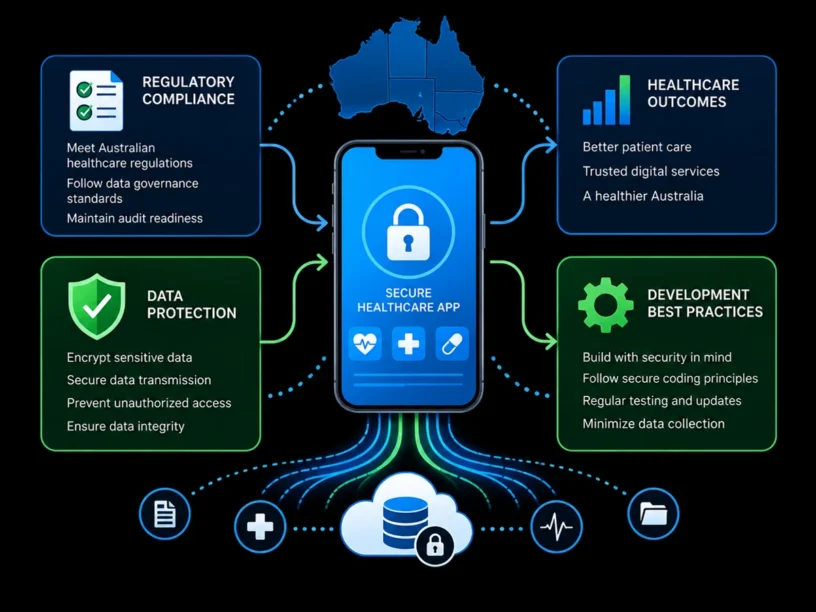
Mobile app security for healthcare in Australia means navigating three overlapping regimes at once: the Therapeutic Goods Administration’s software-as-a-medical-device rules, the Australian Privacy Principles under the Privacy Act 1988, and, if your app touches the national health record system, the My Health Records Act 2012. Getting this wrong is a very real risk. Health service providers reported more data breaches than any other sector in Australia in 2025, and penalties for mishandling health information can run into the millions of dollars per offence. This guide to Mobile App Security for Healthcare in Australia: 2026 Founders Guide is written for non-technical founders, first-time entrepreneurs, and seasoned business owners new to health tech.
Healthcare is one of the fastest-growing and most heavily scrutinised verticals in Australian app development. Appomate works directly with founders turning clinical, wellness, and digital health ideas into market-ready products. Healthcare buyers and investors do thorough due diligence, so understanding compliance early is a competitive advantage, not just a legal safeguard.
In healthcare app development, security isn’t a feature you add before launch. It’s the foundation the whole product sits on. Founders who treat compliance as an afterthought usually pay for it later, through delayed approvals, lost investor confidence, or a breach notification they never wanted to write.
Mobile App Security for Healthcare in Australia: What Startup Founders Need to Know
At its core, mobile app security for healthcare in Australia means protecting sensitive health information across three layers: regulatory classification, data privacy, and technical safeguards. Founders need to know which rules apply before writing a single line of code. The answer shapes your architecture, hosting location, consent flows, and go-to-market timeline. Skipping this step is the most common and most expensive mistake first-time health tech founders make.
The Three Regulatory Layers
- Medical device regulation: If your app diagnoses, monitors, treats, or prevents disease, the TGA may classify it as a medical device requiring inclusion in the Australian Register of Therapeutic Goods before it can be legally supplied.
- Privacy law: The Australian Privacy Principles govern how you collect, store, use, and disclose personal and health information. Health data counts as “sensitive information” and needs extra protection.
- My Health Record integration: Connecting to the national My Health Record system triggers the My Health Records Act 2012, with its own data residency and audit requirements.
- Cross-border obligations: If you serve US-based patients or integrate with US health systems, HIPAA-style safeguards may apply, even though HIPAA itself is a US law.
| Regulatory Body | Governs | Applies To | Key Founder Action |
|---|---|---|---|
| Therapeutic Goods Administration (TGA) | Medical device software, SaMD, AI diagnostic tools | Apps that diagnose, treat, or monitor conditions | Determine if ARTG inclusion is required before launch |
| Office of the Australian Information Commissioner (OAIC) | Privacy Act 1988, Australian Privacy Principles, Notifiable Data Breaches scheme | Any app collecting personal or health information | Build consent, security, and breach-response processes |
| Australian Digital Health Agency | My Health Records Act 2012 | Apps integrating with My Health Record | Host data in Australia, pass conformance review |
| US Department of Health (reference only) | HIPAA Privacy and Security Rules | Apps handling US patient data or US covered entities | Apply HIPAA-equivalent technical safeguards if relevant |
Key Takeaway: Before you scope your build, map your app against all three Australian regimes. A wellness tracker and a clinical diagnostic tool face very different obligations, and misclassifying early can cost months of rework. For deeper context, see Healthcare Software Development in Australia: A Guide.
Healthcare App Compliance in Australia: TGA, SaMD, and the ARTG
Healthcare app compliance in Australia comes down to one question: does the TGA consider your software a “medical device”? Under the Therapeutic Goods Act 1989, software including mobile apps qualifies as a medical device when it is intended to diagnose, prevent, monitor or treat disease. If it does, the product generally must be included in the Australian Register of Therapeutic Goods before it can be sold or used in Australia.
What Triggers TGA Regulation
The TGA regulates software-based medical devices, apps, Software as a Medical Device (SaMD), Digital Therapeutics, and AI-enabled diagnostic tools. General wellness or fitness apps usually sit outside this regime. A sleep-tracking wellness app is treated very differently from an app that recommends treatment for a diagnosed condition.
- Classification tiers: Software-based medical devices are classified from Class I to Class III, based on clinical significance and potential harm. Higher classes face more extensive requirements.
- AI-specific scrutiny: The TGA’s 2025 regulatory review flagged digital scribes and AI mental health tools for closer review. Tools become regulated the moment they suggest diagnoses or treatment pathways, not simply when they transcribe.
- Exclusions and exemptions: Some clinical decision support software is exempt from ARTG inclusion under specific carve-outs, though it may still be a medical device with lighter obligations.
- Enforcement is real: Supplying a device that should be in the ARTG but isn’t exposes founders to criminal offences and civil penalties. The TGA has used fines and public cancellations in the software space.
A product can slide from “wellness tool” into “diagnostic aid” through a single feature update, triggering medical device obligations almost overnight. Track your intended-use claims as closely as you track your code changes.
Key Takeaway: Settle your TGA classification before you start marketing. Advertising claims can themselves establish a therapeutic intended purpose, so one marketing line can pull an otherwise unregulated app into the medical device regime. Your data handling brings its own obligations under privacy law. For deeper context, see Australia Guidance on Software as a Medical Device ….
Mobile Health Data Protection in Australia: Privacy Act, APPs, and My Health Record
Mobile health data protection in Australia is governed mainly by the Privacy Act 1988 and its 13 Australian Privacy Principles. Health information is treated as “sensitive information” and held to the highest standard. The Privacy Act also applies to entities outside Australia that handle the personal data of Australian residents, so overseas founders building for the Australian market are not exempt.
The Privacy Obligations That Matter Most
- Express consent for health data: Organisations must obtain express consent for sensitive information such as health or biometric data. Implied consent, which can cover general personal information, isn’t enough here.
- APP 11 “reasonable steps”: This principle requires the practice to take “such steps as are reasonable in the circumstances” to protect information. The OAIC’s Guide to securing personal information turns that into practical healthcare controls.
- Notifiable Data Breaches scheme: Eligible breaches, such as patient records accessed by an unauthorised party or a ransomware incident, must be reported to the OAIC and affected individuals as soon as practicable.
- My Health Record data residency: Under the My Health Records Act, any servers and infrastructure used to connect to the system must be located within Australia. That’s a hard constraint for your hosting architecture.
- My Health Record penalties: Unauthorised collection, use, or disclosure of My Health Record information carries civil penalties of up to $315,000 for individuals, or up to $1.575 million for a body corporate, per offence.
| Metric (2025 Calendar Year) | Figure | What It Means for Founders |
|---|---|---|
| Total data breach notifications to the OAIC | 1,205, a record high | Breach reporting is increasing, not slowing down |
| Health sector share of all breaches | 225 notifications, 19% of total, the highest of any sector | Healthcare apps are a prime target and face elevated scrutiny |
| Breaches caused by malicious or criminal attacks | 59% of notifications | External attacks, not just internal error, are the dominant risk |
| Average cost of a data breach (IBM, 2024) | $4.26 million | Prevention is dramatically cheaper than remediation |
These figures come from the OAIC’s Notifiable Data Breaches dashboard and its half-year reporting. Health service providers have topped the breach notification list in every period since the scheme began in 2018. This isn’t an abstract compliance checkbox. It shows where attackers and regulators are already focused.
Key Takeaway: Health apps carry a higher breach risk than almost any other sector in Australia. Building in encryption, access controls, and breach-response plans from day one costs far less than retrofitting them after an incident or an OAIC inquiry. For supporting data, see Healthcare App Development – A Complete Guide for 2026.
Best Practices for App Security in Healthcare Builds
App security in healthcare goes well beyond general development hygiene. The data at risk is sensitive information under Australian law, often subject to extra sector-specific rules. A practical security baseline covers encryption, access control, monitoring, and vendor management, with each control mapped to a specific compliance obligation.
Technical Safeguards Founders Should Require
- End-to-end encryption: Health data should be encrypted both at rest and in transit. This meets the technical safeguard expectations set out in international frameworks like HIPAA’s Security Rule for protected health information.
- Secure authentication and session controls: Multi-factor authentication and automatic session timeouts reduce the risk of unauthorised access.
- Audit logging: Detailed logs of login attempts, data access, and administrative actions support internal monitoring and demonstrate compliance during an OAIC or TGA review.
- No unsecured messaging channels: Avoid SMS or MMS for sensitive health data. Encrypted in-app messaging is the better choice.
- Vendor and third-party risk management: Any external developer, cloud host, or analytics provider that touches health data becomes part of your compliance chain, so each needs contractual security obligations.
- Regular penetration testing: Scheduled security evaluations, ideally quarterly for high-risk apps, catch vulnerabilities before attackers or auditors do.
Building Security Into the Development Process
Security works best when it’s part of how the product is developed, not an audit bolted on before launch. Appomate’s Further Faster Framework embeds compliance considerations from the strategy phase. Retrofitting security after launch costs far more than designing it in from day one.
Key Takeaway: Treat security controls as part of your product requirements document, not a post-launch patch. Brief your development partner on TGA and Privacy Act obligations before design begins. For further reading, see Healthcare App Development: A Guide for 2026.
Choosing a Development Partner for Healthcare App Compliance in Australia
The right development partner is often the biggest single factor in whether a healthcare app meets its compliance obligations on time and on budget. Non-technical founders need a partner who understands Australian regulatory nuance, not just someone who can write code. Compliance decisions made at the architecture stage are hard to reverse later.
What to Look for in a Healthcare App Partner
- Full-journey support: A partner covering strategy, design, development, launch, and ongoing support reduces the risk of compliance gaps at handoff points between vendors.
- Australia-based strategy with global delivery: This hybrid model, which Appomate uses, keeps regulatory interpretation and product decisions close to home while delivering quality at startup-friendly pricing.
- AI-native, not AI-wrapped: Appomate builds products that are AI native rather than simple AI wrappers. That matters since the TGA is actively scrutinising AI diagnostic and decision-support tools.
- Proven delivery track record: With more than 250 apps delivered and clients including Adidas, L’Oreal, Lend Lease, and Hoyts, Appomate brings enterprise-grade delivery discipline to startup-stage healthcare products.
- Speed without cutting corners: Appomate has helped founders go from idea to market in as little as six weeks, using AI-driven development without skipping compliance steps.
| Founder Priority | Why It Matters in Healthcare | How Appomate Addresses It |
|---|---|---|
| Regulatory awareness | TGA and Privacy Act obligations shape architecture decisions | Australia-based strategy and product design informs technical scoping |
| Speed to market | Early validation reduces wasted compliance spend | Further Faster Framework and AI-driven development tools |
| Long-term partnership | Compliance is ongoing, not a one-time launch event | One partner across validation, launch, growth, and exit |
| Budget efficiency | Startups need enterprise-grade security without enterprise budgets | Hybrid global delivery model at startup-friendly pricing |
Key Takeaway: For first-time and non-technical founders, the fastest route through healthcare app compliance in Australia is a single accountable partner who manages compliance across the whole product lifecycle, rather than several disconnected vendors. For related guidance, see AI Development Lifecycle A Startup Founders Guide To Using AI At Every Stage.
Ready to build your app?
Book a free Visioning Call with our team today and walk away with a clear roadmap, expert feedback, and a plan to bring your idea to life. No technical knowledge required.
Conclusion
Mobile app security for healthcare in Australia isn’t a single checklist item. It’s an ongoing discipline spanning TGA medical device classification, Australian Privacy Principles compliance, My Health Record obligations, and solid technical safeguards. Founders who build this thinking into their product strategy from day one move faster, raise capital more easily, and avoid costly rework.
- Classify early: Determine whether your app is a TGA-regulated medical device before you finalise features or marketing claims.
- Protect sensitive data by default: Treat all health information as sensitive information under the Privacy Act, requiring express consent and strong technical safeguards.
- Plan for breaches, not just prevention: Build a Notifiable Data Breaches response plan before you need one, given health remains the most-breached sector in Australia.
- Mind data residency: If connecting to My Health Record, ensure servers and infrastructure sit within Australia from day one.
- Partner wisely: Choose a development partner like Appomate that treats compliance as part of product strategy, not an afterthought.
If you’re building a healthcare app and want a partner who understands both the technology and the regulatory landscape, Appomate’s founder-focused approach is designed to help you get further, faster, and more safely.
FAQ
Mobile App Security for Healthcare in Australia: 2026 Founders Guide, what do founders need to know?
Founders need to understand three overlapping regimes: TGA medical device regulation if the app diagnoses, treats, or monitors conditions; the Australian Privacy Principles under the Privacy Act 1988 for handling sensitive health information; and My Health Records Act obligations if the app connects to the national health record system. Getting classification right early shapes your architecture, hosting location, and consent flows.
Does every health app need TGA approval in Australia?
No. General wellness or lifestyle apps focused on fitness or healthy habits typically fall outside TGA regulation. Apps intended to diagnose, prevent, monitor, or treat disease generally require inclusion in the Australian Register of Therapeutic Goods. Assess your app’s intended use and marketing claims against TGA guidance before launch.
What are the Australian Privacy Principles and why do they matter for health apps?
The Australian Privacy Principles are 13 legally binding rules under the Privacy Act 1988 governing how organisations collect, use, store, and disclose personal information. Health information is classified as sensitive information, which requires extra protections such as express consent. Non-compliance can lead to OAIC investigations, enforceable undertakings, and civil penalties.
What happens if my healthcare app has a data breach in Australia?
Under the Notifiable Data Breaches scheme, eligible breaches, such as unauthorised access to patient records or a ransomware incident, must be reported to the OAIC and to affected individuals as soon as practicable. Health service providers reported more data breaches than any other sector in Australia in 2025, so a documented breach-response plan should be in place before launch.
Do I need to worry about HIPAA if my app is built in Australia?
HIPAA is a US law, so it doesn’t directly apply to an Australian-only app. If you plan to serve US patients, integrate with US health systems, or work with a covered entity, HIPAA-equivalent safeguards such as encryption, secure authentication, and audit logging become relevant business requirements. Many founders build to HIPAA-aligned standards from the start to keep US expansion open.
Where must healthcare app data be hosted in Australia?
For apps integrating with My Health Record, the My Health Records Act requires that any servers and infrastructure used to connect to the system be located within Australia. For apps outside that ecosystem, there’s no blanket legal requirement to host locally, though Australian residency is widely considered best practice for reducing privacy and compliance risk.
How much does non-compliance cost healthcare app founders in Australia?
Penalties vary by regime. Unauthorised use of My Health Record information carries civil penalties of up to $315,000 for individuals or $1.575 million for a body corporate per offence, while broader Privacy Act breaches can trigger separate OAIC enforcement action. The average cost of a data breach was estimated at $4.26 million in 2024, factoring in remediation, reputational damage, and lost trust.
How can a development partner help with healthcare app compliance?
A development partner that understands Australian healthcare regulation can build compliance into product strategy, architecture, and design from the outset rather than retrofitting it before launch. Appomate’s Australia-based strategy, combined with a global development team and its Further Faster Framework, is designed to help founders validate, build, and launch compliant healthcare products efficiently.
This article is for general informational purposes only and does not constitute legal, medical, or regulatory advice. Founders should consult a qualified Australian privacy or health law specialist and review current guidance from the Therapeutic Goods Administration and the Office of the Australian Information Commissioner before making compliance decisions. Statistics cited reflect publicly available OAIC and industry data as of the publication date and are subject to change as regulations and reporting periods evolve.