IoT mobile app development Australia Internet of Things integration | Updated August 2026 | 9 min read | Appomate Editorial Team
IoT mobile app development Australia Internet of Things integration is one of the fastest-growing disciplines in the local technology sector — and for good reason. According to IMARC Group, Australia’s IoT market reached USD 34.5 billion in 2025 and is projected to hit USD 99.4 billion by 2034. If you’re a founder, entrepreneur, or business owner exploring this space in 2026, the IoT Mobile App Development Australia: Integration Guide 2026 below covers the market opportunity, integration architecture, compliance obligations, sector use cases, and realistic budget expectations — everything you need to move from idea to connected product with confidence.
The opportunity is broad. Key sectors driving IoT adoption in Australia include manufacturing, smart cities, healthcare, agriculture, and energy utilities, with enterprises increasingly deploying connected devices for operational efficiency and data-driven decision-making. For non-technical founders in particular, partnering with the right development team is the single most important decision: the architecture choices made in week one will determine whether your product scales smoothly or becomes expensive to undo.
“The founders who win in Australian IoT are not the ones with the most hardware expertise — they are the ones who validate the connected experience first, ship a tight MVP, and iterate on real device data before scaling infrastructure.”
Why Australia’s IoT Market Is Ready for Founders in 2026
Australia’s IoT landscape in 2026 offers an unusually strong foundation for new product builders. The Australian IoT Technology Market is valued at USD 18,140 million in 2025, with a projected CAGR of 6.0% through 2030 — significantly outpacing the global average of 3.7%. Strong digital infrastructure, high smartphone penetration, and active government investment in smart city programs create a ready audience for connected mobile products.
The Numbers That Matter
- 5G-powered IoT: Australia’s 5G IoT market generated USD 357.9 million in 2025 and is forecast to reach USD 3.25 billion by 2033, growing at a 30% CAGR. This gives mobile IoT apps the low-latency backbone they need to be truly real-time.
- Industrial sector pull: Australia’s manufacturing sector expects to gain between AUD 50 billion and AUD 88 billion annually through IoT implementation — creating a steady enterprise pipeline for connected mobile applications.
- Healthcare value: Healthcare attributes AUD 8 billion to AUD 22 billion worth of yearly benefits to IoT applications using remote patient monitoring and innovative medical devices.
- Smart city investment: Cities like Sydney, Melbourne, and Brisbane have implemented smart technologies that monitor and optimize energy consumption, reduce traffic congestion, and enhance public services.
- Mobile app market scale: The Australian app market generated around $3 billion in revenue in 2024, with approximately 34.4 million cellular mobile connections active in early 2025.
Sectors Leading IoT Adoption
| Sector | Primary IoT Use Case | Estimated Annual Benefit (AUD) | Mobile App Role |
|---|---|---|---|
| Agriculture | Soil sensors, livestock monitoring | Significant productivity uplift | Remote field dashboard |
| Healthcare | Remote patient monitoring, wearables | $8B – $22B | Clinician and patient companion app |
| Manufacturing | Predictive maintenance, asset tracking | $50B – $88B | Operator control and alert app |
| Mining | Equipment monitoring, worker safety | $16B – $25B | Safety and compliance dashboard |
| Smart Cities | Traffic, energy, waste management | Government-led investment | Citizen-facing service apps |
Key Takeaway: The Australian IoT market is not a speculative bet — it’s an active investment cycle across five major industries. Founders who align their mobile product to one of these proven verticals are entering an already-funded demand pipeline. The next step is understanding how to build the infrastructure that connects devices to your app. For deeper context, see 642.72 KB Internet of Things in media and ….
IoT Mobile App Integration Architecture: What You Need to Know
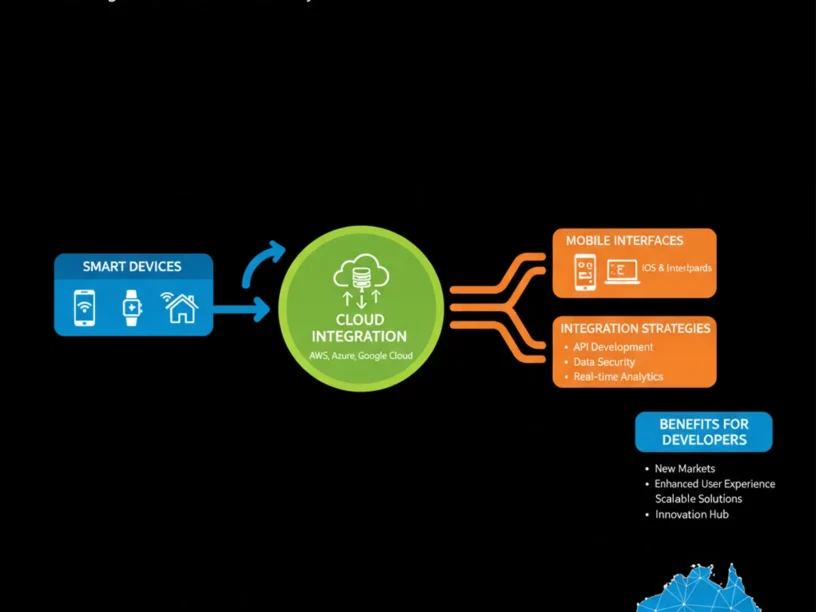
Before a single line of mobile code is written, the integration architecture — how devices talk to your app — must be defined. Architecture covers the protocol stack (MQTT vs HTTPS vs proprietary), cloud platform, database choice, and mobile framework. Getting this wrong early is the most expensive mistake in IoT mobile app development.
The Two Protocol Layers
On the device-facing side, you have MQTT brokers, CoAP endpoints, and WebSocket streams — chosen for bandwidth efficiency, low power consumption, and suitability for constrained networks. On the platform-facing side, REST APIs handle device provisioning, firmware updates, telemetry ingestion, and management dashboards. Most mobile IoT apps consume both layers simultaneously.
- MQTT (Message Queuing Telemetry Transport): Choose MQTT for control commands — its publish-subscribe model with persistent connection delivers data in milliseconds. Best for real-time sensor feeds, alert triggers, and device commands.
- REST API: REST polling works well for daily-aggregated dashboards and user management, device provisioning, and configuration endpoints.
- WebSocket: WebSocket bridges the gap between REST and MQTT for real-time, two-way messaging — useful for live chat overlays within an IoT monitoring app.
- Cross-platform frameworks: In 2026, cross-platform frameworks like Flutter and React Native cover 80% of IoT mobile apps — only deep-integration use cases such as Bluetooth provisioning and low-level BLE characteristics still justify native iOS or Android code.
Cloud Platform Comparison for Australian Builders
| Platform | Best Fit | Indicative Cost at 100 Devices | Key Strength |
|---|---|---|---|
| AWS IoT Core | Startups, MVPs, fast launch | USD 200–600/month (connectivity only) | Widest ecosystem, fastest setup |
| Azure IoT Hub | Enterprise, Microsoft-stack teams | From USD 25/month (S1 tier) | Tight integration with enterprise tools |
| Google Cloud IoT | Data-heavy analytics use cases | Usage-based | BigQuery + ML integration |
| Custom backend | 10,000+ device scale | Higher upfront, lower per-device long-term | No per-message vendor lock-in |
AWS IoT Core and Azure IoT Hub get you to market two to three months faster and cost $30,000–$50,000 less upfront — the right starting point for most Australian founders building their first IoT product.
Key Takeaway: Start with a managed cloud IoT platform to validate your product quickly. Architecture decisions compound — the right choice at MVP stage saves months of rework at scale. Once you’ve locked in your technical foundation, compliance becomes your next critical concern. For deeper context, see IoT Mobile App Development Company – 7 Pillars.
Australian Compliance and Data Privacy for IoT Apps
IoT mobile app development in Australia carries specific legal obligations that every founder must plan for before launch — not after. A major departure in Australian IoT regulation was the Cyber Security Act 2024, enacted in November 2024, with an associated rules schedule commencing March 4, 2026. Compliance is no longer optional: it’s baked into the product launch checklist.
The Key Regulatory Framework
- Privacy Act 1988 and Australian Privacy Principles (APPs): The APPs define obligations on the collection, use, storage, and disclosure of personal information from IoT devices, requiring explicit consent for sensitive data and “reasonable steps” for security.
- Notifiable Data Breaches (NDB) Scheme: Organisations must notify the Office of the Australian Information Commissioner (OAIC) within 72 hours of discovering a data breach likely to cause serious harm.
- Cyber Security Act 2024: This legislation introduces new security standards for smart devices sold in Australia and requires mandatory reporting of eligible cyber incidents within 72 hours.
- Penalties: Maximum penalties for bodies corporate reach AUD 50 million, three times the benefit obtained, or 30% of adjusted domestic turnover. The risk of non-compliance is existential for a startup.
- OAIC 2026 sweep: In January 2026, the OAIC launched its inaugural privacy compliance sweep, reviewing approximately 60 entities across six sectors — entities with non-compliant privacy policies face penalties of up to AUD 66,000 per contravention.
“The era of reactive compliance is over. Data protection is not a compliance checkbox — it is a fundamental business imperative that requires ongoing investment and strategic planning.” — Bird & Bird, 2025 Australia Privacy and Cyber Review
For IoT apps specifically, the Australian Cyber Security Centre (ACSC) provides practical guidelines covering encryption, access controls, and vulnerability management for connected devices. Baking these controls into your product from day one is far cheaper than retrofitting them post-launch.
Key Takeaway: Non-technical founders especially should brief their development partner on Australian Privacy Principles and the Cyber Security Act 2024 before architecture is finalised. Compliance is a design decision, not a legal one. Understanding where your market opportunity sits helps you pick the right vertical to pursue. For supporting data, see Top Mobile App Development Company in Australia for ….
High-Value IoT Use Cases for Australian Startups and Businesses
The most commercially successful IoT mobile app development projects in Australia share one trait: they solve a domain-specific problem with a simple, well-designed mobile interface that makes complex device data actionable. Key sectors driving IoT adoption in Australia include manufacturing, smart cities, healthcare, agriculture, and energy utilities. Below are the use cases generating the clearest return on investment.
Vertical Use Case Breakdown
- Precision agriculture: Mobile apps integrated with IoT sensors enable farmers to manage crops, monitor livestock, and optimize supply chain processes — particularly relevant across Australia’s vast farming regions where on-site monitoring is impractical.
- Remote patient monitoring: IoT devices monitor vital signs such as heart rate, blood pressure, glucose levels, and oxygen saturation, transmitting real-time data to healthcare providers who can monitor patients remotely and detect anomalies. This is accelerating fast in Australia given rural health access challenges.
- Smart building management: Facilities teams use IoT mobile apps to monitor energy consumption, HVAC performance, and occupancy in real time — reducing operational costs without manual inspection. Australian smart city initiatives use IoT-enabled solutions to manage urban infrastructure such as traffic systems, waste management, and energy grids.
- Industrial and mining monitoring: Key trends in Australia’s industrial IoT market include increased adoption of smart sensors, edge computing, and AI-driven analytics, with growing focus on remote monitoring, predictive maintenance, and energy efficiency.
- Retail and hospitality experiences: Mobile IoT apps that respond to in-store sensor data — queue lengths, temperature, inventory levels — let operators make real-time decisions that directly improve the customer experience, aligning with verticals where Appomate has delivered proven products including for Hoyts and hospitality clients.
Nearly 71% of companies now use IoT, and approximately 72% of enterprises outsource the development of IoT solutions — the primary reasons being faster deployment by 38%, access to skilled IoT engineers, and integration with cloud and AI systems. For Australian startups, this validates the partnered-development model over trying to build an in-house IoT team from scratch.
Key Takeaway: The strongest IoT mobile apps solve one specific, high-frequency problem for a defined user — a farm manager, a ward nurse, a facilities engineer — before adding complexity. Vertical specificity is your competitive advantage. Once you’ve identified your market, cost planning becomes essential to avoid surprises down the road.
IoT Mobile App Development Costs in Australia: What to Budget
Understanding realistic cost ranges is essential before approaching a development partner. IoT mobile app development costs more than a standard mobile app because it spans four distinct layers: hardware/device integration, connectivity and protocols, cloud backend, and the mobile front-end. Industry estimates for 2025 to 2026 suggest that IoT app development typically ranges between $20,000 and $200,000 or more, though the right starting point for most Australian startups is an MVP-scoped engagement.
Cost Drivers to Understand
- Hardware integration complexity: Advanced sensors for industrial monitoring, healthcare, or automotive use are more expensive to integrate than basic components — and each new device type adds scoping and testing time.
- Connectivity protocol: Protocols such as Wi-Fi, Bluetooth, Zigbee, LoRaWAN, and cellular (4G/5G) have different infrastructure and operational costs — LoRaWAN suits wide-area rural deployments; BLE suits consumer wearables.
- Cloud platform fees: AWS IoT Core charges USD 1.00 per million MQTT messages; with 100 devices measuring every five minutes, costs reach approximately USD 200–600 per month for connectivity alone.
- Compliance and security: Healthcare and industrial apps require additional security auditing, encryption layers, and documentation to meet Australian Privacy Principles and Cyber Security Act 2024 requirements.
Budget Tier Guide
| Tier | Scope | Indicative Cost (AUD) | Best For |
|---|---|---|---|
| MVP / Proof of Concept | Single device type, basic dashboard, 1 platform | $25,000 – $60,000 | Idea validation, early investor demos |
| Full Consumer Product | iOS + Android, real-time alerts, cloud backend | $60,000 – $150,000 | Direct-to-consumer IoT launch |
| Enterprise IoT Solution | Multi-device, analytics, integrations, compliance | $150,000 – $400,000 | Industrial, healthcare, smart city |
| Scaled Ecosystem | Custom platform, 1,000+ devices, ML analytics | $400,000+ | Infrastructure-grade deployments |
Businesses can reduce IoT development costs by starting with an MVP, using existing hardware and cloud platforms, and leveraging proven frameworks — clear requirements, careful planning, and scalable architecture help avoid costly changes down the track. Melbourne-based Appomate structures engagements around exactly this approach: validate the idea first, then build to scale. Their AI-driven development process has helped founders go from idea to market in as little as six weeks, which significantly compresses the cost of early-stage IoT product validation.
Key Takeaway: The single most cost-effective move in IoT development is investing in architecture and validation before writing mobile code. A well-scoped MVP costs a fraction of rebuilding a poorly architected system at scale. The decision of who to partner with will ultimately shape whether you hit those budgets or blow past them. For deeper context, see How Much Does App Development Cost in Australia in 2026?. For related guidance, see What Type Of Mobile Apps Does Appomate Build.
How to Choose the Right IoT App Development Partner in Australia
Choosing an IoT mobile app development partner in Australia is not just a technical decision — it’s a strategic one. The right partner accelerates your path to market, reduces expensive architecture mistakes, and brings domain knowledge that a general software agency often lacks. IoT mobile app development Australia Internet of Things integration projects require partners with demonstrated capability across both device-level protocols and scalable mobile product delivery.
What to Evaluate Before You Sign
- IoT and API integration expertise: Ask for examples of apps that connect to physical devices — not just mobile apps in general. IoT requires firmware-level awareness, MQTT/REST protocol fluency, and cloud infrastructure experience that many agencies don’t hold.
- Product validation process: The best partners challenge your assumptions before building. A partner who asks “have you validated this with users?” before writing code will save you more money than one who starts building immediately.
- Hybrid delivery model: Many IoT app development companies combine local strategy teams with offshore technical teams to maintain quality while controlling budget. Australia-based strategy and design with a skilled global build team is the model that delivers premium quality at startup-friendly pricing.
- Compliance awareness: Your partner must be familiar with the Australian Privacy Principles, Notifiable Data Breaches obligations, and the Cyber Security Act 2024 — especially if your product handles health, financial, or location data.
- Post-launch support: IoT products require ongoing maintenance: device firmware updates, security patches, cloud infrastructure scaling, and feature iterations based on real device data. A partner who disappears after launch is a liability.
Appomate is a Melbourne-based full-service technology partner with strong expertise in Internet of Things and API integration — and with over 250 apps delivered for clients including Adidas, L’Oreal, Lend Lease, and Hoyts, they bring the track record that de-risks complex product builds. Their Further Faster Framework and founder-focused approach are designed specifically for entrepreneurs without a deep technical background, combining Australia-based strategy and product design with a world-class global development team. For IoT specifically, their AI-driven development approach means faster iteration cycles and smarter architectural decisions from day one.
“We help founders turn app ideas into successful, scalable businesses — not just apps. From validation to launch, growth and exit, we are one partner for the whole journey.” — Appomate
Key Takeaway: Evaluate a potential IoT partner on validation process and post-launch commitment, not just their technology portfolio. The right partner treats your business outcome as their KPI — not just delivery of code. With the right team in place and a clear roadmap, your launch timing matters more than you might think.
Ready to build your app?
Book a free Visioning Call with our team today and walk away with a clear roadmap, expert feedback, and a plan to bring your idea to life. No technical knowledge required.
Conclusion
IoT mobile app development Australia Internet of Things integration is a mature, commercially viable opportunity in 2026 — backed by a USD 18 billion domestic market, active government smart city investment, and strong enterprise demand across healthcare, agriculture, manufacturing, and mining. The founders and businesses who move quickly, validate tightly, and choose the right technical partner will capture the clearest competitive advantage.
- Market timing: Australia’s IoT technology market is growing at a CAGR of 6.0%, outpacing the global average of 3.7% — the adoption curve is steep and the window for first-mover product positioning is now.
- Architecture first: Define your protocol stack (MQTT for real-time, REST for management), choose a managed cloud platform for MVP speed, and treat the mobile app as one of several clients consuming a shared telemetry API.
- Compliance is non-negotiable: The Cyber Security Act 2024 and Australian Privacy Principles apply to virtually every IoT product that handles personal data. Build compliance into the architecture from the start — penalties reach AUD 50 million.
- Start with an MVP: Validate device connectivity, core user workflows, and data usefulness before scaling infrastructure. Most successful Australian IoT products began with a single device type and one core user need.
- Partner strategically: Choose a development partner with proven IoT and API integration capability, a structured validation process, and ongoing post-launch commitment — like Appomate, who help founders get further, faster.
The next step is straightforward: map your product concept to one of the high-value Australian IoT verticals, define the minimum device connectivity needed to deliver your core value proposition, and book a strategy conversation with a partner who has built this type of product before.
FAQ
What is covered in the IoT Mobile App Development Australia: Integration Guide 2026?
The IoT Mobile App Development Australia: Integration Guide 2026 covers the Australian IoT market opportunity, integration architecture (MQTT, REST, WebSocket, cloud platforms), Australian compliance obligations under the Privacy Act 1988 and Cyber Security Act 2024, high-value sector use cases (agriculture, healthcare, manufacturing, mining, smart cities), realistic 2026 cost tiers from MVP to enterprise, and a framework for choosing the right IoT app development partner in Australia. It is written specifically for founders, entrepreneurs, and business owners — including non-technical decision-makers — who are evaluating an IoT mobile product build in 2026.
How much does IoT mobile app development cost in Australia in 2026?
IoT app development in 2026 typically ranges from $20,000 for simple solutions to over $200,000 for complex enterprise systems. In AUD terms, Australian startups should budget approximately $25,000–$60,000 for an MVP with a single device type, $60,000–$150,000 for a full consumer product on iOS and Android with a cloud backend, and $150,000–$400,000+ for an enterprise solution requiring compliance, multi-device support, and analytics. Ongoing cloud and maintenance costs add materially to the total cost of ownership.
What communication protocols do IoT mobile apps use?
Mixing MQTT and REST is the right answer for most IoT apps. MQTT (Message Queuing Telemetry Transport) is a lightweight publish-subscribe protocol ideal for real-time device commands and sensor data, delivering data in milliseconds over a persistent connection. REST APIs are used for device provisioning, configuration, and aggregated dashboards. WebSocket bridges the gap for real-time bidirectional messaging within the mobile UI. The choice of protocol directly affects app responsiveness, battery usage on connected devices, and backend infrastructure cost.
What Australian regulations apply to IoT mobile apps that collect personal data?
The Privacy Act 1988 and Australian Privacy Principles define obligations on the collection, use, storage, and disclosure of personal information from IoT devices, requiring explicit consent for sensitive data and reasonable steps for security. The Notifiable Data Breaches scheme requires organisations to notify the OAIC within 72 hours of a data breach likely to cause serious harm. The Cyber Security Act 2024, which commenced March 2026, introduces new security standards for smart devices. Penalties for non-compliance can reach AUD 50 million for bodies corporate.
Which industries are the best fit for IoT mobile app development in Australia?
Key sectors driving IoT adoption in Australia include manufacturing, smart cities, healthcare, agriculture, and energy utilities. Healthcare remote patient monitoring, precision agriculture sensor dashboards, mining equipment safety apps, smart building management, and industrial predictive maintenance are all generating measurable ROI for Australian businesses in 2026. The clearest commercial opportunities are in verticals with large, distributed physical assets — farms, mine sites, hospital networks, and infrastructure — where mobile IoT apps deliver real-time visibility that was previously impossible.
Should I use AWS IoT Core, Azure IoT Hub, or a custom platform for my Australian IoT app?
For most Australian startups and first-time IoT builders, a managed platform such as AWS IoT Core or Azure IoT Hub is the right starting point. These platforms get you to market two to three months faster and cost $30,000–$50,000 less upfront than a custom platform. A custom backend becomes cost-effective only when you reach high device volumes where per-message cloud fees erode margins. Start managed, validate your product, then evaluate custom infrastructure once you have real-world device data to justify the architecture investment.
How do I find a reliable IoT app development partner in Australia?
Look for a partner with demonstrated IoT and API integration experience — not just general mobile development. Key signals include: previous projects involving physical device connectivity, familiarity with Australian privacy law and the Cyber Security Act 2024, a structured product validation process, and a clear post-launch support commitment. Appomate is a Melbourne-based technology partner with strong IoT and API integration expertise, over 250 apps delivered, and a founder-focused model that combines Australia-based strategy and design with a skilled global development team — making enterprise-quality IoT product development accessible at startup-friendly pricing.
What is the fastest way to launch an IoT mobile app in Australia?
The fastest route to market for an IoT mobile app is to scope an MVP around a single device type, a single core user need, and a managed cloud platform. Starting with an MVP, using existing hardware and cloud platforms, and leveraging proven frameworks significantly reduces development time — clear requirements and scalable architecture help avoid costly changes. Working with a development partner who uses AI-driven development tooling and an agile methodology — like Appomate, whose process has taken founders from idea to market in as little as six weeks — further compresses the timeline without sacrificing product quality.
Methodology and disclaimer: Market size figures are sourced from third-party research firms including IMARC Group, MarketsandMarkets, and Grand View Research, cited inline. Cost ranges are indicative industry estimates aggregated from multiple published sources and may vary based on project scope, team location, and complexity. This article is published by Appomate and reflects publicly available data as of August 2026. It does not constitute legal or financial advice. For compliance obligations specific to your product, consult a qualified Australian legal practitioner familiar with the Privacy Act 1988 and Cyber Security Act 2024.