Updated July 2026 | Author: Appomate Editorial Team | Time Required: 4–8 weeks of sustained effort across channels | Difficulty: Beginner
What You’ll Learn
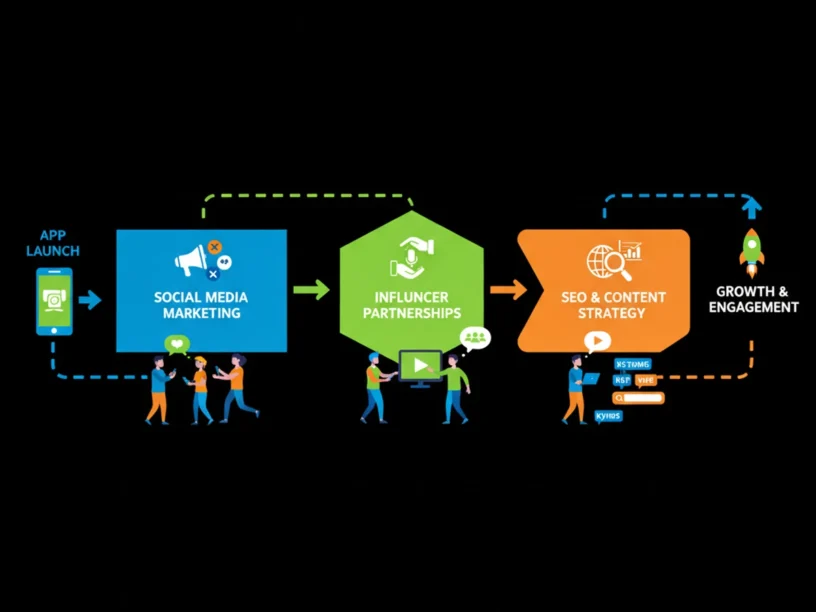
Getting listed in the App Store or Google Play is table stakes — not a growth strategy. This guide provides a step-by-step process for building sustainable momentum outside the stores: pre-launch community building, content and SEO, social media and influencer outreach, paid user acquisition, and retention-first lifecycle marketing.
- Build a warm audience and validated demand before your app goes live
- Drive organic downloads through content, SEO, and social media
- Acquire users at scale with targeted paid campaigns and influencer partnerships
- Keep users coming back with push notifications, email, and a referral program
Prerequisites: A launched or near-launch app, a basic landing page or website, and a clear understanding of who your target user is.
Why Marketing Your App Beyond the App Store Matters in 2026
The App Store contains around 2.19 million apps, and Google Play holds over 2 million. Waiting for organic discovery inside the store isn’t a plan — 40% of smartphone users browse app stores, but most discover apps through social media, ads, or word of mouth. Global app marketing spend on user acquisition reached $78 billion in 2025, up 13% year over year. Founders who build diversified, multi-channel marketing approaches consistently outperform those who rely on a single channel. According to data.ai’s 2026 State of Mobile report, users open an average of 32 apps per month but only use 12 daily, which means retention and re-engagement matter just as much as acquisition.
For Australian founders, the opportunity is significant. Most app founders still focus on store optimisation and leave scalable growth levers untouched. Appomate believes in empowering founders to innovate and transform concepts into market-ready apps quickly. Their philosophy of getting further faster underpins this approach: execute in parallel across channels rather than sequentially, and treat marketing as a core product discipline from day one. For supporting data, see Beyond the App Store: Rethinking Your Competition in the …. For related guidance, see What Type Of Mobile Apps Does Appomate Build.
Ready to build your app?
Book a free Visioning Call with our team today and walk away with a clear roadmap, expert feedback, and a plan to bring your idea to life. No technical knowledge required.
The Process at a Glance
| Step | Action | Time | Outcome |
|---|---|---|---|
| 1 | Build a pre-launch community and waitlist | Weeks 1–4 (pre-launch) | Warm audience ready on day one |
| 2 | Create a content and SEO foundation | Weeks 2–6 (ongoing) | Consistent organic traffic to your app |
| 3 | Run social media and influencer campaigns | Weeks 3–8 (ongoing) | Brand awareness and qualified installs |
| 4 | Launch targeted paid user acquisition | From launch week (ongoing) | Scalable, measurable install growth |
| 5 | Activate retention, push, email, and referrals | From launch week (ongoing) | Lower churn, compounding word-of-mouth |
Total time to first results: 4–8 weeks of sustained effort across all channels.
Step 1: Build a Pre-Launch Community and Waitlist
What You’re Doing
You’re creating a warm, invested audience before your app is available. This gives you a ready-made pool of early adopters on day one and validates that real demand exists.
How to Do It
- Set up a waitlist landing page. Keep it focused on one problem your app solves and one call to action. Robinhood’s landing page converted at over 50% because it was laser-focused and low-friction.
- Add a viral referral loop. Dropbox offered users extra storage for referrals and acquired 4 million users in 15 months, with 35% of daily sign-ups coming directly from the program. Adapt this for your app — offer queue-jumping, premium features, or credits for every friend referred.
- Seed niche communities. Post genuinely helpful content in relevant Reddit threads, Facebook groups, LinkedIn communities, and Slack groups. Talk about the problem your app solves — not the app itself — for the first few weeks.
- Submit to launch directories. Product Hunt remains the highest-reach platform for new apps. Also consider BetaList and Indie Hackers to reach early adopters.
- Warm the list weekly. Send one email per week — a short, personal note that gives subscribers a reason to stay engaged and share.
Best Practices
- Start marketing months before opening day. A well-executed waitlist strategy validates demand, creates exclusivity, and builds community.
- Keep your waitlist active for 30–60 days pre-launch. Longer than 60 days and you risk list fatigue — people forget they signed up.
What Done Looks Like
You have a waitlist of at least 200–500 engaged subscribers, a referral loop active on your landing page, and a presence in two or three niche communities where your target user already spends time. For a more detailed walkthrough, see Pre-Launch Marketing Strategies for Your Mobile App.
Example
| App Type | Waitlist Channel | Referral Incentive | Community Home |
|---|---|---|---|
| Wellness / fitness | Landing page + Instagram | Free premium month for 3 referrals | r/fitness, Facebook wellness groups |
| B2B / productivity | Landing page + LinkedIn | Priority onboarding + 60-day free trial | LinkedIn groups, Slack communities |
| Marketplace | Landing page + TikTok | Founding member pricing | r/entrepreneur, Indie Hackers |
Step 2: Build a Content and SEO Foundation
What You’re Doing
You’re creating a sustainable source of organic traffic that drives downloads without continuous ad spend. A blog, landing page, and basic SEO strategy make your app findable by people actively searching for solutions you provide.
How to Do It
- Build a dedicated app website or landing page. Search is a powerful app discovery channel. Create entry points where users see your app’s download links.
- Research problem-focused keywords. Use Ahrefs or SEMrush to find phrases your target user types when they have the problem your app solves. Target these in your blog posts, landing page copy, and meta descriptions.
- Publish at least two blog posts per week. Create multiple entry points for potential app downloads through search engines, your website, and landing pages.
- Add video to your landing page. Landing pages with video see 86% higher conversion rates than those without, according to HubSpot data.
- Build backlinks through PR and partnerships. Reach out to relevant Australian tech blogs, industry publications, and roundup lists. Businesses with a regular blogging schedule acquire 97% more backlinks than websites without an active blog.
Best Practices
- Write about the problem first, the solution second. People search for problems — “how to track team tasks on mobile” — not product names they’ve never heard of.
- SEO creates consistent organic traffic, ensuring users find your app naturally without continuous ad spend, reducing customer acquisition costs over time.
What Done Looks Like
Your app website ranks on the first two pages of Google for at least three to five problem-focused keywords, and organic search drives a measurable share of your weekly installs within three to four months.
Step 3: Run Social Media and Influencer Campaigns
What You’re Doing
You’re meeting your future users where they already spend their time and building both brand awareness and direct download intent through social channels and credible third-party voices.
How to Do It
- Pick one or two primary platforms based on where your audience lives. Short-form videos work on TikTok, while professional content resonates on LinkedIn.
- Post consistently with value-first content. Build a strong presence with valuable posts, app updates, and user success stories. Aim for three to four posts per week on your primary platform.
- Build or join a community. Create spaces — like Facebook groups, Discord servers, or subreddit communities — where users can connect and advocate for your app.
- Partner with micro-influencers in your niche. Focus on creators with 1,000 to 50,000 followers but highly engaged audiences. Micro-influencers are effective for organic growth because their recommendations feel more genuine and targeted.
- Track ROI with unique links. Track installs and engagement via unique promo codes or affiliate links. Use Branch or AppsFlyer for attribution.
Best Practices
- Micro-influencers are often affordable — sometimes they’ll promote your app in exchange for a premium account, early access to features, or a modest fee.
- User-generated content extends your reach organically. Ask early users to share their experience and feature the best posts on your brand account.
What Done Looks Like
You have at least three active influencer partnerships running, a consistent posting cadence on your primary platform, and a measurable lift in install volume that tracks back to social referral sources.
Step 4: Launch Targeted Paid User Acquisition
What You’re Doing
You’re using paid channels to accelerate growth beyond what organic efforts alone can deliver — spending smarter, not just more, by targeting the right audiences and diversifying beyond dominant platforms.
How to Do It
- Start with Meta and Google App Campaigns. Apple Search Ads reaches users ready to install immediately, while Google App Campaigns use machine learning to optimise placements and maximise efficiency.
- Add TikTok Ads for younger or lifestyle audiences. TikTok Ads are ideal for engaging younger audiences through creative and native video content.
- Diversify beyond the big platforms. Shift budgets to include independent and regional ad networks. This diversification uncovers new audiences and reduces risk.
- Set up mobile attribution. Use AppsFlyer, Branch, or Adjust from day one. Attribution prevents double-counting and reveals your true cost per acquisition per source.
- Test creatives rapidly. The median creative refresh cycle dropped to 3 days in 2026, with top-quartile UA teams shipping 80 to 120 variants per channel per month. Generative tooling cuts production cost per variant by an estimated 60 to 75%.
Best Practices
- Start with a small daily budget (AU$20–50 per channel) and scale only what proves positive return. Paid UA should never run faster than your retention can absorb.
- Successful apps typically allocate 15–25% of their marketing budget to tools and technology. Early-stage apps might start with AU$700–3,000 monthly for basic tools.
Example: Paid Channel Mix for an Early-Stage Australian App
| Channel | Primary Goal | Suggested Starting Budget | Best For |
|---|---|---|---|
| Meta (Facebook / Instagram) | Broad awareness + installs | AU$30/day | Most app categories |
| Google App Campaigns | High-intent installs | AU$20/day | Utility, productivity, B2B |
| TikTok Ads | Viral reach + brand awareness | AU$20/day | Consumer, lifestyle, wellness |
| Apple Search Ads | Ready-to-install audience | AU$15/day | iOS-priority apps |
What Done Looks Like
You have at least two paid channels live with attribution tracking, you know your cost per install on each channel, and you have a weekly cadence of creative testing. For related guidance, see Best Paid User Acquisition Strategies For Mobile Apps In 2026.
Step 5: Activate Retention, Push, Email, and Referrals
What You’re Doing
You’re turning installs into loyal, active users and turning loyal users into your most cost-effective marketing channel. Retention is the multiplier that makes every other step worthwhile.
How to Do It
- Set up push notifications from launch week. Send fewer, better alerts based on what users did and when they’re likely to respond. Earn permission, segment by behaviour, cap frequency, and measure retention rather than raw send volume. OneSignal is free for early-stage apps.
- Build an email lifecycle sequence. Use warm welcome emails, exclusive VIP offers for loyal users, and re-engagement emails with links to a preference centre. Mailchimp or Customer.io both integrate cleanly with mobile apps.
- Launch a referral program. Referral programs are the centrepiece of word-of-mouth strategy. Reward users for inviting colleagues and friends to gain brand advocates.
- Design your referral incentive carefully. Focus on value alignment — rewards that reflect brand values — experience over discounts (exclusive access, early product launches, VIP service), and tiered recognition that acknowledges top advocates.
- Monitor Day-1, Day-7, and Day-30 retention. Average Day-1 retention is 26%, Day-7 is 11%, and Day-30 is 5.4%, according to AppsFlyer and Adjust. Beat these benchmarks and your paid UA budget goes further.
Best Practices
- Hybrid customer engagement — combining push, email, and in-app messaging — outperformed no messaging by nearly 14x for 365-day retention and outperformed push-only messaging by nearly 100%, according to Braze in 2025.
- Ask for push notification permission only after a user has experienced real value. Opt-in rates are significantly higher when users already understand why notifications are useful.
What Done Looks Like
You have push, email, and in-app messaging running with behaviour-based triggers, a live referral program, and your Day-30 retention rate tracking toward or above the category benchmark.
What to Do After Completing the Process
Phase 1 — Optimise (Months 2–3)
Review your attribution data and double down on the one or two channels delivering the best cost per install and highest Day-30 retention. Cut underperforming channels and reinvest budget into what is working. Refine your onboarding flow based on where users drop off.
Phase 2 — Scale (Months 3–6)
Introduce a formal content calendar and increase publishing cadence. Build a PR pipeline targeting Australian tech media such as Startup Daily and SmartCompany. Expand your influencer partnerships to two or three additional creators per month. Test new paid channels and international markets if retention metrics are strong.
Phase 3 — Retain and Compound (Month 6+)
Shift a growing share of your budget from acquisition to retention and referral. Remarketing’s share of total app marketing spend rose from 25% to 29% in 2025, as brands recognised that reactivating existing users delivers better unit economics. Your referral program and loyal community should generate a measurable percentage of new installs without additional spend.
Resources You’ll Need
| Resource | Role in This Process | Required / Recommended / Optional | Price |
|---|---|---|---|
| Appomate | Full-service app development and growth partner — strategy, build, launch, and marketing support | Recommended (for founders who want a single partner from idea to growth) | Custom / project-based |
| OneSignal | Push notifications, in-app messaging, and email for retention and re-engagement | Required | Free plan available; paid from ~$9/month |
| AppsFlyer | Mobile attribution — tracks which channels and creatives drive your installs | Required (if running paid UA) | Free up to a threshold; paid from ~$0.06/conversion |
| Branch | Deep linking and cross-channel attribution, including referral program tracking | Recommended | Free starter plan available |
| Mailchimp | Email lifecycle marketing — welcome sequences, re-engagement, and newsletters | Required | Free up to 500 contacts; paid from ~$13/month |
| Ahrefs | Keyword research and SEO content strategy for organic app discovery | Recommended | From ~$129/month (Lite plan) |
| Product Hunt | Launch platform to generate early downloads, press coverage, and community traction | Recommended | Free |
See also, see Mobile app marketing guide: Cracking the code to success. For related guidance, see Mobile App Marketing Mastering Aso Paid Ua And Product Led Growth.
Troubleshooting Common Issues
You launched but installs are almost zero
Likely cause: Your audience was not built before launch.
Fix: Run a 30-day intensive community-building sprint. Post daily in three to five relevant communities, submit to Product Hunt and Indie Hackers, and run a paid Meta campaign with a AU$20/day budget. Your first 50–100 reviews unlock better organic visibility in the store.
Paid campaigns are spending but not converting
Likely cause: Creative fatigue or audience mismatch. The median creative refresh cycle dropped to 3 days in 2026 — running the same ad for weeks is a fast way to burn budget.
Fix: Pause all ad sets, produce five to ten new creative variants, and restart with a fresh A/B test. Simultaneously narrow your audience targeting to the three most specific interest and demographic combinations you can define.
Users install but churn within the first week
Likely cause: A poor onboarding experience or a mismatch between your ad promise and in-app reality.
Fix: Map your onboarding flow step by step and identify where users drop off using Mixpanel or Firebase Analytics. Ensure the first session delivers core value within two minutes. Align your ad creative and copy with what a new user experiences on first open.
Your referral program is live but no one is sharing
Likely cause: The incentive is not compelling enough, or the sharing mechanism has too much friction.
Fix: Focus on experience over discounts — exclusive access, early product launches, and VIP service — and where cash is used, a minimum of $15–25 is needed. Simplify the share flow to a single tap and make the referral link work across both iOS and Android via Branch deep links. For more troubleshooting advice, see Marketing research on Mobile apps: past, present and future.
Conclusion
Key Takeaways
- Outcome recap: Marketing your app beyond the App Store is a multi-channel system — pre-launch community, content and SEO, social and influencer, paid UA, and retention — where each layer compounds the one before it.
- Key insight: Users open an average of 32 apps per month but only use 12 daily — retention and re-engagement are just as valuable as acquisition. Founders who treat marketing as a post-launch afterthought lose to those who start building their audience before the app is ready.
- Next action: Start today — set up a waitlist landing page and post in one relevant community. If you want a full-service partner covering the whole journey — from idea to launch to growth — Appomate helps founders turn app ideas into successful, scalable businesses. From validation to launch, growth and exit — one partner for the whole journey, with Australia-based strategy and design combined with a world-class global development team.
FAQ
How do you market an app beyond the App Store?
Marketing an app beyond the App Store means building a multi-channel growth engine independent of store algorithms. The most effective approach combines five layers: (1) a pre-launch waitlist and community strategy; (2) a content and SEO foundation that drives sustainable organic traffic; (3) social media and micro-influencer partnerships that generate brand awareness and install intent; (4) targeted paid user acquisition on Meta, Google, TikTok, and Apple Search Ads with mobile attribution tracking; and (5) a retention system built on push notifications, email lifecycle sequences, and a referral program that turns satisfied users into your cheapest marketing channel. Start before launch, execute across channels in parallel, and treat retention as a growth lever.
When should I start marketing my app?
Start marketing four to eight weeks before launch, not after. Building a waitlist, seeding communities, and creating content takes time to compound. Arrive at launch day with a warm audience, early press coverage, and at least one community of engaged potential users already in place.
How much should an Australian startup spend on app marketing?
For early-stage founders, a realistic starting budget is AU$1,500–3,500 per month: roughly AU$700–1,200 on paid acquisition (split across two channels), AU$300–500 on tools (attribution, email, and push), and the remainder on content creation and influencer outreach. Scale spending only once you prove a positive return on at least one paid channel and your Day-30 retention rate beats category benchmarks.
What is the best social media platform to promote an app in Australia?
The right platform depends on your target audience. Instagram and TikTok are highest-reach for consumer apps targeting people under 40 — short-form video performs particularly well. LinkedIn is strongest for B2B apps and productivity tools. Facebook Groups remain valuable for community-led growth. Pick one platform, post consistently for 60 days, and measure results before expanding.
Do micro-influencers actually drive app installs?
Yes — often more efficiently than macro-influencers. Micro-influencers (1,000 to 50,000 followers) have higher engagement rates and closer relationships with their audiences, meaning their recommendations carry more trust. They are also more affordable — many will promote your app in exchange for a premium account, early access to features, or a modest fee. Track every campaign with unique referral links through a mobile attribution tool.
What is the biggest reason apps fail to grow after launch?
Poor retention is the single biggest reason. Acquiring users through paid campaigns then losing them within the first week is economically unsustainable. Average Day-30 retention across all app categories is just 5.4%. If your onboarding flow does not deliver clear value within the first two minutes, users churn before your marketing compounds. Fix retention before scaling acquisition spend.
How does a referral program help market an app?
A referral program turns your existing users into a distribution channel. When a satisfied user invites a friend — particularly with a meaningful incentive like exclusive access or premium features — that new user arrives with higher trust and intent than any paid ad. Referral programs reduce your effective cost per acquisition over time and create a compounding growth loop. Tools like Branch track which users drive the most referrals.
Can Appomate help with app marketing, not just development?
Yes. Appomate is a full-service technology partner covering the entire product journey — strategy, design, development, launch, marketing, and ongoing support. Their model is built on getting founders further faster: from validation to launch, growth and exit — one partner for the whole journey. With 250-plus apps delivered and clients including Adidas, L’Oreal, and Hoyts, Appomate brings both technical capability and growth expertise that first-time founders need.
Methodology: This guide was researched in July 2026 using data from industry sources including AppsFlyer, Adjust, Sensor Tower, data.ai, Business of Apps, and Searchlab. Statistics cited reflect the most recent publicly available benchmarks at time of writing.