app marketing for wellness and health apps — strategies beyond ASO | Updated August 2026 | Appomate Editorial Team
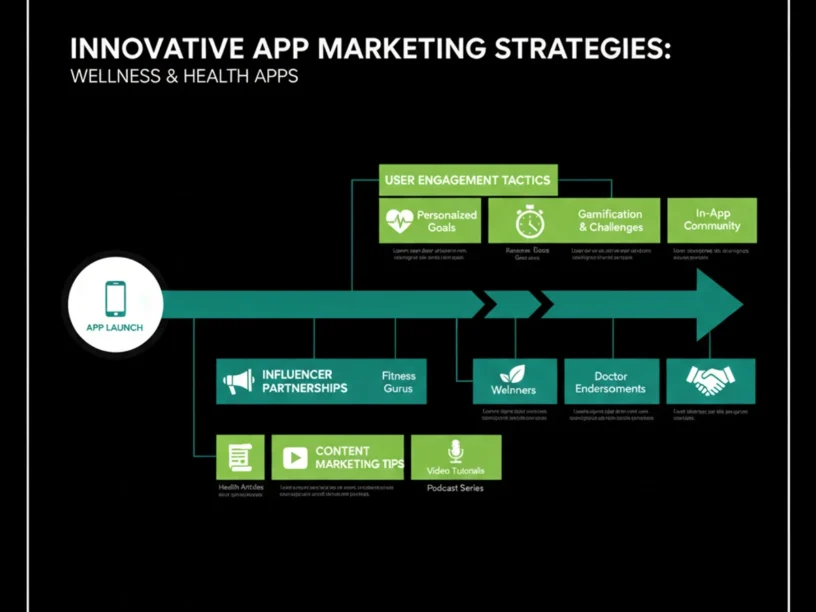
Australian wellness founders operate in one of the fastest-growing digital markets in the country — yet most treat App Store Optimisation as their primary growth lever. App marketing for wellness and health apps — strategies beyond ASO means building a multi-channel growth engine combining health influencer partnerships, in-app community features, strategic PR in Australian wellness media, and category-specific store optimisation. This guide shows you exactly how to do it, with real tactics and Australian-market context.
Australia’s fitness app market was valued at approximately USD 70.1 million in 2025 and is projected to expand to USD 401.5 million by 2034, reflecting a CAGR of 21.40% between 2026 and 2034. Meditation management is the most lucrative wellness app segment. With more than 400,000 health and wellness apps available across the Apple App Store and Google Play, discoverability alone will not sustain you. Standing out requires deliberate, layered marketing well beyond keyword metadata.
The wellness apps that win in Australia are not the ones with the best technology — they are the ones that build the deepest trust with their audience. Trust is built through community, credibility, and consistency. ASO gets you into the room; everything else keeps you there.
Why ASO Alone Is No Longer Enough for Wellness Apps
ASO (App Store Optimisation) improves your app’s visibility within the Apple App Store and Google Play through metadata, visuals, and reviews. It remains essential but has become a baseline, not a growth strategy. Standing out in the app stores is no longer as simple as great creative or a well-run user acquisition campaign.
The Shifting Discovery Landscape
- AI-powered search: LLMs such as ChatGPT, Gemini, and Claude are transforming how users discover apps. If your wellness app is not mentioned in credible online content, it will not appear in AI-generated answers.
- Social-first discovery: Platforms like TikTok and Instagram are goldmines for short-form video campaigns that drive app installs, especially for content mapping to genuine user intent.
- Referral and community: Referral marketing remains cost-effective for app downloads, and wellness is a category where word-of-mouth carries outsized weight.
What the Data Tells Us
| Discovery Channel | Strength for Wellness Apps | Key Action Required | Difficulty |
|---|---|---|---|
| App Store Search (ASO) | High baseline visibility | Metadata + screenshot optimisation | Medium |
| Social Media (TikTok/Instagram) | Very high for trust-building | Short-form video + influencer content | Medium |
| AI Search (ChatGPT, Perplexity) | Rapidly growing | Content authority + PR mentions | High |
| Wellness Media PR | High for credibility | Editorial pitching + founder story | Medium-High |
| Referral / Word of Mouth | Very high for retention | In-app referral mechanics | Low-Medium |
Key Takeaway: ASO is the foundation — without it, paid and organic channels leak installs. But in 2026, ASO is the starting point, not the finish line. The channels that move the needle are the ones that build trust, and trust compounds over time. For deeper context, see Potential and Pitfalls of Mobile Mental Health Apps in … – PMC.
Health Category ASO: Optimising Within the App Store’s Most Competitive Vertical
The Health & Fitness category on both the Apple App Store and Google Play is among the most competitive in Australia. Winning requires precision metadata strategy, conversion-optimised creative, and consistent engagement signals. A health and wellness app moved from ranking #34 to #6 for its primary category keyword in nine weeks through metadata precision alone — rewriting the title, subtitle, and keyword field to eliminate repetitions and fill every character with non-overlapping terms.
iOS-Specific Optimisation Levers
- Custom Product Pages (CPPs): Apple doubled the CPP limit to 70 per app in early 2026 — pairing CPPs with Apple Search Ads campaigns targeting the same keyword cluster is the highest-impact iOS ASO move available today.
- Screenshot captions: Since June 2025, Apple indexes screenshot caption text via OCR — write captions with intent keywords, not just feature labels.
- In-App Events: In-App Events drive 15–40% install lifts without any paid spend. Use recurring events like “30-Day Calm Challenge” as triggers.
- Category selection: Test different categories using AppTweak or data.ai to identify where your keyword cluster has lower competition.
Google Play Differences
- Full description indexing: Google Play indexes all visible copy — target 2–3% keyword density for your primary term while keeping copy compelling enough to convert readers.
- Ratings velocity: Apps with strong engagement metrics rank higher. Build a prompt strategy that asks for ratings at moments of delight.
Key Takeaway: Health category ASO in 2026 is a metadata science and a conversion art. Treat every pixel and every character as a ranking signal, then layer In-App Events on top for organic visibility spikes. For related guidance, see The Ultimate Guide To App Store Optimisation How To Rank Higher And Get More Downloads In 2023.
Health Influencer Partnerships
Influencer marketing is one of the most effective health app user acquisition channels in Australia because wellness decisions are deeply personal and trust-driven. The goal is not reach, but the right reach. Australian wellness creators command genuine community trust, and their audiences actively seek product recommendations.
The Australian Influencer Landscape for Wellness
In Australia, Instagram success is about resonance rather than just reach. Audiences value authentic connection over follower counts, especially in health and wellness where credentialled or lived-experience creators consistently outperform celebrity accounts.
Influencer Tier Framework for Wellness App Founders
| Influencer Tier | Follower Range | Best Use Case | Expected Outcome | AU Compliance Note |
|---|---|---|---|---|
| Nano | 1K – 10K | Niche condition audiences | High engagement, low cost | Paid partnership disclosure required |
| Micro | 10K – 100K | Fitness, nutrition, mindfulness communities | Strong install conversion | Ad Standards AU applies |
| Mid-Tier | 100K – 500K | Brand awareness + credibility | Volume installs + press mentions | Mandatory #ad labelling |
| Macro / Celebrity | 500K+ | Launch campaigns only | Reach, not necessarily conversion | Full ACCC endorsement guidelines |
- Credential over follower count: A physiotherapist with 8,000 followers will outperform a lifestyle influencer with 80,000 for a rehabilitation app.
- Platform match: TikTok and Instagram Reels have seen 189% growth in Australian influencer adoption — prioritise video-first creators for app installs.
- Compliance: All paid partnerships must be disclosed per Ad Standards Australia and ACCC guidelines.
Key Takeaway: Micro and nano influencers with genuine health credentials consistently outperform large-reach wellness accounts for Australian app installs. Allocate 60–70% of influencer spend to this tier. For further reading, see Top App Marketing Companies (2026).
Building Wellness Communities That Drive Mobile App Engagement
Acquiring users is only half the battle. The wellness apps that lead their categories achieve the lowest churn by building community both inside and outside the product. Social accountability is one of the strongest retention mechanics in fitness and wellness.
In-App Community Features
- Group challenges and streaks: Apps that integrated gamified wellness challenges experienced a 30% higher engagement rate, creating daily return habit without additional marketing spend.
- Social feeds and progress sharing: Content features give users a reason to open the app between sessions, creating a feed worth returning to.
- Personalised onboarding: Ask users what their goal is — better sleep, less stress, more focus — and adapt the content flow accordingly. Personalisation keeps users engaged.
- Push notifications done right: Send gentle, context-aware notifications — suggesting a stretch after prolonged inactivity, or a check-in after a stressful calendar event. Avoid generic broadcast notifications.
Insight Timer’s community mechanics — group sessions, anonymous sharing boards, and a massive free library — helped it achieve a 16% Day 30 retention rate, nearly double that of its main competitors. Community is the moat.
External Community Channels
- Instagram community building: Use Stories polls, Q&A sessions, and saved Highlights as a free content hub that pre-sells your app’s value proposition.
- Facebook and Discord groups: Private groups aligned to your app’s niche create belonging and give founders direct feedback loops for product development.
- Referral mechanics: Build a referral programme directly into onboarding. Referral rewards have proven effective in keeping users engaged and driving organic growth.
Key Takeaway: Community reduces your paid acquisition cost every month it matures — because retained users refer new users. For further reading, see 10 Health & Wellness Marketing Strategies for 2026. For related guidance, see Mobile App Marketing Mastering Aso Paid Ua And Product Led Growth.
PR in Australian Health Media
Earned media in Australian wellness publications delivers third-party credibility, lasting SEO authority, and inclusion in AI-generated answers about health apps. A single feature in a credible outlet builds trust that no advertisement can replicate and signals to AI search engines that your app is worthy of recommendation.
Australian Wellness Media Targets
- Wellbeing Magazine: Wellbeing Magazine is Australia’s most comprehensive online natural therapy guide — an ideal editorial home for meditation, mindfulness, and holistic wellness apps.
- Croakey Health Media: Australia’s leading independent health journalism platform — ideal for apps with a preventive health or mental wellness angle.
- ABC Health & Wellbeing: The ABC’s health vertical commands deep audience trust. A mention here generates lasting brand credibility for any Australian health app.
- Podcasts: Wellness podcast audiences actively invest in their health — getting your brand in front of listeners who trust their hosts is high-conversion exposure.
How to Pitch Australian Wellness Media
- Lead with the user story: Editors want human stories, not product announcements. Frame your pitch around a real user’s transformation or a founder’s personal motivation.
- Tie to a health trend: Position your app as the practical tool that meets current wellness trends.
- Include credentialled sources: Quotes from registered psychologists, accredited exercise physiologists, or dietitians dramatically increase the chance of editorial pick-up.
- Time pitches to awareness events: R U OK? Day (September), World Mental Health Day (October), and World Sleep Day (March) are editorial calendars that Australian health journalists actively commission content around.
Key Takeaway: A consistent PR cadence of 2–4 earned media placements per quarter builds the citation footprint that AI search engines use to recommend apps. For further reading, see Australia’s #1 App Marketing Agency | ASO Company, Mobile ….
Compliance, Privacy, and Trust
In Australia, health app marketing operates within a regulatory framework that most founders underestimate. Getting compliance wrong destroys the trust that wellness marketing is built upon. Understanding the rules upfront transforms compliance from a risk into a competitive advantage.
Key Australian Regulatory Requirements
- Privacy Act 1988 (Cth): The Privacy Act 1988 (Cth) is Australia’s primary legislation governing the handling of personal information. It applies if your app uses, collects, or distributes personal information. Health data is among the most sensitive categories.
- OAIC enforcement: From December 2024, the OAIC can issue infringement notices for breaches of core obligations, with penalties of up to AUD 66,000 per contravention.
- TGA classification: The TGA only regulates software if it serves a medical purpose — diagnosis, monitoring, treatment, or clinical decision support. Apps used for communicating with patients, promoting health, or administrative purposes are generally not regulated by the TGA.
- Automated decision-making disclosure: From 10 December 2026, if your app uses AI tools or algorithms to make decisions that affect individuals, you must disclose this in your privacy policy.
How Compliance Becomes a Marketing Asset
- Privacy labels on the App Store: Apple’s detailed privacy nutrition labels are visible to all users before download. Minimising data collection and processing data on-device are competitive differentiators for health apps.
- Transparent data policy in onboarding: A plain-English explanation of what data you collect and why — shown during onboarding — builds immediate trust.
- Trust badges and certifications: If your app has been reviewed by a health professional board or endorsed by a credible health outlet, display this prominently in your App Store listing.
Key Takeaway: Compliance is not just legal hygiene — it is brand positioning. In Australia’s wellness market, the apps that communicate privacy and safety most clearly win the trust of users most likely to pay for premium subscriptions.
Bringing It All Together: Appomate’s Approach to Wellness App Growth
Melbourne-based Appomate has been building and marketing wellness apps for Australian and global founders, including 1 Giant Mind, the meditation app built in collaboration with master teacher Jonni Pollard. The app offers a straightforward 12-step technique that allows users to learn meditation quickly. Four years of in-app research proving stress reduction and well-being became the cornerstone of its PR and influencer outreach, building credibility no paid campaign could replicate.
Appomate’s Full-Journey Partnership
- Holistic Growth Philosophy: Rather than building an app and then asking “how do we market it?”, Appomate works with founders across the full journey — from validating the wellness concept and designing the product experience, through to launch strategy, influencer campaign planning, App Store category optimisation, and ongoing growth.
- Specialised Wellness Vertical: Their dedicated wellness app vertical brings together Australia-based strategy and product design with an AI-driven development process, helping founders reach market in as little as six weeks. This approach is ideal for wellness entrepreneurs who need a partner who understands both the technical build and the growth marketing side of wellness apps.
Key Takeaway: Appomate offers a full-journey partnership for wellness founders, integrating product development with growth marketing from concept to scale, leveraging Australian market expertise and AI-driven efficiency.
Ready to build your app?
Book a free Visioning Call with our team today and walk away with a clear roadmap, expert feedback, and a plan to bring your idea to life. No technical knowledge required.
Conclusion
The Australian wellness app market is growing fast, but growth in the market does not automatically mean growth for your app. Winning requires a deliberate, layered marketing approach where App Store Optimisation is the foundation — not the ceiling. App marketing for wellness and health apps — strategies beyond ASO means investing in influencer trust, community infrastructure, earned media, and compliance-first positioning as a coherent system.
- Layer your channels: The best strategy connects discovery, trust, and user experience where ASO, influencer, PR, and community reinforce each other.
- Invest in Health category ASO precision: Metadata precision, screenshot OCR, In-App Events, and Custom Product Pages are the four most impactful iOS levers available to wellness apps in 2026 — none requires paid spend.
- Choose credentialled influencers: A qualified practitioner with 10,000 followers consistently outperforms a lifestyle creator with 200,000. Vet for credentials, not just counts.
- Build community from day one: Gamified challenges, referral mechanics, and in-app social features are retention tools that compound in value over time — reducing paid acquisition cost as the app matures.
- Treat compliance as brand positioning: Australia’s Privacy Act and incoming 2026 automated-decision-making disclosures are opportunities to signal trustworthiness in a trust-dependent category.
If you are a wellness founder ready to go from idea to market — or already live and looking to accelerate growth — Appomate is the full-journey partner that understands both the build and the business of wellness apps in Australia.
FAQ
What are the best app marketing strategies for wellness and health apps beyond ASO in 2026?
The most effective app marketing for wellness and health apps — strategies beyond ASO — in 2026 combines five core pillars: (1) Health category ASO precision using Custom Product Pages, screenshot OCR, and In-App Events on iOS; (2) health influencer partnerships with credentialled Australian micro and nano creators on Instagram and TikTok; (3) community-building through in-app challenges, streaks, and referral mechanics that drive retention and organic word-of-mouth; (4) strategic PR in Australian wellness media such as Wellbeing Magazine, Croakey Health Media, and ABC Health to build credibility and AI citation footprint; and (5) compliance-first positioning using Australia’s Privacy Act and TGA classification as trust signals. These channels work as a connected system — each one reinforcing the others to lower acquisition costs and increase long-term user retention.
How big is the wellness app market in Australia in 2026?
Australia’s fitness app market was valued at approximately USD 70.1 million in 2025 and is projected to expand to USD 401.5 million by 2034. The broader wellness apps market in Australia is expected to reach projected revenue of US$537.6 million by 2030, growing at a CAGR of 15.9% from 2025 to 2030, making it one of the most significant digital health opportunities in the Asia-Pacific region.
Do Australian wellness apps need to comply with TGA regulations?
The TGA only regulates software if it serves a medical purpose — diagnosis, monitoring, treatment, or clinical decision support. Apps used for communicating with patients, promoting health, or administrative purposes are generally not regulated by the TGA. However, all health apps that collect personal data must comply with the Privacy Act 1988, enforced by the OAIC. From December 2026, apps using AI or algorithms to make decisions affecting users must also disclose this in their privacy policy.
Which Australian influencers should wellness app founders target?
Wellness app founders in Australia should prioritise credentialled micro-influencers (10K–100K followers) over celebrity accounts. Look for registered dietitians, accredited exercise physiologists, psychologists, yoga instructors, and clinical practitioners active on Instagram or TikTok. TikTok and Instagram Reels have seen 189% growth in Australian influencer adoption, making video-first creators particularly valuable for app install campaigns. All paid partnerships must disclose the commercial relationship per Ad Standards Australia and ACCC guidelines.
How important is community building for wellness app retention in Australia?
Community is one of the strongest drivers of long-term retention in wellness apps. Apps that integrated gamified wellness challenges experienced a 30% higher engagement rate. Insight Timer maintains a 16% Day 30 retention rate — nearly double that of its main competitors — by leveraging community mechanics and a free content library. Australian wellness founders should build community infrastructure into the product from day one.
How can a wellness app get featured in Australian health media?
Frame your pitch around a human story rather than a product announcement. Tie your story to a relevant health trend — mental wellness, preventive health, or wearable integration all resonate in the current Australian media environment. Include quotes from credentialled health professionals, and time pitches to national awareness events such as R U OK? Day in September, World Mental Health Day in October, or World Sleep Day in March. Target publications including Wellbeing Magazine, Croakey Health Media, and ABC Health & Wellbeing for the strongest trust signal and AI citation value.
What is the role of AI search in wellness app discovery in 2026?
Large Language Models such as ChatGPT, Gemini, and Claude are transforming how users discover apps — users increasingly ask conversational agents for recommendations instead of navigating app stores manually. Wellness app founders should build an AI citation footprint through earned media, credible backlinks, and authoritative content so that their app appears in these AI-generated responses — a channel that is growing faster than traditional app store search.
How can Appomate help me market my wellness app in Australia?
Appomate is a Melbourne-based full-journey app development and growth partner with deep experience in the wellness vertical. Unlike agencies that only build, Appomate partners with founders through validation, design, development, launch, and marketing, helping wellness entrepreneurs go from idea to market in as little as six weeks. Their Australia-based strategy team combined with a global development capability delivers premium quality at startup-friendly pricing — making them a practical choice for wellness founders at any stage.
Methodology & Disclaimer: This article was compiled using publicly available market research from Grand View Research, IMARC Group, Precedence Research, Statista, and industry sources current to August 2026. Statistics are cited from third-party research providers and are subject to revision. This article does not constitute legal, regulatory, or financial advice. For TGA classification, Privacy Act obligations, or OAIC compliance requirements, consult a qualified Australian legal or regulatory adviser. Appomate is the publisher of this article and is referenced as a relevant service provider in the Australian wellness app development market.