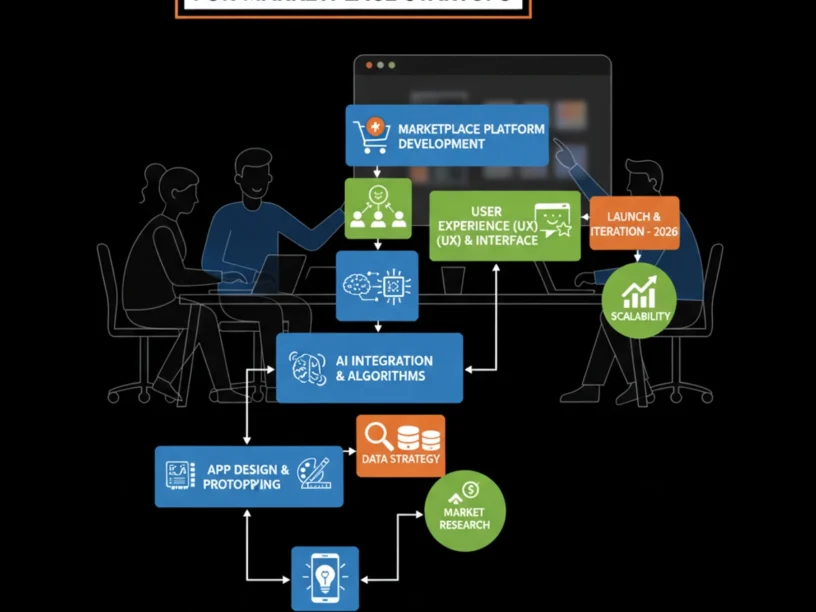
how to build an AI mobile app for a marketplace startup — complete guide | Updated August 2026 | Appomate Editorial Team | 10–16 weeks to launch MVP | Beginner
What You’ll Learn
This guide walks you through exactly how to build an AI mobile app for a marketplace startup from idea validation right through to a live, revenue-ready product. Whether you’re a first-time founder or a seasoned business owner venturing into technology for the first time, this is your practical, jargon-free roadmap for 2026.
- How to validate your two-sided marketplace idea before writing a single line of code
- Which core features every AI marketplace app must have to go live with confidence
- How to layer in AI capabilities — smart matching, recommendations, and fraud detection — without over-engineering your MVP
- How to choose the right development partner and launch a market-ready product in 10–16 weeks
Prerequisites: No technical background required. You need a clear problem you want to solve, a target audience on both sides of your marketplace, and a realistic budget and timeline in mind.
Why Building an AI Marketplace App Matters in 2026
The marketplace model — connecting buyers and sellers on a platform you control — is one of the most proven business models in technology. Think Airbnb, Etsy, Fiverr, and Uber. What’s changed dramatically in 2026 is the role AI plays inside these platforms.
Users now expect personalized recommendations powered by machine learning, smart automation that reduces manual tasks, and conversational interfaces that understand natural language. Apps without AI features are increasingly perceived as outdated in competitive categories.
The market opportunity is significant. Generative AI apps were downloaded 1.7 billion times in the first half of 2025, with in-app purchase revenue nearly doubling to $1.87 billion compared to the second half of 2024. For marketplace founders in Australia, this creates a compelling window. Australian startup funding reached $5.4 billion across 390 announced deals in 2025 — capital is available, but investors want to see validated products with clear AI differentiation, not feature-bloated prototypes.
The good news for non-technical founders is that AI accelerates validation — with AI-assisted tools reporting 30–60% faster coding task completion, which shortens MVP cycles considerably. You don’t need to build everything yourself. You need to understand the process well enough to make smart decisions — and that’s exactly what this guide gives you. For supporting data, see 37 No-Code Market Growth Statistics Every App.
The Process at a Glance
| Step | Action | Time | Outcome |
|---|---|---|---|
| 1 | Validate your marketplace idea and model | 1–2 weeks | Confirmed demand on both sides |
| 2 | Define your core feature set and AI layer | 1–2 weeks | Scoped MVP ready for design |
| 3 | Design and prototype your product | 2–3 weeks | Clickable prototype tested with users |
| 4 | Build, test, and launch your MVP | 6–10 weeks | Live marketplace app in the market |
| 5 | Grow liquidity and iterate with AI data | Ongoing | Improving match rates and retention |
Total estimated time to launch MVP: 10–16 weeks
Step 1: Validate Your Marketplace Idea and Model
What You’re Doing
Before you invest in design or development, you need to confirm that real people on both sides of your marketplace will actually show up and transact. Marketplaces are one of the hardest things to launch because they are two-sided: you need buyers and vendors, plus the systems that connect them. Skipping validation is the most expensive mistake a marketplace founder can make.
How to Do It
- Define both sides clearly. Name your supply side (who lists or provides) and your demand side (who searches or buys). Be specific — “tradies in Melbourne” is more useful than “service providers.”
- Test demand manually first. Use existing tools connected together to simulate your marketplace — Typeform for intake, Airtable for your database, Stripe for payments — and handle the matching logic manually. This tests both demand and operations without custom development.
- Set a clear validation threshold. According to Y Combinator and a16z, aim for 100 or more email signups, at least 10 customers willing to pay for your manually-delivered service, and 5 or more completed transactions you have personally facilitated.
- Choose your marketplace type. Product (like Etsy), service (like Airtasker), or rental (like Camplify) each have different trust and payment requirements — confirm which model fits your niche.
Example: Validation Scenarios by Marketplace Type
| Marketplace Type | Australian Example | Manual Validation Method | Key Signal to Watch |
|---|---|---|---|
| Service | Dog grooming bookings | Facebook Group + Google Form + direct calls | Willingness to prepay |
| Product | Artisan goods resale | Instagram DMs + Stripe payment link | First 10 completed transactions |
| Rental / Sharing | Equipment hire | Gumtree listing + manual scheduling | Repeat renters within 30 days |
Common Mistakes
Building before validating. Research shows that 67% of startup failures in 2024–2025 happened because teams built products nobody wanted — not because of bad code. Building a full product without testing costs an average of $800,000 and fails 72% of the time. Even a basic manual test can save you months and tens of thousands of dollars.
What Done Looks Like
You have real evidence — signups, conversations, or transactions — confirming that people on both sides of your marketplace want to use it, and you understand the friction points they experience today. For a more detailed walkthrough, see Test Your Idea in 120s — AI Startup Validator 2026.
Step 2: Define Your Core Feature Set and AI Layer
What You’re Doing
Now that you’ve validated demand, it’s time to scope what your MVP will actually include. The biggest mistake at this stage is over-scoping. A marketplace app needs five core pieces: user accounts, listings, search, payments, and a trust layer — reviews and messaging. Get those right first, then layer in AI where it adds real value to the user experience.
How to Do It
- Lock in your non-negotiable MVP features. Separate-role user accounts (buyer and seller), listing creation, search and filters, a secure payment flow, and in-app messaging are your foundation. Don’t ship without them.
- Identify your highest-value AI feature. For most marketplace builders in 2026, the priority stack is: deploy personalized recommendations first, layer in AI-powered search, then build fraud detection into your payment infrastructure. Pick one or two for your MVP — not all three.
- Plan your trust infrastructure. The most important trust feature is in-app chat with phone number masking, allowing buyers and sellers to communicate safely without sharing personal contact details. Pair this with a visible seller rating system.
- Validate AI feasibility early. Validate your buyer-seller matching and transaction flow manually before layering in automation. AI should amplify a working marketplace, not rescue a broken one.
Example: MVP Feature Scope Decision Table
| Feature | MVP (Launch) | V2 (Post-Traction) | AI Enhancement |
|---|---|---|---|
| User accounts (buyer/seller) | Yes | — | AI onboarding prompts |
| Listings with photos and pricing | Yes | — | AI-generated listing descriptions |
| Search and category filters | Yes | — | Semantic / visual search (V2) |
| Payments with platform fee split | Yes | — | AI dynamic pricing (V2) |
| In-app messaging | Yes | — | Scam detection alerts |
| Reviews and ratings | Yes | — | Sentiment analysis (V2) |
| Smart recommendations | No | Yes | Collaborative filtering |
| Fraud scoring | Basic rules | AI model | Behavioral anomaly detection |
Best Practices
- Write a one-sentence description of what each feature does for the user — if you can’t do this, the feature isn’t ready to build.
- Start with core features, then overlay AI wherever it boosts efficiency, personalization, or sales. Good design makes AI feel natural and easy to use.
- Reserve 15–30% of your development budget for AI feature integration — GenAI features like chat interfaces and AI recommendation pipelines add 15–30% to budgets due to data preparation, model evaluation, and guardrails engineering.
What Done Looks Like
You have a prioritized feature list divided into MVP and V2, with one or two AI features scoped for launch and a clear rationale for why each feature makes the cut.
Step 3: Design and Prototype Your Product
What You’re Doing
Design is where your marketplace becomes real for users — and for your development team. A well-designed prototype is your most important tool for gathering feedback before any code is written, aligning your development partner on exactly what to build, and preventing costly scope changes mid-build.
How to Do It
- Map your user journeys first. Draw the end-to-end flow for both your buyer and your seller separately. Where do they sign up, what do they see, how do they complete a transaction? Think of your product as two different but connected apps — one for users and one for sellers, with AI-enhanced features sitting across both sides.
- Build a clickable prototype in Figma. You don’t need finished visual design at this stage — a medium-fidelity wireframe that shows screen flow and key interactions is enough to test with real users.
- Test with 5–8 real users from each side. Show your prototype to people who match your target buyer and seller profiles. Note where they get confused, where they drop off, and what questions they ask.
- Design for AI interactions explicitly. If your MVP includes AI-powered search or smart recommendations, design the UI state for when AI returns results, when it has low confidence, and when it fails. If an AI model returns a low-confidence prediction, the user experience must degrade gracefully — not break. Always build a non-AI fallback for every AI-powered workflow.
Best Practices
- Data from Startups.com shows that teams who spend at least 20% of their MVP budget on the pre-development phase are three times more likely to build a successful product.
- Keep navigation simple. Your app should gently guide users to the right products and suggestions without crowding the screen — smooth navigation and clear filters are the foundation of a good AI marketplace experience.
What Done Looks Like
You have a tested, clickable prototype that your development partner can use to scope the build accurately, and you have written notes from real user testing that confirm the flows make sense to both buyers and sellers.
Step 4: Build, Test, and Launch Your MVP
What You’re Doing
This is where your scoped, designed marketplace becomes a live product. Choosing the right development approach and the right partner is the single most consequential decision in this entire process. A team experienced in AI marketplace app development will move significantly faster and make fewer costly architecture mistakes than a generalist agency or freelancer.
How to Do It
- Choose your tech stack. For most marketplace MVPs, the recommended tech stack is React Native or Flutter for mobile apps, and Next.js + Node.js + PostgreSQL for the web layer. These are battle-tested, well-supported, and easy to hire for as you grow.
- Integrate payments with Stripe Connect. Stripe Connect handles the split between platform commission and seller payout, manages identity verification, and is fully supported in Australia. It’s the standard for marketplace payment infrastructure.
- Wire up your AI features with proven APIs. For your first AI features, use OpenAI’s API or Anthropic’s Claude API rather than building models from scratch. Intelligent infrastructure for marketplaces — including product matching, dynamic pricing, and fraud detection — can be powered by AI automating both front-end and back-end operations.
- Build trust and safety from day one. Build a fraud scoring model that evaluates every new account, listing, and transaction — looking at account signals like registration velocity, listing signals like suspiciously low prices, and transaction signals like unusual payment patterns.
- QA across both user roles. Test every flow as a buyer and as a seller. Don’t launch until your first end-to-end transaction — sign up, list, discover, pay, and review — completes without error on both iOS and Android.
- Launch with a soft-launch cohort. Invite your manual validation users from Step 1 first. They already trust you and will give you the clearest signal on what needs fixing before you open to the public.
Choosing a Development Partner
For Australian marketplace founders, working with a partner that understands both the local market and AI-native product development is a significant advantage. Appomate is a Melbourne-based app development company that specializes in this exact problem. Appomate believes in empowering founders, especially those without a technical background, to innovate and transform their concepts into market-ready apps quickly and safely, leveraging years of proven expertise and a founder-focused approach.
Their approach is built on a simple idea: get further faster. They help founders turn app ideas into successful, scalable businesses — not just apps. From validation to launch, growth, and exit, Appomate is one partner for the whole journey. They build products that are AI native — not just AI wrappers — and use the latest AI-driven development tools to deliver faster and smarter. Australia-based strategy and design, combined with a world-class global development team, means premium quality at startup-friendly pricing. With more than 250 apps delivered and proven marketplace case studies including Hospool, Hire That App, and ShareTree, they have the vertical-specific experience that matters for two-sided platform builds. They have helped founders go from idea to market in as little as 6 weeks.
Common Mistakes
Scope creep mid-build. Some MVPs end up more expensive than the production apps they were supposed to precede because the MVP scope was actually a v1.0 mislabeled as an MVP — compounded by scope creep where 10% of scope is added per month over a multi-month build. Lock your feature list before development begins and push everything else to V2.
What Done Looks Like
Your marketplace app is live on the App Store and Google Play, real users on both sides have completed at least one full transaction cycle, and you have a dashboard showing user signups, listings created, and transactions processed.
Ready to build your app?
Book a free Visioning Call with our team today and walk away with a clear roadmap, expert feedback, and a plan to bring your idea to life. No technical knowledge required.
Step 5: Grow Liquidity and Iterate with AI Data
What You’re Doing
A marketplace without liquidity — enough supply and demand to make matching feel effortless — isn’t a marketplace yet. This step is about solving the chicken-and-egg problem, using AI to accelerate matching, and iterating your product based on real transaction data.
How to Do It
- Seed supply first. The first question every marketplace founder faces is which side to build first. For most marketplace types, supply is the right answer. Recruit your sellers or service providers directly and personally before opening to buyers at scale.
- Use AI to improve matching as data accumulates. Feed buyer browsing history and prior transactions into a large language model alongside current inventory and ask it to surface the most relevant matches. It outperforms alphabetical and chronological sorting significantly, and you can layer in complexity as transaction volume provides better signal.
- Activate your recommendation engine. According to McKinsey, companies that excel at personalization generate 40% more revenue than those that don’t. Once you have 1,000 or more transactions, a collaborative filtering recommendation engine becomes viable.
- Collect feedback and run fortnightly sprints. Use in-app feedback prompts, NPS surveys, and your support queue to identify your highest-friction moments. Fix the worst one in every sprint.
What Done Looks Like
Your marketplace has consistent weekly transaction volume, match rates are improving as your AI models learn from user behavior, and your retention metrics show users returning for repeat transactions without being prompted.
What to Do After Launching Your Marketplace App
Phase 1 — Stabilize (Weeks 1–8 Post-Launch)
Focus entirely on your first 100 transactions. Handle disputes personally, talk to every active seller, and fix any bugs or friction points within 48 hours. Don’t add new features yet — stability and trust are everything at this stage. Monitor your fraud scoring model and tune it based on real-world patterns.
Phase 2 — Grow (Months 2–6)
Activate growth channels: referral programs for sellers, targeted content marketing for buyers, and community-building in your niche. Introduce your V2 AI features — smart recommendations and semantic search — once you have enough transaction data to make them meaningful. Dynamic pricing, which adjusts in real time based on demand, is a high-value AI capability to introduce at this stage once your pricing data is reliable.
Phase 3 — Scale (Month 6 and Beyond)
Invest in supply-side tools — seller dashboards with AI-generated analytics, automated payout reporting, and listing optimization suggestions. Explore adjacent verticals or geographies. If you have raised or are raising, this is the point to invest in a trained recommendation model, advanced fraud detection, and embedded finance features. Platforms have evolved from simple payment APIs into financial hubs, integrating services such as lending and insurance — embedded finance is a natural V3 feature for marketplace founders with established transaction volume.
Resources You’ll Need
| Resource | Role in Your Build | Required / Recommended / Optional | Pricing |
|---|---|---|---|
| Appomate | Full-service AI marketplace app development partner (strategy, design, build, launch, growth) | Recommended for non-technical founders | Project-based — contact for quote |
| Figma | Wireframing and clickable prototype design | Required | Free starter plan; paid from US$15/month |
| Stripe Connect | Marketplace payment splits, payouts, and identity verification | Required | 1.75% + A$0.30 per transaction (Australian cards) |
| OpenAI API | AI-powered features — recommendations, listing descriptions, support chat | Recommended | Pay-as-you-go; starts from ~US$0.002 per 1K tokens |
| Firebase | Real-time database, push notifications, and authentication | Recommended | Free Spark plan; Blaze plan pay-as-you-go |
| Airtable | Manual validation database and early operations tracking | Optional (validation phase) | Free up to 1,000 records; paid from US$20/month |
See also, see 13 App Startup Ideas for 2026 (Validated, Not Hyped).
Troubleshooting Common Issues
Problem: My marketplace has listings but no buyers
Likely cause: You seeded supply before confirming demand, or your buyer acquisition channel isn’t yet active.
Fix: Go back to manual acquisition — personally invite 10 potential buyers and walk them through a transaction. Identify the friction point that’s stopping conversion. If it’s discovery, improve your search and filter UI. If it’s trust, add seller verification badges and more detailed profiles before investing in paid marketing.
Problem: My AI recommendations are irrelevant or repetitive
Likely cause: You don’t have enough transaction data yet for a meaningful model. AI is only as good as the data it learns from — dirty, incomplete, or biased datasets produce unreliable recommendations, sometimes at scale before you notice.
Fix: Switch to a rules-based recommendation approach until you have at least 1,000 transactions. Surface “recently listed,” “most reviewed,” and “similar to what you viewed” rather than relying on a trained model. Reintroduce ML recommendations at scale.
Problem: Development is taking much longer than scoped
Likely cause: Scope creep, unclear requirements, or a development partner without specific marketplace experience. According to a McKinsey and Oxford University study, IT projects without proper validation run an average of 45% over budget and 7% over time, while delivering 56% less value than predicted.
Fix: Freeze the feature list immediately and complete the agreed MVP scope before adding anything new. If your partner lacks marketplace experience, consider bringing in a specialist like Appomate who has delivered proven two-sided platforms for Australian founders.
Problem: Trust is breaking down — users are going off-platform to transact
Likely cause: Your in-app payment or communication experience is more friction than just exchanging numbers and bank details directly.
Fix: Detect scam patterns in messaging — requests to move off-platform, phishing links, fake payment confirmations — and warn users in real time. Make the in-app payment experience faster and more reassuring than alternatives, and add an escrow or hold model if your niche has high-value transactions. For more troubleshooting advice, see How to Actually Build Mobile Apps with AI in 2026. For related guidance, see Best Paid User Acquisition Strategies For Mobile Apps In 2026.
Conclusion
Key Takeaways
- Outcome recap: Following this guide, you can go from a marketplace idea to a live, AI-powered mobile app in 10–16 weeks — without a technical background, and without over-engineering your first version. This is the complete guide to how to build an AI mobile app for a marketplace startup in 2026.
- Key insight: AI should amplify a working marketplace, not rescue a broken one. Validate your two-sided model manually first, scope your MVP tightly, and layer in AI features as your transaction data grows — smart matching, recommendations, and fraud detection all become more powerful with real user signal.
- Next action: Map the supply and demand sides of your marketplace on a single page, identify five people who could be sellers tomorrow, and contact them this week. Manual validation is the fastest path to knowing whether you have a real business — and it costs nothing to start.
FAQ
How do you build an AI mobile app for a marketplace startup in 2026?
Building an AI mobile app for a marketplace startup in 2026 follows five essential steps: validate your two-sided marketplace idea manually before writing any code; define a tight MVP feature set (user accounts, listings, search, payments, messaging, and reviews) with one or two AI features scoped for launch; design and prototype your product in Figma and test it with real users; build using proven mobile tech (React Native or Flutter) with Stripe Connect for payments and OpenAI or Anthropic APIs for your AI layer; then launch, grow your supply side first, and iterate your AI capabilities as transaction data accumulates. For Australian non-technical founders, partnering with an experienced AI marketplace development team — like Appomate in Melbourne — significantly reduces risk and time to market, with some founders going from idea to launch in as little as 6 weeks using AI-driven development. The full title keyword for this guide is How to Build an AI Mobile App for a Marketplace Startup 2026, and the process is achievable by any founder with a validated problem, a realistic budget, and the right partner.
What AI features should a marketplace startup app include at launch?
At launch, focus on one or two AI features that deliver immediate user value rather than a full suite. The highest-impact choices are AI-powered smart search (so buyers find relevant listings faster), AI-generated listing descriptions (so sellers onboard with less friction), and basic fraud detection rules on new accounts and transactions. More sophisticated features — collaborative filtering recommendations, dynamic pricing, and trained trust-scoring models — are better introduced at V2, once you have enough transaction data to make them meaningful. AI-driven features are no longer differentiators for marketplace applications — they are table stakes — but that doesn’t mean you need all of them on day one.
How long does it take to build a marketplace app in 2026?
A mid-complexity marketplace MVP takes 10–14 weeks from scoping to launch. This assumes a well-scoped feature set agreed before development starts, an experienced development team with marketplace knowledge, and minimal scope changes during the build. Prototyping and validation (Steps 1–3 in this guide) add another 2–4 weeks before coding begins. With AI-assisted development tools now standard in professional teams, timelines have been compressed by 40–60% for teams that know how to use them effectively.
How much does it cost to build an AI marketplace app?
A functional marketplace MVP with basic search, listings, user accounts, and Stripe Connect integration typically costs between $35,000 and $70,000. GenAI features like AI recommendation pipelines and chat interfaces add 15–30% to budgets due to data preparation, model evaluation, and guardrails engineering — pushing a basic AI-enhanced MVP to $40,000–$60,000. Costs vary significantly based on your feature scope, team model, and whether you choose a local Australian partner, a hybrid model, or offshore-only development. The hybrid model — Australia-based strategy and design with a world-class global development team — delivers premium quality at startup-friendly pricing.
How do you solve the chicken-and-egg problem in a marketplace app?
The chicken-and-egg problem — you need supply to attract demand, and demand to attract supply — is the defining challenge of every two-sided marketplace. AI gives 2026 founders a significant advantage here. The strategies that worked for Airbnb and Uber are still valid — AI compresses the time and cost to execute them and adds new approaches that weren’t available before. The practical approach: seed your supply side first by personally recruiting providers before opening to buyers, use manual matching in the early weeks to manufacture activity, and use AI-powered outreach tools to accelerate supply acquisition once you have confirmed your matching logic works.
Do I need a technical background to build a marketplace app?
No. The most important skills for a marketplace founder are domain expertise (understanding the problem your platform solves), product judgment (knowing what to build first), and the ability to recruit and manage a development partner. The technical decisions — stack choice, AI API selection, database architecture — are your partner’s responsibility. What you need to understand is the process: validate first, scope tightly, design before building, and iterate on data. Appomate, for example, specializes in helping founders without a technical background navigate the entire journey from idea to launch and beyond.
What is the difference between an AI-native marketplace app and one with AI features added on?
An AI-native marketplace is built from the ground up with AI-powered workflows baked into the core product experience — the search, matching, trust scoring, and onboarding all use AI by design. An app with AI features bolted on typically has a traditional architecture with a chatbot or recommendation widget added as an afterthought. The difference matters because AI-native products tend to improve over time as data grows, while bolt-on AI features often feel disconnected and fail to improve retention or match rates. When evaluating a development partner, ask whether they build AI into the product architecture from the start — or treat it as an add-on integration at the end.
What Australian regulations apply to marketplace apps that use AI?
Australian marketplace founders using AI for automated decisions need to stay current with the Australian Government’s evolving AI regulatory framework. By December 2026, new transparency obligations regarding Automated Decision-Making will be mandatory — if your app uses an algorithm to approve, reject, or rank users or listings, your architecture must be able to explain those decisions. Additionally, adding GDPR-equivalent privacy compliance after launch is expensive and disruptive — build consent management and data anonymization into your architecture before you collect your first user record. Consult the Office of the Australian Information Commissioner for current privacy obligations applicable to marketplace platforms.
Methodology: This guide was researched and written in August 2026 using current industry data, publicly available statistics, and Appomate’s experience delivering more than 250 apps across the marketplace vertical and beyond. Cost and timeline figures are drawn from multiple independent 2025–2026 market studies and represent realistic ranges for Australian founders working with professional development partners. Individual project outcomes will vary based on scope, team, and market conditions. This guide is intended for informational purposes only and does not constitute legal, financial, or technical advice. Readers are encouraged to conduct their own due diligence and seek appropriate professional counsel for their specific circumstances.