how much does it cost to build an app in Australia in 2026 | Updated August 2026 | Appomate Editorial Team
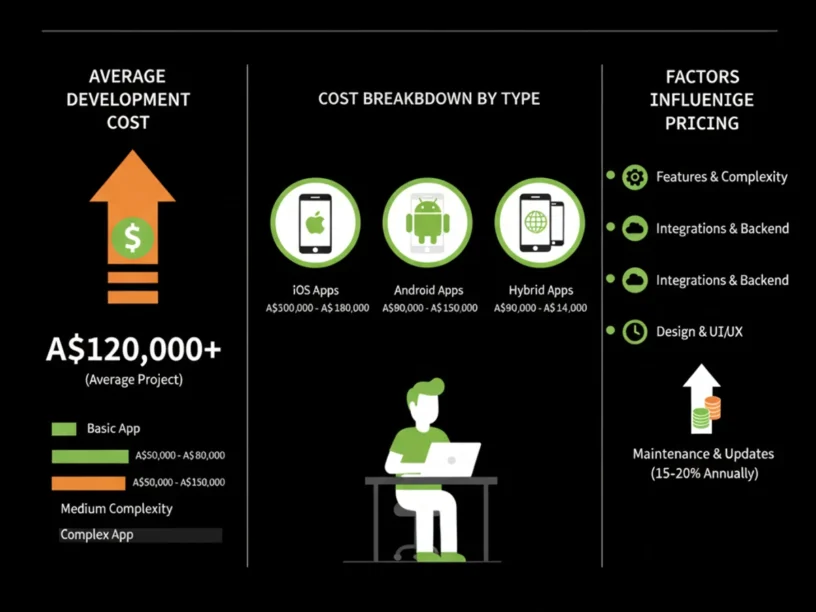
How much does it cost to build an app in Australia in 2026? Custom app development in Australia typically ranges from AUD $25,000 for a lean MVP to $350,000 or more for a full-featured, enterprise-grade product. Most founder-stage and mid-market builds land between $60,000 and $180,000. This range reflects differences in app complexity, platform choice, team structure, and required features.
Understanding App Development Costs in Australia
- For First-Time Founders: This guide breaks down the cost range in plain language for first-time founders and non-technical entrepreneurs.
- Execution Decisions Drive Cost: The final app development cost is shaped by execution decisions — feature depth, platform strategy, compliance requirements, and delivery approach.
- Strategic Advantage: Understanding these levers before approaching a development partner puts you in a stronger position to build something affordable and successful.
The Australian app market generated around AUD $3 billion in revenue in 2024 and is growing at 15.3% year-on-year, with projections reaching $5.6 billion by 2026.
The most expensive mistake a founder can make is not building an app that costs too much — it is building the wrong app at any price. Validate first, build second, scale third.
How Much Does It Cost to Build an App in Australia in 2026? A Tier-by-Tier Breakdown
Mobile app development in Australia typically costs between AUD $40,000 for a simple single-platform MVP and AUD $400,000 or more for a feature-rich cross-platform product, with most mid-complexity apps landing between AUD $80,000 and $200,000. Complexity, not wishful thinking, determines your tier.
The Three Core Pricing Tiers
| Tier | App Type | Typical Budget (AUD) | Timeline | Best Suited For |
|---|---|---|---|---|
| Tier 1 — MVP | Single platform, core features only | $25,000 – $60,000 | 6–12 weeks | Idea validation, early traction |
| Tier 2 — Mid-Market | Cross-platform, custom design, integrations | $60,000 – $180,000 | 3–6 months | Funded startups, SMBs going digital |
| Tier 3 — Full-Featured | Multi-role, marketplace, AI features | $180,000 – $350,000 | 6–12 months | Scale-up products, enterprise builds |
| Tier 4 — Enterprise | Custom workflows, compliance-heavy systems | $350,000+ | 12+ months | Enterprise, fintech, healthcare |
What Each Tier Actually Includes
- MVP (Tier 1): A focused build covering user authentication, one primary user flow, basic UI, and a scalable backend. This is a proof of concept that real users can interact with — not a polished finished product. MVP-first development can reduce initial costs by 30–50%.
- Mid-Market (Tier 2): Adds custom design, multiple user roles, third-party integrations (payments, maps, notifications), and cross-platform delivery via React Native or Flutter. This is the most common tier for Australian startups.
- Full-Featured (Tier 3): A marketplace, booking platform, or fintech product with user roles, real-time updates, offline mode, analytics dashboards, and payment flows. AI-powered features are increasingly common in this tier.
- Enterprise (Tier 4): Enterprise systems with custom workflows, role-based access, and reporting, often exceeding AUD $300,000.
Key Takeaway: App complexity drives 60% or more of pricing. Build only what you need at launch — every additional feature adds cost, time, and risk. For deeper context, see How Much Does It Cost to Build an App in Australia?. For related guidance, see React Native Vs Native Apps In 2026 Which Is Best For Your Business.
The Six Biggest Factors That Drive App Development Cost in Australia
App development cost is shaped by six core factors: app complexity, platform choices, design requirements, backend needs, testing scope, and team expertise.
Factor 1: Platform Choice
Cross-platform app development via Flutter or React Native allows developers to reuse code across iOS and Android, reducing development time by approximately 30–40%. For most Australian startups in 2026, cross-platform is the default smart choice.
Factors 2–6: Design, Backend, Testing, Rates, and Compliance
- Design Complexity: Custom animations, branded design systems, and accessibility compliance (WCAG 2.1) can add 15–25% to overall project cost.
- Backend Infrastructure: Real-time data, cloud databases, third-party API connections, and custom admin dashboards add significant backend scope.
- Testing and QA: Testing consumes 10–20% of the budget over 2–6 weeks.
- Hourly Rates and Team Location: Australian developers charge AUD $150–$200 per hour. Offshore developers charge AUD $25–$60 per hour. Hybrid models blend these at a middle rate.
- Compliance Requirements: Apps in fintech, healthcare, education, and real estate carry specific regulatory obligations under Australian law that add material cost if not scoped upfront.
Key Takeaway: Platform choice and backend complexity are the two variables with the most leverage on final cost. Clarify these before engaging a development partner. For deeper context, see App Development Cost Australia | Complete Pricing Guide. For related guidance, see Why Your Mobile Apps Needs Maintenance Complete Guide.
Hidden Costs That Catch Australian Founders Off Guard
The quote you receive is rarely the total cost of bringing your app to market. Hidden costs add 20–50% annually, covering infrastructure, maintenance, third-party APIs, compliance, and app store fees.
Post-Launch Costs You Must Budget For
- Annual Maintenance: Ongoing maintenance is commonly estimated at 15–20% of the original development cost annually. For a $100,000 application, budget AUD $15,000–$25,000 per year.
- App Store Fees: Apple charges AUD $149 per year for the Apple Developer Program and Google Play has a one-time AUD $25 fee. Apple and Google take 15–30% commission on in-app purchases and subscriptions.
- Cloud Hosting: Budget AUD $200–$2,000 per month depending on traffic.
- Third-Party API Subscriptions: Payment gateways, mapping services, push notifications, and analytics platforms each carry recurring costs.
- Privacy Act Compliance: From 10 December 2026, new transparency obligations require disclosure of automated or AI-driven decision-making in privacy policies. Apps in fintech, healthcare, and real estate carry the highest compliance load.
| Hidden Cost Category | Typical Annual Cost (AUD) | Notes |
|---|---|---|
| App maintenance and updates | 15–20% of build cost/yr | OS updates, bug fixes, security patches |
| Cloud hosting (AWS/Azure/GCP) | $2,400 – $24,000+ | Scales with user base and data needs |
| App Store fees | $149 (Apple) + 15–30% commission | Plus Google Play one-time $25 |
| Third-party APIs and tools | $1,200 – $10,000+ | Payments, analytics, notifications |
| Privacy Act compliance | $2,000 – $20,000+ | Higher for fintech, health, real estate |
Key Takeaway: A $100,000 app costs $130,000–$145,000 in its first full year once post-launch costs are included. Build these into your business case from day one.
Local, Offshore, or Hybrid: Which Development Model Suits Your Budget?
How you structure your development team is one of the most consequential decisions you’ll make and directly affects your total mobile app pricing. In 2026, Australian founders have three realistic models: fully local, fully offshore, or hybrid.
Comparing the Three Models
| Model | Hourly Rate (AUD) | Key Advantage | Key Risk | Best For |
|---|---|---|---|---|
| Fully Local | $120 – $200 | Best communication, compliance, accountability | Highest cost | Regulated industries, complex builds |
| Hybrid (Local lead + offshore dev) | $60 – $130 blended | Quality oversight at reduced cost | Requires strong local technical lead | Most founder-stage and SMB projects |
| Fully Offshore | $25 – $60 | Lowest rate, large talent pool | Communication friction, IP risk, rework | Well-scoped, low-compliance projects |
Why the Hybrid Model Dominates in 2026
Hybrid models combining local project management with offshore development have become the practical default for the majority of Australian app projects. This model consistently delivers the best outcome per dollar invested.
- Local Strategy and Accountability: Project management, architecture, and accountability are handled locally, while development execution happens offshore.
- Compliance Confidence: Australian-based agencies provide clear remedies under Australian Consumer Law, local contract enforcement, and professional indemnity insurance.
- Cost Savings That Hold: The difference between a Melbourne-based team and hybrid can represent 60–70% cost savings.
- The One Non-Negotiable: Hybrid only works when the Australian lead has real authority and technical depth.
Appomate operates on this hybrid model — Australia-based strategy, product design, and management paired with a skilled global development team. With 250+ apps delivered for clients including Adidas, L’Oreal, and Hoyts, their approach delivers premium quality at startup-friendly pricing.
Key Takeaway: The hybrid model is not a compromise — it’s deliberate architecture that delivers the best combination of quality, compliance confidence, and cost control. For deeper context, see How Much Does App Development Cost in Australia in 2026?.
How to Get a Custom App Quote in Australia Without Getting Burned
The quality of the quote you receive is directly proportional to the quality of the brief you send. Founders who approach this strategically save tens of thousands of dollars before code is written.
Before You Request a Quote
- Define Your Core User Journey: Map the single most important user action end-to-end before contacting developers. Ambiguity translates directly into scope creep and budget blowout.
- Separate Must-Haves from Nice-to-Haves: Use a priority framework — must have for launch, should have in version two, nice to have eventually. This reduces financial risk and produces a product shaped by genuine market demand.
- Understand What the Quote Includes: Ask whether it covers discovery, design, development, QA, app store submission, and post-launch support. Reputable agencies should cover end-to-end delivery.
- Ask About the Team Structure: Who specifically works on your project? Are they local or offshore? What is the project management methodology?
- Check IP Ownership Upfront: Your contract must explicitly assign all code, design, and intellectual property to you — this is non-negotiable.
Red Flags in App Development Quotes
- Suspiciously Low Pricing: A quote below AUD $25,000 for a functional multi-feature app signals severe scope underestimation or offshore-only delivery with no oversight.
- No Discovery Phase: Skipping structured discovery before quoting is guessing. Two weeks and $5,000 on planning can save $20,000–$50,000 in rework costs.
- Vague Deliverable Descriptions: Quotes should itemise phases and deliverables. If you can’t tell what you’re getting at each stage, you won’t hold the agency accountable.
Key Takeaway: A great quote results from a great brief and structured discovery. Founders who invest time in scoping before requesting quotes receive more accurate pricing and significantly better project outcomes.
Ready to build your app?
Book a free Visioning Call with our team today and walk away with a clear roadmap, expert feedback, and a plan to bring your idea to life. No technical knowledge required.
Smart Strategies to Reduce App Development Cost Without Cutting Corners
Reducing app development cost doesn’t mean building a cheaper app — it means building a smarter one. Founders who get the most from their budget make the fewest expensive mistakes before and during the build.
The MVP-First Principle
Building an MVP first is the most reliable cost-reduction strategy. Concentrating on basic features required to deliver value can reduce initial development costs by approximately 30–50%, with user feedback guiding which features develop next.
Canva, now valued at tens of billions, launched from Sydney with a stripped-back MVP focused on simplified design tools. It attracted 300,000 users within 12 months before scaling to 260 million monthly active users by early 2026. The lesson is: prove demand before scaling investment.
Five Practical Cost Reduction Strategies
- Choose Cross-Platform Development: Cross-platform frameworks save 30–40% compared to separate native iOS and Android apps.
- Use Proven Third-Party Services: Don’t build custom payment gateways when Stripe exists, or custom authentication when Firebase does it in a day. Leverage established SaaS tools and save your budget for what makes your app unique.
- Invest in Discovery Before Development: A structured discovery phase prevents building the wrong thing. This phase typically costs AUD $8,000–$15,000 and covers stakeholder workshops, user research, and architecture planning.
- Plan for AI-Assisted Development: AI-driven development tools compress build time without compromising quality. Partners who build AI-natively into their process can shorten timelines and reduce cost. Appomate’s AI-driven approach has helped founders go from idea to market in six weeks.
- Validate Before You Build: Use clickable prototypes, landing page tests, or manual processes to confirm real user demand before committing your full build budget.
Key Takeaway: MVP-first, cross-platform frameworks, discovery-led scoping, and AI-assisted development are available to every Australian founder. Used together, they can compress a $150,000 project into an $80,000 MVP without sacrificing core product hypothesis. For further reading, see How much does it cost to build an app in Australia in 2026?. For related guidance, see How To Test Your Idea Before You Invest Too Much.
Conclusion
Understanding how much it costs to build an app in Australia in 2026 is about making informed decisions that give your product the best chance of succeeding. Every dollar of the range is explainable once you understand what drives the numbers.
- Budget by Complexity Tier: App development in Australia typically costs between AUD $40,000 for a simple single-platform MVP and AUD $400,000+ for a feature-rich cross-platform product.
- Complexity Drives Cost: App complexity drives 60% or more of pricing — scope conservatively and expand after validation.
- Budget for the Full Lifecycle: Ongoing costs are 15–25% of initial build cost per year — plan from day one.
- The Hybrid Model Delivers: Australia-based strategy combined with a skilled global development team delivers premium quality at startup-friendly pricing.
- Validate Before You Build at Scale: MVP-first development is the single most reliable way to reduce financial risk and build what the market actually wants.
If you’re ready to move from idea to market, Appomate — Melbourne’s full-service app development partner with 250+ delivered products — helps founders get further faster through a proven process covering validation, design, build, launch, and growth.
FAQ
How Much Does It Cost to Build an App in Australia in 2026?
Building an app in Australia costs between AUD $25,000 and $350,000 or more, depending on complexity, platform, features, and team structure. A lean MVP on a single platform starts around $25,000–$60,000. A mid-market app with custom design, cross-platform delivery, and integrations costs $60,000–$180,000. Full-featured products range from $180,000 to $350,000. Enterprise builds exceed $350,000. Australian developer rates of AUD $150–$200 per hour are among the highest globally, which is why the hybrid model — pairing Australia-based strategy and design with a skilled global development team — is dominant for founders maximizing quality per dollar spent.
What is the cheapest way to build an app in Australia?
Build a cross-platform MVP using Flutter or React Native with a hybrid team model pairing an Australian technical lead with offshore developers. This reduces costs by 30–60% compared to fully local, native-code builds. Building only the core user journey can reduce initial costs another 30–50%. Use third-party SaaS tools for payments, authentication, and analytics instead of custom-built equivalents.
How long does it take to build an app in Australia?
A lean MVP takes 6–12 weeks. A mid-market cross-platform app takes 3–6 months. Full-featured products require 6–12 months. Enterprise builds take 12 months or more. Structured discovery before development accelerates timelines by locking scope upfront. AI-assisted development tools compress timelines further in 2026.
What are the hidden costs of app development in Australia?
Annual maintenance (15–20% of build cost), cloud hosting ($2,400–$24,000+ per year), Apple Developer fees (AUD $149/year), Google Play fees (one-time AUD $25 plus 15–30% commissions), third-party API subscriptions, and Privacy Act compliance costs begin at or after launch. From 10 December 2026, new transparency obligations require disclosure of automated decision-making in privacy policies — particularly relevant for fintech, healthcare, and real estate apps.
Is it worth using a local Australian app development agency vs. going offshore?
Local agencies offer superior communication, regulatory knowledge, and accountability under Australian Consumer Law at AUD $150–$200 per hour. Pure offshore teams reduce costs to AUD $25–$60 per hour but introduce communication friction and IP risks. The hybrid model — Australia-based strategy and management with a skilled global development team — delivers the best balance of quality, compliance confidence, and cost. Appomate operates this way, combining Australia-based leadership with a world-class global development team.
What should I ask an app development company before signing a contract?
Ask: What does the quote include — discovery, design, development, QA, app store submission, post-launch support? What is the team structure — local or offshore? Who owns the code and intellectual property? What methodology is used — agile sprints or milestones? What does post-launch support cost? A reputable agency answers all questions clearly in writing before any contract is signed.
How does the Australian Privacy Act affect app development costs in 2026?
Australia’s Privacy Act and Australian Privacy Principles govern how apps collect and use personal data. From 10 December 2026, new transparency obligations require disclosure of automated or AI-driven decision-making in privacy policies. The Office of the Australian Information Commissioner began its first-ever compliance sweep in January 2026, signalling proactive enforcement. Build compliance into your architecture from day one — retrofitting costs significantly more.
What is an MVP and should I build one before a full app?
An MVP is the smallest version delivering genuine value that allows testing your core hypothesis with real market data. For most Australian founders, building an MVP first is the right strategy. It reduces financial risk, shortens time to market, and produces a product shaped by actual user behaviour. MVPs cost $25,000–$60,000 and deliver in 6–12 weeks. MVP-first development can reduce initial costs by 30–50%, and validated learning improves the full product that follows.
Methodology and disclaimer: Cost ranges are synthesised from 2025–2026 Australian market data, developer rate benchmarks, and agency pricing guides. All figures are in Australian dollars (AUD) and represent professional, agency-delivered app development — not freelance or no-code tools. Actual costs vary based on scope, team structure, compliance, and market conditions. This is a general educational guide, not a formal quotation or financial advice. Obtain project-specific quotes from qualified development partners before making commitments. Privacy Act information is accurate as of August 2026 and reflects the Privacy Act 1988 (Cth) as amended by the Privacy and Other Legislation Amendment Act 2024. Published by Appomate.