What is AI-native app development? (And why it's different from adding AI to an app) | Updated August 2026 | Appomate Editorial Team
AI-native app development is the practice of designing and building a software application with artificial intelligence as the foundational architecture — not as a feature bolted on after the fact. AI-native products rely on models, data pipelines, and learning systems as fundamental components. In AI-native apps, the AI cannot be removed without destroying the app, while in AI-enabled apps, removing the AI feature simply eliminates that specific function.
For Australian entrepreneurs, the timing matters significantly. The AI market in Australia is projected to grow from about AUD 4.8 billion in 2024 to nearly AUD 295.8 billion by 2034, growing at a CAGR of 51% from 2025 to 2034. The AI apps segment in Australia specifically generated USD 41.1 million in 2024 and is forecast to grow at a CAGR of 48.8% from 2025 to 2030, according to Market.us. Founders who understand AI-native principles from the outset are building products that compound in value.
“In 2026, simply wrapping a Large Language Model API around a traditional interface no longer qualifies as innovation. True AI nativity is defined by how deeply intelligence is woven into the application’s DNA — from the data layer to the user experience.”
AI-Native vs. AI-Enabled Apps
AI-native refers to systems with AI tightly integrated into core design and functionality — AI is the foundation of the system. AI-enabled refers to systems that have AI features added as later enhancements rather than being built with AI at their heart. For non-technical founders, this distinction is critical before investing in development.
The “Remove the AI” Test
AI-native products cannot function without AI — the intelligence is the product. An AI-enabled product, like a CRM with a chat assistant, still works as a CRM if the assistant breaks. An AI-native product — like an autonomous diagnostic tool — ceases to exist without its intelligence layer.
The User Experience Difference
In an AI-native product, users state an objective, the system proposes a plan, completes parts of the task, and users review and adjust. This shifts the user from operator to supervisor, leading to higher retention because the product removes planning effort.
| Dimension | Traditional App | AI-Enabled App | AI-Native App |
|---|---|---|---|
| AI role | None | Optional feature layer | Core architecture |
| Value without AI | Full value | Reduced but functional | No value — app breaks |
| Data strategy | Stored, static | Queried when needed | Continuously feeds model improvement |
| User posture | Operator | Operator with suggestions | Supervisor and reviewer |
| Competitive moat | Features, brand | Features plus AI add-ons | Proprietary data flywheel |
Key Takeaway: Being AI-native ensures long-term sustainability, adaptability, and innovation. This architectural choice shapes everything that follows — from data structure to team scaling. For a side-by-side breakdown, see Application Development in 2026: The Ultimate Guide to …. For related guidance, see The Best Apps Of 2024 Celebrating Innovation And User Experience.
The Core Architecture of an AI-Native App
Being AI-native means designing software where intelligence is central to how value is created and delivered. Unlike traditional applications relying on deterministic logic, AI-native platforms learn, adapt, and evolve over time using LLMs, vector databases, real-time data pipelines, and agent-based orchestration.
Key Components
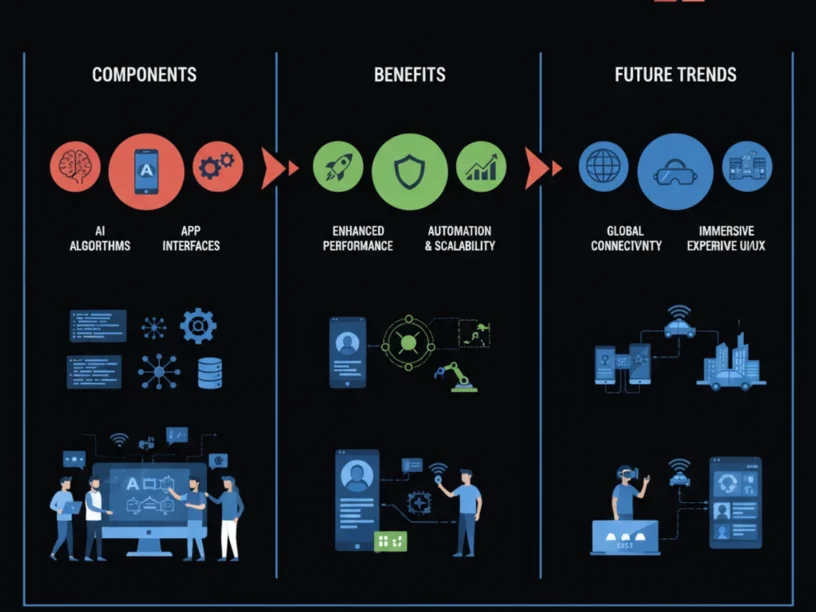
- Intelligence layer (LLMs and reasoning models): Natural language interfaces, contextual awareness, and autonomous workflows powered by Large Language Models and multi-model reasoning systems.
- Agentic workflows: Systems capable of planning, using tools, and self-correcting without constant prompting.
- Vector databases and retrieval-augmented generation (RAG): Standard architectural components for contextual understanding and dynamic knowledge access.
- MLOps and model lifecycle management: Versioning ML models, automating retraining, deploying to production, and monitoring performance continuously.
- On-device inference (edge AI): Smaller, specialised models running locally on mobile hardware providing sub-100ms latency and enhanced privacy.
- Evaluation and output quality pipelines: Automated scoring, human-in-the-loop review, regression detection, and drift monitoring for probabilistic quality measurement.
AI changes the operating model of an app. It introduces prompt versioning, model selection, logging, access controls, fallback behaviour, and spend management — concerns that don’t live comfortably in an afterthought architecture.
Key Takeaway: Understanding these layers helps founders ask the right questions and avoid commissioning an AI-enabled product while believing it to be AI-native. For deeper context, see What Is AI Native? | IBM.
Why AI-Native Matters for Australian Founders in 2026
Australian startups operate in one of the fastest-growing AI markets globally. The window to build a differentiated AI-native product is still open — but narrowing. In 12 to 18 months, AI-native products will be the baseline expectation. Australia continues strengthening its position as a high-growth digital economy through mobile-first behaviour, AI adoption, fintech expansion, and startup funding.
The Business Case
- Faster time to market: Release MVPs within weeks instead of months.
- Stronger investor signal: 73% of successful Australian startups are prioritising mobile-first strategies powered by AI-native architectures.
- Compounding data advantage: Every user interaction improves the model, creating a moat that AI-enabled competitors cannot easily replicate.
- Operational efficiency: 30% savings in operations over three years for companies adopting AI-native architecture, according to Gartner.
- Scalable with leaner teams: Leading AI-native companies reach tens of millions in recurring revenue with teams that would look impossibly small by traditional standards.
AI adoption is accelerating in healthtech, fintech, and education in Australia. Victoria is the fastest-growing region, fuelled by AI startup investments and technology parks. For founders in Melbourne and Sydney, infrastructure and talent to build genuine AI-native products has never been more accessible.
Key Takeaway: The case for AI-native is strategic and financial. Founders designing for AI-nativity from day one build products that improve automatically and scale efficiently.
Common Mistakes in AI-Native Development
The market is flooded with products claiming AI-native status but using traditional apps with an API call to a large language model. Simply wrapping a Large Language Model API around a traditional interface no longer qualifies as innovation.
The Most Common Pitfalls
- Building an AI wrapper and calling it AI-native: Applications built from the ground up around AI capabilities differ fundamentally from traditional applications with AI features bolted on.
- Neglecting the data architecture: 23% faster AI implementation and 31% better model performance result from mature data governance, according to Gartner.
- Over-engineering before validating: Start with validation, then specialise the intelligence layer once demand is proven.
- Ignoring Australian compliance obligations: AI in Australia is governed through the Privacy Act 1988, Australian Consumer Law, and the Online Safety Act 2021. From 10 December 2026, covered organisations must disclose in their privacy policy where personal information is used in automated decisions that significantly affect individuals.
- Shipping without quality controls: Shipping AI-generated code without senior engineer review is how software looks finished while quietly failing.
| Mistake | What It Looks Like | The Risk | The Fix |
|---|---|---|---|
| AI wrapper mistaken for AI-native | ChatGPT API call added to existing app | No data flywheel, easily replicated | Redesign core value loop around AI |
| Weak data strategy | No pipelines, raw data untreated | Poor model performance at scale | Invest in data infrastructure early |
| Privacy Act non-compliance | No automated-decision disclosure | OAIC enforcement from December 2026 | Audit AI decisions; update privacy policy |
| No quality evaluation layer | AI output shipped without review | Silent quality degradation | Implement probabilistic eval pipelines |
Key Takeaway: Most early-stage AI app failures are architectural decisions made before a line of code was written. Validate, architect, then build. For more on common pitfalls, see The Ultimate Guide to AI in Mobile App Development (2026). For related guidance, see Iot Mobile App Development Australia Integration Guide 2026.
How to Choose the Right AI-Native Development Partner in Australia
Choosing the right development partner is arguably more important than technology decisions themselves. You are selecting a technology partner who will architect your competitive advantage using AI agents, real-time ML inference, and autonomous systems. In Australia, this means finding a team combining local strategic insight with technical depth to build AI-native from the ground up.
What a Genuine AI-Native Partner Looks Like
- They validate before they build: A strong partner challenges assumptions about whether AI-native architecture is right for your use case. The right product strategy saves more money than the cheapest hourly rate.
- They understand Australian compliance: A competent local partner factors Office of the Australian Information Commissioner guidance and Privacy Act requirements into the architecture, not as an afterthought.
- They use AI-driven development tooling: Accelerate the development process itself to shorten time to market without sacrificing quality.
- They have a proven delivery track record: Look for verifiable case studies and industry verticals they have built in before.
Appomate is a Melbourne-based app development company building AI-native products with over 250 apps delivered across AI Apps, Healthtech, Marketplace, Fintech, and Education for clients including Adidas, L’Oreal, and Lend Lease. Their Further Faster Framework is designed for founders going from validated idea to market with confidence. Their hybrid model — Australia-based strategy and product design with a global development team — delivers premium quality at startup-friendly pricing, helping founders reach market in as little as six weeks.
Key Takeaway: The right development partner reduces risk, not just cost. Treat your development partner as a product co-creator — not a vendor executing a brief. For deeper context, see Top 10 AI Development Companies in Australia (2026). For related guidance, see Australian Startup Success Stories Mobile Apps Case Studies 2026.
Ready to build your app?
Book a free Visioning Call with our team today and walk away with a clear roadmap, expert feedback, and a plan to bring your idea to life. No technical knowledge required.
The Australian Regulatory Landscape for AI App Developers
Building an AI-native app in Australia means operating within an evolving compliance environment that shapes how you design data handling. AI regulation in Australia in 2026 is based on existing laws rather than a dedicated AI Act. AI is governed through the Privacy Act 1988, Australian Consumer Law, and the Online Safety Act 2021, alongside voluntary frameworks.
Key Regulatory Touchpoints
- Privacy Act 1988 and automated decision-making: From 10 December 2026, organisations must clearly explain where AI influences decisions about customers, employees, or users.
- Australian Consumer Law (ACL): Build explainability into your AI layer from the start to avoid misleading or deceptive outputs.
- National AI Centre guidance: October 2025 guidance set out six essential practices (AI6) as the primary government guidance for responsible AI governance.
- AI Safety Institute (AISI): Operational from early 2026 with AUD 29.9 million in government funding, playing a central coordination role across regulatory guidance for AI systems.
- OAIC Privacy guidance: Updating Privacy Act guidance to address AI-specific data handling requirements.
Australian law is technology-neutral — obligations around privacy, consumer protection, discrimination, workplace safety, and intellectual property apply regardless of whether decisions are made by humans or AI. Design data pipelines and decision logging with compliance in mind from sprint one. The government’s consolidated guidance portal is available at ai.gov.au.
Key Takeaway: The December 2026 Privacy Act deadline for automated decision-making disclosure is a concrete, near-term obligation — building for compliance from the start is far cheaper than retrofitting later.
Conclusion
AI-native app development is a fundamental architectural philosophy determining whether your product improves with use or stagnates. For Australian founders in 2026, understanding what AI-native development is and why it differs from adding AI to an app is the prerequisite to smart decisions about product strategy, partner selection, and competitive positioning.
- AI-native means intelligence is the architecture: Genuine AI-native apps differ from AI-enabled products wearing AI-native branding.
- The Australian market opportunity is significant and time-sensitive: The window to build a differentiated AI-native product is open — but closing.
- Common mistakes are architectural, not technical: Fastest routes to an expensive rebuild include building an AI wrapper, neglecting data strategy, and ignoring Privacy Act obligations.
- Compliance is not optional: Privacy Act automated decision-making disclosure obligations apply from December 2026.
- Partner selection is a product decision: Work with a team like Appomate that validates your idea, designs for AI-nativity from the start, and uses AI-driven development tools to get you to market faster and smarter.
The smartest next step for any Australian founder is a structured validation conversation before a single line of code is written — because the architecture you choose in week one will define how your product scales in year three.
FAQ
What is AI-native app development, and how does it apply to building an app in 2026?
AI-native app development is the practice of designing and building a software application with artificial intelligence embedded as the foundational architecture. AI-native products rely on models, data pipelines, and learning systems as fundamental components. In 2026, AI-native apps learn and improve continuously from user interactions, generate personalised experiences at scale, and create compounding competitive advantages through proprietary data flywheels. Building AI-native from day one is far more efficient than retrofitting AI into a product designed around conventional logic.
What is the difference between AI-native and AI-enabled apps?
An AI-native app is built from the ground up with AI as its core architecture. An AI-enabled app is a traditional application with AI features added, where the core product still functions if those features are removed. If you strip out the AI and the app still works, it is AI-enabled. If it breaks entirely, it is AI-native. AI-native products differ in their data strategy — every user interaction feeds back into the model, creating continuous improvement.
How is AI-native app development different from just using an AI API?
Using an AI API is typically an AI-enabled approach, not AI-native. AI-native development involves designing the entire application architecture around intelligence from day one: data pipelines, model lifecycle management, agentic workflows, retrieval-augmented generation, and evaluation systems are baked into the product’s foundation. An API call is a feature. An AI-native architecture is a system that learns, adapts, and improves across every layer.
What are the key components of an AI-native app architecture?
A genuine AI-native app architecture typically includes: an intelligence layer (LLMs or multi-model reasoning systems), agentic workflows that can plan and self-correct, a vector database for contextual memory and retrieval-augmented generation, real-time data pipelines that continuously feed model improvement, MLOps infrastructure for versioning and retraining models, on-device inference for privacy and low-latency use cases, and a probabilistic output evaluation pipeline. The combination of these components — not just one or two — makes an app genuinely AI-native.
What do Australian AI regulations mean for founders building AI-native apps in 2026?
Australia does not have a standalone AI Act in 2026, but AI-native apps are not unregulated. The Privacy Act 1988, Australian Consumer Law, and the Online Safety Act 2021 apply to AI systems. Critically, from 10 December 2026, Australian organisations must disclose in their privacy policies where personal information is used in automated decisions that significantly affect individuals. Consult ai.gov.au for consolidated guidance.
How long does it take to build an AI-native app in 2026?
Simple AI-native features can launch in two to three months. Full AI-native products with custom data pipelines, agent orchestration, and evaluation frameworks typically take four to six months for a validated MVP. Development partners using AI-driven development tooling themselves can meaningfully compress these timelines. Appomate has helped founders go from validated idea to market in as little as six weeks.
Is AI-native app development more expensive than traditional app development?
Upfront investment is often comparable to or slightly higher than traditional development due to more deliberate architecture work. However, long-term economics favour AI-native products: they improve automatically, scale with leaner teams, and generate compounding competitive advantages. The most expensive approach is building AI-enabled first, then rebuilding as AI-native.
How do I know if my app idea is a candidate for AI-native development?
Your idea is a strong candidate if: (1) core value comes directly from intelligence, prediction, or autonomous action; (2) the product gets meaningfully better with use because user interactions generate training signal; (3) competitive advantage depends on continuous learning rather than static features. If AI is just one feature among many, AI-enabled architecture may be more appropriate. A structured product strategy session with a team that can validate which approach is right is the best first step.
Methodology and disclaimer: This article was produced by the Appomate editorial team using primary web research and publicly available industry data sourced in August 2026. Statistics cited are attributed to their respective publishers; readers should verify figures independently for commercial decision-making. This article is for general informational purposes and does not constitute legal, financial, or technical advice. Australian Privacy Act and AI regulation information is accurate as of August 2026 but may change; consult a qualified legal professional for compliance advice specific to your product.