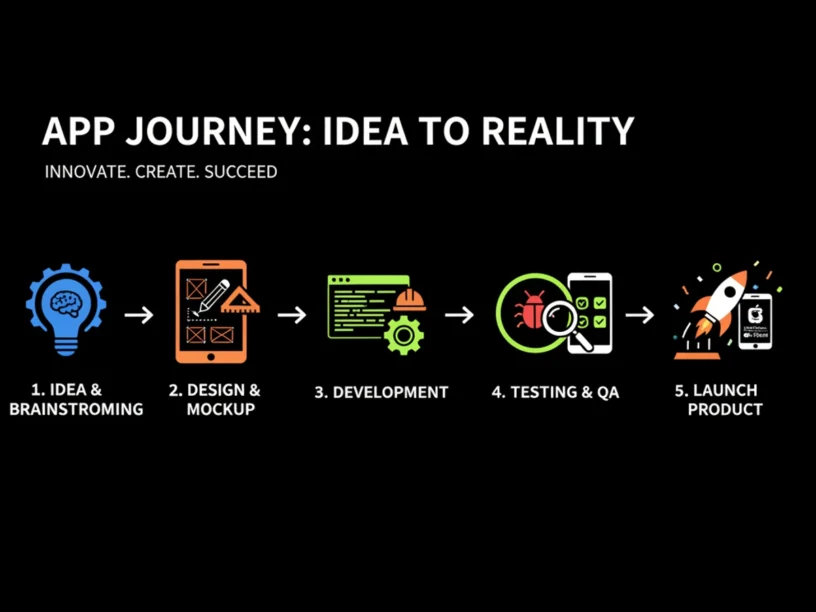
How to go from app idea to launched product in 2026 | Updated August 2026 | 9 min read | Appomate Editorial Team
Getting your app from concept to market in 2026 follows a proven path: validate your concept with real users before writing code, build a lean Minimum Viable Product (MVP) to test market fit, and launch with a go-to-market plan that prioritises retention over raw download numbers. With smartphone penetration exceeding 90% of the Australian population, you’re looking at a ready and engaged market.
Over 57,000 apps release monthly on the App Store alone, so getting noticed takes more than a good product. Successful founders treat their app as a business from day one — validating assumptions, designing for user delight, and pairing a polished product with a smart go-to-market strategy.
“The biggest mistake first-time founders make is building first and validating second. By the time they discover their assumptions were wrong, they have spent their budget and their runway.” — A pattern seen consistently across the Australian startup ecosystem.
Step 1: Validate Your App Idea Before You Build Anything
Confirm that a real market problem exists, that people want a solution, and that they’re willing to pay for it — before you invest in development. Skipping this stage is the most common reason Australian app projects fail. A strong idea can still flop if it solves the wrong problem.
What Validation Actually Looks Like
- Customer discovery interviews: Talk to at least 20 potential users in your target segment about their frustrations and current solutions. Listen for emotion — frustration signals genuine pain worth solving.
- Competitor analysis: Map what already exists in the Australian market. Tools like Sensor Tower and Google Trends surface real search demand data.
- Landing page test: Build a simple one-page site describing your app’s value proposition and drive paid traffic to it. A conversion rate above 5% on cold traffic is a strong signal of genuine interest.
- Smoke test or concierge MVP: Manually deliver the outcome your app promises before automating it. If people pay for the manual version, they’ll pay for the app.
- Australian regulatory check: If your idea touches healthcare, fintech, or consumer data, review obligations under the Privacy Act 1988 and sector-specific regulators like APRA or the TGA early.
Validation vs. Assumption: A Quick Framework
| Assumption Type | Validation Method | Success Signal | Timeline |
|---|---|---|---|
| Problem is real | Customer interviews | Consistent, unprompted frustration | 1–2 weeks |
| Demand exists | Landing page + paid ads | 5%+ email sign-up rate | 1–2 weeks |
| Willingness to pay | Pre-orders or concierge delivery | At least one paying user | 2–4 weeks |
| Competitive gap | App store + Sensor Tower audit | Identified unserved segment | 3–5 days |
Key Takeaway: Two to four weeks spent validating can save six months of wasted development. Now that you’ve validated the market exists, define exactly what you’ll build. For deeper context, see How to Validate a Startup Idea in 2026: AI Framework Guide.
Step 2: Define Your MVP — Build the Minimum, Learn the Maximum
A Minimum Viable Product is a working version containing only core features needed to validate your business model with real users. It’s the smallest thing you can ship that delivers genuine value.
How to Scope Your MVP
- Start with one core user journey: Identify the single most important thing your user needs to do. Build that end-to-end before adding anything else.
- Apply ruthless feature prioritisation: For each proposed feature, ask: “Does this directly test our key assumption?” If no, cut it.
- Choose the right platform for your audience: Roughly 55–60% of Australian users are on iOS, while 40–45% use Android. For most Australian consumer apps, starting with iOS and adding Android in Version 2 is pragmatic.
- Plan for scalable architecture from day one: An MVP built on shortcuts will collapse under growth. Insist on clean code and a scalable backend even in the first version.
Australian MVP Cost and Timeline Benchmarks
| MVP Type | Typical Timeline | Indicative AUD Cost | Best For |
|---|---|---|---|
| Simple utility app | 6–10 weeks | $30,000–$60,000 | Single-feature tools, B2B workflow apps |
| Consumer marketplace | 10–16 weeks | $70,000–$120,000 | Two-sided platforms, on-demand services |
| SaaS / subscription app | 8–14 weeks | $50,000–$100,000 | B2B tools, recurring-revenue models |
| AI-native app | 8–16 weeks | $60,000–$130,000 | Personalisation, automation, content tools |
Australia’s most celebrated app companies — from Canva to Airwallex — didn’t launch with their full feature sets. They validated a narrow slice of value, iterated on feedback, and expanded from a position of evidence.
Key Takeaway: A well-scoped MVP gets you to market faster and acts as a learning engine that tells you what to build next. For deeper context, see MVP App Development: How to Build, Launch & Validate Fast.
Step 3: Design and Build Your App — Process, Partners, and Pitfalls
Once your idea is validated and MVP scoped, the build phase begins. For non-technical founders, choosing the right development partner is the single most consequential decision.
Choosing the Right Development Partner in Australia
- Look for a full-cycle partner, not just a dev shop: Seek partners who cover the entire product lifecycle — from discovery through to launch and beyond.
- Verify their portfolio in your vertical: A partner with experience in your category understands the specific UX patterns and technical challenges you’ll face.
- Assess communication as rigorously as technical skill: Weekly progress updates, clear sprint reviews, and honest scope conversations are non-negotiable.
- Understand the hybrid model advantage: Many leading Australian app companies combine Australia-based strategy and design with a skilled global development team. This delivers premium quality at startup-friendly pricing.
The Build Phases in Brief
- Product discovery and wireframing: Define user flows and feature scope in detail before design work. Changes at this stage cost hours; changes during development cost weeks.
- UI/UX design: Great design drives adoption, engagement, and retention. Invest in high-fidelity prototypes and test them with real users before handing to developers.
- Agile development sprints: Two-week sprints with regular demos keep development on track and give you visibility without requiring technical knowledge.
- QA and testing: Functional, performance, and device testing should be continuous throughout development — not a final-week scramble.
Appomate, a Melbourne-based full-service app development partner, exemplifies this approach. With over 250 apps delivered across verticals including Marketplace, Wellness, Healthcare, and B2B — working with clients like Adidas, L’Oreal, and Hoyts — they combine Australia-based strategy and design with a world-class global development team. They’ve helped founders go from idea to market in as little as six weeks.
Key Takeaway: The right development partner proactively protects your vision, communicates clearly, and builds for long-term scalability from the first sprint. For more on common pitfalls, see Product mistakes I won’t repeat in 2026 – Ant Murphy – Medium.
Ready to build your app?
Book a free Visioning Call with our team today and walk away with a clear roadmap, expert feedback, and a plan to bring your idea to life. No technical knowledge required.
Step 4: Your App Launch Strategy for 2026
A strong launch strategy starts at least 90 days before your app goes live. Pre-launch activity builds the audience you need; launch day converts that audience into your first cohort of active users.
Pre-Launch: Build Momentum Before Day One
- App Store Optimisation (ASO): ASO drives up to 70% of organic installs and costs nothing after setup. Research keywords your Australian target audience uses, write a compelling description, and produce high-quality screenshots and a preview video.
- Build a waitlist: A simple landing page with email capture, backed by targeted social media content and modest paid ads, can generate hundreds of interested early adopters before your app is available.
- Beta programme: Release a TestFlight or Android beta to 50–200 early users. Their feedback surfaces usability issues, and engaged beta users often become loyal long-term advocates.
- PR and media outreach: Contact Australian tech media — Startup Daily, SmartCompany, and vertical-specific publications — with a newsworthy story focused on the problem you solve for Australians.
Launch Day and the First 30 Days
- Time your submission correctly: Apple and Google review processes typically take 24–72 hours. Submit at least five days before your target launch date.
- Measure retained users, not just installs: Day 30 retention averages 5.8%. A smaller number of retained, engaged users is worth far more than a spike of churned installs. Instrument your app with analytics tools like Firebase, Mixpanel, or Amplitude from day one.
- Optimise onboarding ruthlessly: Short onboarding sequences of three screens or less typically convert 15% better for utility apps.
Key Takeaway: Your launch is a 90-day campaign. Pre-launch audience building, ASO, and retention-first mindset in the first 30 days determine whether your app compounds or stalls. For deeper context, see From Idea to Launch: How to Build a Startup App Without ….
Step 5: Post-Launch Growth — From First Users to Scalable Product
Turning app ideas into products that grow requires a deliberate post-launch strategy focused on retention, iteration, and scalable user acquisition.
Retention Is the Growth Engine
- Personalise from the first session: Successful apps use AI-driven personalisation alongside human-curated experiences. Tailor the experience immediately based on user intent — users who experience value in session one are dramatically more likely to return.
- Update frequently: Update your app every 14 to 30 days to maintain visibility and fix bugs. Regular updates signal active maintenance and improve search ranking organically.
- Act on feedback loops: Monitor App Store reviews, set up in-app feedback prompts, and schedule monthly calls with your most active users.
- Invest in push notifications strategically: Maintain engagement through nurturing campaigns via email, SMS, and in-app notifications. Relevance and timing matter — irrelevant notifications accelerate uninstalls.
When to Scale Paid Acquisition
Scale paid acquisition only after your retention metrics are healthy. A channel delivering users at $4 CPI with 5% Day 30 retention produces a cost per retained user of $80, while a channel at $6 CPI with 15% Day 30 retention produces a cost per retained user of just $40. Pouring budget into acquisition before fixing retention exhausts your runway.
For founders wanting a single partner from post-launch through to growth, Appomate offers ongoing support, marketing strategy, and product iteration. Their philosophy helps founders build successful, scalable businesses rather than just apps.
Key Takeaway: Post-launch success is built on retention, fast iteration, and data-driven acquisition — in that order.
Conclusion
Going from app idea to launched product in 2026 requires five disciplined stages: validate before you build, scope your MVP ruthlessly, partner with the right team, launch with a 90-day strategy, and invest in retention-first post-launch growth. With over 27 million active smartphone users expected in Australia by 2026, this is one of the most fertile environments for founders with well-validated ideas.
- Validate first, build second: Two to four weeks of validation can prevent six months of misdirected development spend.
- MVP scope is a strategic decision: The narrower your MVP, the faster you learn and the less capital you risk on unproven assumptions.
- Your development partner shapes your outcome: Choose a full-cycle partner with proven Australian experience and a founder-first mindset.
- Launch is a 90-day campaign: Pre-launch ASO, waitlist building, and beta feedback are as important as the product itself.
- Post-launch is where the business is built: Rapid iteration, personalisation, and data-driven acquisition compound into sustainable growth.
If you’re ready to take your app idea from concept to market, Appomate offers a proven path — from validation and design through to launch, marketing, and long-term growth — built specifically for founders.
FAQ
How do you go from an app idea to a launched product in 2026?
Validate your idea through customer interviews, landing page tests, and competitor analysis. Scope a Minimum Viable Product focusing on a single user journey. Engage a full-cycle development partner with Australian market experience. Execute a launch strategy beginning 90 days before go-live, including App Store Optimisation, a waitlist campaign, and a beta programme. Invest in post-launch retention and rapid iteration using analytics tools and user feedback. Partners like Appomate specialise in taking non-technical founders from idea to market efficiently.
How long does it take to develop an app in Australia in 2026?
A simple utility MVP typically takes 6–10 weeks; a consumer marketplace or AI-native app requires 10–16 weeks. Using an AI-driven development approach and agile methodology can significantly compress timelines compared to traditional waterfall development.
How much does it cost to build an app in Australia?
A lean MVP for a simple utility app may start around AUD $30,000–$60,000, while a consumer marketplace typically ranges from AUD $70,000–$130,000. Development partners using a hybrid model — combining Australia-based strategy and design with skilled global delivery — deliver premium quality at significantly lower cost than fully Australian-onshore teams.
Do I need a technical background to launch an app in Australia?
No. The majority of successful Australian app founders are non-technical. What you need is a validated idea, clear understanding of your target user, and the right development partner. A full-cycle partner handles technical decisions on your behalf and communicates progress in plain language.
What is the most common reason app startups fail in Australia?
Building before validating. Founders invest months and capital into development, only to discover the problem wasn’t painful enough or that users already had an acceptable workaround. The second most common cause is scope creep during development — MVPs that expand into full-featured products before a single user tests the core concept.
What is App Store Optimisation (ASO) and why does it matter for Australian founders?
App Store Optimisation improves your app’s visibility through keyword-optimised titles, descriptions, screenshots, and ratings. It drives up to 70% of organic installs and costs nothing after setup while compounding over time. For Australian founders with limited budgets, ASO is one of the highest-ROI activities available.
When should I scale paid user acquisition for my app?
Scale paid acquisition only after your Day 30 retention rate is healthy — typically above 10% for general apps and above 20% for subscription products. Investing heavily in paid installs before fixing retention means paying to acquire users who churn before generating value. Optimise onboarding and retention in the first 30–60 days post-launch, then scale acquisition.
How do I choose the right app development partner in Australia?
Evaluate partners across five dimensions: portfolio relevance in your app category, communication quality, process transparency using agile sprints, post-launch capability, and pricing structure. Ask prospective partners for case studies from Australian clients, references, and a sample project plan for your brief. The right partner acts as a growth co-founder — not just a vendor.
Methodology: This article draws on publicly available market research including data from Business of Apps, Red Search, and Airwallex’s Australian Startup Statistics. Cost and timeline figures are indicative ranges based on market benchmarks. Regulatory guidance is general in nature and does not constitute legal or compliance advice. Last updated August 2026.