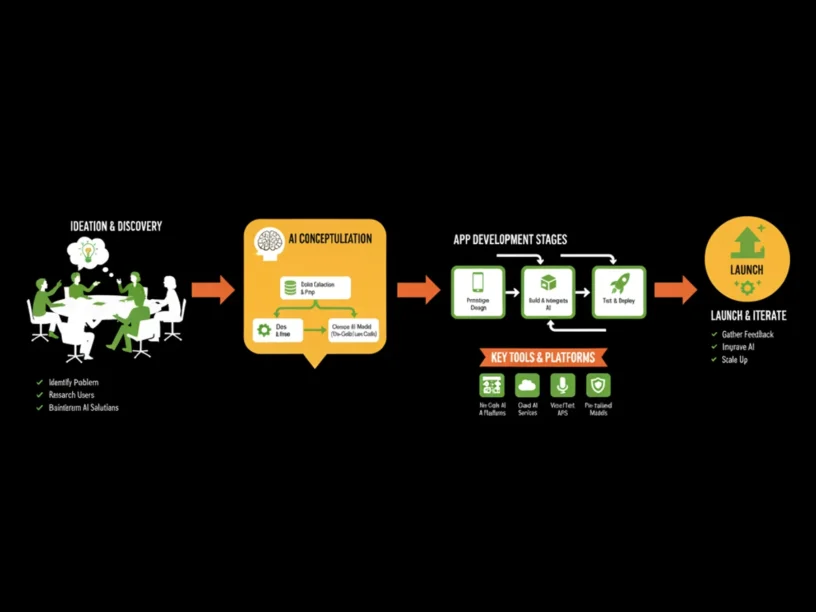
how to build an AI app as a non-technical founder in Australia | August 2026 | Appomate | 8–16 weeks from idea to launch | Beginner
What You’ll Learn
You don’t need to write code to build an AI app. You need a validated idea, a clear problem to solve, and the right development partner. This guide walks you through validation, selecting a partner, building your MVP, and launching in the Australian market.
- Validate your AI app idea before spending a dollar on development
- Understand the AI concepts you need — without learning to code
- Choose a development partner who acts as a growth partner, not just a code factory
- Launch an MVP and iterate toward product-market fit in the Australian market
Prerequisites: A problem worth solving, access to potential users you can talk to, and a budget to invest in building. No technical background required.
Why Building an AI App as a Non-Technical Founder in Australia Matters in 2026
The Australian AI market has reached over USD 6 billion in 2025 and is growing rapidly in healthtech, fintech, and education. The barrier to entry has never been lower for founders without a technical background. Citizen developers already outnumber professional software developers four to one, and no-code platforms can cut development time by up to 90%. The no-code AI platform market is growing from $6.56 billion in 2025 to a projected $75 billion by 2034. Apps using AI-driven personalization have seen up to 40% higher retention rates.
The hard part is no longer building — it’s knowing what to build. Your domain expertise and understanding of a real customer pain point are your competitive advantage. The technical execution is something you can partner your way through. For supporting data, see How You Can Build a Startup as a Non-Tech Founder.
The Process at a Glance
| Step | Action | Time | Outcome |
|---|---|---|---|
| 1 | Validate your AI app idea with real users | 1–3 weeks | Confirmed problem worth building for |
| 2 | Learn enough AI to lead the build | 1–2 weeks | Confident brief, no coding required |
| 3 | Choose the right development partner | 1–2 weeks | Trusted partner signed and scoped |
| 4 | Build and manage your MVP | 6–12 weeks | Live, testable AI app in market |
| 5 | Launch, measure, and iterate | Ongoing | Real users, real feedback, real growth |
Total estimated time to first launch: 8–16 weeks for a focused MVP with one core AI feature.
Step 1: Validate Your AI App Idea Before You Build Anything
What You’re Doing
You’re confirming that a real problem exists, that real people want a solution, and that an AI-powered approach meaningfully improves on what already exists. Skipping this step is the single most expensive mistake a founder can make.
How to Do It
- Define the problem in one sentence without mentioning your solution.
- Talk to 10–20 potential users focused entirely on the problem — not your solution. Ask about current workarounds, frustration levels, and what a fix would be worth.
- Check for market demand signals. Search Reddit, Facebook Groups, and Australian LinkedIn communities for people describing the problem. Use Trend Seeker or ValidatorAI for feasibility checks.
- Test willingness to pay. Build a simple landing page with a clear value proposition and email signup. If nobody signs up, revisit the problem.
- Map your AI advantage. Does AI make this solution meaningfully better than a non-AI alternative? If not, don’t force AI into the product.
Example: Validation in Practice
| Validation Method | What It Proves | Tool |
|---|---|---|
| 10+ user interviews | Real pain, not assumed pain | Zoom, Calendly |
| Landing page + email signup | Willingness to act | Carrd, Notion |
| Competitor research | Market exists; gap to fill | Google, App Store search |
| AI demand report | Market size, feasibility signal | ValidatorAI |
Best Practices
- Don’t show users a prototype during validation — you want their unfiltered experience of the problem, not their reaction to your solution.
- The fundamental reason for startup failure remains unchanged: building something nobody wants. Treat validation as your most valuable unfair advantage.
- For Australian-specific validation, check StartupAus ecosystem reports and engage in communities like Startmate.
What Done Looks Like
You’ve spoken to at least 10 target users, identified a consistent pain point, and have evidence — email signups, verbal pre-commitments, or existing workarounds — that people want a solution badly enough to pay for it. For a more detailed walkthrough, see AI Tools for Non-Technical Founders: The Complete 2026 ….
Step 2: Learn Enough AI to Lead the Conversation (Not the Code)
What You’re Doing
You’re building a working vocabulary around AI so you can write a clear product brief, evaluate partner proposals, and make smart product decisions — without needing to understand the engineering underneath.
How to Do It
- Understand the three types of AI: AI recommendations (suggesting content based on user behaviour), AI generation (producing text, images, or audio from a prompt), and AI automation (completing tasks without human input).
- Know the difference between native AI and AI wrappers. A native AI feature is built deeply into your product’s core value. An AI wrapper is a thin interface built on top of an existing model like ChatGPT. Aim for deeper AI integration from day one.
- Learn what APIs are. An API lets your app connect to an AI model — like OpenAI’s API or Google Vertex AI — without building the AI from scratch. Your development team will integrate them.
- Get familiar with privacy obligations. Review the Privacy Act 1988 and the Australian Privacy Principles before launch — especially if your app handles health, financial, or personal data.
Example: The Language You Need
| Term | What It Means for You |
|---|---|
| LLM (Large Language Model) | The AI that understands and generates natural language (e.g. GPT-4, Claude) |
| API integration | Connecting your app to an external AI service — your dev team handles this |
| Personalisation engine | AI logic that adapts the app experience to each individual user |
| On-device vs. cloud AI | Where AI processing happens — on-device is faster and more private |
| MVP (Minimum Viable Product) | The leanest version of your app that delivers core value and enables real feedback |
Best Practices
- Spend 3–5 hours using AI tools as a consumer — ChatGPT, Perplexity, Notion AI — before your first partner meeting.
- Write your product brief in plain language describing the problem, target user, core AI feature, and desired outcome.
What Done Looks Like
You can explain your AI app concept in plain language, describe the core AI feature you want to build, and hold a confident conversation with a development partner — without needing to write any code. For related guidance, see Why Launch Your App With Minimum Viable Product.
Step 3: Choose the Right AI App Development Partner in Australia
What You’re Doing
For a non-technical founder, selecting a development partner is one of the highest-leverage decisions you’ll make. You want a team that challenges your assumptions, shapes your product strategy, and de-risks the build — not one that simply takes an order and executes it.
How to Do It
- Look for AI-native experience. Ask every potential partner to show you live, downloadable apps with real AI features — not mockups. Ask how they’ve integrated AI in past projects.
- Prioritise Australian accountability. Australian-incorporated partners are accountable under AU law. This matters when deadlines slip or IP disputes arise.
- Confirm IP ownership upfront. IP ownership should be explicit in the contract before work begins. You should own 100% of the code and product from day one.
- Evaluate their validation process. A great partner will want to validate your idea before building. If they skip straight to quoting a build, that’s a red flag.
- Ask about post-launch support. Confirm whether your partner offers ongoing iteration, marketing support, and long-term maintenance.
Best Practices
- To vet a developer in Australia without a technical background, look for a portfolio with live, downloadable apps; verified client references; a written proposal with itemised estimates; clear post-launch support terms; and transparent communication during the sales process.
- Check listings on Clutch and GoodFirms for verified client reviews before committing.
What Done Looks Like
You’ve signed with a development partner who has demonstrated AI app experience, confirmed your IP ownership in writing, and presented a structured build plan that starts with validation or discovery.
Appomate is a Melbourne-based partner worth considering. They help founders turn app ideas into successful, scalable businesses — not just apps. They build AI-native products using the latest AI-driven development tools, combining Australia-based strategy and design with a world-class global development team at startup-friendly pricing.
Ready to build your app?
Book a free Visioning Call with our team today and walk away with a clear roadmap, expert feedback, and a plan to bring your idea to life. No technical knowledge required.
Step 4: Build Your MVP — Focused, Fast, and AI-Native
What You’re Doing
You’re building the leanest version of your app that delivers your core AI-powered value proposition to real users. An MVP that ships in 8 weeks and generates real user feedback is worth infinitely more than a polished product that takes 12 months and misses the market.
How to Do It
- Define your one core AI feature. What is the smallest AI-powered feature that still solves the problem? Build that first, and only that.
- Agree on a sprint-based build process. Work in two-week sprint cycles where your partner delivers working software at the end of each sprint. Review it, give feedback, and keep the build moving.
- Manage scope obsessively. Every feature request beyond the MVP adds time and cost. Use a “must have / nice to have / post-launch” framework to triage every idea.
- Stay close to your users during the build. Share early prototypes with 3–5 target users before the final build is complete.
- Plan your data strategy from day one. Audit your existing datasets for availability, structure, and quality.
Common Mistakes
Mistake: Building too many features at once. Generating a beautiful app UI with an AI prompt takes 10 minutes. Turning that prototype into a secure, scalable startup is where most founders hit a brick wall. Stay disciplined about scope. Launch lean and iterate fast.
Best Practices
- AI-assisted development tools have compressed MVP timelines, with developers reporting 40–60% faster prototyping. Choose a partner who actively leverages these tools.
What Done Looks Like
You have a live, testable app in the hands of real users, with one clear AI feature working as intended, a feedback loop in place, and a prioritised roadmap for what gets built next.
Step 5: Launch, Measure, and Iterate Toward Product-Market Fit
What You’re Doing
Your launch isn’t the finish line — it’s the starting gun. Real user interaction is when the most valuable learning begins. Your job is to measure what matters, talk to your users constantly, and use that data to improve the product.
How to Do It
- Set up analytics before launch day. Use Mixpanel or Amplitude to track user behaviour from the first session.
- Focus on retention, not downloads. Track how many users return after day 1, day 7, and day 30.
- Run a 30/60/90 day review cycle. At 30 days, diagnose what’s working. At 60 days, iterate on critical user drop-off points. At 90 days, assess whether you’re heading toward product-market fit.
- Collect qualitative feedback continuously. Speak to at least 2–3 active users every week for the first three months post-launch.
Best Practices
- For Australian app stores, set up App Store Optimisation (ASO) from day one — your app title, description, and keyword strategy directly affect organic discovery.
- Build the habit of reviewing your key metrics weekly with your development partner — not monthly.
What Done Looks Like
You have a real user base generating real data, a weekly review rhythm with your development partner, and a prioritised iteration backlog driven by user evidence.
What to Do After Your AI App Launches
Phase 1 — Stabilise (weeks 1–4): Fix critical bugs immediately. Respond to every early user complaint personally. Monitor app store reviews daily. Ensure the core AI feature works reliably for every user.
Phase 2 — Grow (months 2–4): Once retention metrics are healthy, shift focus to growth. Explore organic channels first — content marketing, community building, and word-of-mouth. For Australian startups, LinkedIn and niche industry communities often outperform paid ads. Consider government programs like the Entrepreneurs’ Programme or the R&D Tax Incentive.
Phase 3 — Scale (months 4+): With proven retention and early revenue, invest in paid acquisition, deeper AI feature development, and potentially fundraising. Global corporate AI investment more than doubled in 2025, with private AI investment up 127.5% and generative AI capturing nearly half of private AI funding. Australian investors are actively seeking AI-native startups with real traction.
Resources You’ll Need
| Resource | Role in the Process | Required/Optional | Cost |
|---|---|---|---|
| Appomate | Full-service AI app development partner — strategy, design, build, launch, and growth | Recommended | Startup-friendly pricing; contact for quote |
| Figma | Design and prototype your app screens before development begins | Recommended | Free plan available; from $15/month |
| ValidatorAI | AI-powered startup idea validation and feasibility feedback | Recommended | Free |
| Mixpanel | User behaviour analytics and retention tracking post-launch | Required post-launch | Free plan available; paid from $28/month |
| OpenAI API | Core LLM integration for generative AI features in your app | Optional (depends on AI feature type) | Usage-based pricing |
See also, see 9 Best AI App Builders for Non-Technical Founders in 2026.
Troubleshooting Common Issues
Problem: My development partner keeps asking me technical questions I cannot answer
Fix: Ask your partner to reframe every technical question as a business trade-off: “This decision affects cost, timeline, and scalability in the following way — here’s what I recommend and why.” If they can’t do this, escalate it or reconsider the partnership.
Problem: The build is running over time and over budget
Fix: Freeze scope immediately. Anything not in the original MVP brief goes into a post-launch backlog. Look for teams that price iteratively with transparent replanning. Agree on a formal change request process for any scope additions.
Problem: Users are downloading the app but not coming back
Fix: Interview 5–10 churned users immediately. Ask what they were expecting and what they got. Use that feedback to redesign onboarding and sharpen the core AI feature.
Problem: I cannot tell whether the AI feature is actually working correctly
Fix: Measure model performance indicators like accuracy and precision, and product metrics like retention and engagement. Ask your development partner to set up a simple monitoring dashboard that tracks both from launch day. For more troubleshooting advice, see Sergio Pereira’s Post.
Conclusion
Key Takeaways
- Validation first, always. Knowing how to build an AI app as a non-technical founder in Australia starts with proof that your idea solves a real problem people will pay to fix.
- Your expertise is your edge. In 2026, the technical barrier is effectively gone. The founders who win are the ones who understand the problem most deeply.
- Partner, don’t outsource. The difference between a development vendor and a development partner is the difference between an app that gets built and a business that gets launched.
FAQ
How do you build an AI app as a non-technical founder in Australia in 2026?
Validate your idea by talking to real users before spending anything on development. Develop a working fluency in core AI concepts so you can lead product decisions without writing code. Select an Australian development partner with genuine AI app experience who acts as a full growth partner. Build a lean MVP focused on one core AI feature using sprint-based delivery. Launch, measure user retention and engagement, and iterate continuously based on real data. No coding experience is required — your domain knowledge, problem understanding, and business instincts are your most important assets.
How much does it cost to build an AI app in Australia?
A simple MVP starts around $30,000 to $60,000. A mid-complexity product runs $80,000 to $200,000. Complex platforms can reach $300,000 to $500,000+. AI-native features add cost depending on complexity. Partnering with a team that combines Australian-based strategy and design with a skilled global development team can deliver premium quality at startup-friendly pricing. The Australian Government’s R&D Tax Incentive may offset a significant portion of your development costs.
Do I need a technical co-founder to build an AI app in Australia?
No. Non-technical founders build apps every day by partnering with a development agency. Your job is to deeply understand the problem, the users, and the business model. The dev team handles the code. The key is selecting a development partner who communicates in business language, proactively guides product decisions, and holds themselves accountable to your commercial outcomes.
How long does it take to build an AI app in Australia?
The total estimated time to launch is 8–16 weeks for a focused MVP with one core AI feature. Validation and partner selection typically takes 2–5 weeks before development begins. More complex products will naturally take longer. The most important variable is how disciplined you are about MVP scope — the tighter the scope, the faster the launch.
What AI features can a non-technical founder realistically build in their first app?
The most achievable first-version AI features include AI-powered recommendations, conversational AI or chatbots using LLM APIs like OpenAI, intelligent search and filtering, automated content generation, and personalised user experiences that adapt over time. Start with one AI feature that directly addresses your core user problem, prove it works, and expand from there. Don’t build AI for AI’s sake.
What is the biggest mistake non-technical founders make when building an AI app?
The most common and costly mistake is skipping idea validation and going straight to development. About 90 percent of startups fail because their product never finds real demand. The second most common mistake is scope creep — adding features during the build that weren’t in the original brief. The third is treating the development partner as a vendor rather than a strategic partner. Solve these three problems and you’re already ahead of most first-time founders.
Are there Australian government grants available for AI app startups?
Yes. The R&D Tax Incentive provides a tax offset of 43.5% for eligible R&D expenditure for companies with less than $20 million in annual turnover — AI development often qualifies. The Entrepreneurs’ Programme provides advisory support and grant funding for eligible startups. Austrade also offers export programs relevant once your AI app targets international markets.
How do I know if my AI app has achieved product-market fit?
The clearest indicator is strong retention: users are returning to the app repeatedly because it delivers consistent value. Aim for a day-30 retention rate above 20% as an early benchmark. Other signals include organic word-of-mouth growth, users expressing genuine disappointment at the idea of losing access to the product, and revenue growth that doesn’t depend entirely on paid acquisition. Lifetime value (LTV) should exceed customer acquisition cost (CAC) by three times or more.
Methodology: This guide was developed using current industry research, publicly available market data, and analysis of Australian startup and AI app development best practices as of August 2026. Statistics are sourced from published reports by Hostinger, Stanford HAI, Sensor Tower, RevenueCat, and other named research organisations. Development timelines, cost ranges, and product recommendations reflect general market conditions and may vary based on project complexity, team composition, and market factors. This guide is published by Appomate for educational purposes and does not constitute financial or legal advice. Always seek qualified professional advice before making significant business investments.